

Team coaching certification can mark an important step toward professional accreditation, but it is not the destination itself. An accredited team coaching certification online provides structured learning in a virtual format, while the pathway to EMCC Accredited Coach status has separate requirements. Participants who complete all requirements of the Coaching Accreditation Program receive a Certificate of Completion of an EMCC Quality Awarded Course and become eligible to pursue that pathway.
It’s reasonable to want clarity before committing: what the training involves, how online and in-person formats differ, how the schedule fits around work, and what the fees cover. The deeper question is how each learning milestone develops your capacity to work with teams as living systems, not simply as a collection of individuals.
This guide explains the training sequence, formats, schedules and course prices, then clarifies how course completion relates to EMCC accreditation. You’ll have a clearer basis for deciding which learning path fits your practice, your aspirations and the kind of change you hope to support.
Key Takeaways
- Compare online and in-person training formats by their session structure and how each fits your learning needs.
- Use the course milestones to map a practical route from team coaching development toward further accreditation.
- Review the published schedules and course fees to understand the commitment involved before choosing a cohort.
- Understand how completing an EMCC Quality Awarded Course relates to pursuing EMCC Accredited Coach status.
Coach training program details and milestones
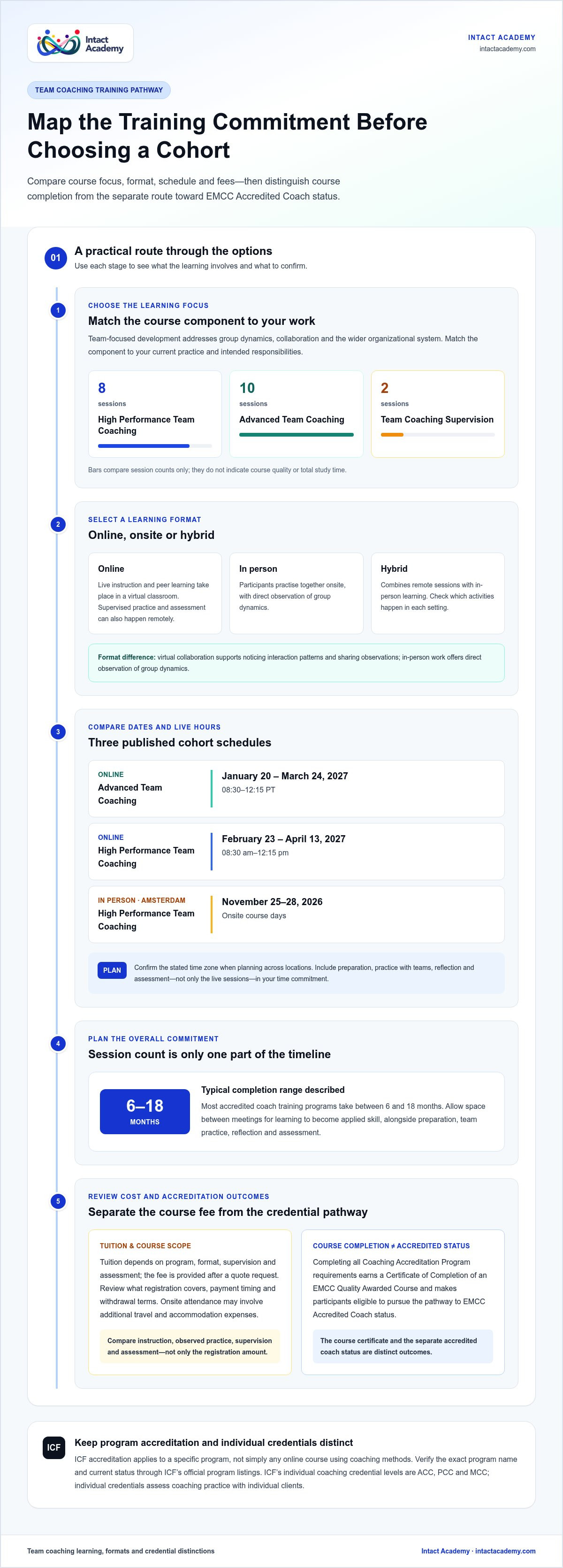
Compare a program’s learning milestones, practice structure, and accreditation pathway before weighing its format. Online team coaching courses may include 8, 10, or 2 sessions, depending on the training component.
Program Options and Intended Audiences
Start with the work you want to develop: individual coaching, team development, or supervision. A coaching program focused on teams should address group dynamics, collaboration, and the wider organizational system. For example, online course structures include 8 sessions for High Performance Team Coaching, 10 for Advanced Team Coaching, and 2 for Team Coaching Supervision. Match each component to your current practice and intended responsibilities.
Tuition and Registration Choices
Online team coaching program tuition in the United States depends on the program’s scope, format, and supervision; the fee is provided after a quote request. Compare the full learning commitment, not just the registration amount: consider live teaching, observed practice, supervision, and assessment. Before enrolling, review payment timing, withdrawal terms, and whether registration covers the complete course or separate components. These details shape the practical cost and learning experience.
Timelines and Time Commitments
Most accredited coach training programs take between 6 and 18 months to complete. Session count alone doesn’t show the full commitment: include preparation, practice with teams, reflection, and assessment in your planning. For instance, a 10-session online course requires space between meetings for learning to become applied skill. Compare the schedule with your work and coaching responsibilities before registering, then map each milestone against your intended completion timeline.
Accreditation Checks and Credential Differences
ICF accreditation applies to a specific program, not simply to any online course that uses coaching methods. Verify the exact program name and its current status through ICF’s official program listings before enrolling. Team coaching training builds the capacity to work with groups, while individual credentials assess coaching practice with individual clients. ICF offers three individual coaching credential levels: ACC, PCC, and MCC. Program accreditation and an individual credential are distinct outcomes, so establish which one aligns with your goal.
Is Team Coaching available both online and in person?
Team coaching training is available online and in person, and the format shapes how participants practise skills and collaboration. Choose the learning environment and schedule that best support your work with organizations.
Virtual, In-Person, and Hybrid Formats
Online courses bring live instruction and peer learning into a virtual classroom, while onsite training places participants together for practice. For example, the High Performance Team Coaching course runs online from February 23 to April 13, 2027, and in Amsterdam from November 25 to 28, 2026. Advanced Team Coaching runs online from January 20 to March 24, 2027. A hybrid format combines remote sessions with in-person learning; review the schedule to see which activities happen in each setting.
Online Completion and Assessment
ICF certification requires live instruction, and live teaching can take place online. Full online completion also means supervised practice and assessment happen remotely, so review the course structure for each milestone. The Advanced Team Coaching online schedule is 08:30-12:15 PT; the High Performance course runs 08:30am-12:15 pm. Confirm the stated time zone when planning across locations.
Credential renewal and continuing education requirements follow the credential issuer and credential type. There is no single renewal rule for every team coaching credential; distinguish completing a training course from maintaining an individual credential. For virtual team coaching, participants can practise noticing interaction patterns and sharing observations through facilitated online collaboration. In-person work offers direct observation of group dynamics. Consider which format best supports the coaching skills your organizations need, then explore a team coaching learning pathway as a next step.
Course schedules and prices
Compare course dates, live hours, and tuition together before choosing a cohort. The online Advanced Team Coaching course runs January 20 to March 24, 2027, from 08:30 to 12:15 PT. The online High Performance Team Coaching course runs February 23 to April 13, 2027, from 08:30am to 12:15 pm. These schedules show the rhythm of live learning, but preparation and practice also shape your commitment.
For in-person learning, High Performance Team Coaching is scheduled in Amsterdam for November 25 to 28, 2026. That option concentrates the course into onsite days, while the two online cohorts extend across multiple weeks. If you’re working across global time zones, compare the listed session hours with your local workday and team responsibilities. Then consider where leadership practice, peer engagement, and reflection can fit between meetings.
Tuition depends on the program, format, supervision, and assessment, and is provided after a quote request. Compare what the fee covers, including instruction and learning milestones, rather than judging cost alone. Separate course tuition from any additional expenses involved in attending onsite, such as travel and accommodation. Consider the full commitment required for the learning experience and the credential pathway you intend to pursue.
Before registering, match course dates to your calendar, confirm the time zone, and set aside time for practice. For example, the January-to-March Advanced Team Coaching cohort may suit someone who can attend morning sessions in Pacific Time. The February-to-April High Performance cohort follows a different timetable. Choose the schedule that supports consistent participation, not simply the earliest start. A workable rhythm helps turn course concepts into sustained coaching skills.
Online tuition depends on the program, format, supervision, and assessment; request a quote to learn the amount.
Pathway to EMCC Accredited Coach status
Completing team coach training and earning EMCC Accredited Coach status are separate milestones. Participants who complete all requirements of the Coaching Accreditation Program receive a Certificate of Completion of an EMCC Quality Awarded Course. They are then eligible to pursue a pathway to EMCC Accredited Coach status; completing the course does not itself confer that status.
For this route, eligibility requires successful completion of every Coaching Accreditation Program requirement. The certificate recognizes course completion, while eligibility opens a further pathway. Before enrolling, identify your intended outcome: team coaching education, a course completion certificate, or progress toward an individual coach credential. These stages are connected, but not interchangeable.
The program provides 78 learning hours for successful participants. Treat those hours as part of a broader professional development process, not as proof that every credential requirement has been met. For example, an executive coach adding team coaching to their practice can use course learning to deepen systemic work, then consider the separate accreditation pathway. Keep course records and completion documents together as you plan your next step.
Map the pathway in sequence: complete the course requirements, receive the EMCC Quality Awarded Course certificate, then pursue EMCC Accredited Coach status. This distinction matters for career planning: training develops capability, while accreditation recognizes a separate professional status. If your goal is team coaching, consider how the education supports your work with teams alongside any ambitions for an individual credential. A certificate is a milestone, not a substitute for the next stage.
Choose coach training that aligns with the work you intend to do, whether that involves team development or executive practice. Intact Academy’s TA EMCC Senior Team Coach Academy is a relevant next step for professionals developing their team coaching practice. Consider how its focus fits your learning goals and the direction you want your career to take.
Intact Academy: TA EMCC Senior Practitioner academy
Intact Academy’s TA EMCC Senior Practitioner academy supports coaches who want to deepen their professional practice. For a focus on team development, the TA EMCC Senior Team Coach Academy is more directly aligned with building team coaching capability. The TA EMCC Senior Supervisor academy offers a path for professionals drawn to supervision, while Executive Coaching supports work with individual leaders.
Choose according to the practice you want to develop: team systems, supervision, or executive work. A useful learning path connects your next qualification goal with the clients and organizational challenges you intend to serve.
To explore which academy aligns with your direction, visit intactacademy.com.
Let your next step reflect the work you want to do
The most useful accredited team coaching certification online is one that supports the practice you want to develop, not simply a credential to collect. Consider where you want to deepen your attention: the dynamics between team members, the wider system shaping their work, or the development of fellow practitioners. That intention can help turn training into a coherent direction for your professional life.
Intact Academy’s TA EMCC Senior Practitioner academy, TA EMCC Senior Team Coach Academy, and TA EMCC Senior Supervisor academy offer distinct paths for different areas of practice. As you consider which direction fits your aims, focus on the responsibility you want to take on and the contribution you want to make.
Contact Intact Academy to explore a learning path that aligns with your next step. Choose with care, then let your practice develop with purpose.
Frequently Asked Questions
Pursuing Team Coaching Certification?
Start by deciding whether you want to coach intact teams, support team leaders, or bring a systemic lens to your existing coaching work. Then compare programs by their focus, practice opportunities, supervision, and accreditation pathway. For example, someone coaching leadership teams may prioritize group dynamics and organizational context, while a practitioner supporting other coaches may seek supervision-focused learning.
How to Become a Coach?
Build a foundation through coach training, practice, and reflection, then choose the professional path that fits your intended work. A practical first step is to identify the people and systems you want to support, such as executives, intact teams, or organizations in transition. Let that focus guide your learning choices and help you develop a coherent approach to your coaching practice.
What is the structure of the course?
Intact Academy’s programs combine theory, supervised practice, and reflection. The approach also includes pattern-interruption techniques that help learners examine thinking, feeling, and behavior patterns. Participants can connect a concept from teaching with practice, then reflect on what happened and how they might respond differently. This sequence links knowledge with deliberate development rather than treating theory as a subject in isolation.
How many training hours and practice sessions are required for team coaching certification?
Hours and practice sessions depend on the specific program and credential pathway. Successful participants in the Coaching Accreditation Program receive 78 learning hours. Team coaching courses may also be organized by sessions, but that count alone doesn’t establish a universal requirement. Compare the requirements for the exact course and intended credential, and distinguish course completion from eligibility to pursue accreditation.
Which online team coaching certification programs are best, and how do they compare?
The best fit depends on your professional aim, learning preferences, and accreditation goal. Compare each program’s team coaching focus, teaching approach, supervised practice, and assessment structure. Also distinguish program accreditation from an individual coach credential. For example, a practitioner seeking deeper team-system skills may value a different curriculum from someone primarily focused on executive coaching.
How long does it take to complete an accredited team coaching certification online?
Many accredited coach training programs take between 6 and 18 months to complete. The actual course timeline depends on its session schedule and the learning milestones involved. To plan realistically, place live sessions on your calendar first, then reserve time for preparation, practice, and reflection. This gives you a clearer view of how training can fit alongside client work and other responsibilities.


