

A change initiative can be well designed and still fail to take root. Creating sustainable change in organizations starts with recognizing the real need for change, then aligning leadership behavior, shared learning, and employee participation around it. The aim is not simply to launch something new, but to help people make useful change part of how the organization works.
It’s understandable to look for a clear plan when familiar processes no longer meet the moment. Yet lasting progress takes more than a plan: people need room to raise concerns, learn from what doesn’t work, and shape practical responses together.
This article explores how organizations can recognize when change is needed, foster continuous learning, and hold leaders accountable for sustaining progress. It also explains how workshops can build collective capacity, making change less of an isolated project and more of a shared practice.
Key Takeaways
- Assess the gap between your organization’s current reality and its desired direction before choosing a change initiative.
- Build a learning culture where people can share concerns, test ideas, and use setbacks to refine new practices.
- Make leadership accountability visible through aligned decisions, clear communication, and recognition of progress along the way.
- Use workshops to map stakeholders, understand resistance, and involve employees in shaping changes they can sustain.
How can organizations cultivate a culture that supports continuous change?
Organizations sustain change when shared values, everyday behaviors, and learning practices reinforce new priorities. A pilot initiative lets teams test whether those priorities work in practice before expanding them.
Embedding Sustainability in Organizational Culture
Sustainable organizational change means making improvements endure in everyday decisions, processes, and behaviors. It matters because a program lasts only when people can apply its principles beyond launch. For sustainable procurement, ISO 20400 is cited as a framework by the International Organization for Standardization.
Embed sustainability by linking it to existing responsibilities, routines, and decision criteria. For example, a procurement team can weigh environmental and social impacts alongside operational needs when reviewing purchases. Leaders can invest in staff learning and use feedback from a pilot to refine processes. These steps help sustainability become part of organizational culture rather than a separate program.
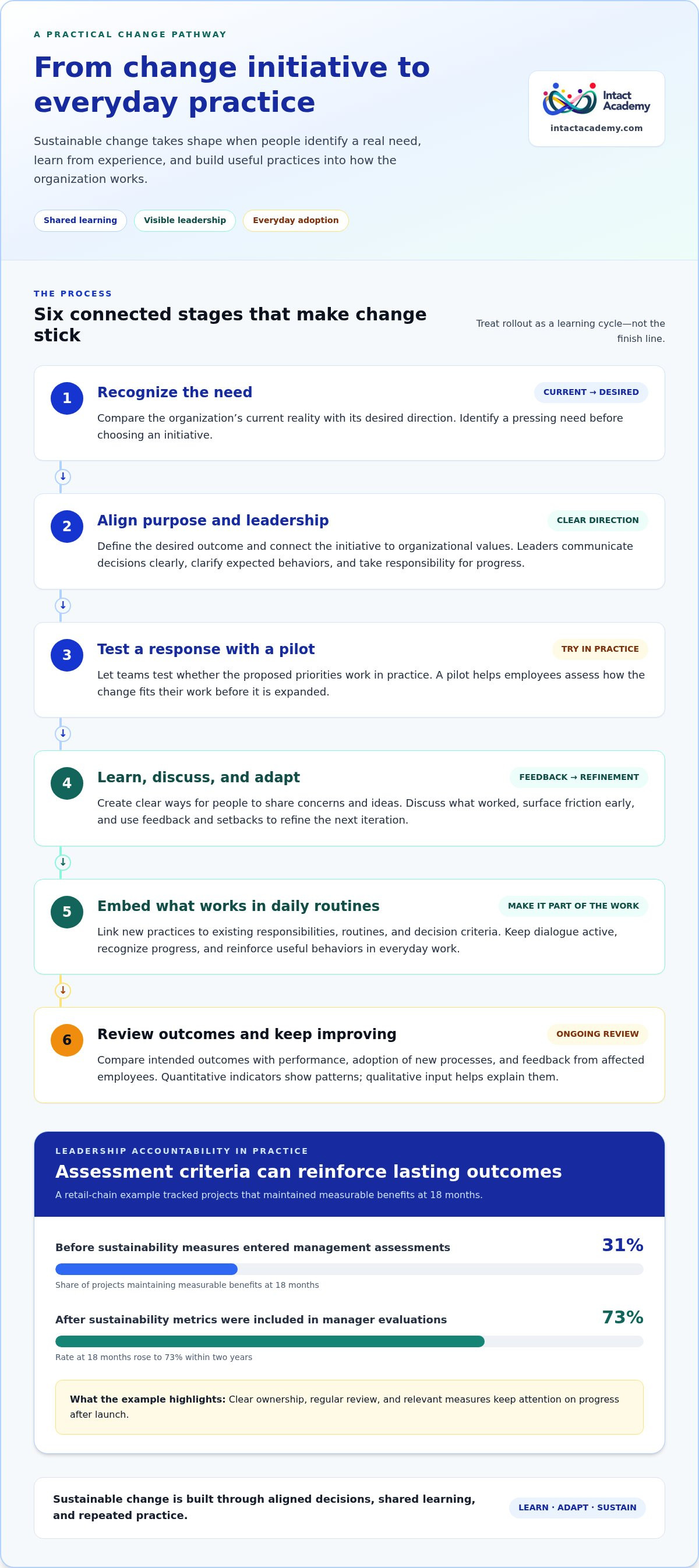
Key steps include identifying a pressing need, defining the desired outcome, testing a response, and adapting it based on what teams learn. A pilot gives employees a practical way to assess how the change fits their work.
Building Openness to Continual Change
A change-supportive culture treats questions, feedback, and thoughtful experiments as part of improvement. This openness helps employees surface friction before it becomes an entrenched obstacle. Teams need clear ways to share concerns and ideas, especially in the early stages of a new initiative.
No single framework is universally best for lasting change. Guided, iterative approaches invite people across the organization to contribute as conditions evolve, rather than relying on control alone. A team can test a new process, discuss what worked, and adjust the next iteration.
A culture of play makes experimentation purposeful, not careless: teams explore possibilities within agreed goals and learn from setbacks. After rollout, managers can sustain change by keeping dialogue active, recognizing progress, and reinforcing useful practices in everyday work. Continual learning helps teams respond when circumstances shift.
Culture’s Role in Strategy Implementation
Culture shapes how strategy translates into decisions and repeated behaviors. A strategy cannot achieve its intent if daily routines pull in another direction. Leaders should connect each initiative to organizational values and explain how team actions support the desired outcome.
Measure success by comparing intended outcomes with performance, adoption of new processes, and feedback from affected employees. Quantitative indicators show patterns; qualitative input helps explain them. Evaluation meetings after implementation can identify effective practices and areas to adjust, keeping improvement tied to strategy rather than treating rollout as the finish line.
Supporting change through leadership accountability
Leadership accountability makes transformation visible in decisions, resource choices, and everyday conduct. It matters because teams watch what leaders reinforce, not only what they announce.
Leadership Commitment and Accountability
Leaders demonstrate commitment by aligning initiatives with organizational values, communicating decisions clearly, and taking responsibility for progress. This consistency gives employees a useful reference point when priorities compete. During a sustainability effort, for example, executives can explain how decisions reflect stated values, recognize teams applying new practices, and address barriers rather than treating implementation as someone else’s task.
Accountability also needs governance: clear ownership, regular review, and measures that remain relevant after launch. A retail chain’s improvement projects maintained measurable benefits at 18 months in 31% of cases before sustainability measures entered management assessments. After sustainability metrics were included in manager evaluations, the rate at 18 months rose to 73% within two years. The example shows how evaluation criteria can reinforce attention to lasting outcomes.
Aligning Leaders and Teams
Alignment means leaders and teams share an understanding of the change’s purpose, expected behaviors, and decision-making boundaries. Conflicting messages can weaken trust and slow implementation. Leaders can connect organizational goals to team responsibilities, invite questions, and clarify how employees can raise risks or suggest adjustments.
Make alignment practical. A leadership group can agree on a shared explanation, identify which team routines need to change, and schedule regular progress reviews. Managers can then translate the direction into local actions while sharing obstacles and frontline insights with executives. This two-way flow supports adaptability without losing strategic coherence.
Accountable leadership also protects the conditions for innovation. Leaders can assess team capacity, remove avoidable obstacles, and acknowledge effort before a transformation is complete. When a new practice encounters difficulty, examine the process and its assumptions instead of assigning blame. This makes learning part of governance and helps teams keep improving.
Finally, make review part of ongoing leadership practice. Compare intended outcomes with actual progress, discuss employee feedback, and adjust responsibilities as conditions change. Fair, transparent decisions help sustain trust, while visible follow-through shows teams that commitments matter beyond the initial announcement.
How workshops build organizational change capacity
Workshops give employees a structured space to examine change, surface concerns, and shape practical responses. They are most valuable when discussion informs decisions and implementation.
Mapping Stakeholders and Their Readiness
Stakeholder mapping identifies who is affected, how much influence they have, and how interested they are in an initiative. Readiness and resistance vary across teams, roles, and locations. In a workshop, participants can map stakeholders, note likely concerns, and identify who needs information, involvement, or support. This makes engagement more deliberate and helps leaders distinguish practical risks from misunderstandings.
Engaging Employees in Change Initiatives
Employee engagement means involving people in shaping the changes that affect their work. It matters because frontline employees often see obstacles and opportunities that planning groups miss. Workshops can invite staff to describe current processes, test proposed alternatives, and suggest adjustments before wider implementation. A logistics company received 347 frontline suggestions and implemented 168 over one year, illustrating how employee input can become practical improvement.
Communication, Training, and Feedback
Communication explains why an initiative matters; training builds the capability to act; feedback reveals what needs adjustment. Together, they help employees understand expectations and raise issues early. Workshops can explain the change, let participants practise new tasks, and make room for open discussion. Anonymous feedback channels can also help participants share candid concerns about a pilot without making every comment public.
The costs and timeframes of major change initiatives depend on their scope, affected teams, training needs, and operational disruption. Poor communication, limited employee involvement, and inadequate support can undermine implementation. Workshops help address these risks by bringing concerns to light and creating opportunities to learn before an initiative expands.
Recognizing the need for organizational change
Change is easier to justify when leaders can identify the gap between current performance and the organization’s intended direction. Start by assessing outcomes, recurring problems, and external pressures. For example, if customer complaints rise while resolution processes stay the same, examine where delays occur and which behaviors contribute to them. A clear problem statement gives change management a meaningful starting point and helps teams distinguish a persistent issue from a temporary disruption.
Data can reveal trends, performance shifts, and weak points, but it cannot explain every cause. Pair operational indicators with employee observations and stakeholder feedback. A missed target may reflect an outdated process, unclear decision rights, competing priorities, or a capability gap. Comparing possible explanations helps leaders avoid mistaking a visible symptom for the underlying problem. This broader assessment supports creating sustainable change in organizations by connecting evidence with the lived experience of the people doing the work.
Next, define the direction the organization wants to take and what evidence would show progress. Separate urgent issues from conditions that require ongoing adaptation. Traditional linear change management can fall short when business conditions and socio-technical systems keep evolving. An iterative framework gives teams room to test a response, learn from its effects, and revise their approach as new evidence emerges. It should clarify the problem without pretending every future condition is predictable.
Before committing to a broad transformation, make the case for action explicit: identify the pressing issue, explain who experiences its effects, and connect it to organizational priorities. Then assess whether existing behaviors, processes, and capabilities can achieve the desired outcome. If not, specify what must change and where a pilot could reveal practical constraints. This assessment grounds decisions in evidence and lived experience, both essential to creating sustainable change in organizations.
A useful starting point is a structured organizational change assessment that connects the need for action with a workable direction.
Intact Academy: TA EMCC Senior Practitioner academy
Intact Academy’s TA EMCC Senior Practitioner academy is a learning pathway for professionals who want to deepen their coaching practice and support organizational change with greater awareness. It may be relevant when you’re helping people examine patterns, strengthen collaboration, and sustain new ways of working.
For change involving teams, the TA EMCC Senior Team Coach Academy develops team coaching practice. The TA EMCC Senior Supervisor academy supports professionals developing their supervision practice, while Intact Academy’s Executive Coach Program focuses on executive coaching. Programs combine theory, supervised practice, and reflection.
Each program offers a distinct development context. Consider whether your responsibilities involve individuals, teams, or leaders, and which practice you want to deepen. To discuss the TA EMCC Senior Practitioner academy, contact Intact Academy.
Turn the Next Insight Into Lasting Practice
The next meaningful step may be smaller than a new organization-wide program. Choose one persistent point of friction, listen closely to the people who encounter it, and agree on a change worth testing. Then make space to notice what shifts, what remains difficult, and what the experience reveals about the system around the work.
This approach keeps creating sustainable change in organizations grounded in lived experience, rather than treating change as a distant ideal. It also asks leaders to stay curious: where do existing habits support the desired direction, and where do they quietly work against it? Honest answers can turn good intentions into more grounded practice.
If you’re considering how to strengthen your capacity to support change, a conversation can help clarify the development path that fits your work. Contact Intact Academy to explore the next step. Begin with one thoughtful choice, and let learning shape what follows.
Frequently Asked Questions
How does 'guided change' differ from traditional change management approaches?
Guided change evolves through input and learning, while traditional approaches often follow a more fixed plan directed from the top. For example, if a new workflow creates handoff delays, a guided process lets the people doing the work suggest and test adjustments. Leaders still provide direction, but the route can adapt as teams learn. This approach is useful when outcomes or conditions are uncertain.
What are the primary factors influencing organizational change capacity?
Change capacity depends on how well an organization can learn, coordinate, and adapt while continuing its core work. Complexity matters: a change affecting connected teams or technologies requires coordination across those systems. Capacity also depends on available skills, leadership attention, trust, and employees’ ability to raise problems. For example, overlapping initiatives can strain teams, so leaders should consider workload and dependencies before launching another effort.
What benefits arise from enhancing change readiness among organizational members?
Greater readiness can help people understand why change is happening, see how it affects their roles, and contribute with less uncertainty. It can also reveal capability gaps before they disrupt implementation. For instance, a team preparing to use a new reporting process may identify unclear decision rights during planning. Addressing that confusion early gives employees a firmer basis for participating and helps the organization coordinate its response.
How can leaders build employee buy-in and reduce resistance to change?
Leaders build buy-in by treating resistance as information, not disloyalty. Ask employees what they fear losing, what risks they see, and what would make the change workable. A frontline worker may point out that a proposed procedure conflicts with customer needs. Listening, explaining trade-offs, and involving that worker in revisions can turn skepticism into useful participation without dismissing legitimate concerns.
How can organizations embed new behaviors into their culture and processes?
Make the desired behavior part of the systems people already use. For example, if teams should share lessons from errors, include a brief learning review in an existing project closeout rather than relying on occasional reminders. Clarify who owns the practice, give new employees examples during onboarding, and review whether it helps. Consistent reinforcement makes the new approach easier to repeat across teams.


