

Psychological safety at work means people believe they can speak up with ideas, questions, concerns, or mistakes without being punished or humiliated. Coaching for psychological safety helps leaders and teams examine the everyday behaviors that make openness possible, while recognizing that 100% psychological safety in a team is impossible.
It’s natural to think of psychological safety as something a team either has or lacks. In practice, people can experience the same leadership team differently, and even a coaching conversation can feel more or less safe from one meeting to the next. The difference often lies in how people listen, respond to challenge, and handle discomfort.
This article explains what psychological safety is, why it supports learning and performance, and why perceptions can vary across senior leadership teams. It also explores how coaching can help leaders reflect on their impact, and how the coaching relationship can model openness, respect, and honest dialogue. You’ll come away with practical ways to recognize where safety is growing, where it may be strained, and what helps teams learn together.
Key Takeaways
- Recognize psychological safety through what people can do in practice: raise concerns, admit mistakes, ask for help, and challenge ideas without fear of humiliation.
- See openness as a condition for learning and performance, not simply a measure of whether people get along.
- Notice differences in how leaders experience the same team; in a Center for Creative Leadership study, 62% of senior leadership teams showed significant variability in members’ perceptions of safety.
- Look for everyday signals of learning, including leaders welcoming input, responding openly to feedback, and treating errors as opportunities to improve.
- Build safety in coaching through consistent relational behaviors, respect for the other person’s priorities, and room for candid conversation.
What Is Psychological Safety at Work?
Psychological safety shapes whether people contribute their thinking when a team faces uncertainty. It matters for performance because unspoken concerns can leave a team acting on incomplete information.
Defining Team Psychological Safety
Harvard Business School professor Amy Edmondson defines psychological safety as a shared belief that people can speak up with ideas, questions, concerns, or mistakes without punishment or humiliation. For a team member, that can mean admitting a mistake before it affects a project or asking for help while a decision is still open. No team can have 100% psychological safety; the practical aim is to make candid participation possible across roles and situations.
Psychological Safety and Team Performance
Psychological safety supports team performance by making it easier to surface information that can improve decisions and learning. In a Center for Creative Leadership study, teams with higher psychological safety reported higher performance and lower interpersonal conflict. For example, when a colleague names a risk early, the team can adjust its plan instead of discovering the problem after work is underway. Safety supports contribution, but it doesn’t replace clear goals or accountability.
Echo Chambers and Team Dissent
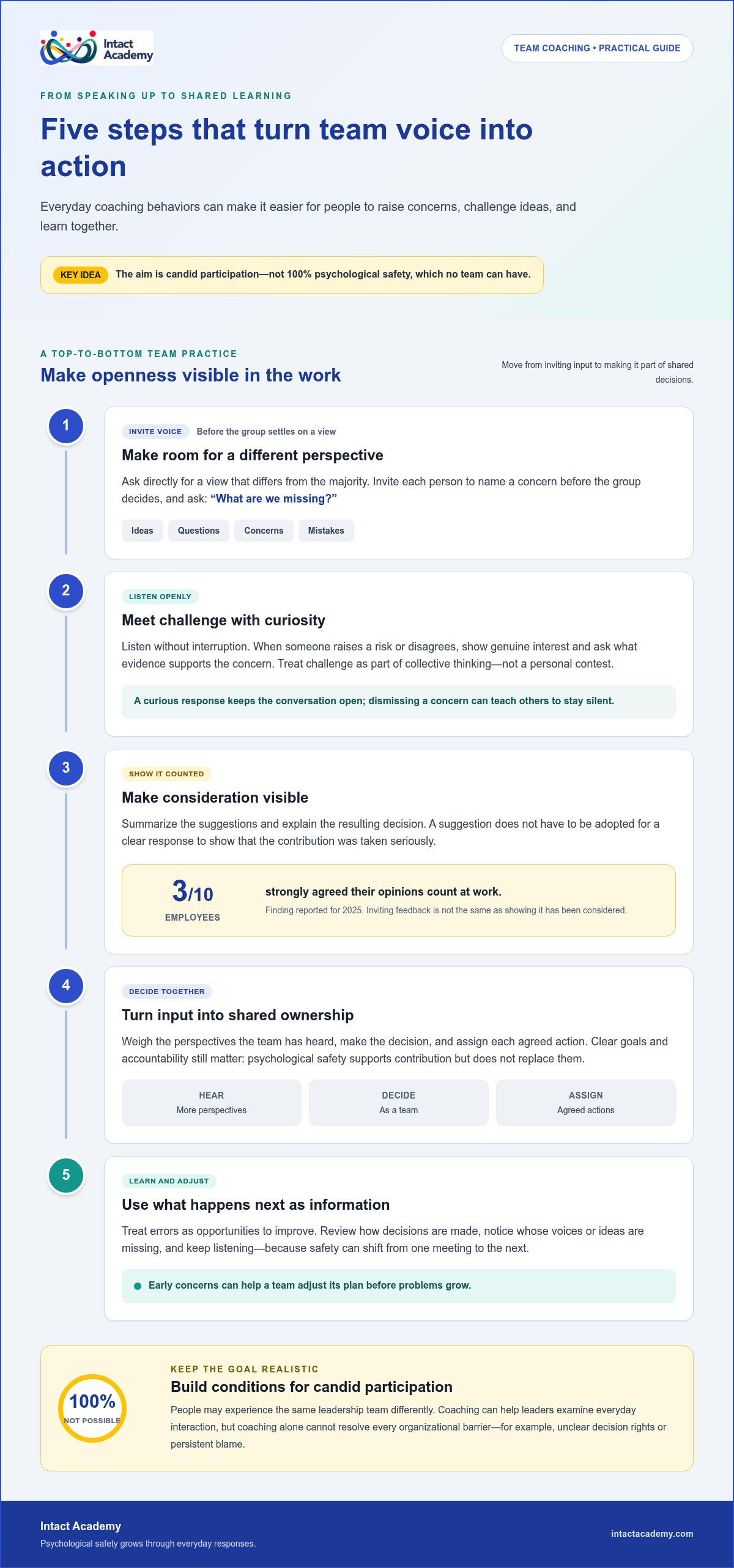
An echo chamber forms when people repeat the prevailing view while withholding disagreement. That silence can look like consensus, even when someone sees a flaw in the plan. Leaders can invite dissent by asking directly for a perspective that differs from the majority, then responding with genuine interest. This makes challenge part of collective thinking, rather than a personal contest. A useful question before settling a decision is, “What are we missing?”
Systems-focused team coaching looks beyond one person’s confidence to the patterns shaping interaction: who speaks, whose ideas influence decisions, and how the team receives disagreement. A coach can help the team examine these dynamics, clarify shared responsibility, and turn input into ownership and accountability. For example, after gathering views on a proposed change, the team can make its decision and assign each agreed action.
In the United States, the cost of psychological safety coaching depends on the scope of work, whether it involves an individual or a team, and the coaching format. The fee is provided after a quote request.
Methods for building workplace psychological safety include facilitated team conversations, reflective questions, invitations to dissent, and reviews of how decisions are made. A coach can help leaders notice whose voices are missing and explore how to encourage more open participation.
A limitation is that coaching alone cannot resolve every organizational barrier, such as unclear decision rights or persistent blame. Psychological safety can also shift between meetings, so leaders need to keep listening, address scapegoating, and make room for challenge in everyday work.
Benefits of psychological safety at work
A psychologically safe workplace gives employees room to raise challenges before they become bigger problems. When people can speak without fear of reproach, they can bring concerns, ideas, and mistakes into the open. For example, an employee who flags a recurring handoff error gives colleagues a chance to examine the process instead of quietly working around it. That openness supports learning and fuller participation.
Feeling heard also matters. In 2025, 3 out of 10 employees strongly agreed that their opinions count at work. The finding points to a practical distinction: inviting feedback is not the same as showing that feedback has been considered. A manager who asks for input on a meeting process, summarizes the suggestions, and explains the resulting decision makes participation visible. Even when a suggestion isn’t adopted, a clear response can show that the employee’s contribution was taken seriously.
When coaches invite team members to contribute, they can help build trust and reinforce the sense that everyone has a voice. This matters when someone has relevant knowledge but holds back because a senior colleague has already expressed a strong preference. A facilitator can invite each person to name one concern before the group decides. The team can then weigh more perspectives instead of mistaking the first confident opinion for shared agreement.
Psychological safety can also support innovation, engagement, and adaptability. A study of heart surgery teams moving from open-heart to keyhole surgery identified psychological safety as the key factor influencing how teams developed the speed and quality required for their operations. The example shows why speaking up matters in complex work: team members need to share observations, learn together, and adjust their practice as demands change.
These benefits depend on how people respond when someone speaks. If an employee raises a risk and receives curiosity, the team can investigate it; if the concern is dismissed, others may stay silent. Leaders can make it worthwhile to speak up by listening without interruption, asking what evidence supports the concern, and explaining the next decision. These responses link individual contributions with shared responsibility, making it easier to surface problems and learn from them.
For teams seeking to strengthen these habits, coaching conversations that make room for employee voice can help leaders notice how their responses shape participation. The focus is not simply on encouraging more speech. It is on creating a workplace where employees can raise a concern, receive a thoughtful response, and see how their input informs collective action.
When employees can raise workplace challenges without fear of reproach, they have more room to perform at their best and contribute fully.
Differences in perceived safety across senior leadership teams
Senior leaders can sit in the same meeting yet hold different beliefs about whether speaking honestly is safe. In a Center for Creative Leadership study sample, 62% of senior leadership teams showed significant variability in members’ perceptions of psychological safety. A leader who sets the agenda may experience direct debate as normal, while a colleague who depends on that leader’s approval may experience the same exchange as risky.
That distinction matters because an overall impression can hide uneven participation. One executive may freely question a proposal while another stays quiet about mistakes or concerns. Leaders can compare perceptions by asking each person what happens after disagreement, bad news, or a request for support. The answers can reveal how rank, history, and decision-making habits shape the team’s sense of safety.
Intentional leadership practices help turn that insight into observable change. Leaders can treat mistakes as opportunities to learn, invite feedback on their own behavior, and respond to challenge without defensiveness. They can also share a concern of their own, then ask what others see differently. These actions make openness reciprocal, rather than placing the burden only on less senior team members.
Coaching gives leaders room to pause and examine how their behavior affects the group. A coach may help a leader prepare for an uncomfortable conversation, consider what support people need, and decide how the team will know whether a change is working. For example, a leader might invite dissent before making a decision, then review whether all perspectives received attention.
Executive coaching focuses on an individual leader’s reflections and choices; team coaching works with shared interaction patterns and collective responsibility. Psychological safety training generally builds shared understanding and practice, while coaching supports reflection and application in real situations.
Leaders and coaches exploring systems approaches may encounter ORSC, or Organizational Relationship Systems Coaching, training. Its relevance depends on whether the work calls for attention to relationships, group dynamics, and the team as a system, rather than individual behavior alone.
A psychological safety coach should bring relevant coaching education, practical experience with leadership or team dynamics, and a clear ethical approach to confidentiality and feedback. Ongoing reflection or supervision can help a practitioner examine their own impact, especially when a conversation becomes uncomfortable. Applied skill matters: the coach should help people stay present, listen openly, and make room for perspectives that challenge established beliefs.
Coaching gives leaders space to pause, reflect, and consider what they might change to build psychological safety in their teams. It can also support them in working through discomfort constructively. In practice, this means listening openly, receiving feedback without defensiveness, and staying present when conversations become uncomfortable. Leaders can be transparent and encourage candid contributions, while treating mistakes as opportunities to learn rather than reasons for punishment.
Coaches who acknowledge mistakes and commit to improving can build trust as they help teams develop psychological safety.
Observing learning, voice, openness, and integration
Psychological safety shows up in ordinary interactions, not just survey responses. During a project review, notice whether each member can question an assumption, acknowledge an error, or ask for help. Then observe what happens next: does the group explore the issue or quickly move on? These moments show whether openness is shaping how the team thinks and works together.
Voice is about more than speaking time. A line manager can make participation clearer by saying that ideas and opinions are welcome, then listening without interruption. After a proposal, for example, invite a different perspective and pause before responding. Notice whose contributions shape the discussion, whose suggestions receive follow-up, and whether quieter members can join without competing for attention.
A team’s response to mistakes reveals how it learns. When an error occurs, a coach can help the group treat it as part of the learning process, rather than focusing first on blame. The team might identify what happened, which conditions influenced the outcome, and what it wants to adjust. This sequence makes reflection specific and turns an uncomfortable moment into shared learning.
Openness is also visible in how leaders handle change. Before adopting a new approach broadly, they can test it through a safe-to-fail experiment. For example, a team could trial a revised handoff process on one project, gather feedback, and discuss what needs to change. The experiment gives members a practical way to raise concerns and contribute evidence before the approach becomes established.
Integration means insight shapes the team’s next actions instead of remaining a thoughtful conversation. After hearing feedback, a leader can name what the team will change, who will act, and when members will revisit the decision. If someone raises a concern about unclear responsibilities, the group can clarify ownership and return to the issue at its next review. Following through builds trust in speaking up.
Organizations can measure impact by combining the questionnaire “How psychologically safe is this team?” with observations of voice, learning, and follow-through. Compare responses over time and examine concrete examples: are members raising concerns earlier, and are teams discussing mistakes without defaulting to blame?
To help positive change last, make reflection part of regular team routines. A meeting can close with each member naming one useful insight and one unresolved concern. Leaders can revisit those points at the next meeting, showing whether the team acted on what it heard. This repeated cycle connects openness with learning and integration, rather than treating psychological safety as a one-time initiative.
Psychological safety in the coaching relationship
Coaching for psychological safety is a reflective process that helps people speak honestly, examine difficult dynamics, and learn without humiliation. Its foundation is the relationship between coach and client. Safety can shift from one meeting to the next, so trust depends on consistent attention, respectful listening, and clear agreements, not just a warm welcome.
At the start of a session, the coach can explain confidentiality and its boundaries, then agree how to handle sensitive information. A private setting supports openness, but the coach’s responses matter just as much. When a client shares a mistake and meets curiosity instead of judgment, it can become easier to explore what happened and what they can learn from it.
The client’s priorities should guide the conversation. A coach might ask, “What feels most useful to explore today?” and let the answer shape the session. This is more than courtesy: it communicates that the client has agency. If the coach pushes a preferred agenda instead, the client may comply outwardly while withholding the concern that matters most.
Safety is dynamic. A client may speak freely about a routine challenge but hesitate when discussing a conflict with a senior colleague. The coach can notice a change in pace, silence, or eye contact, then ask whether the topic still feels workable. That check-in gives the client room to pause, choose another direction, or continue with greater care.
Appropriate disclosure can deepen connection when it serves the client’s work. For example, a coach may acknowledge uncertainty about a question rather than pretend to be certain. The disclosure should remain purposeful and brief; the session is not a place for the coach’s story to displace the client’s. Respectful boundaries preserve trust and keep the client’s learning central.
When discomfort arises, the coach can name the moment without assigning blame: “I noticed we moved quickly past that feedback. Would you like to stay with it?” The client can then decide whether to continue. This supports honesty while respecting choice, and helps distinguish productive challenge from pressure. That distinction shapes whether people feel able to speak up.
After each session, it is useful to reflect on what enabled candor and what constrained it. The coach can consider whether the client’s priorities led, confidentiality remained clear, and a difficult moment received enough attention. These questions make relational safety an ongoing practice, rather than an assumption that one good conversation guarantees openness next time.
Strengthen your ability to hold these conversations by exploring coaching approaches for deeper reflection.
Intact Academy: TA EMCC Senior Practitioner academy
Intact Academy’s TA EMCC Senior Practitioner academy is a next step for professionals who want to deepen their coaching practice and support more open, reflective conversations. If you work with leaders or teams, the learning can help you consider how your presence, questions, and responses shape the coaching relationship. For work centered on team dynamics, the TA EMCC Senior Team Coach Academy is another relevant path; Executive Coaching supports individual leadership development.
Choose the direction that fits your work: developing as a practitioner, coaching teams, or supporting leaders as they reflect on their impact. Psychological safety grows through attentive practice, honest dialogue, and consistent relational choices. To explore a learning path that fits your professional direction, contact Intact Academy.
Make openness part of how you lead
The next step is not to wait for perfect conditions. Choose one interaction where candor matters, then notice what your response makes possible. Do people leave with greater clarity or a reason to stay silent? That reflection can turn coaching for psychological safety into an ongoing leadership practice, grounded in how you listen, respond, and learn alongside others.
For coaches and practitioners ready to deepen their work, Intact Academy offers the TA EMCC Senior Practitioner academy, TA EMCC Senior Team Coach Academy, and TA EMCC Senior Supervisor academy. Each offers a distinct learning direction: developing individual practice, team coaching, or supervisory capability. Consider which capacity would best support the conversations and systems you work with.
Contact Intact Academy to explore your next step. Small, deliberate changes in how people meet can help create more room for honest contribution and shared learning.
Frequently Asked Questions
What does psychological safety coaching help teams and leaders achieve?
Coaching helps leaders and teams address interaction patterns that obstruct candid collaboration. For example, a leadership group preparing a reorganization can use coaching to explore whose concerns are missing, how disagreement affects decisions, and what support affected colleagues need. The work can clarify shared responsibilities and encourage more deliberate conversations, so people can contribute relevant information before plans become difficult to change.
How can a coach assess psychological safety on a team?
A coach can combine the “How psychologically safe is this team?” questionnaire with observations of real team interactions. During a planning meeting, for example, they might note who speaks after a senior leader, whether questions receive thoughtful answers, and how the group responds when someone disagrees. Comparing these observations with members’ perspectives can reveal gaps between the team’s stated values and its lived experience.
What steps can managers take to create psychological safety at work?
Managers can make sensitive conversations more respectful by checking in before raising a difficult topic, inviting a different view, and asking for feedback on their leadership. When discussing a proposed change, they might ask who will be affected, what challenges could arise, and what support people need. Returning to those concerns shows that employee input shapes how the change is considered and carried forward.


