

A portfolio earns trust through coherence, not volume. When building a coaching portfolio for EMCC, bring together your coaching philosophy, biography, career highlights, credentials, references, and selected work samples. A clear structure gives your philosophy, biography, and career highlights a page each, with three to four professional references.
Deciding which parts of your experience belong together can be challenging, especially when you want your portfolio to feel credible and genuinely yours. The aim isn’t to make every achievement fit. It’s to show how your values shape your practice and how your learning and experience support your work with people and systems.
This guide will help you choose and present each element with intention, from describing your coaching approach to selecting relevant examples of your work. You’ll also learn how to shape the portfolio into a clear account of your development, so readers understand not only what you’ve done, but also the principles that guide your coaching.
Key Takeaways
- Write a concise coaching philosophy that connects your values to the way you develop people, shape programs, and approach your work.
- Choose career highlights and references that show your growth and give a rounded picture of your practice, not just a list of achievements.
- Present credentials and professional memberships clearly, distinguishing formal qualifications from ongoing professional involvement.
- Use your biography and cover page to help readers quickly understand your background, coaching focus, and professional direction.
- Select work samples for relevance and clarity, and adapt the portfolio to the context in which you’ll use it.
Coaching philosophy and core values
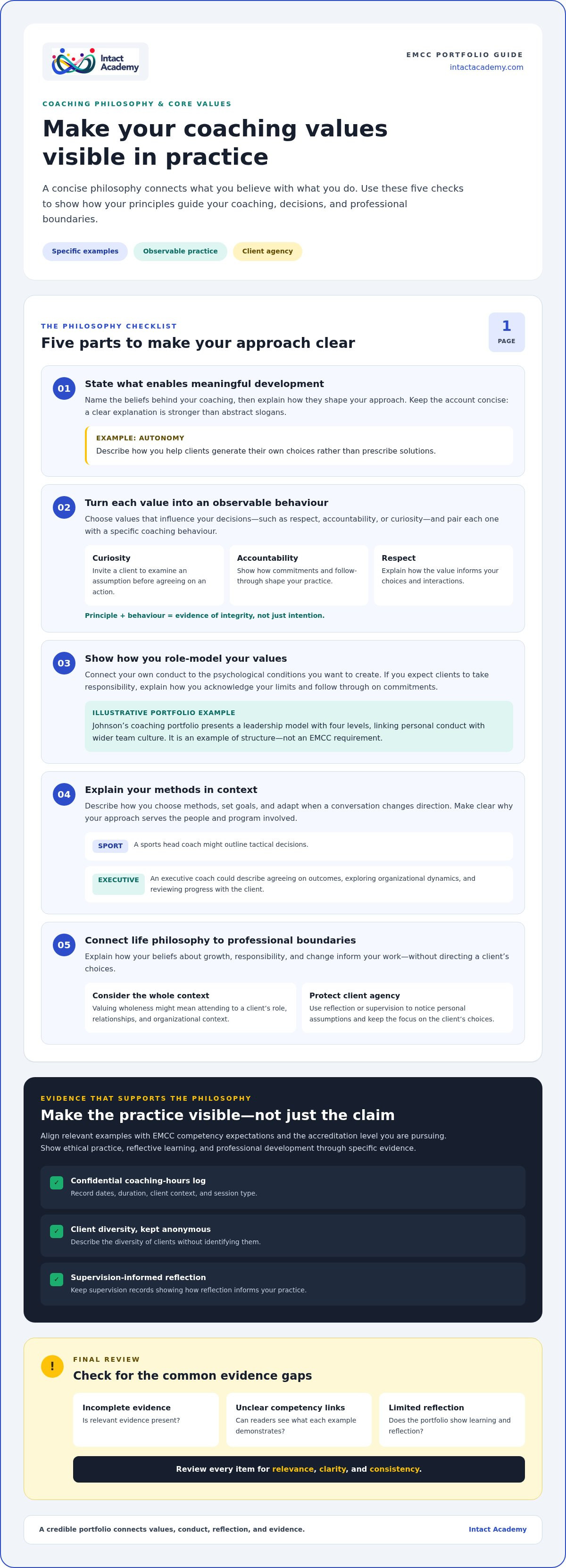
Show how your portfolio aligns with EMCC competency expectations and the accreditation level you’re pursuing. Use specific examples to make ethical practice, reflective learning, and professional development visible rather than relying on unsupported claims.
Record coaching hours in a confidential log, including dates, duration, client context, and session type. Describe client diversity without identifying clients, and keep supervision records showing how reflection informs your practice.
Common weaknesses include incomplete evidence, unclear links between examples and competencies, and limited reflection. Before submission, review every item for relevance, clarity, and consistency.
- Write a one-page coaching philosophy. State what you believe enables meaningful development, then explain how those beliefs shape your practice. For example, if autonomy is a core value, describe how you help clients generate their own choices rather than prescribe solutions. A concise page gives readers a clear account of your approach without reducing your values to abstract slogans.
- Translate each value into observable practice. Choose values that influence your decisions, such as respect, accountability, or curiosity. For each, describe a specific coaching behaviour. A coach who values curiosity, for instance, might invite a client to examine an assumption before agreeing on an action. Connecting principle with conduct helps your portfolio demonstrate integrity, not just intention.
- Show how you role-model your values. Explain how your behaviour supports the psychological conditions you aim to create. If you expect clients to take responsibility, describe how you acknowledge your own limits and follow through on commitments. Johnson’s coaching portfolio presents a leadership model with four levels, showing how a coach can connect personal conduct with wider team culture. Treat it as an example of structure, not an EMCC requirement.
- Describe your tactical philosophy in context. Explain how you choose methods, set goals, and adapt when a conversation changes direction. A sports head coach might outline tactical decisions; an executive coach could describe how they agree on outcomes, explore organizational dynamics, and review progress with the client. In either setting, clarify why the approach serves the people and program involved.
- Connect your life philosophy to your professional boundaries. Describe the beliefs that shape how you understand growth, responsibility, and change, then explain how they inform your coaching without dictating a client’s choices. Valuing wholeness, for instance, might mean attending to a client’s role, relationships, and organizational context. Keep the focus on client agency, and show how reflection or supervision helps you notice personal assumptions.
Show how relevant, clear, and consistent evidence aligns with EMCC competency expectations and the accreditation level you’re pursuing. Make ethical practice, reflective learning, and professional development visible. Connect specific examples, including coaching hours, client diversity, and supervision-informed reflection, to the competencies they demonstrate.
Career highlights and references
Build this section as a concise trail of evidence, not a complete employment history. A one-page highlights section can show how your responsibilities, learning, and results developed over time. As you begin building a coaching portfolio for EMCC, select experiences that make your development clear to its intended reader.
- Select career highlights that demonstrate progression. Choose roles, projects, and achievements that explain how your coaching practice has evolved. A recent graduate can include playing honors, awards, and individual or program achievements, then connect them to relevant skills such as communication, reflection, or leadership. Experienced coaches can show increasing responsibility and explain the context behind significant work. Keep each entry factual, specific, and connected to your professional story.
- Make each achievement understandable. State your role, the setting, and the result, then explain what the experience taught you. Matthew L. Johnson’s resume records 202 wins and 50 losses in varsity basketball at Williamsport Area High School, alongside an 80% winning percentage. Those figures illustrate one way to provide context, not a template for coaching portfolios. Describe the contribution behind an outcome, rather than relying on the outcome alone.
- Include playing experience selectively. Playing history can add useful context, especially early in a coaching career, but it shouldn’t displace evidence of coaching practice. The portfolio creator describes scoring 2,000 points and recording 1,000 assists while playing at Kentucky Christian University. If you include similar honors, explain how that experience informs your work with clients, teams, or organizations. The connection to present practice matters more than the accolade alone.
- Choose references who can speak to your work. List 3-4 coaching professionals or mentors who have observed your practice and can describe it with concrete examples. A head coach, position coach, or strength coach may suit a sport-coaching portfolio; in another professional context, choose people familiar with your coaching or developmental work. Ask permission before listing anyone, and provide each reference’s name, role, and professional relationship to you.
- Shape the page for its reader. Use one page for career highlights, with consistent dates, brief descriptions, and clear headings. Building a coaching portfolio for EMCC means prioritizing career evidence relevant to your coaching development. For a head-coaching interview, foreground program development and staff leadership; for an assistant-coach interview, emphasize tactical knowledge. Check the page for accuracy, confidentiality, and relevance before sharing it.
The portfolio structure recommends a one-page career highlights section, so treat space as a prompt to select evidence rather than compress every role. The creator says his portfolio helped him land a head coaching job less than three years into his coaching career. He also says his teams won at least 10 games every season of his head-coaching career and won four district championships.
Place those outcomes alongside context that lets a reader understand your development. Matthew L. Johnson's coaching career began at Williamsport Area High School in Pennsylvania in 1995. For new coaches, the author recommends requesting letters of recommendation from a head coach, position coach, strength coach, or similar colleagues. Together, concise highlights and informed recommendations can make progression easier to assess without turning the page into a full employment record.
Certifications and professional memberships
Present qualifications as verifiable evidence, then connect them to your coaching practice. Keep credentials, reflective learning, and professional memberships distinct so each has a clear purpose.
-
Gather accreditation evidence and documents
Gather qualification records, training certificates, practice logs, supervision records, reflective notes, and continuing professional development evidence. EMCC accreditation evidence should show how your learning and practice relate to the application criteria and level sought. Use consistent file names and dates, and remove confidential client details. An organized record makes it easier to trace each claim to its supporting documentation.
-
Match evidence to accreditation levels
Map each document to the EMCC Global Individual Accreditation level you’re pursuing and the relevant competency area. The framework structures the assessment; your examples should show how you apply coaching knowledge, ethical judgment, and reflection in practice. Don’t present one certificate as proof of every competency. Explain what each item demonstrates, using a concise example from your professional work.
- Separate credentials from memberships. List each qualification’s exact title, awarding organization, and completion status. Then create a separate membership entry naming the professional body and your membership status. Membership shows professional connection, while a certificate documents a specific learning achievement. For example, an assistant coach with a background playing a sport can include relevant training, but should explain how it connects to current coaching competence rather than present playing experience as a coaching credential.
Accreditation evidence commonly includes records of practice, training, supervision, and professional development. Keep original documents together with a short index identifying the evidence each one supports.
- Make reflective practice and continuing development visible. Maintain a dated learning record that captures the activity, insight, and effect on your practice. A supervision note might show how discussion helped you reconsider a coaching assumption; a development entry might explain how new learning shaped a later session. EMCC-focused evidence should show reflection, not just attendance. Trace the process from learning to changed understanding and considered practice.
Protect client confidentiality in every example. Use anonymized descriptions and focus on your decisions, learning, and professional boundaries.
- Plan for assessment and renewal as distinct stages. Application duration depends on evidence readiness and the assessment process, so organize records before submitting. Renewal follows the cycle attached to the accreditation; ongoing development and reflective practice help maintain your professional record. Common application weaknesses include missing documents, unclear evidence mapping, and claims unsupported by examples. Review each entry against the relevant criteria, then remove duplicates and resolve inconsistencies.
Keep a working evidence file after submission, adding new learning and supervision records as your practice develops. This makes future portfolio updates more coherent and reduces the need to reconstruct past activity.
Cover page and coaching biography
Give the portfolio a clear entry point, then use a one-page biography to connect your background with your coaching direction. Shape both pages for the position or professional opportunity you’re pursuing. Building a coaching portfolio for EMCC gives the biography a clear purpose: helping readers understand how your experience informs your practice.
- Design a purposeful cover page. Put your name, professional role, and a concise description of your coaching focus where readers can find them quickly. For example, “Executive coach supporting leadership development and organizational change” communicates a focus more clearly than a broad label alone. Add relevant contact details and a restrained visual style. The cover should orient the reader, not compete with the evidence and reflection that follow.
- Write the biography as a one-page professional narrative. Start with your current coaching work, then select earlier experiences that explain your development. A recent graduate might describe moving from player to assistant coach, while an experienced practitioner could trace a transition from leadership into coaching. Choose details for relevance, not completeness. The biography should help readers understand how your experience informs your current practice.
- Use education and training accurately. Name each qualification, institution, and relevant specialization in a consistent format. Matthew L. Johnson’s biography, for example, records a Bachelor of Science in Sports Administration from Lock Haven University of Pennsylvania. It also notes his master’s study in Exercise Science and Health Promotion, with a Sport Psychology concentration, completed at California University of Pennsylvania in 2011. Precise details make a biography concrete.
- Explain transitions, not just dates. Add a sentence showing what each meaningful career stage contributed to your coaching perspective. The portfolio creator describes beginning as a 22-year-old assistant coach and grounding his portfolio in 12 years of coaching experience. That progression gives the reader a frame for interpreting later responsibilities. In your own account, connect a role or opportunity to a learning edge, such as developing greater awareness of team dynamics.
- Adapt the emphasis to the intended reader. A biography for a team-coaching opportunity may foreground work with groups, collaboration, and organizational context. An individual coaching profile may instead emphasize the clients and developmental questions central to your practice. While building a coaching portfolio for EMCC, keep the underlying story consistent while adjusting which details come first. Check names, dates, qualifications, and role descriptions against your records before sharing.
Optional operational and creative work samples
Choose samples that make your approach tangible without turning the portfolio into an archive. A focused example can show how you think, prepare, and adapt in practice.
- Select work that answers a reader’s question. Before including a sample, ask what it demonstrates. A practice plan might show how a coach turns objectives into a structured session; a coaching framework might clarify how you agree on goals, explore, and review progress. For a college coaching role, a practice plan may be relevant. For an EMCC-focused portfolio, choose material that reveals your coaching process, not just your operational expertise.
- Build a one-page practice plan sample. The portfolio structure recommends a one-page sample practice plan. Use clear sections for the intended outcome, session sequence, prompts, and review. For example, a team session plan could move from agreeing on a shared objective to exploring different perspectives, then identifying commitments. Keep it readable and explain how each element supports learning. The sample should reveal your decisions, not just present a finished template.
- Show your reasoning alongside the artifact. Add a brief note explaining the context, your choices, and what you learned. If a sample includes a reflection prompt, explain why it suits the conversation. If you show a session outline, describe how you would adapt it if a client’s priorities shifted. This commentary helps readers understand the thinking behind the work rather than interpret the document without context.
- Protect confidentiality and clarify authorship. Remove names, identifying details, and sensitive organizational information from case materials. Label a sample as your own work, a fictionalized example, or a collaborative resource, as appropriate. For instance, replace a real team’s distinctive details with a generic scenario while preserving the learning point. If colleagues contributed to a tool, describe your role accurately. Clear attribution lets the sample demonstrate professional judgment as well as capability.
- Keep the portfolio adaptable. Treat it as a dynamic collection and revise its samples for each application. An assistant coach’s interview portfolio may foreground sport strategies and techniques, while a head-coach discussion may call for program-building evidence. In a coaching portfolio, retain a core set of relevant materials, then select only samples that fit the opportunity. To deepen your coaching practice and develop the work behind your portfolio, explore coaching development pathways.
To deepen your coaching practice and develop the sample over time, revisit the choices it reveals. Check that the intended outcome, sequence, prompts, and review work together, and that your commentary explains the connection. Keep the practice plan to one page, as the portfolio structure recommends, so readers can grasp its design without losing sight of its purpose. If a prompt or activity feels disconnected, revise it or explain your choice more clearly.
A useful sample helps readers understand your judgment without claiming that one format suits every conversation. Leave room for adaptation, and make clear what you would notice as the session unfolds. This keeps the material practical while showing that your approach can respond thoughtfully to changing priorities.
Intact Academy: TA EMCC Senior Practitioner academy
Intact Academy’s TA EMCC Senior Practitioner academy is a next step for coaches who want to deepen their Transactional Analysis practice and professional impact. It may suit you when you’re ready to connect portfolio evidence with sustained learning, reflection, and further development of your coaching approach.
If your work focuses on teams or supervision, the TA EMCC Senior Team Coach Academy and TA EMCC Senior Supervisor academy offer related learning pathways. Consider which direction best fits your current practice and the capabilities you want to strengthen. Your portfolio remains your own account of experience; further development can keep it grounded in ongoing learning.
Contact Intact Academy to explore the TA EMCC Senior Practitioner academy and how it aligns with your development goals.
Carry your professional development forward
Building a coaching portfolio for EMCC can mark more than an assessment milestone. It can become a working record of your evolving practice, helping you notice which questions, relationships, and learning experiences are shaping your next professional direction. Revisit it as your work changes, and let new insights refine how you describe your contribution.
If you’re ready to deepen your development, Intact Academy offers the TA EMCC Senior Practitioner academy, TA EMCC Senior Team Coach Academy, and TA EMCC Senior Supervisor academy. Each offers a distinct pathway for coaches developing their practice in individual, team, or supervisory contexts. Consider which one best connects with the work you want to cultivate.
Contact Intact Academy today to explore a learning pathway aligned with your professional goals. Keep moving forward with curiosity, grounded reflection, and a portfolio that remains true to your practice.
Frequently Asked Questions
What are the EMCC Global Individual Accreditation levels and requirements?
Map evidence to the accreditation level sought and the application criteria. Evidence commonly includes records of practice, training, supervision, and professional development.
What are the EMCC portfolio assessment criteria and competency framework?
Map each document to the relevant competency area and accreditation level. Assessment evidence should clearly and consistently show how you apply coaching knowledge, ethical judgment, and reflection in practice.


