

A virtual team doesn’t protect work-life boundaries by accident. Effective virtual team coaching best practices pair clear communication norms with flexible schedules, regular check-ins, and explicit agreements about availability and time away. A 15-minute check-in can create space for connection and well-being; for hybrid teams, planned breaks every 90–120 minutes can help mark a pause in the workday.
When work happens across screens and time zones, connection can fade, and flexibility can start to feel like constant availability. Strong leadership helps teams set clear expectations, raise concerns, and build routines that support shared goals and personal boundaries. This article covers practical ways to agree on how to work, strengthen communication and trust, and support healthier transitions between work and home. It also explores how virtual team coaching and leadership development can turn these practices into lasting habits.
Key Takeaways
- Set communication norms and team agreements so people know what’s expected, which channels to use, and when they can step away.
- Account for time zones, cultural differences, and individual working patterns when shaping shared routines.
- Create deliberate opportunities for informal connection so remote colleagues can feel seen and included beyond task updates.
- Build interpersonal trust through open dialogue, shared purpose, and team activities that invite everyone to contribute.
- Choose a steady coaching rhythm that supports reflection and follow-through without turning check-ins into micromanagement.
1. How can individuals on virtual teams manage boundaries, transitions and work–life balance effectively?
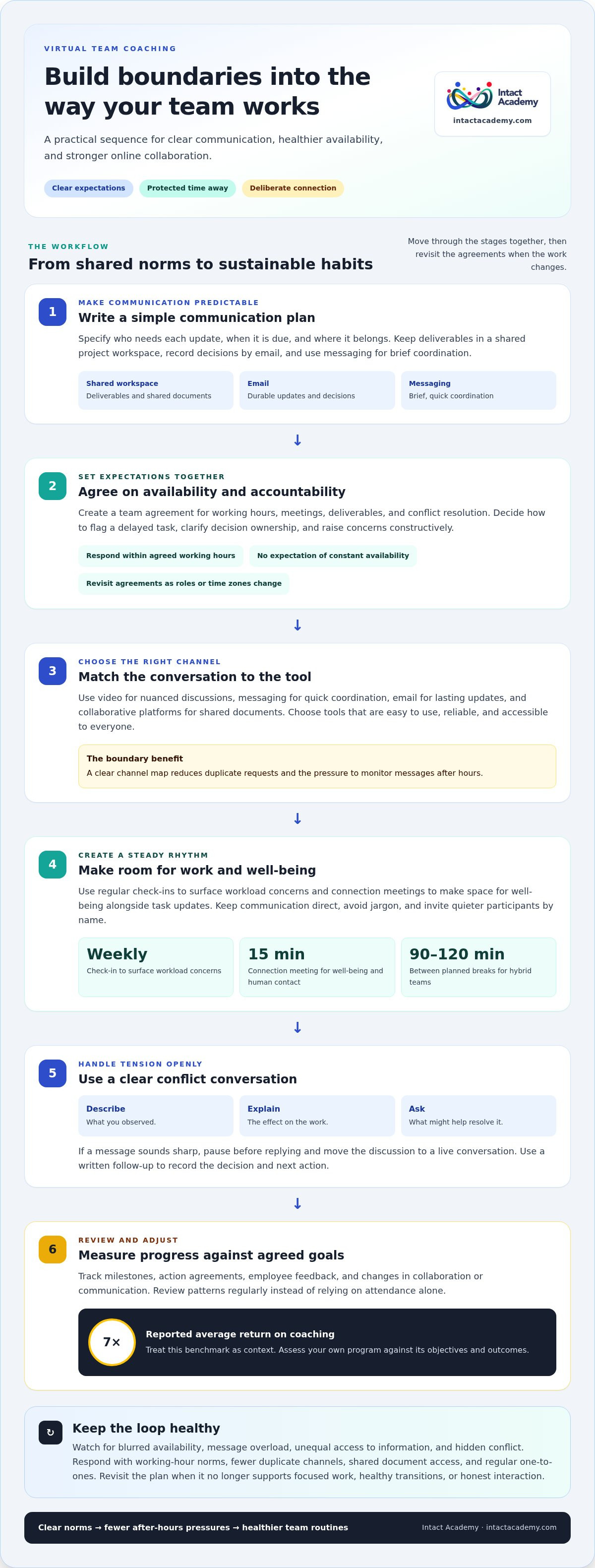
Start with a written communication plan that says who needs each update, when it is due, and which channel to use. For example, keep deliverables in a shared project workspace, record decisions by email, and use messaging for brief coordination. Set response expectations around working hours, not constant availability. This helps people sign off without missing essential information. Among the most useful virtual team coaching best practices are clear availability norms that do not require people to stay online.
Pair the plan with a team agreement covering accountability, meetings, deliverables, and conflict resolution. Decide how colleagues flag a delayed task, who makes a decision when ownership is unclear, and how disagreements are raised. For example, the agreement could ask team members to bring concerns to a scheduled conversation rather than letting frustration build in chat. Revisit it when responsibilities or time zones change so expectations remain practical.
For virtual team coaching, use video calls for nuanced discussions, messaging for quick coordination, email for durable updates, and collaborative platforms for shared documents. Choose tools that are easy to use, reliable, and accessible to everyone. A clear channel map prevents the same request from appearing across several platforms and reduces the pressure to monitor messages after hours. This clarity is another virtual team coaching best practice that supports healthier boundaries.
Make communication consistent, clear, and open, then ask for feedback about what needs adjustment. A weekly check-in can surface workload concerns, while a 15-minute connection meeting can make room for well-being alongside task updates. Keep speech direct, avoid jargon, and invite quieter participants by name. Active listening means reflecting back the concern before responding, rather than preparing a rebuttal while someone speaks.
Conflict needs a process, not silence. When tension arises, describe what you observed, explain its effect on the work, and ask what might help resolve it. If a message sounds sharp, pause before replying and move the discussion to a live conversation. Video can help people read tone and expression, while a written follow-up records the decision and next action.
Measure coaching effectiveness against goals agreed before sessions begin. Track milestones, action agreements, employee feedback, and changes in collaboration or communication. Review the pattern regularly rather than relying on attendance alone. A reported benchmark puts the average return on coaching at seven times the original investment. Treat that figure as context and assess your own program against its objectives and outcomes.
Common risks include blurred availability, message overload, unequal access to information, and conflict that stays hidden online. Address them with working-hour norms, fewer duplicate channels, shared access to documents, and regular one-to-ones. For hybrid teams, schedule breaks every 90–120 minutes to create a deliberate pause. Review the communication plan when these practices stop supporting focused work, healthy transitions, or honest interaction.
2. Team dynamics, cultures, and working hours
Geographic distance affects how people interpret silence, urgency, and participation. One team member may see a quick reply as courteous; another may experience it as an interruption. Before planning collaboration, map each location’s working hours, cultural context, and technology limitations. Agree on shared periods for decisions, while protecting the time outside them for focused work and personal commitments.
Virtual coaching can accommodate time zones by rotating meeting times and using asynchronous updates for decisions that do not need live discussion. To include different communication styles, offer several ways to contribute, such as spoken discussion, written reflections, and shared documents. Send an agenda in advance so reflective participants can prepare, then invite spontaneous input during the meeting.
Working-hour norms need to account for both organizational needs and individual capacity. Surveys by Adecco and Gallup found employees want roughly 50% of their workweek to be remote. That preference doesn’t mean every team needs the same arrangement; it does make clear why leaders should discuss what remote work looks like in practice. Set core collaboration windows, identify who covers urgent work, and avoid treating a delayed response outside agreed hours as disengagement.
Culture develops through repeated choices, not a statement on a shared page. Ask team members what respectful disagreement looks like in their context, how they prefer to receive feedback, and what helps them participate. Someone may be comfortable challenging an idea in writing but less comfortable interrupting a senior colleague on video. Naming these differences helps the group avoid mistaking communication style for commitment.
Peer coaching can turn these conversations into a learning culture. Pair colleagues from different locations to reflect on a current challenge, exchange observations, and choose one action to try. Rotate the pairs periodically so learning reaches beyond familiar relationships. Managers can reinforce the practice by recognizing useful questions and lessons, not just completed deliverables.
Hybrid inclusion takes deliberate design. If some people meet in person while others join remotely, share the same documents, make remote participants’ contributions visible, and assign someone to monitor their access to discussion. Gallup workplace research cited in the research findings reports that 36% of fully remote workers are thriving, compared with 42% of hybrid workers. Those figures make a useful prompt for reviewing team experience, not a verdict on any one arrangement.
For a practical review, ask the team to assess meeting times, participation, and access to information together. Choose one change, such as rotating a meeting time or adding written input, then review its effect on collaboration. This cycle helps a geographically diverse team adapt its norms without expecting every culture or working pattern to fit one default.
3. Human connection and social isolation in remote teams
Remote work can make task coordination easier while leaving relationships thinner. Gallup research reports that 57% of fully remote workers are actively looking for new job opportunities. It also reports high stress among 45% of fully remote workers, compared with 39% of on-site employees. These figures make regular attention to connection and well-being a leadership responsibility, not an optional social extra.
Build connection into everyday work instead of relying on a single annual team event. A leader can open a meeting with a brief personal check-in, create an informal chat space, or arrange virtual coffee conversations. Keep participation voluntary and varied. One person may prefer a relaxed conversation, while another may connect more comfortably through a shared project or written exchange.
Trust often develops around tasks first, while interpersonal trust takes more deliberate attention. Invite colleagues to share what support helps them do their best work, then follow through. If a team member raises a concern, acknowledge it and agree on a next step. Reliable responses over time show that honest communication has practical value.
Design meetings so interaction doesn’t depend on the fastest speaker. Use a poll, invite written input in chat, or ask pairs to discuss a question before returning to the full group. Breakout discussions in pairs or trios can run for six minutes, giving participants a defined space to contribute. Virtual coaching groups larger than 12 participants lose intimacy rapidly, so structure becomes especially important as attendance grows.
Virtual leadership also calls for self-awareness. A manager who notices a tendency to interrupt can pause and invite another perspective; a leader who defaults to silence can explain which decisions need discussion. Ask team members how your leadership behavior affects them, and listen without immediately defending your intentions. This strengthens the soft skills behind trust, feedback, and conflict repair.
Training helps remote teams practise these skills before high-pressure moments arise. Use a realistic scenario, such as a missed handoff or unclear decision, and let participants rehearse raising concerns respectfully. Identify each person’s development needs and set an individual learning goal. In a follow-up conversation, discuss what worked and what the team could adapt.
Connection needs attention after training ends. Rotate meeting facilitation, pair colleagues from different locations, and check periodically whether everyone feels seen and heard. Leaders can also make care calls to ask how work is affecting team members and respond with appropriate support. These repeated choices help create a culture where people can contribute as whole people, not just names on a task board.
4. Building interpersonal trust and rapport
Trust grows when team members can predict how colleagues will respond under pressure. Make that predictability visible in a virtual setting: clarify who owns a decision, explain how to raise dissent, and follow through on commitments. After a project handoff, for example, the receiving colleague can confirm responsibilities and flag risks. This simple exchange demonstrates reliability before a bigger challenge tests it.
Virtual team coaching can create the reflective dialogue of in-person coaching, but the interaction differs. In-person conversations offer shared physical cues; online sessions call for more deliberate turn-taking, clear pauses, and explicit invitations to contribute. A facilitator can ask each member to share an observation before the group discusses what it means.
Use team-building sessions to practise collaboration, not just to provide a pleasant break. Give members a shared problem, such as mapping a customer journey or planning a project handoff, then ask them to explain their approach. The exercise makes communication patterns visible. A brief reflection afterward can reveal whose ideas were heard, where assumptions surfaced, and what the group wants to change.
Resilience-building starts with how a team responds to uncertainty. In a coaching conversation, ask members to separate what they know from what they assume, identify what remains within their control, and choose a next action. If a deadline shifts, the team can review dependencies before assigning blame. This approach builds the capacity to recover and solve complex problems together.
Engagement improves when employees can shape how team-building happens. Rotate who chooses an activity or leads a discussion, and offer verbal and written ways to participate. Someone who prefers time to prepare can contribute through a shared document; another may develop an idea through live discussion. Different routes make participation more accessible without lowering expectations.
Training is most useful when it connects interpersonal skills to real team challenges. Practise giving feedback with a specific example: describe the behavior, its effect on the work, and the change that would help. Then switch roles so each participant experiences speaking and listening. A coach can help the group notice defensiveness, curiosity, and the difference between intent and impact.
Keep learning alive through regular team-building sessions and review what changes afterward. Ask which behavior helped members speak openly, which decision became easier, and what still creates friction. Record one action for the next meeting, such as inviting dissent before reaching agreement. Over time, these reflections make rapport an everyday practice, supporting trust at work and in dedicated coaching.
5. How often should managers hold virtual team coaching sessions?
A practical starting rhythm is two 90-minute virtual coaching sessions per month, rather than one six-hour video session. This creates space to reflect, test changes, and return with fresh observations. Treat the cadence as a working structure: keep it steady enough to build continuity, then use team feedback and progress toward goals to shape future sessions.
Keep each session focused. Set one shared objective, invite participants to identify the issue they want to work on, and reserve time for reflection and action. Virtual coaching sessions should last 90–120 minutes, with scheduled 10-minute breaks during longer sessions. The final 10 minutes can be used to document action agreements, owners, and follow-up, so insight becomes a visible commitment.
Coaching sessions are not the only useful touchpoint. Weekly check-ins can address immediate obstacles, while monthly one-to-one meetings make room for individual feedback and development. Annual development conversations can explore longer-term goals. Each conversation has a different purpose, so avoid turning every check-in into a coaching session or every coaching session into a status report.
Use quarterly retrospectives to examine how the team works together, not only what it delivered. Ask which agreements supported collaboration, where decisions stalled, and what the team wants to change. Reviews can also connect progress with goals and milestones. Record the agreed adjustment, then revisit it at the next retrospective to see whether it improved the team’s working process.
Between sessions, leaders should follow up regularly without micromanaging. Agree on a simple progress signal, such as a shared milestone update, and step in when a dependency or decision blocks progress. If participants repeatedly raise the same issue, bring it into the next coaching session. Address concerns that need immediate attention directly rather than waiting for a scheduled session.
Let the team’s needs guide the coaching rhythm. A new project, unresolved conflict, or major change in responsibilities may call for closer reflection; stable work may need less intensive group coaching. Look for observable signs: whether action agreements are completed, goals remain clear, and participants can raise concerns. Use these patterns and participant feedback to decide whether the cadence still serves the team.
To strengthen the skills behind a sustainable coaching rhythm, develop your virtual team coaching practice.
Intact Academy: TA EMCC Senior Practitioner academy
Intact Academy offers the TA EMCC Senior Practitioner academy for professionals who want to deepen their coaching practice and bring greater awareness to their work with people and systems. For those helping virtual teams build trust, clarify shared responsibilities, and learn through challenges, the TA EMCC Senior Team Coach Academy is closely aligned with that development. The right path depends on whether you want to strengthen your individual coaching practice or develop your ability to work with teams.
For leaders seeking focused support with their own development, Executive Coaching offers another route for reflection and growth. Consider these options when practical team routines need to be supported by deeper development in coaching capability, leadership, or team dynamics. Contact Intact Academy to explore which learning path fits your goals.
Turn team insight into a lasting practice
Lasting change begins when a team treats its working culture as something it can shape together. Choose one pattern to address, invite honest reflection, and agree on an experiment the team can review. Virtual team coaching best practices are most useful when people can adapt them to real relationships, responsibilities, and organizational context.
This work also asks leaders and coaches to keep developing their ability to notice group dynamics, hold complexity, and support learning without taking ownership away from the team. Intact Academy offers the TA EMCC Senior Practitioner academy, the TA EMCC Senior Team Coach Academy, and the TA EMCC Senior Supervisor academy for professionals developing their coaching practice.
If you’re ready to explore a learning path that fits your direction, contact Intact Academy. Your team’s next step can begin with a thoughtful conversation and a willingness to keep learning.
Frequently Asked Questions
How can individuals on virtual teams manage boundaries, transitions and work–life balance effectively?
Use a personal start-and-stop routine to separate work from home life. Review tomorrow’s priorities before signing off, close work applications, and take a short walk to mark the transition. Share your usual availability with colleagues and make it visible in your calendar status. If work repeatedly spills into personal time, identify the trigger, such as late decisions or unclear ownership, and raise the pattern with your manager.
How should virtual and hybrid teams decide what work happens where?
Match the setting to the task’s need for interaction, concentration, and shared resources. Focused analysis may suit remote work, while a sensitive disagreement or complex planning session may benefit from live discussion. Map recurring tasks, identify where participation matters most, and agree how decisions will be documented. Review the arrangement when project dependencies change rather than treating one location as the default for every activity.
How do leaders balance trust and control remotely?
Set clear outcomes, then give employees room to decide how to achieve them. A manager might agree on a project milestone and a brief progress review instead of asking for constant activity updates. Make intervention criteria explicit: a blocked dependency, missed commitment, or changed priority should prompt discussion. This links accountability to work and results, not online presence or immediate replies.
How do people stay visible and connected when working remotely?
Make contributions visible through shared work, not performative availability. Keep project decisions, completed deliverables, and emerging risks in the team’s workspace, then explain your role in collaborative outcomes during review conversations. Connection also grows through two-way contact: ask a colleague for their perspective, offer help on a shared task, and acknowledge useful contributions. These actions clarify impact without requiring constant calls.
How do virtual teams create psychological safety remotely?
Leaders build psychological safety by responding constructively when someone raises a risk, admits an error, or questions a decision. Thank the person, clarify what they observed, and explore the issue before assigning blame. After a handoff fails, for example, examine where the process broke down and invite suggestions from everyone involved. Consistent responses show whether candor is genuinely welcome, especially when the news is uncomfortable.
How do you manage an executive who is obviously multitasking during a virtual call?
Address the impact without shaming the person. Pause and say, “I may be missing your perspective. Would you prefer to focus on this discussion now, or should we reschedule?” If the executive needs to stay, ask for a specific decision or reaction and make room for a direct response. If the behavior recurs, discuss privately whether the meeting’s purpose, length, or relevance needs adjustment.
How has the nature of work changed?
Work increasingly depends on coordination across locations, digital channels, and changing schedules. Teams often make decisions without sharing a room or working day, making written context and clear ownership more important. Leaders also need to notice how systems shape behavior: unclear priorities can create unnecessary availability, while thoughtful autonomy can support focused contribution. Effective work design connects individual responsibility with collective outcomes.
How should remote leaders manage expectations and alignment?
Turn priorities into observable outcomes, owners, and decision points. At a project launch, ask each person to explain their understanding of the goal and the next dependency; differences can then surface before they lead to rework. Record decisions in a shared place and revisit them when priorities shift. Leaders should distinguish a changed expectation from a missed commitment, discuss the cause, and agree on a realistic adjustment.


