

A team can look productive while underlying patterns remain unseen. Effective team diagnostic tools make progress visible by combining survey responses, performance indicators, structured assessments, and feedback from people who work with or support the team. Their value lies not in a score alone, but in what it reveals about how the team functions.
It’s understandable to want clear evidence that a team is moving forward, especially when effort is high but collaboration still feels strained. A useful diagnostic creates a shared picture of strengths and development areas, then gives the team a way to revisit those patterns and assess change over time.
Here, you’ll learn how surveys, KPIs, periodic assessments, and stakeholder feedback work together, how to interpret the findings, and how to turn them into focused action. The aim is to move from measurement to meaningful development while keeping the human dynamics behind the data in view.
Key Takeaways
- Combine pulse surveys, relevant KPIs, and periodic assessments to see whether team behaviors and outcomes are changing over time.
- Gather confidential input from team members, sponsors, and stakeholders to understand how collaboration is experienced from different perspectives.
- Use consistent survey questions and clear score interpretation to spot patterns, while treating averages as prompts for discussion rather than the whole story.
- Map strengths alongside development areas so the team can build on what works and focus its effort where it matters most.
- Choose an assessment approach that fits the team’s needs, then translate the findings into practical actions and a way to review progress.
Monitoring progress with pulse surveys, KPIs and periodic assessments
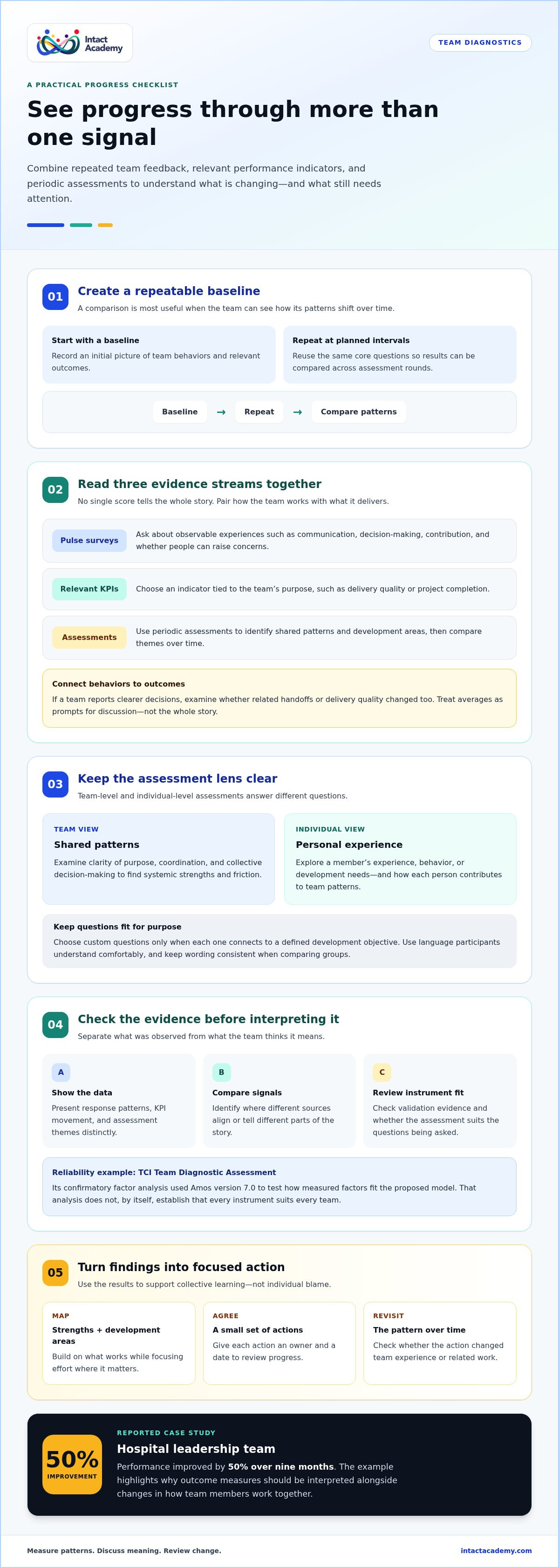
Progress is clearest when pulse surveys, performance indicators, and periodic assessments are compared over time. Reliability varies by instrument; the TCI Team Diagnostic Assessment’s confirmatory factor analysis used Amos version 7.0, testing how its measured factors fit the proposed model.
Begin with a baseline, then repeat the same core questions at planned intervals. Pair responses about communication or decision-making with a KPI tied to the team’s purpose, such as delivery quality or project completion. In a reported hospital leadership-team case study, performance improved by 50% over nine months. That example illustrates why teams should interpret outcome measures alongside changes in how members work together.
Team and Individual Assessment
A team-level assessment examines shared patterns, such as clarity of purpose, coordination, and collective decision-making. An individual assessment focuses on a member’s experience, behavior, or development needs. Use the team view to identify systemic strengths and friction, and individual reflection to understand how each person contributes to those patterns. Keep the distinction clear when choosing questions and discussing results.
To assess engagement, ask about observable experiences: whether people can contribute, understand priorities, and raise concerns. Compare responses across assessment rounds, then explore shifts alongside relevant KPIs. For example, a team reporting clearer decisions can examine whether handoffs or delivery quality changed too. Choose custom questions only when each one connects to a defined development objective.
Language affects whether respondents understand questions in the same way. Choose an assessment language participants can use comfortably, and keep wording consistent across groups when comparing results. If a team works across languages, explain key terms before collecting responses. This helps distinguish genuine differences in engagement from confusion about the survey’s meaning.
Findings and Assessment Reliability
Reliable reporting separates observed data from interpretation. Present response patterns, KPI movement, and assessment themes in distinct sections, then identify where they align or differ. The Amos version 7.0 analysis supports examination of the TCI assessment’s factor structure; it doesn’t, by itself, establish that every instrument suits every team. Review the assessment’s validation evidence and fit with the questions being asked.
Close the report with a small set of agreed actions, an owner for each, and a date to review progress. For example, if responses point to unclear decision rights, document who decides and track whether related work moves more smoothly. This makes team effectiveness measurable without reducing the team to a single score. Keep findings focused on collective learning, not individual blame.
Team member, sponsor, and stakeholder feedback
Feedback is more useful when it captures how the team experiences its work and how others experience its impact. Gather perspectives from team members, the sponsor, and key stakeholders, then compare where their observations converge or differ. For example, members may describe slow decisions while a sponsor sees missed commitments. That difference calls for shared inquiry, not an immediate judgment.
Collecting confidential team feedback
Make confidentiality part of the feedback process from the beginning. The diagnostic recommends keeping responses confidential and not attributable to individual team members. Explain how themes will be shared before inviting responses, and avoid reporting comments in ways that identify their authors. This helps members discuss difficult patterns, such as withheld disagreement or unclear accountability, without turning the assessment into a record of individual blame.
Use focused prompts about observable team interactions. Ask where information gets stuck, how decisions are revisited, or what enables members to challenge an assumption. Keep questions consistent across respondents, then group responses by theme. A comment about silence in meetings, for instance, can prompt discussion about turn-taking and psychological safety without naming its source.
Using sponsor and leader feedback
A sponsor can describe the outcomes the team is expected to deliver, while team members describe the conditions shaping their work. Ask the sponsor for concrete examples, such as a decision delayed between functions, then compare these with members’ accounts. Leaders can use the contrast to examine how their communication, delegation, or response to dissent affects team effectiveness.
Leader feedback should support development, not become a separate performance verdict. Invite the leader to reflect on one observed strength and one behavior to practice. For example, a leader might summarize competing views before closing a decision. The team can then notice whether this enables clearer participation and follow-through.
Telephone feedback sessions
A telephone session offers a focused way to explore survey themes with a member, sponsor, or stakeholder. Share the purpose first, ask open questions, and listen for examples rather than assumptions. If a stakeholder reports inconsistent communication, clarify which handoff or decision created that experience. Record themes without attaching comments to individuals, in line with the confidentiality approach.
Close each conversation by reflecting the main themes and identifying what needs discussion with the team. Compare stakeholder feedback with members’ perspectives, then bring forward patterns rather than isolated remarks. A facilitated systemic team coaching approach can help teams turn those patterns into shared learning and deliberate changes in how they work.
Using surveys and analysis spreadsheets
Choose a diagnostic tool by checking whether its questions match your goal, whether members can answer candidly, and whether results support practical action. A survey is useful only when its measures fit the organization’s context and the team leader can interpret the findings responsibly.
Survey Use and Suitability
Use a survey when the team needs a structured view of recurring patterns, such as decision-making, role clarity, or coordination. Before launching it, define the question the assessment should answer and who will act on the results. Avoid surveying when members can’t respond thoughtfully or leaders have no plan to discuss the findings and follow through.
For a useful data set, keep questions focused and make the response scale clear. An analysis spreadsheet can place each item in a row, with response averages and written comments in separate columns. Group related questions under themes, such as communication or accountability. This helps the facilitator identify patterns without treating one response as the team’s overall experience.
Interpret score bands according to the diagnostic’s stated method. In one score interpretation, averages from 1.0 to 2.4 indicate a negative attitude, 2.5 to 3.4 indicate a neutral attitude, and 3.5 to 5.0 indicate a positive attitude. These ranges belong to that interpretation; don’t assume another survey uses the same scale. Compare like with like, and review comments alongside averages.
Interpreting Results and Choosing a Tool
Read each result as a prompt for inquiry, not a verdict. If a team rates decision clarity below its other themes, compare comments and examples: are priorities shifting, or do decision rights remain unclear? Then check whether the team’s own account aligns with observable work. A spreadsheet shows the pattern; discussion helps explain what it means.
When selecting a tool, examine its intended use, dimensions assessed, scoring guidance, language options, and reporting format. Check whether the questions address team-level dynamics rather than only individual preferences. Also consider whether the process protects confidential responses and provides a way to revisit actions. These criteria help distinguish a relevant diagnostic from a generic questionnaire.
Survey pricing depends on scope and is given after a quote request; factors include assessment design, facilitation, analysis, and reporting depth. A Team Diagnostic Survey may be a poor fit when the team cannot give candid responses or when no time is available to interpret results. In that case, begin by clarifying the purpose and creating conditions for an honest conversation before collecting data.
Team strengths and weaknesses
A diagnostic should reveal what helps a team succeed and what repeatedly interrupts its work. Findings become useful when the team connects them to examples, such as strong technical knowledge alongside unclear ownership of cross-functional decisions. That contrast shifts attention from blaming individuals to understanding how skills, roles, and working conditions interact.
The scale of the challenge is reflected in reported figures: 79% of teams were described as ineffective in a cited 2020 source, while a cited 2013 source reported that 86% of teams under-perform. Fewer than 25% of executives feel confident in their ability to build a cross-functional team. These figures point to a practical task: identify the specific conditions affecting this team, rather than treating a broad statistic as its diagnosis.
Start by sorting findings into strengths to preserve and development areas to address. For example, members may describe dependable peer support as a strength, while missed handoffs reveal a coordination weakness. Ask what enables the strength, then consider how that condition could support the weaker process. This creates a fuller picture of team effectiveness, not a simple list of good and bad traits.
- Protect a strength: If members share information readily, retain the meeting or workflow that enables it.
- Define a development focus: If decisions stall, clarify who recommends, decides, and communicates each outcome.
- Connect behavior to outcomes: If work is delayed at handoffs, trace where ownership becomes unclear.
Use coaching to turn a finding into a small experiment. The team might agree to name a decision owner during each planning discussion, then review whether decisions become clearer in practice. Keep the action specific enough to observe, and invite individuals to reflect on their contribution without making one person responsible for a systemic pattern. The team’s strengths can support that change.
Interpretation also depends on how the diagnostic is administered. If a method requires a certified facilitator, include that requirement when planning who will guide the discussion. The facilitator should help the group test its assumptions against concrete examples, such as a recent project decision, rather than treating scores as proof of individual capability. This preserves the distinction between a measured pattern and its possible causes.
Finally, revisit the original focus after the team has tried its agreed action. Compare the same evidence, such as decision clarity or handoff reliability, and ask what changed in the work itself. A useful assessment doesn’t label a team permanently; it helps members recognize what is already working, choose a meaningful development edge, and build on progress together.
Team diagnostic tools
The strongest diagnostic combines a structured assessment with evidence from how the team actually works. Use the findings to identify improvement priorities, then connect them to team coaching, stakeholder needs, and observable changes in team dynamics.
Different tools examine different parts of team effectiveness. The Team Performance Diagnostic assesses performance across 11 key indicators, while the Highly Effective Teams diagnostic template covers 8 characteristics. These frameworks offer distinct lenses, so first define the decision the team needs to make. Is the central issue collaboration, clarity, or delivery? Choose a diagnostic whose dimensions speak directly to that question.
The Team Diagnostic Survey was in use by at least the mid-2000s. Modern practitioners are more likely than they were 15 years ago to pair it with meeting observation, decision-rights analysis, and hybrid-work design. That combination matters because a survey captures reported experience, while observation can reveal interaction patterns. For example, members may report clear roles, yet meeting observation shows decisions repeatedly returning to the same unresolved question.
Consider the method as a set of complementary evidence sources, rather than a score in isolation:
- Assessment: surfaces shared perceptions and areas the team wants to develop.
- Meeting observation: shows how participation, challenge, and decisions unfold in practice.
- Decision-rights analysis: clarifies who contributes, recommends, and makes decisions.
- Hybrid-work review: explores how working arrangements shape communication and coordination.
Before collecting data, agree on the purpose, participants, and intended use of the findings. Then select relevant dimensions, explain confidentiality, and plan a facilitated discussion of results. For example, if responses indicate friction around accountability, examine a recent handoff and identify where ownership became unclear. The team can then implement a focused change and decide what evidence will show whether it helps.
Selection should reflect the team’s context. A newly integrated group may need to explore shared purpose and decision processes, while an established team may focus on recurring coordination barriers. In either case, consider whether stakeholders’ expectations are visible in the assessment, whether findings can be discussed safely, and whether the process supports follow-through. A useful tool makes its scope clear and connects evidence to action.
Diagnostics create value when skilled facilitation helps a team interpret patterns without turning them into labels. If you’re ready to strengthen that capability, develop your team coaching practice and bring assessment insight into meaningful improvement.
Intact Academy: TA EMCC Senior Practitioner academy
Intact Academy’s TA EMCC Senior Practitioner academy is a next step for professionals seeking to deepen their coaching practice and work thoughtfully with organizational dynamics. If diagnostic findings point to recurring patterns in collaboration, leadership, or team relationships, structured development can help you turn insight into a more deliberate coaching approach.
For practitioners focused specifically on teams, the TA EMCC Senior Team Coach Academy connects directly with the work of helping teams understand their dynamics and develop new ways of working. Executive Coaching is another path when the central need concerns an individual leader’s role in the wider system. The right direction depends on the work you want to undertake and the people you aim to support.
Explore the learning pathways and contact Intact Academy through intactacademy.com.
Turn insight into your team’s next step
A diagnostic matters most when it changes the quality of the next conversation. Use what the team has learned to choose one meaningful practice, make responsibility clear, and create space to notice what shifts. This keeps team diagnostic tools connected to lived experience, rather than leaving insight in a report.
If you’re developing the capacity to guide this work, Intact Academy offers the TA EMCC Senior Practitioner academy, the TA EMCC Senior Team Coach Academy, and the TA EMCC Senior Supervisor academy. Each provides a learning pathway for deepening professional practice and supporting development with care and structure.
For a conversation about team coaching and the next step that fits your aims, contact Intact Academy. The work begins with attention: to the patterns already present, and to the possibilities your team can create together.
Frequently Asked Questions
How does it work?
A team completes structured prompts, then uses response patterns to guide discussion and choose a development focus. For example, if members disagree about what “urgent” means, they can define shared criteria and observe whether prioritization improves. The assessment supports reflection; it doesn’t make decisions for the team. Its practical value comes from linking a finding to a specific change in everyday work.
What are team diagnostic tools and what do they measure?
These are structured methods for examining how a team functions and where it can develop. Depending on the method, measures may include shared purpose, trust, role clarity, decision-making, communication, or coordination. A leadership group might explore whether members can challenge assumptions constructively, while a project team might examine how responsibilities cross between functions. Compare the dimensions with the issue the organization wants to understand.
What are the best team diagnostic tools for organizations in 2026?
The best choice in 2026 depends on what the organization needs to learn and how it will use the findings. For a focused conversation, a simple reflection framework may be enough. For complex dynamics, choose a structured assessment with clear interpretation guidance and a process for discussing results. Before deciding, define the team’s question, intended participants, and next action. A familiar name alone doesn’t establish fit.
How do team diagnostic tools such as Google re:Work, Team Canvas, and Lencioni compare?
These approaches serve different purposes, so compare them by the conversation each supports. Google re:Work offers a research-oriented lens on team effectiveness; Team Canvas structures a team’s discussion of shared agreements; Lencioni’s model frames discussion around common team dysfunctions. A facilitator might use a canvas to align expectations, then select a deeper assessment if the group needs systematic evidence about recurring patterns.
How much do popular team assessment tools cost?
Costs vary with the assessment format, access model, reporting, facilitation, and the amount of interpretation support. A self-guided resource and a facilitated diagnostic aren’t directly comparable. For budgeting, identify whether the team needs only materials or also an interpreted report and structured discussion. Request a breakdown of those components so the organization can compare scope, not just a headline fee.
How do you conduct a team diagnostic assessment step by step?
Start by defining the decision or challenge the assessment should inform. Select a method that measures relevant dynamics, explain its purpose to participants, and collect responses using consistent instructions. Review findings for patterns, then discuss them with the team using concrete work examples. Agree on an action, assign responsibility, and choose evidence for a later review. This sequence keeps assessment connected to practice.
Which team diagnostic tools are free or offer trial versions?
Availability depends on the provider and can change, so distinguish open educational resources from assessment products with trial access. A downloadable reflection worksheet may support an initial discussion, while a trial of a digital assessment may limit features or reporting. Before using either, check whether its questions match your goal and whether results can be interpreted responsibly. Free access alone doesn’t establish assessment quality.
What are the risks and limitations of using team diagnostic tools?
A score can oversimplify complex relationships, especially if participants interpret questions differently or fear consequences for candid answers. Results may also reflect a temporary disruption, such as a reorganization, rather than a stable team pattern. Reduce these risks by explaining how responses will be used, interpreting scores in context, and inviting members to test conclusions against real examples. Don’t treat a diagnostic as a verdict on individuals.


