

EMCC accreditation is more than a credential to display: it makes your coaching competence visible and signals a structured commitment to reflection and development. The benefits of EMCC accreditation include recognition at four levels, from Foundation to Master Practitioner, each reflecting a different stage of professional experience and practice. Accreditation is voluntary, but it can help you demonstrate how you work and continue to grow.
It’s understandable to want a qualification that means more than a line on a profile. Coaching depends on trust, yet clients and organisations can’t always see the judgment, ethical awareness, and self-reflection behind a session. Professional accreditation can make that underlying practice clearer.
This article explains what EMCC accreditation recognises, how it connects competence with client experience, reflective learning, supervision, and ongoing professional development, and what those requirements may mean for your career. You’ll also see how accreditation can strengthen professional credibility, and why its value rests not only in the designation but in the quality of practice it asks you to sustain.
Key Takeaways
- Understand how the four EMCC Individual Accreditation levels reflect different stages of coaching and mentoring practice.
- Distinguish accreditation for individual practitioners from accreditation for training providers and coaching programmes.
- See how supervision, reflective learning and continuing professional development contribute to evidence of competence.
- Assess whether accreditation aligns with your goals for professional credibility and the way you want to develop your practice.
- Explore how an accredited learning pathway can support your next stage of growth as a coach, team coach or supervisor.
Why accredit as a coach with EMCC Global?
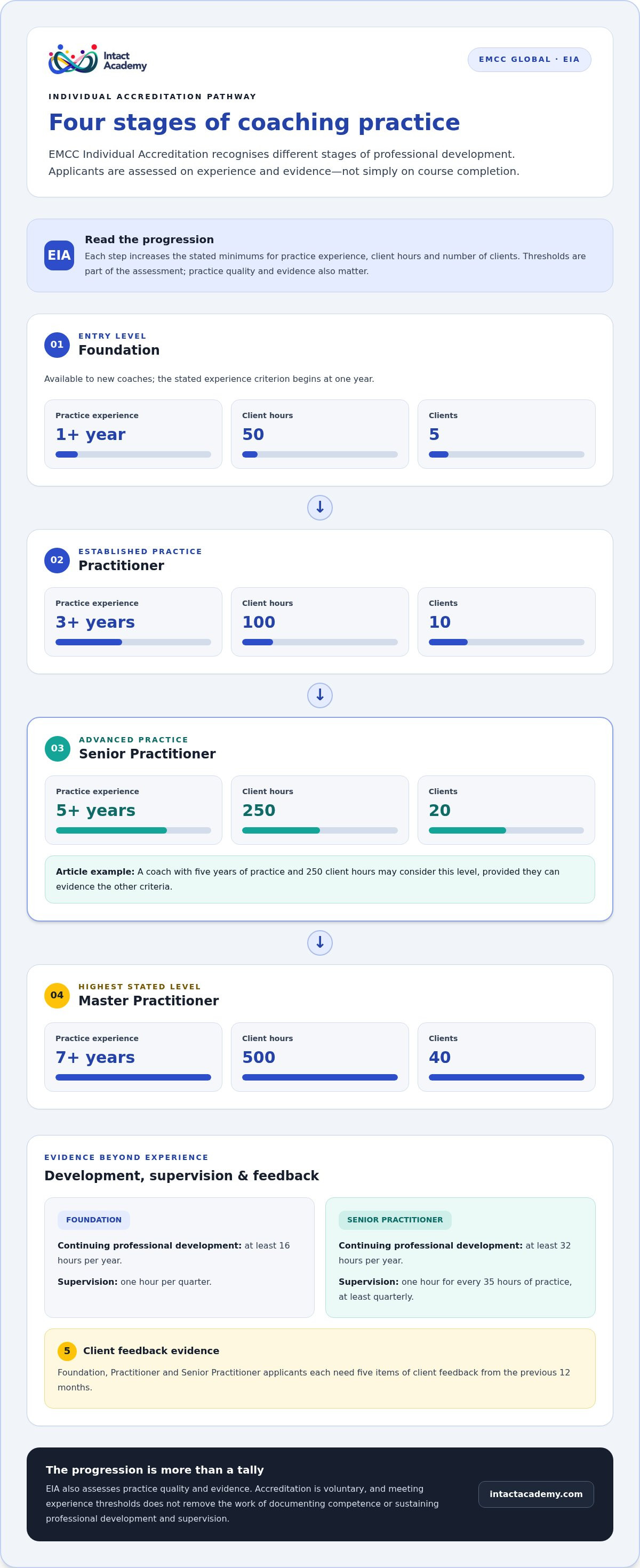
EMCC Global Individual Accreditation, or EIA, gives coaches and mentors professional recognition based on demonstrated practice. Its four levels, Foundation, Practitioner, Senior Practitioner, and Master Practitioner, recognise different stages of professional development. Applicants are assessed on experience and evidence, not simply on course completion. That distinction can help you identify a realistic level and understand what your current practice demonstrates.
Each level has defined experience thresholds. The Foundation level is available to new coaches, with eligibility criteria that include at least one year of coaching or mentoring experience.
- Foundation: At least one year of experience, 50 client hours, and five clients.
- Practitioner: At least three years of practice, 100 client hours, and 10 clients.
- Senior Practitioner: At least five years of practice, 250 client hours, and 20 clients.
- Master Practitioner: At least seven years of practice, 500 client hours, and 40 clients.
These thresholds make the progression tangible. For example, a coach with five years of practice and 250 client hours may consider Senior Practitioner, provided they can evidence the other criteria. EIA also assesses practice quality, client numbers, and client hours, so accumulated experience is only part of the application.
Professional development and supervision also shape eligibility. Foundation applicants need at least 16 hours of continuing professional development per year and one hour of supervision per quarter. Senior Practitioner applicants need at least 32 hours of continuing professional development per year and one hour of supervision for every 35 hours of practice, at least quarterly. Foundation, Practitioner, and Senior Practitioner applicants each need five items of client feedback from the previous 12 months.
How does EMCC accreditation compare with ICF accreditation? EMCC EIA has four levels and evaluates practice through its professional framework, while ICF credentials include ACC, PCC, and MCC. ICF experience criteria include 100 coaching practice hours for ACC, 500 hours of experience for PCC, and 2,500 practice hours for MCC; MCC also requires 200 hours of education.
How much does EMCC accreditation cost in the United States? The award fee varies by EIA level and membership status, and VAT may apply. The amount is set in euros, so US applicants should account for the payment currency when planning their application budget.
How long does the EMCC accreditation application process take? Preparing an EMCC Practitioner-level application might take a few months. The time depends on how readily you can gather evidence of practice, client feedback, supervision, and professional development.
What are the limitations or drawbacks of EMCC accreditation? Accreditation is voluntary, and meeting a level’s experience thresholds doesn’t eliminate the work of documenting competence. The application also involves ongoing commitments, including supervision and professional development, so its value depends on whether those standards support the way you want to practise.
Accreditation of coaching training institutions
Individual coach accreditation evaluates a practitioner; EMCC also assesses the learning structures that prepare coaches. Its European Quality Award, known as Training Provider Accreditation (EQA), is designed for providers of mentoring and coaching training. For learners, the distinction matters: a programme’s accreditation can indicate that its design and delivery have been reviewed, while an individual award recognises the coach’s own competence and practice.
EQA has four levels: Foundation, Practitioner, Senior Practitioner, and Master Practitioner. They give providers a framework for aligning course depth with stages of professional development and help prospective learners understand a course’s place in a wider pathway. For example, someone developing foundational coaching skills can distinguish that programme level from advanced preparation for experienced practitioners.
EMCC’s Program Accreditation, or ISMCP, is separate from EQA. ISMCP is awarded to organisations that design, deliver, and evaluate mentoring or coaching programmes. It assesses whether a programme is thoughtfully designed, systematically managed, and contributes to participant development. Provider accreditation and programme accreditation can assess different aspects of training and development. This distinction helps organisations identify whether they need recognition for their training provision or for a designed development initiative.
For coaches comparing courses, accreditation offers a useful perspective, not a substitute for considering learning aims. Look at the programme’s intended audience, how it develops practical skills, and how learning is evaluated. A course designed for individual coaching may not address the same competencies as one focused on teams. Accreditation frameworks clarify quality expectations, while your professional direction determines which content is relevant.
ICF uses a different training framework. Its Associate Certified Coach (ACC) credential requires at least 60 hours of training. That requirement is specific to ACC; it should not be treated as a universal training-hour rule for every ICF credential. Comparing the ACC threshold with EMCC’s provider accreditation means comparing different things: one is a credential requirement for an individual, and the other assesses a training provider.
Completing an EQA-accredited course can also connect training with an individual EIA application. Applicants graduating from such a programme need evidence of past and ongoing one-to-one supervision, alignment with the Global Code of Ethics, EMCC membership, and payment of the accreditation fee. The course is one part of the pathway, not a substitute for demonstrating practice and professional responsibility. Keep your learning evidence connected to supervision and the ethical framework you apply.
If your development is moving toward team coaching, explore how the TA EMCC Senior Team Coach Academy relates to your professional learning goals and the kind of practice you want to build.
Evidence of competence and reflective practice
EMCC Global EIA assesses more than accumulated coaching hours. Applications are assessed against a professional framework with eight core competency areas. Applicants must provide evidence of continuing professional development, reflective learning, and ongoing one-to-one supervision. This approach makes competence visible through both practice and a coach’s ability to examine and develop that practice.
Reflection gives experience meaning. A coach might describe a challenging client engagement, identify assumptions that shaped their response, and explain how supervision or learning influenced their next step. The application can then show how knowledge becomes sound judgment in practice. EMCC’s holistic approach considers how coaches integrate learning and adapt to client needs, rather than relying on a qualification alone.
Client feedback adds another perspective. Foundation, Practitioner, and Senior Practitioner applicants each need five items of client feedback from the previous 12 months. These materials can help a coach notice patterns, such as whether clients experience the work as focused or whether contracting needs greater clarity. Feedback supports an evidence-based account of practice; it doesn’t replace reflection on the coach’s own decisions.
- Professional development: Foundation applicants need at least 16 hours per year. Senior Practitioner applicants need at least 32 hours per year.
- Supervision: Foundation applicants need one hour per quarter. Senior Practitioner applicants need one hour for every 35 hours of practice, at least quarterly.
- Client perspective: Five feedback items from the previous 12 months are required for Foundation, Practitioner, and Senior Practitioner applications.
These requirements give practitioners concrete ways to connect learning with client work. For example, a Senior Practitioner can link an insight from supervision to a change in contracting, then reflect on its effect in later sessions. That thread shows development over time, rather than presenting courses, feedback, and supervision as disconnected records.
Documentation need not mean submitting private session records. EMCC Global Individual Accreditation candidates aren’t required to provide records of their sessions. Instead, applicants build an account of competence through relevant evidence and reflective explanation. This distinction matters for confidentiality: the application can demonstrate learning without turning client conversations into assessment materials.
Accreditation also involves a sustained commitment. EIA accreditation is valid for five years, and renewal requires evidence of continuing professional development and reflective practice during that period. Renewal keeps credibility connected to current practice, not just a past application. For coaches, the cycle can make ongoing learning a deliberate part of professional identity and ethical responsibility.
For a coach working toward the Senior Practitioner level, the evidence can form a coherent account: practice experience, client feedback, supervision, and learning all show how competence is applied. A reflective portfolio is strongest when each item answers a clear question about development, judgment, or adaptation, rather than simply adding more documents.
Benefits of EMCC accreditation
The practical value of EMCC Global accreditation lies in making professional standards clearer. The EIA is an internationally recognised designation for coaches and mentors, assessed against eight core competency areas. It gives a coach a structured way to explain their professional approach, rather than relying on a title or course history alone. It can support credibility in conversations with clients and organisations, while the quality of each coaching relationship depends on the work itself.
Accreditation also offers a developmental framework. EIA’s four levels, from Foundation to Master Practitioner, mark different stages of practice. A practitioner can use the relevant level to describe their current professional standing and identify what further evidence or development is needed. The progression is not simply a ladder of status; it connects experience with competence and continuing learning.
That structure can help clients and organisations understand a coach’s preparation. For example, a procurement team comparing proposals can consider an EIA designation alongside the coach’s experience, specialism, and fit for the work. Accreditation does not establish that one coach suits every context. It provides a recognised reference point for a more informed conversation about professional practice.
Reflective practice is another central benefit. EMCC Global’s assessment considers how coaches integrate learning and adapt to client needs. Through supervision and reflection, a coach can examine assumptions, notice recurring patterns, and respond more thoughtfully. In a changing organisational context, this ongoing inquiry helps keep practice responsive rather than dependent only on methods learned in initial training.
The five-year validity period also makes accreditation a continuing commitment, not a one-time achievement. Renewal requires evidence of continuous professional development and reflective practice during that period. This creates a reason to connect learning with real coaching work. For instance, a practitioner might reflect on how new learning changed their contracting or helped them adapt an approach to a client’s needs.
These benefits are strongest when accreditation supports honest professional communication. It can clarify the standards a coach has met, create a structure for development, and make reflective learning more visible. It cannot promise a particular client outcome or replace the relational judgment required in each engagement.
- Communicate competence: Explain how an international designation relates to an assessed framework.
- Clarify development: Use the four EIA levels to locate your professional stage.
- Sustain learning: Connect supervision and reflection with continuous development across the five-year validity period.
The clearest takeaway is to treat accreditation as both a signal and a practice discipline. Its credibility comes not only from the designation but from how consistently a coach brings its standards into client work, reflection, and ongoing development.
What is EMCC accreditation for coaches and mentors?
EMCC Global accreditation is professional recognition for coaches and mentors, not a coaching method or course certificate. Its Individual Accreditation, or EIA, is a quality award for individual practitioners. It assesses skills, knowledge, and the ability to follow professional guidelines. The framework has eight core competency areas, giving applicants a shared structure for describing their practice across professional settings.
Accreditation is voluntary. A coach can practise without an EIA, but the designation provides an internationally recognised reference point for professional competence. For example, a client comparing coaches can distinguish an assessed individual award from a training qualification. Neither label alone determines whether a coaching relationship is a good fit, but each describes a different kind of professional evidence.
EMCC has distinct accreditation pathways because coaching and mentoring involve different roles. Individual accreditation focuses on a practitioner’s own professional practice. EQA assesses providers of mentoring and coaching training, while ISMCP assesses organisations that design, deliver, and evaluate programmes. ESIA recognises the competence of mentors and coaches who provide supervision. These awards address different layers of professional practice, rather than interchangeable versions of one credential.
- EIA: Recognition for an individual coach or mentor’s professional practice.
- EQA: Accreditation for providers of mentoring and coaching training.
- ISMCP: Accreditation for designed and evaluated coaching or mentoring programmes.
- ESIA: Recognition for professionals who provide supervision.
This distinction helps clarify what an accreditation can tell you. An EIA relates to the practitioner; an EQA relates to the training provider; an ISMCP relates to a programme. If a coach has completed an accredited course, that course offers evidence about training. The individual EIA application separately considers the coach’s own practice and professional development.
EMCC Global also recognises prior learning, regardless of training or education, including accreditation gained through other accreditation bodies. This means an applicant’s professional pathway can include varied learning experiences. The application still needs to show how learning informs current practice, rather than relying on a qualification title alone.
For teams, the distinction between individual and collective development is especially relevant. A coach may hold individual recognition while working with a team as a system, where relationships, roles, and shared objectives shape the work. Practitioners building that focus can explore the TA EMCC Senior Team Coach Academy as a learning pathway for team coaching practice.
In short, EMCC accreditation identifies what is being assessed and which professional framework applies. Understanding whether an award concerns an individual, a training provider, a programme, or a supervisor helps you interpret its relevance accurately.
Intact Academy: TA EMCC Senior Practitioner academy
Intact Academy’s TA EMCC Senior Practitioner academy is a natural next step for coaches who want to deepen their practice through Transactional Analysis and develop toward senior practitioner work. It may suit you if you’re strengthening your professional approach, integrating reflective learning, or seeking a structured pathway aligned with your coaching development. The academy supports that progression; accreditation itself depends on meeting the applicable EMCC criteria and demonstrating your competence.
If your focus is team coaching or supervision, Intact Academy also offers the TA EMCC Senior Team Coach Academy and TA EMCC Senior Supervisor academy. Choose the direction that best reflects the work you want to develop.
To explore the academy, visit intactacademy.com or contact Intact Academy.
Shape your next stage of coaching practice
Let your next step begin with the kind of practitioner you want to become. The benefits of EMCC accreditation matter most when professional recognition is connected to meaningful development, reflective practice, and the work you want to do with clients or teams.
Intact Academy’s TA EMCC Senior Practitioner academy may suit coaches developing toward senior practitioner practice. The TA EMCC Senior Team Coach Academy and TA EMCC Senior Supervisor academy offer learning pathways for those drawn to team coaching or supervision. Each direction has a different focus, so consider where you want your practice to deepen and what questions you want your learning to help you explore.
If you’re ready to consider how accreditation and your professional development can fit together, contact Intact Academy to discuss accreditation. Take the next step with curiosity and a clear sense of the practice you want to build.
Frequently Asked Questions
EMCC, why is it increasingly being chosen?
Coaches may choose EMCC because its framework recognises both coaching and mentoring, with an emphasis on reflective practice and supervision. The benefits of EMCC accreditation can matter to practitioners who want a structured way to communicate their development across professional settings. For example, a coach working internationally may value a shared competency framework. The choice still depends on whether EMCC’s standards and ongoing commitments fit the practitioner’s goals.
What is the difference between certification and accreditation?
Certification commonly confirms that someone completed a defined course or assessment, while accreditation recognises a person, programme, or provider against stated professional standards. The exact meaning varies between organisations, so look at what the award assesses. For example, a training certificate may evidence course completion, while an individual accreditation evaluates professional practice. Reading the award’s criteria helps you understand what a credential represents before presenting it to clients.
Why get accredited?
Accreditation can give you a structured way to communicate your practice and plan your professional development. The benefits of EMCC accreditation may matter when an organisation requests evidence of professional standards, or when you want a formal framework for reviewing your learning. Before applying, consider whether you can assemble relevant practice evidence and sustain the required development activities. That reflection helps you decide whether recognition fits your current career direction.
What are the benefits of EMCC accreditation for coaches?
This recognition can give coaches a framework for describing their professional standing and examining how they work. For example, a coach can connect client feedback, supervision insights, and learning to specific decisions in practice. This can make development more intentional. Accreditation is most useful when you treat it as an ongoing discipline, not simply a credential to display on a profile.
How does EMCC accreditation improve credibility and client trust?
EMCC accreditation can support credibility by showing that a coach’s practice has been assessed against professional expectations. It gives clients a clearer reference point than an unexplained title, particularly when they’re comparing different approaches. Trust still develops through the relationship itself: clear contracting, ethical conduct, and responsiveness matter in each engagement. A coach can explain what their accreditation assesses, then discuss how their working approach fits the client’s needs.
What are the EMCC accreditation levels and their requirements?
EMCC EIA has four levels: Foundation, Practitioner, Senior Practitioner, and Master Practitioner. Their minimum experience criteria are respectively one, three, five, and seven years of practice; 50, 100, 250, and 500 client hours; and five, 10, 20, and 40 clients. These thresholds help applicants identify an appropriate level. Each application also involves evidence beyond hours, so match your records to the level’s full criteria.
What qualifications and coaching hours are required for EMCC accreditation?
EMCC recognizes prior learning regardless of training or education, including accreditation from other bodies; EIA criteria focus on practice and supporting evidence. Client-hour thresholds range from 50 at Foundation to 500 at Master Practitioner. Applicants also need to demonstrate relevant competence and meet their level’s requirements. For example, graduates of an EQA-accredited course provide evidence of supervision, ethical alignment, EMCC membership, and payment of the accreditation fee.


