

What if a team’s maturity isn’t a rung to climb, but its capacity to learn from the work, relationships, and pressures shaping it? Assessing team maturity can feel straightforward when a model offers clear categories and scores. Yet a score may flatten important differences: one person’s experience of open collaboration may be another’s experience of holding back. And when teams repeat assessments without changing how they work, the exercise can lose its purpose.
It’s reasonable to want a clear picture of where a team is and what could improve. Use assessment to understand the team in context, not to rank it or reduce its progress to a number. This guide offers a practical process for choosing a relevant lens, bringing different perspectives into a shared view of strengths and tensions, and turning findings into useful next steps. You’ll explore how to make space for honest discussion and follow through in ways that support learning over time.
Key Takeaways
- Begin with the decision the assessment needs to inform, then choose a lens that fits the team’s work and context.
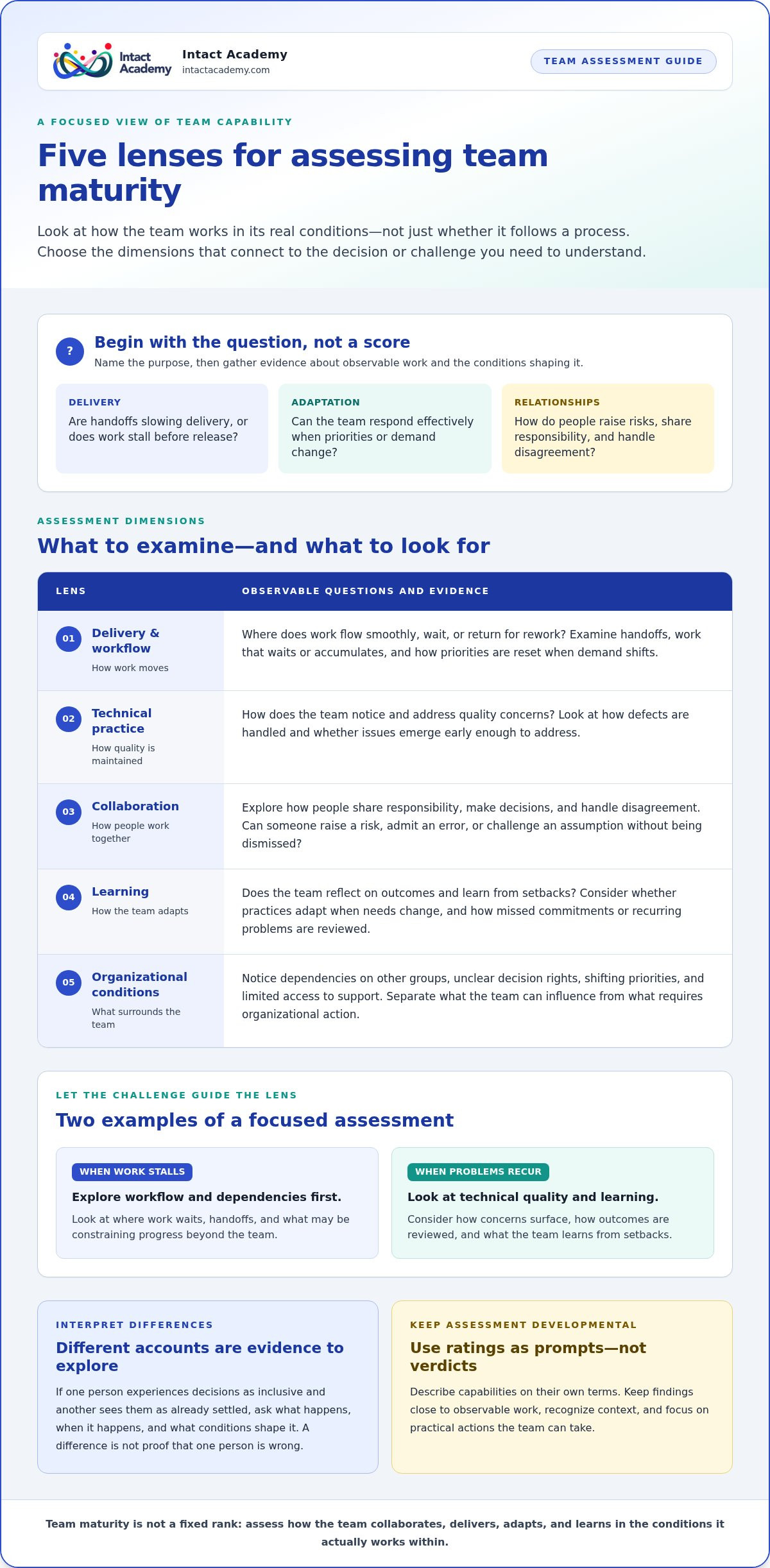
- Look across delivery, technical practice, collaboration, learning, and organizational conditions to build a focused picture.
- Use ratings as prompts for conversation, not verdicts about people or a team’s potential.
- Make assessing team maturity developmental: agree clear boundaries, examine varied evidence, and choose practical follow-up actions.
- Revisit meaningful questions over time to support learning, and use facilitation when team dynamics need deeper exploration.
Assessing Team Maturity: What the Assessment Is For
Team maturity is a team’s observable capacity to collaborate, deliver, adapt, and learn in the conditions it actually works within. It isn’t a fixed rank or a measure of how long people have worked together. Focus on what the team can do, how consistently it can do it, and what its context makes possible.
Start with a question, not a scoring model. Are handoffs slowing delivery? Does the team need to respond more effectively to changing priorities? Is there a shared concern about how people raise risks? A clear purpose helps determine which behaviours and evidence matter. Maturity models offer different ways to organize development, as the broad overview of the Maturity Model concept illustrates, but no single scale establishes a universal standard for every team.
What does team maturity mean in practice?
Look for repeatable behaviours: team members coordinate work, make decisions with relevant information, surface obstacles, and reflect on outcomes. Tenure alone doesn’t show these capabilities, and holding daily stand-ups or retrospectives doesn’t prove they’re working. Agile activity is visible; maturity also involves adapting those practices when needs change.
Capabilities can develop unevenly. A team may deliver reliably while struggling to learn from setbacks, or collaborate well internally while being constrained by slow decisions elsewhere in the organization. Describe each area on its own terms rather than compressing these differences into a single label.
Why assess a team’s maturity?
Assessment is useful when it supports a real decision, a learning need, or an improvement conversation. Without a purpose, teams can complete a model without knowing what to do with the result. With one, they can focus their inquiry: for example, whether unclear ownership is causing work to stall, or whether the team has room to adjust its process.
A shared vocabulary can help people compare experiences without turning differences into personal blame. If one person sees decisions as inclusive and another sees them as already settled, the contrast is evidence to explore, not proof of whose interpretation is right. Ask what happens, when it happens, and what conditions shape it.
Before choosing criteria, name the intended use and who will interpret the findings. Keep the discussion close to observable work, such as how priorities are reset or how a missed commitment is reviewed. Treat labels like “immature,” “advanced,” or “high-performing” with care: they can close inquiry before the team understands what is happening.
Findings have value when the team can act on them. If a concern sits outside the team’s influence, such as a decision bottleneck elsewhere, record that context rather than presenting it as a team failure. A useful assessment clarifies both the team’s current capabilities and the conditions that may support or limit development.
What to Assess: Agile Practice, Relationships, and System Context
A useful assessment looks beyond whether a team follows a process. It asks how work moves, how people coordinate, and what in the surrounding organization enables or constrains progress. The core dimensions are delivery and workflow, technical practice, collaboration, learning, and organizational conditions; which ones to examine depends on the team’s purpose, work, and current challenges. Keeping the inquiry focused helps the team notice connections instead of collecting data it can’t use.
Choose a small number of dimensions linked to the team’s question. If work repeatedly stalls before release, explore workflow and dependencies first. If delivery is steady but problems recur, look more closely at technical quality and how the team learns from outcomes.
Which agile and delivery practices are worth examining?
Examine whether practices help the team deliver value, receive useful feedback, and maintain quality. A team using Scrum might consider whether its review helps it respond to feedback; a team using Kanban might look at where work waits or accumulates. These practices matter when they reflect how the team actually operates, not simply because a model recommends them.
Ask what each practice makes possible. Does planning clarify priorities, or does it become a reporting ritual? Can the team adapt its workflow when demand shifts? Look at technical practices, too, such as how defects are handled and whether quality concerns emerge early enough to address. Framework compliance alone doesn’t demonstrate effectiveness; the evidence lies in how well practices serve the work.
How do relationships and the wider system shape maturity?
Team capability is also visible in how people share responsibility, handle disagreement, and learn together. Explore psychological safety through observable conditions rather than imposing a score: can someone raise a risk, admit an error, or challenge an assumption without being dismissed? Gather different perspectives on specific situations. A gap between accounts can point to an important pattern, not a reason to decide that one person is wrong.
Then look beyond the team boundary. Dependencies on another group, unclear decision rights, shifting priorities, or limited access to support can shape outcomes even when the team’s own practices are sound. Separate what the team can influence from what requires organizational action. This distinction prevents systemic constraints from being misread as a lack of team commitment.
- Delivery and workflow: Where does work flow smoothly, wait, or return for rework?
- Technical practice: How does the team notice and address quality concerns?
- Collaboration: How are decisions, conflict, and shared ownership experienced?
- Learning: What changes after feedback, mistakes, or completed work?
- Organizational conditions: Which dependencies or decisions sit outside the team’s control?
Use these prompts to compare observations, not to build an exhaustive checklist. For team coaches who want to deepen their ability to facilitate these conversations, the TA EMCC Senior Team Coach Academy develops team coaching practice through theory, supervised practice, reflection, and real-world application.
Interpreting Team Maturity Evidence Without Scores
Evidence can take different forms, each making some things easier to see while leaving others in the background. Descriptive accounts preserve context; scales create shared reference points; visual summaries make patterns easier to scan. None can explain a team’s experience on its own. In assessing team maturity, treat every format as a lens for inquiry, not a verdict about people, potential, or future performance.
A rating can be useful when the team understands what its anchors mean. For example, a shared scale might help members discuss how consistently they review work after delivery. But the number is only a starting point. It doesn’t tell you why people chose it, whether their examples differ, or what conditions shaped their responses.
Should teams use a maturity scale or model?
Use a model when its criteria help the team describe a capability relevant to its work. Shared anchors can make observations easier to compare, especially when terms like “consistent” or “adaptive” mean different things to different people. Before using a scale, align on what each description would look like in practice.
Don’t assume the same levels fit every team. A team with a distinct mandate, dependencies, or operating constraints may need adapted criteria. Keep the model in service of the improvement question rather than treating its categories as a universal standard the team must reach.
The formats below can complement one another, but each has limits:
| Evidence format | What it can show | What it can’t show alone |
|---|---|---|
| Descriptive evidence | Specific examples, context, and how people experience a behaviour | Whether the examples represent a recurring pattern across the team |
| Maturity scale | A shared shorthand for discussing a capability against agreed anchors | Why people chose a rating or whether their interpretations match |
| Visual summary | Areas of apparent alignment, variation, or perceived strength | The stories and conditions behind a pattern or apparent gap |
How should teams make sense of different ratings?
Invite examples before discussing averages or chart patterns. If some team members rate decision-making as clear and others rate it as inconsistent, ask when decisions feel clear, who is involved, and what happens when priorities shift. Their disagreement may reflect different roles or situations, not a lack of honesty or commitment.
Also distinguish disagreement about what happened from disagreement about what it means. Team members may agree that a concern was raised late but differ on whether that signals caution, unclear ownership, or limited time to respond. Explore both the observation and its interpretation. A facilitated conversation can help people stay curious about these differences instead of rushing to consensus.
Record the pattern without flattening it: note strengths the team wants to preserve, tensions that need exploration, and unanswered questions requiring more evidence. If a numeric summary is useful, keep it alongside these notes. A rating should open a conversation; the team’s examples and context give it depth.
How to Run a Team Maturity Assessment and Turn It Into Action
A sound assessment is a structured conversation with a clear boundary: it supports team development, not individual performance ratings. Agree this distinction before gathering input, especially if findings will be shared beyond the team. People need to understand how evidence will be used and what decisions it can inform. Without that clarity, an assessment can feel like evaluation rather than an opportunity to learn.
What are the steps in a useful assessment?
Keep the process proportionate to the question. This sequence helps teams move from purpose to evidence, then from insight to a follow-up they can review:
- Agree the purpose and scope. Name the question the assessment should help answer, who will take part, and how findings will be used. Clarify that the focus is team patterns and conditions, not judging individual capability.
- Choose a fit-for-purpose way to gather evidence. Use focused reflection prompts, a facilitated discussion, or a questionnaire suited to the question. Ask about observable situations, such as how the team handles a changed priority or raises delivery risks.
- Review observations together. Look for recurring patterns, exceptions, and contrasting experiences. Invite examples before drawing conclusions. If accounts differ, explore the circumstances behind each one instead of forcing agreement too quickly.
- Select a small number of priorities. Choose issues the team can influence and identify constraints that need organizational attention. Distinguish a team-owned change from a dependency that requires another decision-maker or group.
- Agree an experiment and review point. Define what the team will try, who will help keep it in view, and what observable evidence might show whether it is useful. Set a time to reflect and adjust, rather than treating the first action as a permanent solution.
Assessment findings should lead to owned, observable experiments that help the team learn what changes in practice. For example, if handoffs are often unclear, the team might test a brief ownership check at a relevant point in its workflow, then review whether responsibilities are easier to understand.
How can teams keep the conversation constructive?
Use neutral prompts about behaviour and conditions. Ask, “What happens when someone raises a concern?” rather than, “Are people committed?” Make space for quieter or minority views, and invite examples that challenge an emerging consensus. Those accounts may reveal that a practice works in one situation but not another, a distinction a quick vote can miss.
In assessing team maturity, keep responsibility visible at the right level. The team may be able to change how it shares information, while a delay caused by an external approval process needs organizational attention. Name both without blaming either group. When teams need support holding complex or emotionally charged conversations, skilled facilitation can help make differences discussable. Intact Academy’s team coach development supports coaches who want to build their practice in this area.
From Assessment to Team Development: Build Learning Capacity
An assessment becomes more useful when it opens a learning cycle rather than closing with a score. Revisit the question that prompted the inquiry: what has changed in the team’s work, what remains difficult, and what new conditions have emerged? Look at concrete experiences alongside any ratings. A team might ask whether a change to how it handles handoffs has made ownership clearer, then adjust its approach based on what members notice.
Recurring assessment supports development when it makes room for reflection, not when it repeats the same checklist by habit. Keep what the team has learned, let go of measures that no longer serve the question, and notice whether a development priority is within the team’s influence. Team-owned action might involve changing a meeting practice or clarifying how decisions are shared. A dependency on another group or a wider organizational constraint may call for a different conversation.
When can team coaching support the next stage?
Coaching or skilled facilitation may help when the same pattern returns despite team efforts, tension remains difficult to discuss, or a key dependency sits beyond the team’s control. A coach can help members examine how their interactions shape the pattern, hear perspectives that might otherwise be missed, and explore how the wider system contributes. This creates space for clearer inquiry, not a promise of a particular performance outcome.
Assessing team maturity can inform this work, but the team’s lived experience needs thoughtful interpretation. Coaching support doesn’t replace the team’s responsibility for its choices. It can help members stay curious about difficult dynamics, distinguish what they can change from what they can influence, and turn reflection into deliberate practice.
How does Intact Academy develop team coaching practice?
Intact Academy combines pragmatic theory with techniques, supervised practice, reflection, and real-world application. Coaches can bring ideas into practice, examine what happens in the room, and learn from the complexity of actual team work. The focus is not on applying a formula, but on developing judgement that responds to the people and system in front of the coach.
Over the last 40 years we have trained more than 3600+ participants in 14 different countries. Programs are EMCC accredited at senior coach level, provide ICF CCE accreditation, and lead to TA accreditation.
For coaches who want to deepen their capacity to support teams through assessment and development, the TA EMCC Senior Team Coach Academy offers a relevant next step. Its training approach connects theory, supervised practice, reflection, and real-world application.
Let the Next Conversation Begin With Curiosity
The next step doesn’t need to be a sweeping change. Choose one question the team is willing to stay with, then use what you learn to shape a small, meaningful action. Over time, this practice can help the team respond to its real conditions with greater awareness and shared responsibility. That is the deeper value of assessing team maturity: not arriving at a final label, but growing the capacity to keep learning together.
For coaches who want to strengthen their ability to support this work, the TA EMCC Senior Team Coach Academy connects theory with supervised practice, reflection, and real-world application. Explore the TA EMCC Senior Team Coach Academy and consider how developing your coaching practice could help teams make space for more honest, useful conversations.
Progress begins when a team can look at its patterns with openness and take its next step with intention. Start there, and let learning build from the work itself.
Frequently Asked Questions
How often should a team assess its maturity?
Assess team maturity when there’s a reason to learn, such as a substantial change in the team’s remit, membership, or working environment. A regular review can help teams reflect, but repeating the same questionnaire on a fixed schedule may create activity without insight. Agree what the team wants to understand, then revisit that question after it has had time to work with relevant changes. The right interval depends on the purpose and pace of change.
Who should take part in a team maturity assessment?
Include the people who do the team’s day-to-day work and understand how it depends on others. Depending on the question, that might mean including a product owner, delivery partner, or decision-maker who works closely with the team. Be clear about each person’s role: some may contribute observations, while others help interpret conditions or remove barriers. If membership has recently changed, note whose experience the findings reflect and whose perspective may be missing.
Should team maturity assessments be anonymous?
Anonymity can help people share candid views, particularly where there’s a power difference or concern about repercussions. It’s not automatically the best choice: in a small team, comments may be recognizable, and anonymous responses can make it harder to clarify what someone meant. Explain how responses will be handled before collecting them. A team might gather private input first, then discuss themes without attributing comments, while agreeing clear boundaries for confidentiality.
Can you compare maturity scores across different teams?
Compare scores across teams cautiously. A similar number may reflect different definitions, work, constraints, or respondent groups, so it doesn’t necessarily mean the teams have equivalent capabilities. If comparison is needed for planning, first establish that the teams used the same criteria and understood the rating anchors consistently. Use the result to identify questions for further exploration, not to rank teams or make decisions about individuals based on a score alone.
Is team maturity the same as agile maturity?
No. Agile maturity is one lens that focuses on how a team applies agile principles and practices. Team maturity can also include capabilities that aren’t specific to agile, such as how people share responsibility, learn from experience, or respond to organizational constraints. A team may use agile methods without developing every capability relevant to its goals. Choose the lens that fits the question rather than assuming agile terminology describes the whole team.
What should a team do if an assessment reveals problems beyond its control?
Make the constraint visible and describe its impact in concrete terms. For example, note which work is delayed by an external approval, what decisions the team can’t make, and how that affects its commitments. Bring the issue, supporting examples, and a clear request to the person or group with authority to act. Meanwhile, agree what the team can do within its own remit, and set a point to review whether the dependency has changed.


