

What if a remote team’s biggest challenge isn’t distance, but the patterns that distance makes harder to see? Team coaching for remote teams can help bring those patterns into view: who gets heard, how decisions take shape, and what happens when time zones or cultural contexts give a message different meanings. More calls may create more contact, but they don’t automatically create connection.
If informal conversations have faded and misunderstandings are harder to repair, that tension is real. The right approach depends on what the team needs: clearer agreements, space to reflect together, or a deeper look at how relationships and ways of working affect collective performance. Team coaching is distinct from group facilitation or individual coaching delivered to several people; it develops an intact team’s shared capability over time.
This article compares approaches to remote team coaching and shows how to choose one that fits your team’s situation, supports participation across different working patterns, and strengthens connection as well as effectiveness. It also considers how practitioners can deepen their capability through the TA EMCC Senior Team Coach Academy, with supervised practice, real-world application and reflection.
Key Takeaways
- Team coaching for remote teams can help uncover how shared relationships, goals and interaction patterns shape the way work gets done.
- Use a systemic lens to consider the team’s purpose, stakeholders and context, without reducing challenges to individual shortcomings.
- Choose between team coaching, leader coaching and facilitation by clarifying whether the need is collective development, a leader’s growth or support for a specific group process.
- Design coaching around real working conditions, with clear agreements, a shared focus and participation options that suit different schedules.
- Explore how supervised practice, real-world application and reflection can support the development of team-coaching capability.
Why team coaching for remote teams must address more than screen-time fatigue
A full calendar of video calls can create the appearance of closeness while leaving important questions untouched. Who feels able to disagree? How are decisions made when some colleagues are offline? What assumptions grow in the gaps between messages? Team coaching for remote teams works with these shared relationships, goals and interaction patterns, rather than treating tiredness from screen time as the whole problem.
It differs from individual coaching delivered over video. Individual coaching centres one person’s development; team coaching engages the team as a collective, supporting it to observe how its members work together and how those patterns affect its purpose. The focus is not on diagnosing individuals, but on making the system’s habits more visible and open to change.
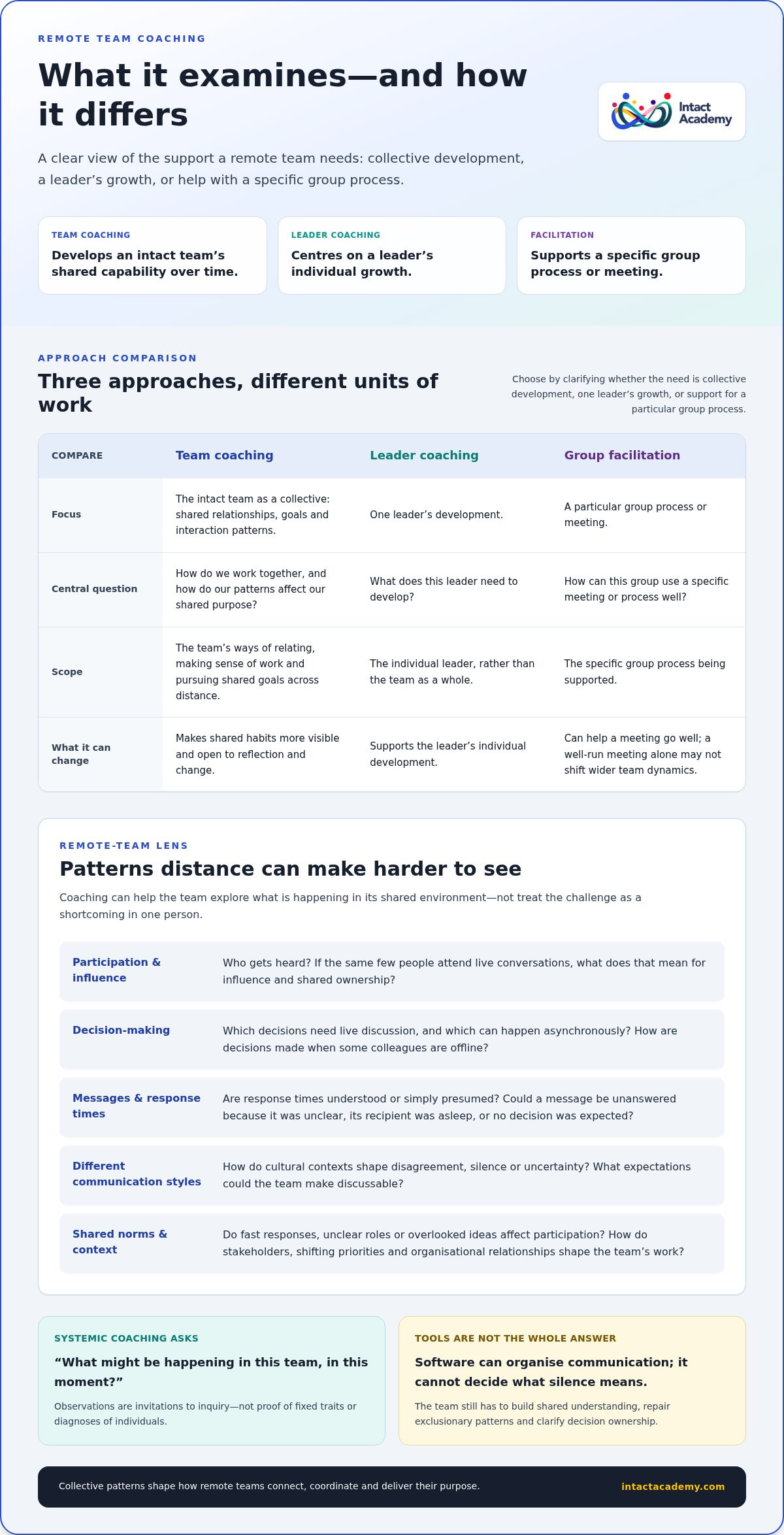
Remote team coaching develops how an intact team relates, makes sense of its work and pursues shared goals across distance; virtual meeting facilitation helps a group use a particular meeting well. Facilitation can be valuable, but a well-run meeting alone doesn’t necessarily shift the dynamics that shape the next one.
Which remote-team challenges can coaching help a team examine?
Distance changes what the team can readily notice. In a shared office, a quick pause or a colleague’s expression may prompt someone to clarify a point. Online, a short message may go unanswered because its meaning was unclear, its recipient was asleep, or a decision wasn’t expected. Without conversation, people can fill in the gaps with assumptions.
Coaching can help the team examine practical questions: Are response times understood, or simply presumed? Which decisions need a live discussion, and which can happen asynchronously? Do colleagues in different time zones have a fair opportunity to contribute before a decision is settled? If the same few people attend every live conversation, the team can explore what this means for influence and shared ownership.
Cultural differences also shape how people express disagreement, interpret silence or signal uncertainty. A systemic approach treats these as differences to understand together, not deficits located in particular individuals. The team can make its expectations discussable and develop working agreements that respect varied communication styles.
Why connection is a team-system question, not only a wellbeing issue
Isolation and fatigue matter, but they don’t sit apart from the team’s way of working. Someone’s reluctance to speak may connect to a norm of moving quickly, unclear roles, or a history of ideas being overlooked. The useful question is not only “How is each person feeling?” but also “What in our shared environment makes it easier or harder to participate?”
That wider view matters because individual experience and collective patterns influence one another. If the team rewards rapid responses, people may feel pressure to stay constantly available. If disagreement is treated as disruption, important concerns may move into private chats instead of informing shared decisions. Examining these norms can open a path toward stronger trust and belonging.
New software can make communication easier to organise, but it can’t decide what silence means, repair a pattern of exclusion, or clarify who owns a decision. Tools support the work; the team still has to build shared understanding. That is why connection is not just a wellbeing concern. It is part of how the team relates, coordinates and delivers its purpose.
How systemic team coaching works when colleagues are geographically apart
A systemic lens looks beyond the team’s immediate conversations to the relationships and conditions shaping its work. The coach explores the team’s purpose, its stakeholders, its internal relationships and the wider organisational context. For a distributed team, that might include how decisions made in one region affect colleagues elsewhere, or how shifting priorities from leadership shape collaboration across functions.
Systemic team coaching helps a remote team notice how its relationships, purpose and wider context shape collective work, then reflect and act on those patterns together. The coach doesn’t diagnose individuals or assume that a quiet participant lacks confidence. Instead, they treat what they observe as an invitation to inquiry: what might be happening in this team, in this moment?
What the coach pays attention to beyond the video call
The coach notices recurring patterns in who contributes, how decisions form and what happens when people disagree. For instance, if ideas raised asynchronously are often absent from live decisions, the team can explore how its process gives different contributions weight. Observations are offered as questions, not proof of fixed traits: “What do you notice about whose views shape this decision?”
The wider context matters, too. Stakeholders may set competing expectations, or teams in different parts of an organisation may depend on one another without clear agreements. A coach can help the team examine these relationships and consider how its choices affect the people it serves. This keeps the work connected to real organisational conditions, rather than treating every challenge as an issue within the team alone.
How trust and shared responsibility can develop across distance
Trust grows through repeated experiences of clarity and follow-through, not simply through more screen time. A team can make its expectations explicit: how quickly a response is needed, where decisions are recorded, and how colleagues can raise concerns when they can’t attend a live discussion. These agreements reduce the space for untested assumptions and help distribute responsibility for keeping work moving.
Contracting gives the coaching work a purposeful container. The coach and team clarify what the team wants to examine, whose perspectives need to be included and how progress will be reflected on. As the work unfolds, the team can review what has shifted and whether its focus still serves its purpose. Reflection matters because a new agreement is only useful if the team can notice its effect and adapt it.
Psychological safety supports candid contribution and respectful challenge: people can raise a concern, question an assumption or offer a different view without being reduced to that moment. It doesn’t mean avoiding tension. It means the team can stay curious about tension and use it to learn. For coaches looking to deepen their practice, Intact Academy’s team-coaching development offers a professional pathway grounded in supervised practice, real-world application and reflection.
Team coaching, leader coaching or facilitation: which fits a remote team?
The right format depends on the question the team needs to work on, its context and the depth of change it hopes to make. Is the challenge about one leader’s choices, a shared pattern across colleagues, or a defined task that needs a well-held conversation? Choosing with care helps the team use its time and attention where they can make a difference.
| Approach | Purpose | Primary focus | Participants | Suitable situations |
|---|---|---|---|---|
| Team coaching | Develop the team’s collective capability over time | Shared goals, relationships, roles and recurring dynamics | The intact team, with its leader as a member or participant | Repeated misunderstandings, unresolved agreements or patterns affecting joint work |
| Leader coaching | Support a leader’s development and decision-making | The leader’s perspective, choices and impact | The leader and coach | A leadership transition or a question the leader needs space to explore individually |
| Facilitation | Help a group complete a defined conversation or task | Structure, participation and progress toward an agreed outcome | People involved in the meeting or working session | Planning, reviewing a decision or working through a specific agenda |
When remote team coaching is a better fit than one-to-one coaching
Look at where the difficulty lives. If colleagues repeatedly interpret the same agreement differently, or decisions stall because responsibilities are unclear, the issue may sit in shared working patterns. Team coaching for remote teams can give the group a way to examine these dynamics together and develop collective responsibility for changing them.
By contrast, if a leader is considering how to respond to a particular challenge, or wants to explore their own leadership impact before bringing an issue to the team, one-to-one coaching may be a better fit. Neither format is inherently superior. Sometimes individual reflection helps a leader prepare for a team conversation; sometimes the team itself needs to work on what happens between its members.
When a facilitated session can help, and where its scope differs
Facilitation can be useful when the team has a clear task: for example, setting priorities, reviewing a project or agreeing a decision-making process. A facilitator supports the structure of that conversation so participants can contribute and work toward its purpose. The session may produce a helpful decision or agreement.
Its scope is usually the defined event. If the same tensions or interaction patterns keep returning across meetings, a single facilitated session may not provide the ongoing reflection needed to understand them. Coaching offers space to notice those patterns over time, explore their effects and review how the team is responding. In some situations, facilitation and coaching can complement one another: a structured session addresses an immediate task, while longer-term team development engages the recurring relationships underneath it.
How to design remote team coaching around real working conditions
A useful coaching process fits the team’s actual work, not an idealised calendar. Before choosing a platform or setting recurring calls, consider who can participate, what the team needs to examine, and how learning will carry into everyday collaboration. The sequence below gives the work structure while leaving room to adapt as the team learns.
Remote session design supports equitable participation when people can contribute in ways that fit their time zones, access needs and communication preferences. Live conversation may suit one purpose; thoughtful asynchronous input may suit another. Neither needs to be the default for every part of the work.
- Contract the work. Clarify the purpose, who is involved, how the sponsor relates to the coaching, and what information may be shared. Agree how the team will handle sensitive topics and differences of opinion, and identify useful signs of progress.
- Map the context. Understand the team’s responsibilities, dependencies, stakeholder relationships and working rhythms. Note time-zone differences, accessibility considerations and communication preferences that may affect participation.
- Agree the focus. Choose a meaningful question the team can work on together, such as how decisions are made across locations or how commitments are followed through. Keep the focus connected to the team’s purpose.
- Coach the team. Use sessions to explore what is happening in the team’s work, what assumptions or patterns may be influencing it, and what alternative responses are possible. Select live or asynchronous methods to fit the question.
- Reflect between sessions. Invite brief observations linked to the agreed focus. For example, team members might note when a decision felt clear, or whose perspective was missing from a discussion.
- Review and adapt. Return to the team’s signs of progress, notice what is changing and what remains difficult, then revise the focus or participation agreements as needed.
Contracting for outcomes, roles and confidentiality
Contracting creates clarity about the work and its boundaries. The team, coach and sponsor can establish what the coaching is for, what sits outside its scope, and how progress will be considered without reducing development to a single metric. They should also agree how confidential material is handled and what happens if a participant raises a concern. Clear coaching agreements and contracting help create a reliable foundation for candid exploration.
Keeping participation meaningful between coaching sessions
Between sessions, use short prompts that connect directly to the team’s chosen focus, rather than adding activity for its own sake. A shared written reflection may work well across time zones; a brief live check-in may suit a team with overlapping hours. Review who is contributing and through which channels with curiosity. Lower visibility doesn’t necessarily mean lower commitment, so use participation patterns as a question to explore, not a verdict.
Coaches developing their ability to work thoughtfully with these dynamics can explore Intact Academy’s TA EMCC Senior Team Coach Academy, which includes supervised practice, real-world application and reflection.
Building remote team-coaching capability with Intact Academy
Supporting a team across distance calls for more than confidence with online tools. Coaches need to work with the relationships, purpose and organisational context shaping the team, while staying attentive to how their own interventions affect the system. For practitioners who want to develop this capability, Intact Academy’s TA EMCC Senior Team Coach Academy offers a relevant professional development pathway.
The work of team coaching for remote teams can involve complex questions: whose perspective influences a decision, how the team responds to disagreement, and how its wider organisational environment shapes collaboration. Training can help practitioners deepen their capacity to hold these questions without rushing toward a simple explanation or solution.
What practitioners can develop through deeper team-coach training
Systemic awareness means attending to the team and its context together: its relationships, purpose, stakeholders and patterns of interaction. Practitioners can build on that awareness by connecting theory with practical work, then reflecting on what they notice and how they respond. This integration matters because a coaching intervention that seems helpful in one moment may have a different effect across the team or organisation.
Intact Academy’s training includes supervised practice, real-world application and reflection. These elements give practitioners ways to bring their work into view, consider it with others and learn from experience. The emphasis is on developing the practitioner’s capability, not promising a particular outcome for a client team.
Intact Academy’s programs are accredited at EMCC senior coach level and provide ICF CCE accreditation, as well as TA accreditation. Over the last 40 years, we have trained more than 3600+ participants in 14 different countries. That experience informs a professional learning environment for coaches, consultants and organisational practitioners who want to strengthen their work with teams.
Explore a systemic team-coaching development route
As you consider a development pathway, reflect on the teams and contexts you work with. Do you want to become more attentive to recurring relational patterns, hold complexity without fixing blame, or connect team dynamics with organisational purpose? These questions can help you clarify what you want to deepen through further learning.
The TA EMCC Senior Team Coach Academy is one route for developing this practice through supervised reflection and application. If you’re a coach, consultant or organisational practitioner considering your next step, explore Intact Academy’s team-coaching programs or arrange a business conversation to consider your development needs.
Take the next step toward more connected teamwork
Connection across distance isn’t a one-time achievement. It grows as a team learns to notice its own habits, make room for different perspectives and choose how it wants to work together. The next step doesn’t need to be a sweeping redesign. Begin with a question the team genuinely wants to explore, then consider what kind of support would help that inquiry become shared learning.
For practitioners, team coaching for remote teams invites ongoing attention to the relationship between people, purpose and context. It asks you to stay curious about what is emerging, rather than assume that a familiar technique will fit every team. That steadiness can help create space for teams to find more genuine ways of relating and working across distance.
If you’re ready to deepen your practice, explore Intact Academy’s team-coach development. Consider how further learning could strengthen your ability to accompany teams through complexity with reflection, care and professional grounding. Each thoughtful step can help make connection part of how the team works, not just something it hopes to feel.
Frequently Asked Questions
Can team coaching for remote teams be as effective as in-person coaching?
It can support meaningful reflection, but the medium alone doesn’t determine what the team gains. The purpose of the work, the quality of participation and the relationships involved all matter. For example, a team might use an online session to examine a recurring handoff issue, then agree how to communicate and review whether the change helps. Set shared expectations for contributing and follow-up, and revisit the design as the work develops.
How do you include quieter voices in remote team coaching?
Offer more than one way to contribute, such as a pause for reflection, written input before discussion or structured turn-taking during a session. The coach can invite a view without requiring personal disclosure; silence alone doesn’t show whether someone is disengaged. Agree participation norms with the team, then adapt them for cultural preferences, accessibility needs and time zones. A person might contribute most clearly in writing rather than in a fast-moving conversation.
What happens if a remote team has members across several time zones?
Start by acknowledging how meeting times affect access and influence, then agree fair ways for people to contribute. A team might rotate live-session times and invite written reflections from members who can’t attend a particular discussion. Asynchronous input can complement shared sessions when it suits the team’s purpose. Review the arrangement periodically: consider whose contributions are shaping decisions and whether the current pattern gives everyone a workable opportunity to participate.
How can a remote team coach work with conflict online?
A coach can slow the exchange and help participants distinguish what they observed from the meaning they assigned to it. For instance, the team might examine how a delayed response was interpreted and what effect that interpretation had on collaboration. Agree on respectful ways to challenge ideas, pause a conversation or return to an unresolved issue. Online coaching can create space for inquiry, but it doesn’t resolve every conflict or replace relevant organisational processes.
How can a team know whether remote coaching is helping?
Return to the aims agreed at the outset and look for observable changes in how the team works. Has a handoff become clearer? Are decisions easier to revisit, or are commitments followed through more consistently? Progress might also show up as more candid discussion or shared responsibility, not just in numerical measures. The team and sponsor can review examples together, note what remains difficult and decide whether the coaching focus still fits.
Does a remote team coach need specialist team-coaching training?
Working with a team as a system calls for capabilities beyond delivering individual coaching sessions online. Relevant areas include contracting with the team and sponsor, understanding group dynamics, attending to organisational context and reflecting on the effects of an intervention. Professional development can help practitioners examine and strengthen these skills. No single credential should be assumed to fit every situation, and training itself doesn’t guarantee a particular result for a team.
Can remote team coaching include both live sessions and work between sessions?
Yes, the design can combine live conversation with reflection or application between meetings, depending on the team’s aims and working conditions. For example, colleagues might try a new decision practice in their day-to-day work, then bring observations to a later discussion. Agree what participation and follow-up involve so the between-session work feels purposeful, not like extra activity. There’s no standard frequency or format; choose what fits the team’s context.


