

What if the feedback a senior executive most needs is also the hardest to say aloud? When status and influence are in the room, even a well-intended message can feel politically risky, sound accusatory, or become so cautious that its meaning disappears. Learning how to give feedback to senior executives starts with recognising that tension, not pretending the power difference isn’t there.
Clear feedback doesn’t require bluntness or certainty about someone’s intentions. It means separating observable behaviour from its impact, then inviting reflection rather than passing judgment. This guide will help you prepare a specific, evidence-based message, deliver it respectfully and confidently, and open a constructive conversation about shared understanding and next steps. You’ll also learn to account for organisational context and interaction patterns, so the conversation supports change without reducing a complex situation to a personal flaw.
Key Takeaways
- Recognise how hierarchy can affect what feels safe to say and how a message may be received.
- Prepare feedback by separating what you observed, its impact, your interpretation, and an invitation to discuss it.
- Use a concise conversation structure to keep feedback focused on shared purpose and observable actions.
- When an executive disagrees, listen and clarify; return calmly to the evidence without insisting on your interpretation.
- Learn how to give feedback to senior executives while also noticing the relationship and organisational patterns that shape the conversation.
Why giving feedback to senior executives feels different
An observation that feels routine between peers can carry more weight when it’s directed upward. A senior executive may influence priorities, resources, and career opportunities, so you may weigh the value of speaking against the risk of being misunderstood or damaging trust. That hesitation is understandable. It doesn’t mean the feedback is inappropriate; it means the relationship and its power dynamics deserve thoughtful attention.
Status can also change how the same words are heard. A brief comment from a colleague might sound collaborative, while the same sentence from someone with decision-making authority could feel like a judgment or instruction. The reverse is true, too: a junior person’s tentative concern may be easy to overlook, even when it points to an issue affecting the wider team. The aim isn’t to correct or manage the executive. It’s to improve shared work by making relevant information discussable.
Keep your focus on conduct and its effects, not assumed character or intent. “You don’t respect the team” makes a broad judgment. “In Tuesday’s planning meeting, the discussion moved on before two colleagues had finished; we didn’t hear their concerns about the timeline” describes an observable moment and a possible work impact. This distinction reflects the Corrective Feedback Principles, which describe feedback as specific and supportive rather than a verdict on a person.
What makes upward feedback feel risky?
You might worry that your credibility will be questioned, trust will suffer, or your words will be taken differently than you intended. Those concerns call for care, not alarm. Excessive deference, however, can leave a consequential pattern unspoken. Respect doesn’t require disguising the message; it means being candid without turning directness into accusation. Bluntness can shut down reflection, while a grounded observation leaves room for the executive to respond.
When is feedback worth raising?
Before raising a concern, ask whether there’s another action you can take or whether the issue is substantially shaped by the executive’s behaviour. Then consider recurrence, impact, and timing. A single tense exchange may be a passing frustration; repeated interruptions that prevent relevant risks from being heard may affect decisions and outcomes. You don’t need absolute certainty to raise a concern, but you do need a reason beyond immediate irritation.
- Recurrence: Was this isolated, or have you observed a similar interaction more than once?
- Impact: Did it affect participation, a decision, a working relationship, or delivery?
- Timing: Can the conversation happen privately and with enough space to consider the issue?
If the concern is important enough to raise, bring forward the clearest example and explain why it matters to the work. If it isn’t, consider what you can address directly or what further context you need. This discernment is part of how to give feedback to senior executives with both courage and proportion: neither suppressing useful insight nor treating every moment of discomfort as a pattern.
How to prepare feedback for a senior executive
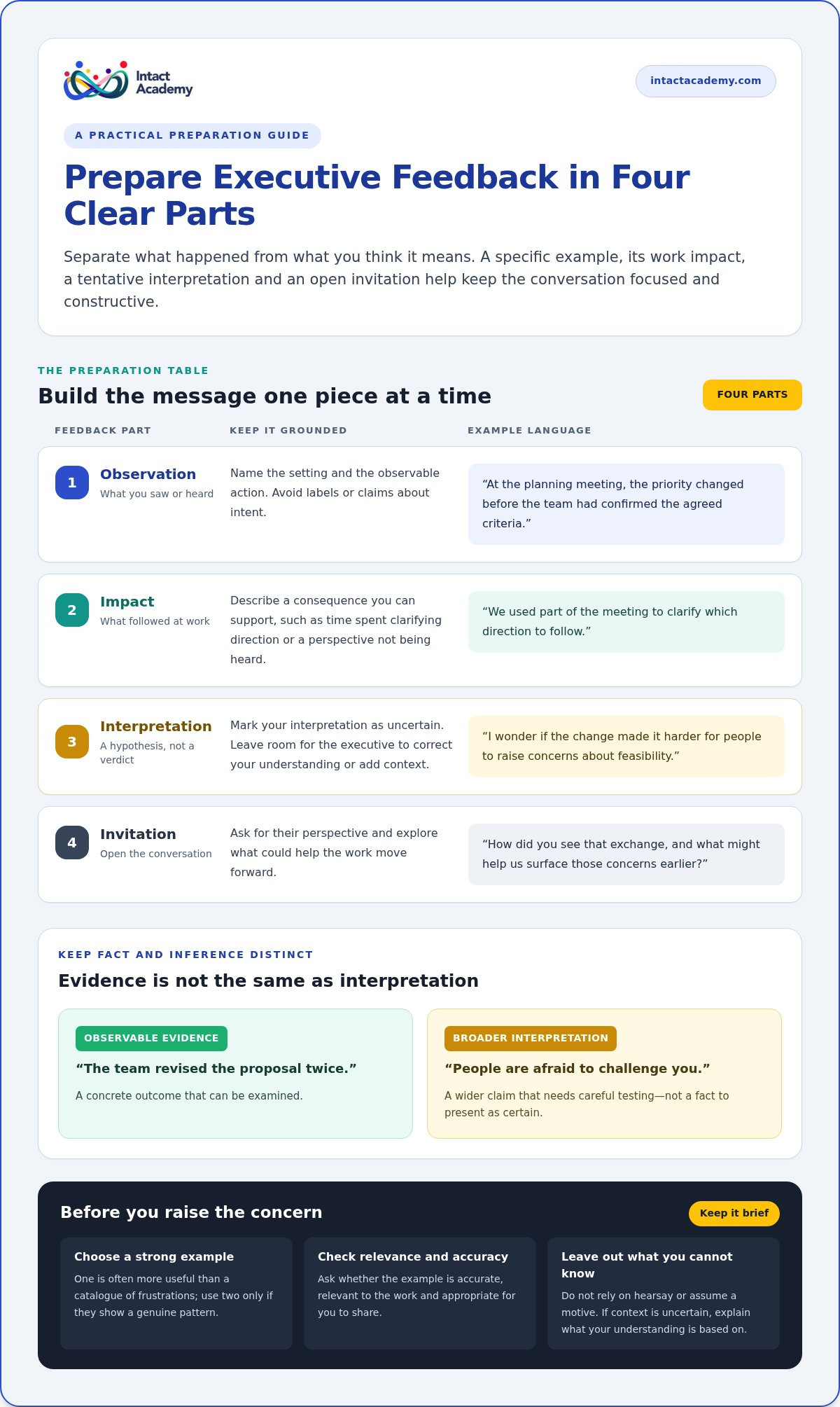
Preparation helps you raise a concern without presenting your interpretation as fact. Before the conversation, organise your thinking into four parts: observation, impact, interpretation, and invitation. This gives the executive something concrete to consider and leaves room for you to be both clear and curious.
Constructive feedback is specific information about an observable action, its impact, and a useful next step. This shifts the focus from judging a person to examining what happened and what might help the work move forward. Keep your preparation brief: one strong example, or two if they show a genuine pattern, is usually more useful than a catalogue of frustrations.
Turn a concern into an observable example
Start with the setting, the action you saw or heard, and what followed. For instance: “In the project review on Thursday, the team was asked to revise its recommendation before the criteria were settled. The group spent the next discussion clarifying which version to use.” This describes a sequence without claiming the executive intended to create confusion.
Replace labels such as “controlling” or “difficult” with details another observer could recognise. Then check your example: Is it accurate? Is it relevant to the work? Is it appropriate for you to share? If the account depends on hearsay or a motive you can’t know, leave that part out or explain where your understanding comes from. Precision helps keep the conversation from becoming a debate about character.
Connect individual behaviour to organisational impact
Next, name an impact you can support. Did the team spend time resolving competing instructions? Was a decision delayed, or did a key perspective go unheard? Distinguish what you observed from what you infer. “The team revised the proposal twice” is evidence; “people are afraid to challenge you” is a broader interpretation that needs careful testing.
Use the four parts to prepare a short account:
- Observation: “At the planning meeting, the priority changed before the team had confirmed the agreed criteria.”
- Impact: “We used part of the meeting to clarify which direction to follow.”
- Interpretation: “I wonder if the change made it harder for people to raise concerns about feasibility.”
- Invitation: “How did you see that exchange, and what might help us surface those concerns earlier?”
The interpretation is a hypothesis, not a conclusion. Leave room for the executive to correct your understanding or add context. A systemic lens can also help you consider how roles, expectations, and repeated interactions shape what happens, rather than locating the whole issue in one person. Transactional Analysis can help practitioners notice interaction patterns without turning them into labels.
Preparing this way supports how to give feedback to senior executives with proportion: clear enough to be useful, open enough to invite reflection. For practitioners developing this capacity through reflection and practice, Intact Academy’s executive coaching offers a related learning context.
Delivering Clear and Respectful Executive Feedback
Once you’ve prepared the substance, give the conversation a simple shape: shared purpose, specific observation, impact, and an open question. This keeps the discussion anchored in the work rather than assumptions about the executive’s character or intentions. One useful distinction is: A behavioural observation describes what someone did; a character judgment claims who they are.
Choose a private setting where neither of you is rushing into another meeting. Avoid raising sensitive feedback in front of colleagues, where the executive may feel exposed and others may feel drawn into the exchange. Protecting dignity doesn’t mean softening the point until it disappears. It means being direct in a setting that gives both people room to think.
A practical opening and feedback script
Start with the outcome you share, then ask whether the timing works for a candid observation. Keep the example brief, state its effect, and pause. The pause gives the executive time to respond instead of requiring you to fill the space with further explanation.
You might say: “I want us to make clear decisions the team can act on. Is now a suitable time for a candid observation? In yesterday’s review, the priority changed after the team had begun assigning work. We then had to revisit responsibilities. I may be missing some context, but I wonder how we could make changes clearer as they happen. How did that moment look from your perspective?”
This wording is direct without treating your interpretation as settled fact. If the executive adds context, listen before you clarify. If they ask for more detail, return to the example rather than introducing unrelated concerns. One focused conversation is easier to engage with than a list of past frustrations.
Adapt the message to the situation
The core sequence stays steady, but the impact you name should fit the issue. Describe what happened in the work, then ask a question that invites joint problem-solving. For example:
- Unclear priorities: “The team received two different priorities for the same period, so we weren’t sure which work to advance first. Could we clarify how to resolve that conflict?”
- Changing decisions: “After the decision changed, the teams coordinating delivery were working from different versions. What would help us communicate changes consistently?”
- Limited guidance: “We haven’t yet agreed who will make the final call on this issue, so the team has paused the next step. What guidance would help us move forward?”
Use only impacts you can describe honestly. If you’re unsure whether the effect is shared or how the executive understands the situation, frame it as a question, not a conclusion. Practising this balance can build confidence in how to give feedback to senior executives. Reflective executive coaching can also provide space to develop this skill in relation to real workplace dynamics; executive coaching development is one avenue for that learning.
Handling Executive Reactions or Disagreements
A senior executive may respond with curiosity, silence, defensiveness, or a different account of events. You don’t need immediate agreement for the conversation to be useful. Listen for what they understood, acknowledge relevant context, and clarify where your perspectives differ. The aim isn’t to win a case; it’s to understand the work and the relationship more clearly.
A difficult reaction doesn’t prove your feedback was inaccurate, just as a calm response doesn’t prove it was accepted. Stay with what you can substantiate. Avoid escalating the exchange or diagnosing motives, such as deciding the executive is dismissive or unwilling to change. Keep the distinction clear between shared evidence, your interpretation, and the impact you experienced.
If the executive becomes defensive
Pause and slow the conversation. If the executive says, “That’s not what happened,” don’t intensify the argument by repeating your point more forcefully. You could respond, “I hear that you remember it differently. I’m trying to describe how the change landed for the team, not assume why you made it.” If the conversation stops being productive, suggest a pause and agree when to return to it.
Acknowledging their response isn’t the same as withdrawing your concern. You might say, “I can see you were working with information I didn’t have,” then clarify which part remains important to you: “The team still left without knowing which deadline to prioritise.” This keeps the exchange respectful while bringing attention back to the consequence. A brief pause can help both people respond thoughtfully.
If the executive disagrees with the feedback
Ask what context you may be missing before defending your interpretation. Perhaps the decision had already been communicated elsewhere, or the executive understood the discussion differently. Separate what you both agree occurred from the meaning each of you gives it. You can acknowledge a difference in perspective without forcing a resolution in the moment.
For example: “We agree the deadline changed during the meeting. I understood that the team left unsure which work took priority; what did you observe?” If the impact remains uncertain, agree what to notice next time. That could mean checking whether responsibilities are clear after a decision or asking the team what information they still need. Keep this proportionate and focused on the work, rather than turning the conversation into surveillance.
Before closing, establish a practical follow-through: agree on an action, clarify who owns it, and decide when it makes sense to revisit the outcome. If no action is agreed, name that plainly and consider what you can do within your own role. This makes how to give feedback to senior executives a continuing practice of reflection, not a single high-stakes exchange.
Build your capacity to work with feedback, reflection, and relationship dynamics through Intact Academy’s executive coaching development.
Building a Systemic Approach to Executive Feedback
A feedback conversation can reveal more than an individual interaction. If the same friction appears across decisions, teams, or stakeholder relationships, look at the conditions around it as well as the behaviour itself. Are responsibilities unclear? Do different groups hold competing expectations? Does the executive’s role reward speed in a way that leaves less space for challenge? These questions widen the lens without excusing impact or assuming a cause.
Look beyond the individual interaction
Notice whether a concern recurs, and where. A delayed decision in one meeting may be an isolated moment; similar delays across teams could point to unclear decision rights or a communication gap. Treat that as a possibility to explore, not proof of a fixed pattern or a diagnosis of the executive. Stay close to what you’ve observed, and remain open to context that changes your understanding.
After a conversation, reflect on both sides of the interaction. What did you notice? How did you respond? What changed in the work, if anything? Reviewing the exchange helps distinguish a repeated organisational dynamic from a single disagreement. It can also show where your own role, assumptions, or communication choices shaped the conversation. A systemic perspective considers relationships, roles, and conditions alongside behaviour.
Over time, steadier feedback comes from practice rather than a perfect script. Before a conversation, rehearse the opening and check that your example is fair. Afterwards, reflect on what you learned, including what you might phrase differently next time. For professionals developing coaching capability, supervised practice offers a setting to examine real interactions, test assumptions, and build confidence while staying attentive to the people and system involved.
Develop feedback capability through practice
Intact Academy’s teaching brings theory together with practical application, supervised practice, and reflection. This supports learning that can be considered, tried, and refined, rather than relying on one formula for every executive or organisation. Over the last 40 years, more than 3600+ participants in 14 different countries have taken part in its training. Programs are accredited at EMCC senior coach level, provide ICF CCE accreditation, and lead to TA accreditation.
For those developing coaching expertise, Intact Academy’s executive and team coach development programs connect reflective learning with the practice of supporting development in organisational settings. Transactional Analysis can help practitioners notice interaction patterns without turning them into labels for individuals. The value lies in using those insights thoughtfully: to understand what may be happening between people and what could make their shared work more effective.
Learning how to give feedback to senior executives is part of a broader professional capacity: staying genuine and respectful while engaging with complexity. Explore Intact Academy for professional development in coaching and organisational change.
Make your next conversation a practice in shared learning
The next opportunity to speak with a senior leader doesn’t need to be a perfect performance. Treat it as a chance to stay present, communicate what matters, and remain open to what you may learn in return. Even when the conversation doesn’t resolve everything, a thoughtful exchange can make an important issue easier to examine together.
As you build confidence in how to give feedback to senior executives, notice what helps you stay both genuine and considerate. Which assumptions are yours to test? What would make it easier to speak clearly next time? Reflecting on these questions can turn each conversation into a source of professional learning, not simply a moment to get through.
For a deeper space to develop your coaching and leadership practice, explore Intact Academy’s executive coaching and development programs. Keep learning, keep reflecting, and trust that honest, respectful dialogue can help create better conditions for people and work to flourish.
Frequently Asked Questions
Should feedback to a senior executive be anonymous?
Anonymous feedback can reduce the personal exposure involved, but it may also make examples harder to clarify or follow up. Its value depends on the purpose, process, and trust surrounding the feedback. In a direct conversation, ground your message in what you observed and how it affected the work. For a formal multi-source process, explain clearly how confidentiality will be handled and how responses will be used.
Can you give a senior executive feedback by email?
Yes, email can help arrange a conversation or share a short, factual summary, but sensitive feedback is often easier to clarify through dialogue. Written words can be reread without the tone or context you intended. Keep the message brief, state why you’re raising the issue, and invite a discussion about its specific impact. For example, ask for time to discuss a decision that affected your team’s handover.
What should you do if a senior executive asks for feedback?
Offer a considered response rather than improvising a sweeping assessment. You can ask, “Would a candid development perspective be useful, or are you looking for feedback on a particular situation?” Then choose one or two relevant observations from your direct experience. When learning how to give feedback to senior executives, remember that an invitation creates room for honesty, not a need to guess at motives or speak for colleagues.
How do you give positive feedback to a senior executive?
Make positive feedback precise enough to be useful. Identify an action and its effect, such as, “You confirmed who owned each decision at the start of the review, which helped the teams coordinate their follow-up.” That tells the executive what supported the work, rather than offering general praise like “You’re a great leader.” Specific recognition can also clarify which leadership behaviours colleagues value and would benefit from seeing repeated.
Is 360-degree feedback useful for senior executives?
It can provide a structured view of how leadership is experienced across different working relationships, but the process needs a clear developmental purpose. Treat the results as material for reflection, not as a score that explains the whole person. For instance, if several colleagues identify unclear delegation, explore where and when it occurs before drawing conclusions. A facilitated discussion can help distinguish recurring themes from isolated experiences and identify useful questions.
How can I give feedback when I am not the executive’s direct report?
You can share feedback from your own role and working relationship without implying that it represents everyone’s view. Explain how you encountered the situation, describe its effect within your area, and be clear about the limits of your perspective. For example, a project partner might say a late change affected their delivery plan, while avoiding claims about how the whole department felt. Ask whether the executive is open to hearing your observation.


