

What if the most important part of an offsite is the conversation that wasn’t on the agenda? A carefully planned day can still miss the team’s real concerns when every hour is filled with activities, presentations and decisions. Facilitating a team coaching offsite means staying attentive to what is unfolding in the room, including the tensions and competing priorities that may shape the team’s ability to move forward.
You likely want more than a schedule that runs on time. You want the team to engage with its actual work, speak honestly about its relationships and leave with a clearer sense of what needs to change. That takes a purposeful structure, as well as enough flexibility to respond when the conversation reveals something the plan didn’t anticipate.
This guide shows you how to build an agenda around a clear team purpose, create conditions for meaningful participation and facilitate difficult conversations with care. It also explores how to turn insights from the offsite into practical next steps, so the day becomes part of the team’s ongoing development rather than a pause from its work.
Key Takeaways
- Begin with the team’s purpose, current reality, stakeholders and constraints before shaping the agenda.
- Distinguish team coaching from a retreat or team-building activity by keeping the focus on shared goals, relationships and performance.
- When facilitating a team coaching offsite, choose dialogue, reflection, decisions or practice according to the progress the team needs to make.
- Respond to disagreement by noticing participation and interaction patterns, then reconnecting the conversation to the team’s purpose.
- Close with clear commitments, responsible owners and a review point to carry learning into everyday work.
Why facilitating a team coaching offsite takes more than a well-filled agenda
A full timetable can create the appearance of progress while leaving the team’s central questions untouched. Facilitating a team coaching offsite starts with the team’s purpose, then makes room to examine how people work together in pursuit of it. The focus isn’t on filling time with engaging activities. It’s on helping the team see its patterns, explore its choices and develop how it works.
A team coaching offsite is a facilitated space for an intact team to work on shared goals, relationships and performance in the context of its wider organisation. Unlike a standard meeting, it gives the team space to consider not only what it needs to do, but how its ways of working help or hinder that work.
What makes a team coaching offsite different?
A retreat may offer time away from routine, and a team-building activity may invite people to connect through a shared experience. Team coaching can include reflection or activities, but neither defines the work. Attention moves between the task at hand, the relationships shaping collaboration and the organisational context influencing the team’s choices. This connects with Organizational Development, which considers ways to improve organisational effectiveness and culture.
Consider a team balancing a push for faster delivery with a need to improve quality. A schedule of presentations might clarify targets but leave the tension between them unexplored. A coaching-led conversation helps the team surface different assumptions, hear how competing priorities affect collaboration and decide what it needs to resolve. The facilitator supports participation and inquiry; the team remains responsible for its conclusions.
That distinction matters. A novel exercise can prompt useful insight, but only if the team connects it to its real work. Reflection is not a break from performance. It can help the team notice how decisions are made, whose perspective carries weight and what happens when priorities conflict.
What should the offsite make possible?
Begin by asking what meaningful progress would look like for this team. The answer may be greater shared understanding, clearer choices or agreed responsibilities. These are intended outcomes, not guaranteed deliverables. Whether a team can reach a decision, resolve a tension or settle responsibilities depends on its purpose, context and the conversations it is ready to have.
Before designing the agenda, consider:
- What does the team need to understand about its work or relationships?
- Which choice or tension would be useful to address together?
- What should participants be able to carry back into everyday work?
Let those answers guide the shape of the day. A purposeful agenda offers structure without prescribing every moment. It keeps the work connected to the team’s aims while leaving room to respond as its dynamics emerge.
Diagnose the team’s purpose and context before designing the offsite agenda
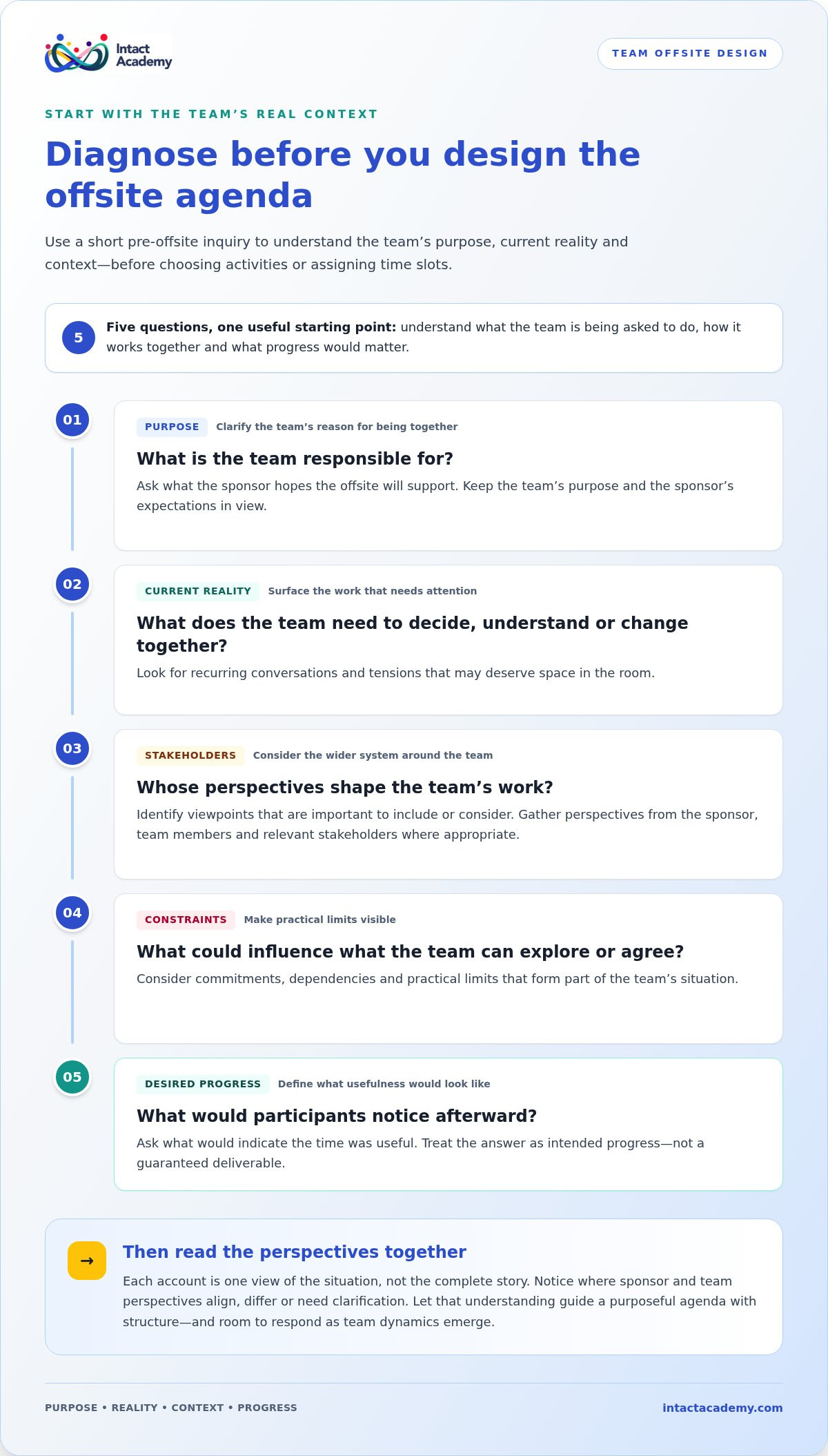
An agenda is a response to a team’s situation, not a substitute for understanding it. Before choosing activities or assigning time slots, explore what the team is being asked to do, how it currently works together and what progress would matter. Diagnose first, because an agenda can only serve the team when it reflects the system the team is actually part of.
Gather perspectives from the sponsor, team members and relevant stakeholders where appropriate. Treat each account as one view of the situation, not the complete story. A sponsor may want faster decisions, while team members may be asking how to balance those decisions with operational realities. Both perspectives offer useful context, but neither should predetermine the conversation.
Which questions reveal the team’s real agenda?
Use a short pre-offsite inquiry to shape your understanding before designing the day. Ask participants for observations and questions, then look for themes without assuming that agreement or disagreement is already clear. This systemic lens connects with systemic team coaching principles, which place the team in relationship with its wider context.
- Purpose: What is the team responsible for, and what does the sponsor hope the offsite will support?
- Current reality: What does the team need to decide, understand or change together? Which recurring conversations or tensions might deserve attention?
- Stakeholders: Whose perspectives shape the team’s work, and which viewpoints are important to include or consider?
- Constraints: What commitments, dependencies or practical limits will influence what the team can explore or agree?
- Desired progress: What would participants notice afterward that would indicate the time was useful?
These questions help distinguish the sponsor’s expectations from the team’s own questions. Keep both in view, then identify where they align, differ or need clarification. The Harvard Business Review on effective offsite planning also emphasizes beginning with desired outcomes and purposeful questions. For a team-coaching lens, the inquiry should also attend to relationships and how the team’s work connects with its wider environment.
How do you establish a useful working agreement?
Before the offsite, agree on its purpose, how participation will work and what confidentiality means in this context. Clarify that the facilitator holds the process, while the team shares responsibility for the conversation and its choices. A clear agreement gives people a steadier basis for speaking candidly, especially when perspectives differ.
Discuss how the team wants to handle disagreement and what should happen if a new issue shifts the focus. Agree on how you’ll check whether a discussion is still serving the purpose, and how insights will become actions the team owns. This keeps the conversation open and purposeful without scripting every exchange. For coaches developing this capability, systemic team coaching development can deepen the practice of reading context and working with team dynamics.
Design a flexible team coaching offsite agenda around the work
Once the team’s purpose and context are clear, shape an agenda that guides the work without scripting every exchange. A useful sequence creates movement from orientation to inquiry, from inquiry to focused work, and from learning to commitments. The content and pace should still respond to what the team needs to explore.
Think in stages rather than fixed time blocks:
- Arrival and purpose: Reconnect participants with the reason for gathering and the outcomes they hope to pursue.
- Shared inquiry: Surface the team’s current understanding, questions and different perspectives.
- Focused work: Choose dialogue, reflection, decision-making or practice to serve the team’s central objective.
- Integration and commitments: Name what has shifted, what remains open and what the team will carry into its work.
This is a framework, not a universal timetable. A team facing an immediate decision may need more time to examine options and agree a way forward. A team seeking to understand a recurring interaction may benefit from reflection and practice before attempting to decide. When facilitating a team coaching offsite, select each method for the work it enables, not because it makes the agenda look varied.
How should an agenda move from inquiry to action?
Begin each major segment by reconnecting it to the shared purpose, then invite the team to describe its current view of the issue. Make space for differences before moving to a response. At the end of the conversation, pause to identify what the team understands now, which decisions it has reached and what questions remain open. This transition helps prevent discussion from becoming either a premature answer or an unresolved loop.
How can you keep the schedule flexible but purposeful?
Mark the essential outcomes separately from the methods used to reach them. Check in at natural transitions: Is the team ready to move on, or does an unresolved point matter to the agreed purpose? Adjust an exercise when the change serves the work and participants, not simply to fill a gap or relieve discomfort. Government Executive on productive leadership offsites also emphasizes clarity about objectives and the experience an offsite should create.
Build in breaks and transition time as part of the design. Reflection, informal conversation and a pause between demanding topics can help participants arrive more fully for the next exchange. These aren’t spare minutes to reclaim if the agenda runs late; they support the quality of attention the work requires.
For example, if inquiry reveals that a decision depends on hearing from a less vocal perspective, pause and invite individual reflection. Then return to group dialogue before deciding. The sequence adapts, but the purpose remains visible. Coaches seeking to deepen their techniques for high-stakes team facilitation can continue developing their ability to work with the team’s live process. Intact Academy’s team coaching development offers a related professional learning pathway.
Facilitate disagreement, participation and changing dynamics in the room
A coaching-led agenda doesn’t have to mean an open-ended conversation. Keep dialogue connected to the agreed purpose, and use review points to help the team decide whether to continue, shift focus or move toward a decision. The facilitator’s role is to notice how the conversation is unfolding, not to diagnose individuals or decide whose view is right.
For example, you might notice that several people have spoken quickly while others haven’t yet entered the discussion. Describe what you can see without assigning motives: “I’ve noticed we’ve heard a few perspectives so far. What might help us hear from others?” This brings the interaction into shared awareness and lets the team make sense of it together.
What can a facilitator do when disagreement emerges?
Slow the exchange before positions harden. Clarify the specific question people are addressing, then invite each perspective without pressing for immediate agreement. Ask what the disagreement reveals about the decision, the information available or the priorities in play. Reconnect the discussion to the team’s purpose: what does it need to decide now, and what needs further exploration?
Disagreement can help a team examine assumptions and make a more considered choice. But tension alone isn’t evidence of progress. Distinguish a difference of perspective from interaction that crosses the team’s agreed boundaries or causes harm. If that happens, pause the process, restate the working agreement and attend to what’s needed to continue safely. Don’t use a desire to reach an outcome as a reason to push past a boundary.
To keep the exchange purposeful, try a simple sequence:
- Pause: Give people time to reflect rather than react.
- Clarify: Ask what specific issue or decision is being discussed.
- Widen: Invite different interpretations without requiring consensus.
- Review: Check whether the conversation is serving the agreed purpose and what the team needs next.
How can you widen participation without forcing disclosure?
Participation doesn’t require everyone to share personal reflections in the same way. Offer a quiet moment to think or write before opening the conversation; invite people to contribute verbally or pass for now. Notice who has spoken and who hasn’t, but don’t interpret silence as agreement, resistance or lack of interest. A respectful invitation leaves room for choice.
When facilitating a team coaching offsite, stay responsive to what’s happening while holding the structure lightly. You might say, “We can stay with this question a little longer, or capture it and return to the decision we agreed to address. Which would be more useful?” That makes the choice explicit and returns responsibility to the group. Check progress against the purpose, not against a preference for a tidy or comfortable discussion.
These moments call for practice: listening closely, naming observable patterns and staying grounded when views diverge. Develop your systemic team coaching practice to strengthen your capacity to facilitate participation and work thoughtfully with team dynamics.
Turn the offsite’s learning into team commitments and continued development
The close of an offsite is a moment to make learning visible, not to claim the work is finished. Before people leave, bring together what the team has understood, decided and left unresolved. Capture these in language participants recognise, so the record reflects their conversation rather than a facilitator’s interpretation.
How do you make team commitments actionable?
Translate broad intentions into a next step the team can recognise and own. “Communicate better,” for example, needs further definition: what action would make communication more useful, who will take responsibility, and how does that action serve the team’s purpose? Avoid turning every insight into a task. Some learning may need time to settle or further discussion before it becomes a commitment.
A simple closing review can separate the different kinds of learning:
- Insights: What does the team see more clearly about its work or ways of working?
- Decisions: What has the team agreed, and what assumptions or boundaries shape that choice?
- Open questions: What remains unresolved, and what would help the team address it?
- Commitments: What is the next action, who owns it, and when will the team revisit it?
Agree on a realistic review point, such as an upcoming team meeting or an existing planning conversation. Use that moment to ask what has been tried, what the team has noticed and whether its approach needs adjustment. This keeps responsibility with the team and connects offsite learning to daily work without promising a particular result.
How can coaches deepen their team facilitation practice?
Facilitation develops through more than knowing a sequence of activities. Coaches can strengthen their judgment by combining theory, practice, supervised practice, real-world application and reflection. Reviewing what happened in a conversation, including how the facilitator responded to participation or tension, helps turn experience into considered learning for future work.
For coaches developing systemic team-coaching capability, Intact Academy’s TA EMCC Senior Team Coach Academy is a relevant professional-development path. Its programs are accredited at EMCC senior coach level and provide ICF CCE and TA accreditation. The Academy’s approach brings together learning and reflection, supporting coaches to develop their practice in relation to the complexity of real teams.
If you’re considering this next step, explore an intake conversation about the TA EMCC Senior Team Coach Academy. Facilitating a team coaching offsite is a practice of attention: each engagement offers questions to reflect on, capabilities to refine and new possibilities for supporting teams in their work together.
Carry the learning into your next team coaching conversation
The value of an offsite continues in the ordinary moments that follow: how the team makes a decision, shares responsibility or revisits a difficult question. As you plan your next step, consider what you want to strengthen in your own facilitation practice, and how reflection on real team work could help you develop it.
Intact Academy has trained more than 3600+ participants in 14 different countries over the last 40 years, with training delivered since 1992. Its programs provide EMCC senior coach level, ICF CCE and TA accreditation. For coaches who want to deepen their systemic team-coaching capability, continued learning can bring theory, practice and reflection into closer relationship.
If you’re ready to explore how that development could support your work, explore a conversation about team coach development. Each offsite offers a chance to learn alongside the team. With curiosity, care and a willingness to keep refining your practice, you can help create the conditions for more purposeful work together.
Frequently Asked Questions
What should a team coaching offsite agenda include?
A useful agenda includes a clear purpose, time to surface what participants currently think, focused work on the issue and a way to translate learning into next steps. Choose methods according to the intended result: use structured comparison when a choice is needed, or individual reflection before dialogue when views differ. Account for dependencies, decision authority and transitions so the agenda fits the team’s working conditions.
How do you facilitate a team offsite when participants disagree?
Help participants clarify the point of disagreement before trying to resolve it. Ask each person to distinguish what they’ve observed from what they infer, then explore what information or priority may sit behind each position. For example, two people may interpret a missed deadline differently because they’re focused on different risks. The team can then consider those risks without treating consensus as the only useful outcome.
How long should a team coaching offsite last?
Set the duration according to the work the team needs to do, rather than choosing a standard format. A focused question may need less time than several connected decisions or a conversation that requires careful attention to relationships. Consider participants’ capacity, preparation and the space needed to reflect. If the work can’t be completed thoughtfully in one session, identify what belongs in the offsite and what should continue in regular team meetings.
Who should facilitate a team coaching offsite?
A facilitator should be able to hold the process, notice interaction patterns and help the team stay connected to its purpose without taking ownership of its decisions. A leader who has a strong stake in the discussion may find it difficult to facilitate and participate fully at the same time. In that case, a team coach can support the conversation while the leader contributes as a team member and sponsor.
How do you make a team offsite more than a team-building event?
Connect any activity to a real question about how the team works. After an exercise, invite participants to identify what they noticed about coordination, decision-making or shared responsibility, then consider where that pattern appears in their work. If the team can’t make that connection, the activity may be enjoyable but isn’t necessarily advancing its purpose. Use reflection to turn experience into an insight the team can apply.
What should happen after a team coaching offsite?
Share a concise record of decisions, open questions and agreed actions in language the team recognises. At a later meeting, ask owners to describe what they tried and what happened, rather than simply reporting whether a task was completed. The team can use that review to learn from obstacles, revise commitments or identify an issue that needs further attention. This keeps follow-through connected to the team’s actual work.
Can a team coaching offsite address both relationships and business goals?
Yes. The two are connected: how people share information, handle challenge and make decisions can influence how the team pursues its goals. For instance, if a delivery decision repeatedly stalls, the team can examine both the operational trade-offs and how differing views are heard. Keeping the business question visible while exploring the relationship dynamics helps the conversation remain relevant to performance without reducing people to roles.


