

When to recommend team coaching vs individual coaching depends on where the change needs to happen. A leader may benefit from individual coaching, but if the same tension keeps resurfacing across meetings, the pattern may involve the team as a system.
It’s understandable to focus on the person whose actions are most visible. Yet treating a shared dynamic as several separate development needs can leave the conditions driving it untouched. The reverse is also true: team coaching may not be the right response when the goal is personal and specific to one individual.
This article offers a practical, systemic framework for matching the intervention to the level of change. You’ll learn how to distinguish individual, team-level, and shared needs, make a clear recommendation to stakeholders, and agree confidentiality and contracting before work begins. It also explores when a carefully contracted blend of individual and team coaching can support change without blurring the purpose of either format.
Key Takeaways
- Match the coaching format to where the desired change needs to happen: with one person, within the team, or across both levels.
- Look beyond the presenting symptom to recurring interaction patterns, role tensions, and shared assumptions.
- To decide when to recommend team coaching vs individual coaching, consider the goal, participants, confidentiality, and organisational context.
- Use a clear contracting sequence to align outcomes, stakeholders, format, and expectations before coaching begins.
- A blend of individual and team coaching may suit connected but distinct needs when each format has a clear purpose and agreement.
Team coaching vs individual coaching: what is the real difference?
The distinction isn’t simply how many people are in the room. It’s who or what the coaching is intended to help change. Individual coaching centres on one person’s development; team coaching treats the team and its shared work as the focus. That distinction shapes the goals, conversations, and agreements needed to make the work safe and useful. For a broad overview of coaching’s different forms and applications, see Coaching.
A practical rule is to match the format to the level where the desired change must happen. If a leader wants to make different choices in their role, individual coaching may fit. If a team needs to improve how it makes decisions together, coaching one member at a time may not address the central issue.
What makes a coaching engagement individual?
In individual coaching, the client’s goals, choices, leadership patterns, and work context are the primary focus. A person might want to understand how they respond to conflict, build confidence in a new role, or reflect on how their leadership affects colleagues. A private coaching space can help them examine sensitive or role-specific concerns at their own pace.
Individual focus doesn’t mean ignoring relationships or organisational context. A coach may explore how expectations, authority, team culture, or workplace pressures shape the client’s experience. The person remains the client, and the work supports their development and agency. When an organisation sponsors the work, agree confidentiality and its boundaries as part of the coaching relationship.
What makes team coaching different from group coaching?
Team coaching works with an intact team: people connected by shared responsibilities, purpose, and ongoing work. The coach attends not only to what each person says, but also to patterns in how the team communicates, handles disagreement, makes decisions, and coordinates action. The team’s relationships and collective effectiveness are part of the work, not just the setting for individual development.
Group coaching brings people together for shared learning or development, but they may not work together as a team. Participants can compare experiences and learn from one another without being jointly responsible for the same outcomes. A group shares a coaching space; a team also shares a system of work.
Consider a product launch. If one manager wants to strengthen their confidence when presenting, individual coaching could focus on that person’s goals and choices. If the product team repeatedly leaves meetings with conflicting priorities, team coaching can work directly with the interactions and agreements shaping the launch. The topic may overlap, but the unit of change is different.
When considering when to recommend team coaching vs individual coaching, ask: Who needs to work differently for the intended outcome to become possible? The answer helps distinguish a personal developmental goal from a collective one and keeps the format connected to the change being sought.
Where does the change need to happen: the person or the team system?
A visible difficulty is not always located where it first appears. A manager may seem hesitant, for example, while the wider team routinely dismisses new ideas or leaves decisions unclear. Coaching that focuses only on the manager’s confidence may help them respond differently, but it may not change the conditions that keep the pattern in place.
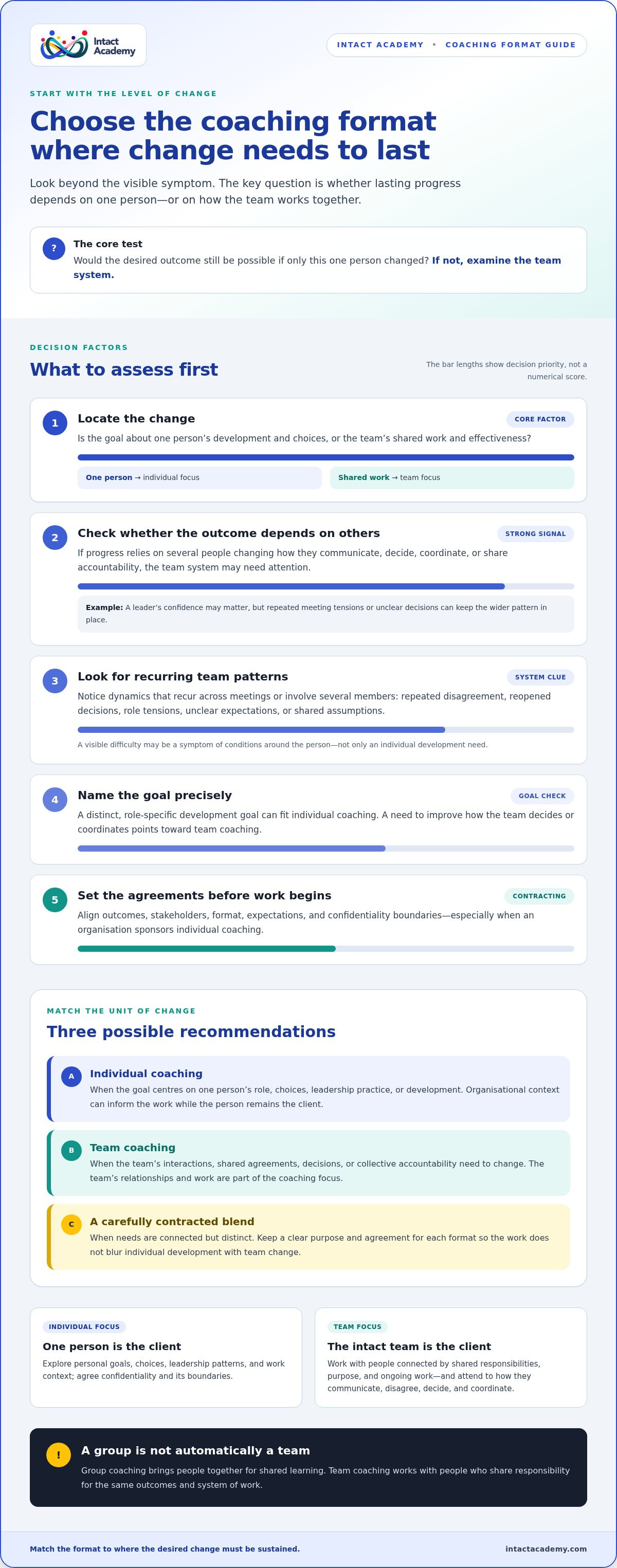
Start with the outcome, then identify what would need to change for it to last. Does success depend mainly on one person developing a capability or making different choices? Or does it depend on several people changing how they communicate, decide, coordinate, or share accountability? Ask: Would the desired outcome still be possible if only this one person changed? If not, examine the team system before settling on an individual intervention.
The right coaching format follows the level at which change needs to be sustained. This doesn’t mean treating every personal difficulty as a team issue. It means distinguishing the presenting symptom from the patterns around it, such as repeated interactions, role tensions, unclear expectations, or assumptions several people may share.
Signals that individual coaching may be the better starting point
Individual coaching may fit when the development goal is distinct and linked primarily to one person’s role, decisions, or leadership practice. They might be adjusting to a new remit, preparing for a difficult conversation, or reflecting on how they use authority. A confidential space can support honest exploration, especially when the person wants to test perspectives before acting.
Organisational context still matters. The coach and client might consider how workload, reporting lines, or team expectations affect the person’s choices. That context informs the work; it doesn’t automatically make the team the coaching client. Keep the recommendation aligned with the agreed developmental goal.
Signals that the team itself may need coaching
Look for patterns that involve several members or persist across different individuals. For instance, a team may repeatedly reopen decisions because members hold different assumptions about who has authority. The presenting complaint might be one person’s “indecisiveness,” but lasting progress may depend on the team clarifying how it makes and owns decisions together.
Team coaching may be relevant when the outcome depends on changed interactions, shared commitments, or collective accountability. Conflict isn’t a prerequisite. A team with a clear mission and constructive relationships may still need to strengthen coordination, learn through a transition, or align its approach to shared work. The team’s task and purpose help define what effectiveness means in its context.
The Administration for Children and Families’ Group and Individualized Coaching for Employment describes a program using both approaches, illustrating how formats can serve distinct needs within a wider context. The question is not which format is universally superior, but which level of work matches the intended change. For practitioners developing their ability to work systemically with teams, the TA EMCC Senior Team Coach Academy offers a relevant learning pathway.
How to choose between team coaching and individual coaching
Neither format is inherently better. The right choice depends on the change sought, the people who need to participate, and the context shaping the challenge. Compare the coaching focus, intended outcome, and level at which progress needs to hold, rather than choosing on convenience alone.
| Consideration | Individual coaching | Team coaching |
|---|---|---|
| Focus | One person’s goals, choices, and role | The team’s shared purpose, relationships, and work |
| Participants | The individual and coach | An intact team and coach |
| Desired outcome | Individual development or changed practice | Improved collective interaction or effectiveness |
| Confidentiality | Boundaries between client and sponsor are agreed | Information and participation agreements are made across the team and stakeholders |
| Organisational context | Explored as it affects the individual’s goals | Considered as it shapes the team’s purpose, task, and relationships |
Which coaching format fits the presenting challenge?
Start with the outcome, not the label attached to the problem. A leader seeking to strengthen delegation or prepare for a role transition may benefit from individual coaching, where their own insight and choices are central. A team seeking more reliable coordination needs attention to how members share information, make decisions, and follow through. Choose the format based on what must change, not simply who first raised the concern.
Pause when an individual difficulty appears within a wider pattern. A team member may seem reluctant to contribute, for example, while the meeting structure leaves little room for dissent. Explore the context before concluding that the person alone needs to change. The question of when to recommend team coaching vs individual turns on whether progress depends on personal development, collective interaction, or a defined connection between the two.
How do confidentiality and stakeholder expectations affect the choice?
Organisational sponsorship adds another layer: a sponsor may want improved performance, while the individual or team needs space to learn and develop. Contracting should clarify the purpose, roles, intended outcomes, and information that may be shared. Agreeing these boundaries before coaching begins helps participants understand the work and reduces the risk of conflicting expectations.
Don’t promise absolute confidentiality on behalf of an engagement. Instead, establish appropriate information boundaries for the format and context. Discuss what progress updates may be shared with a sponsor and how the team will handle sensitive contributions. A sound recommendation is one stakeholders can understand and participants can enter with clarity.
In brief: individual coaching focuses on one person, team coaching engages an intact team, and the intended level of change guides the choice.
How to make and contract a coaching recommendation
A sound recommendation does more than select a format. It makes the reasoning visible, clarifies who the work is for, and gives everyone a shared understanding of what progress could look like. Use this five-step sequence to move from an initial concern to an explicit agreement.
- Clarify the outcome. Describe the change in practical terms. What should become possible, and how might the person or team recognise progress?
- Locate the change. Ask whose thinking, actions, or relationships need to shift. Is the goal individual, collective, or connected across both levels?
- Identify stakeholders. Establish who is commissioning, participating in, and affected by the work. A sponsor’s objectives may differ from a coachee’s priorities or the team’s development needs.
- Choose the format. Recommend individual coaching when the goal centres on one person’s development, team coaching when progress depends on shared work, or a considered combination when both levels matter.
- Contract. Agree the purpose, roles, boundaries, intended outcomes, and how the engagement will be reviewed.
Questions to ask before recommending a format
Ask questions that test where change needs to take root. Who needs to think, act, or relate differently for the outcome to occur? Is the concern concentrated in one role, or does it recur across the team? What happens when the people involved try to address it together? Whose goals and expectations are shaping the request, and where do they align or differ?
These questions separate the presenting concern from the work required to address it. If one leader needs to prepare for a role-specific decision, individual coaching may be a clear starting point. If decisions repeatedly stall because responsibilities are unclear across the team, the recommendation may need to address shared agreements as well as individual contributions.
How to explain the recommendation and agree boundaries
State the recommendation in relation to the desired outcome, rather than presenting it as a personal preference for one coaching format. For example: “Because this goal depends on the team agreeing and using a shared decision process, I recommend team coaching. We’ll look for progress in how decisions are made, communicated, and followed through.” This gives stakeholders a rationale they can discuss and refine.
Contracting should also clarify what information may be shared, with whom, and for what purpose. Set review points to consider whether the work is addressing the right level of need. If new information emerges, revisit the approach by agreement. Contracting for change in coaching offers a related perspective on making agreements explicit.
For practitioners looking to deepen their capability in team-level work, explore the TA EMCC Senior Team Coach Academy as a development pathway.
When to combine coaching formats and how practitioners can build capability
Sometimes the work belongs at more than one level. A leader may need space to reflect on how they use authority, while their team needs to examine how it shares decisions and responsibility. A blended approach can address these connected but distinct needs, provided each format has a clear purpose. It isn’t automatically more effective, and it shouldn’t be used to avoid naming a team-level issue.
The question of when to recommend team coaching vs individual coaching may lead to one format, the other, or a carefully agreed sequence. Let the intended change guide the choice, rather than a preference for offering more sessions or formats.
When a blended approach can make sense
Imagine a newly appointed department head joining a team that has struggled to make decisions. The leader may want individual coaching to reflect on their transition, authority, and responses under pressure. The team may need coaching together to clarify decision-making and shared accountability. These aims are related but not interchangeable: the leader’s development is not a substitute for the team examining its working relationships.
Keep the purpose and boundaries of each engagement explicit. Agree who the client is in each format, what information can be shared, and how the work connects without turning private individual conversations into material for team sessions. Without clear boundaries, people may feel caught between competing expectations, or a shared team pattern may be reframed as one person’s deficit.
Sequence the work only when it serves the goals. Individual reflection might prepare a leader to participate differently in team coaching; team dialogue might reveal a separate developmental question for that leader. Review the recommendation as circumstances and learning evolve, and revisit the agreement if the work points to a different level of need.
Developing skill in team coaching practice
Recommending team coaching well requires more than recognising visible tension. Practitioners need to attend to the team’s task, relationships, roles, and recurring interaction patterns, while remaining alert to their own assumptions about what they observe. Reflective practice and supervision can help coaches consider whether an intervention serves the team’s shared work or simply follows the most prominent voice in the room.
Intact Academy’s TA EMCC Senior Team Coach Academy is a practitioner-development pathway for professionals seeking to build capability in this work. Its learning approach combines theory, practice, supervised application, and reflection, connecting conceptual understanding with real-world complexity. Programs are accredited at EMCC senior coach level, provide ICF CCE accreditation, and lead to TA accreditation.
Explore systemic team coaching principles as you consider how a coach can attend to the whole system without losing sight of the people within it. A thoughtful blend depends on clear purpose, sound boundaries, and a willingness to learn from what emerges.
Bring a systemic lens to your next coaching decision
The next time a coaching request arrives, pause before naming the format. Ask what needs to become different, whose participation can make that change possible, and how you’ll recognise progress. This reflection can turn a quick intervention into a considered developmental choice.
Knowing when to recommend team coaching vs individual coaching is a capability that deepens through practice. Each recommendation invites you to stay curious about the person, the relationships around them, and the wider system shaping their work. When you’re ready to develop that capability, explore Intact Academy’s team coach development.
With thoughtful contracting and a willingness to keep learning, you can help people and teams move toward grounded, meaningful, and sustainable change. Explore Intact Academy’s team coach development to build your capability in this work.
Frequently Asked Questions
Can individual coaching help when a team is underperforming?
Yes, individual coaching can help a person strengthen their contribution while a team is underperforming, but it may not address the causes of the team’s results. For example, a manager might use coaching to prepare for clearer conversations with colleagues. If delays stem from unclear handoffs across several roles, individual development may support improvement without resolving those coordination gaps. Identify what one person can influence and what requires shared action before choosing the format.
Is team coaching suitable when the team is not experiencing open conflict?
Yes. A team doesn’t need visible conflict to benefit from examining how it works together. Colleagues might have respectful relationships yet struggle to adapt priorities when customer needs shift. Team coaching can help them reflect on how they coordinate, make trade-offs, and learn from outcomes. The starting point can be a shared ambition, such as improving cross-functional collaboration, rather than a breakdown in relationships.
What happens if an individual issue is affecting the whole team?
First, avoid treating the issue as either purely personal or automatically systemic. Explore the impact, the work conditions, and how colleagues respond. For instance, if one person’s missed deadlines create pressure for others, individual coaching may help them examine planning and communication, while the team may need clearer workload agreements. The choice about when to recommend team coaching vs individual coaching depends on whether progress rests on one person’s actions, shared adjustments, or both.
Can individual coaching and team coaching happen at the same time?
They can, if the distinct purposes and boundaries are clear to everyone involved. An executive might work individually on how they receive challenge, while their leadership team explores how it surfaces risks in meetings. Before both engagements begin, clarify who participates in each, what information stays within each coaching space, and how progress will be discussed. If those agreements cannot be made clearly, consider sequencing the work and reviewing the need for a second format later.
How should confidentiality work when an organisation sponsors coaching?
Agree information boundaries with the sponsor and participants before coaching starts. Clarify what the sponsor will receive, such as an agreed progress update, and what remains within the coaching conversation. For team coaching, discuss how members will handle sensitive contributions and what, if anything, may be shared beyond the team. Avoid assuming everyone has the same understanding. If expectations differ, pause to resolve them before inviting people into the work.
What if team members disagree about the purpose of coaching?
Don’t treat disagreement as proof that coaching cannot begin. Treat it as useful information about expectations that need attention. Invite members to name what they hope will change, what they’re concerned might happen, and what would make participation worthwhile. A sponsor’s aim may not match the team’s immediate priorities. Before proceeding, establish a purpose that participants can understand, even if they don’t all describe the desired outcome in exactly the same way.
How can a coach tell whether a team is ready for team coaching?
Readiness is less about enthusiasm from every member than whether there is enough agreement to engage with a shared task. Explore whether the team can name a meaningful focus, participate in the conversation, and consider its own contribution to current patterns. If members expect the coach to fix one colleague or deliver a predetermined verdict, clarify the purpose first. A short contracting conversation can reveal whether the team is ready to begin or needs alignment beforehand.


