

What if the story that shifts a leadership conversation isn’t the coach’s story at all? Using storytelling in leadership coaching can help a leader find new meaning in their own experience. But a well-meant anecdote can take up too much space or imply there’s one right answer. The difference lies in whether the story serves the client’s thinking.
Stories can make an abstract challenge more human. Yet knowing when to invite one, how to connect it to a client’s situation, and what to ask next can feel less certain. A story is useful not because it persuades, but because it helps the leader notice assumptions, relationships, and choices that were harder to see before.
This practical guide shows how to use stories and narrative questions with a clear coaching purpose. You’ll learn how to keep the client’s experience at the centre, invite alternative perspectives without prescribing them, and turn reflection into a meaningful, observable next step. The aim is not a more compelling tale, but a more deliberate choice in the leader’s real context.
Key Takeaways
- Explore how using storytelling in leadership coaching can turn a leader’s lived experience into insight without making the coach’s story the focus.
- Notice recurring themes as clues to assumptions and choices, while staying curious rather than diagnosing or labelling.
- Connect a leader’s interpretation of events with relationships, organisational culture, and the wider system shaping their options.
- Use a purposeful sequence to move from contracting and story exploration to broader perspective and an observable next step.
- Strengthen storytelling practice through theory, real-world application, feedback, and reflection.
Why Use Storytelling in Leadership Coaching?
Using storytelling in leadership coaching isn’t about teaching a leader to deliver a polished speech. It’s a way to examine lived experience: what happened, how the leader understood it, and what that interpretation made possible or difficult. A story can bring values, assumptions, identity, and perceived choices into view. That gives coach and client something specific to explore instead of relying on abstract labels such as “I need to communicate better.”
A leadership story turns an experience into meaning, and meaning into a choice the leader can examine. That distinction matters. A story crafted for a presentation is shaped to influence an audience, communicate a message, or build commitment. In coaching, the client’s account is not a persuasive performance. The coach listens for the client’s meaning and helps them consider it without deciding what the story should mean.
Imagine a leader describing a tense meeting where a team member challenged a decision. “I had to take control” may sound like a straightforward account. Exploring it could reveal that the leader values competence, assumes disagreement threatens authority, or sees only two options: dominate or lose credibility. These are possibilities to investigate, not conclusions to impose. The client may understand the moment differently, and their interpretation belongs at the centre of the work.
Connect the exploration to a live coaching objective. If the leader wants to invite more challenge from their team, the meeting story might clarify what they do when challenged and what they want to do differently. If the story doesn’t illuminate the stated goal, it may be interesting without being useful. Keep returning to the purpose: What is the client trying to understand or choose?
What makes a leadership story useful in coaching?
A useful story includes a particular situation, the leader’s interpretation, and what mattered to them. A coach might ask, “What happened just before you stepped in?” and then, “What were you hoping to protect?” The first question grounds the account in observable events; the second opens space to explore values and assumptions. The story needn’t be dramatic or complete. Its usefulness depends on the meaning the client finds in it and its connection to their coaching objective.
When can storytelling deepen a coaching conversation?
A recurring account, vivid example, or moment the client returns to may be worth exploring, especially when an abstract value such as trust or fairness meets a concrete leadership dilemma. Start with curiosity, not interpretation: “Would it be useful to stay with that moment?” Check what feels relevant and let the client set the depth and pace.
Stories can reveal a gap between a leader’s stated intention and their experience of acting under pressure. That gap isn’t evidence of failure; it can become a point of choice. The client may discover that a familiar response once served them but no longer fits the leadership relationship they want to build. Coaching can hold both possibilities: the response had meaning, and another response may now be possible.
Used with care, storytelling doesn’t hand a leader a lesson. It creates room to revisit an experience, see what shaped their interpretation, and decide what they want to carry forward. The story remains theirs, and so does the choice that follows.
How Stories Reveal Leadership Patterns and New Perspectives
A single story offers a view of one moment. Across several stories, a coach may notice recurring roles, turning points, perceived choices, or ways the leader describes other people. Perhaps colleagues repeatedly appear as “resistant,” while the leader takes responsibility for keeping everything on track. That pattern may point to an assumption worth exploring, such as “I have to carry this alone.” It isn’t proof of a fixed trait or a diagnosis.
A person’s story is a meaningful account of experience, not an objectively complete account of everything that happened. This distinction lets the coach respect the leader’s perspective without treating it as the only possible one. The account reflects what the leader noticed and how they made sense of events; others may have experienced the same situation differently.
What can recurring stories reveal about a leader’s assumptions?
Listen for repeated phrases, familiar roles, and moments where the leader seems to have had no choice. Ask, “What did you feel responsible for there?” or “What options did you see at the time?” Transactional Analysis can offer one lens for exploring relational patterns, such as the roles people take up in an interaction. Use it as a prompt for inquiry, not a label. One story is a starting point, not a verdict.
Interpretations also take shape within a wider context. A leader may describe themselves as reluctant to challenge authority, yet their role, the organisation’s decision-making norms, or the way dissent is received may all influence that experience. Exploring the relationship between the person and the system helps avoid reducing a complex pattern to an individual flaw. It can reveal where a meaningful choice might exist, and where constraints are real.
How can a coach help a leader reframe a story?
Reframing isn’t replacing the client’s interpretation with a more positive one. It’s inviting them to look again. Ask what they may be overlooking, protecting, or trying to make sense of. Then, with care, explore how another person in the story might describe the same exchange. Keep the questions open: the aim is to make another perspective available, not to persuade the leader to adopt it.
For example, if a leader describes a colleague’s silence as agreement, the coach might ask, “What else could their silence mean?” or “What might they say was happening for them?” The leader can consider several explanations without deciding too quickly which is true. A useful reframe expands the field of view while preserving uncertainty where the facts remain unclear.
In using storytelling in leadership coaching, the coach’s curiosity can help distinguish personal interpretation from relational and organisational signals. A recurring account might point to a leadership habit, a team dynamic, or a norm reinforced by the wider organisation. Exploring these layers takes practice, including the ability to notice one’s own assumptions as a coach. Reflective coach development and supervision can support deeper listening and systemic awareness, helping practitioners hold more than one perspective without taking ownership of the client’s meaning.
Storytelling in Coaching Compared with Leadership Presentations
A leader may tell a story to help an audience understand a change, then bring the same moment into coaching to examine what it meant to them. The story may be similar; its purpose, audience, and the listener’s role are different. A presentation shapes a message for others. Coaching creates space for the client to explore their own meaning.
| Element | Leadership presentation | Coaching conversation |
|---|---|---|
| Purpose | Clarify direction, values, or change | Explore a leadership question |
| Storyteller | The leader shapes and tells the story | The client shares; the coach may invite or, sparingly, offer an example |
| Audience | Colleagues or stakeholders | The client, with the coach listening |
| Coach role | Not usually part of the presentation | Ask questions and support reflection |
| Intended outcome | Shared understanding or a clearer message | New insight, perspective, or choice |
Neither purpose is inherently better; they call for different kinds of attention. For an audience, the leader selects details that make a message relevant to listeners and the communication context. In coaching, the leader can slow down and notice what they left out, how they interpreted events, and what they might understand differently. Using storytelling in leadership coaching means keeping the exploration in service of the client’s inquiry, rather than shaping the account to persuade.
When should a leader tell a story to an audience?
A leader might use a concise example to make an organisational change more tangible, express a value through a decision, or connect people with a shared direction. The story should fit the audience and the moment: what helps a team understand a transition may not suit a board update. A story can clarify the leader’s message, but it can’t guarantee agreement, motivation, or changed behaviour.
When should a coach invite or share a story?
Invite a client’s story when it serves a question they’ve chosen to explore. A coach’s own example requires more care: keep it brief, relevant, and bounded, and don’t imply the client should reach the same conclusion. Then return attention to the client with a question such as, “What does that bring up for you?” If the example shifts focus to the coach, let it go.
A leader’s presentation can also become useful coaching material afterward. Perhaps the leader told a story about a difficult decision to explain a new direction. In coaching, they might reflect on what they chose to share, how they hoped listeners would respond, and what reactions they noticed. The coach needn’t judge the presentation’s effectiveness; the conversation can instead help the leader examine their intentions and assumptions about communication.
For coaches, learning to distinguish these purposes involves practice and reflection, not simply collecting compelling anecdotes. Coach development and supervision can support the listening and judgement needed to keep a story relevant, appropriately bounded, and centred on the client’s work.
A Practical Storytelling Process for Leadership Coaching
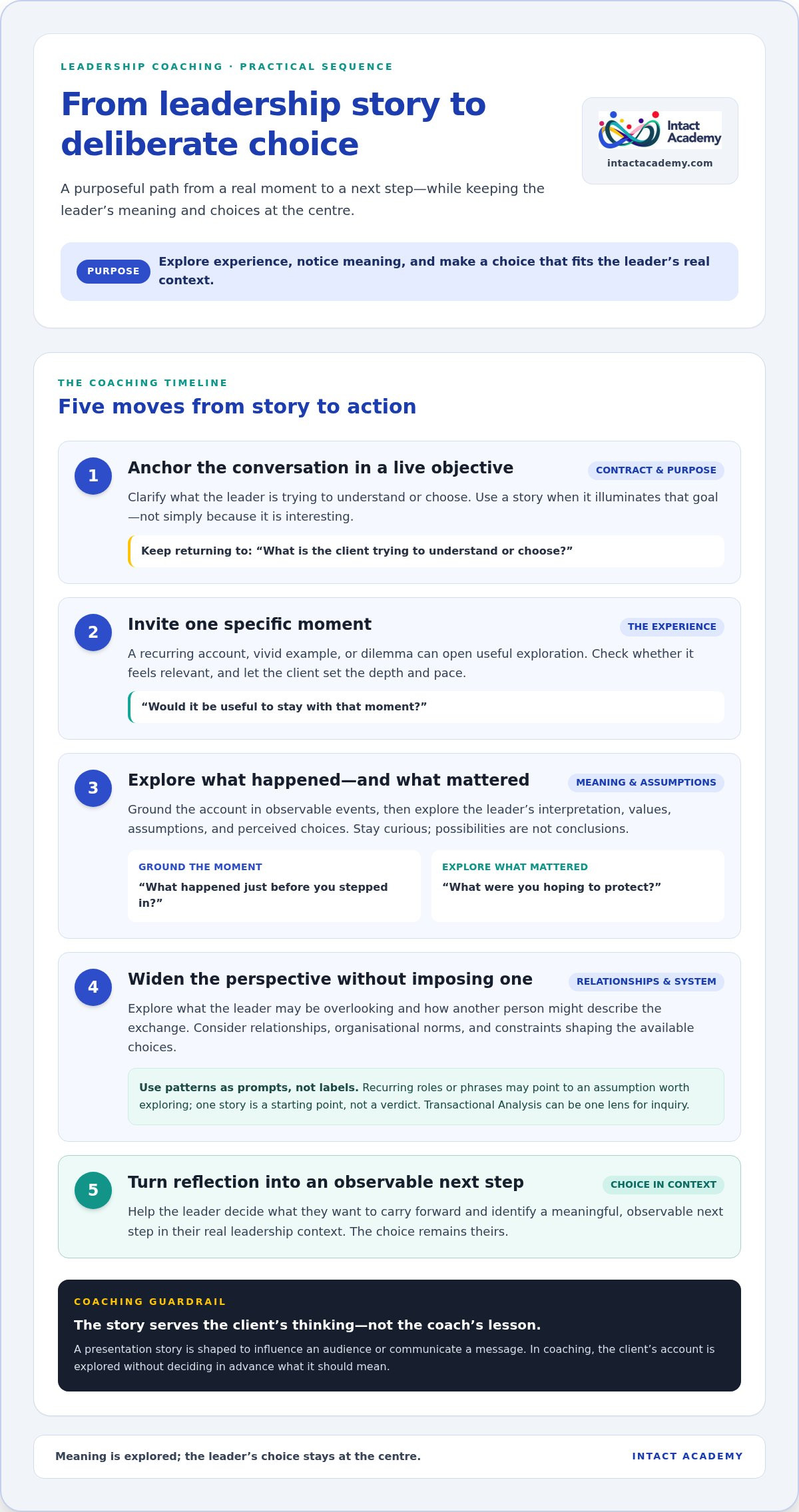
A clear process keeps story work connected to the client’s purpose, rather than letting an engaging account take over the session. Coach and leader can move through these stages at a pace that fits the coaching goal and the leader’s organisational context. They may pause, return to an earlier question, or decide not to explore further.
- Contract. Agree what the leader wants to understand or work towards. Ask whether exploring a specific experience could serve that goal, and clarify what would make the conversation useful.
- Invite an episode. Ask for one particular moment connected to the goal. “Can you recall a recent conversation where this came into play?” helps focus the discussion without requiring a polished account.
- Explore meaning. Invite the leader to describe what happened, what they noticed, and what they made of it. Check rather than assume: “What was going through your mind?” or “How did you experience that?”
- Broaden perspective. Explore what else might have been happening, including another person’s possible viewpoint and the pressures or norms shaping the interaction. Keep alternative interpretations open for the client to consider.
- Identify action. Ask what the leader wants to test in their role or relationships. Agree on one proportionate, observable action and how they’ll reflect on what they learn.
Contract the inquiry, explore the experience, widen the view, and let the client choose a next step. This sequence offers structure, not a guaranteed result. Its value depends on the coach staying responsive to the leader and the context around the story.
How can a coach explore a leadership story?
Suppose a leader wants to understand why a difficult team conversation ended without resolution. The coach can reconnect to the leader’s goal, then invite them to recall one exchange. Questions about what was said, what they noticed, and what they thought was at stake help make the episode specific. Explore the leader’s experience and organisational context without deciding in advance what either means.
How can reflection become a leadership experiment?
Once a new perspective emerges, ask what the leader would like to test, not what they should do. They might choose to ask one open question before offering a solution in their next team discussion. Make the action observable and proportionate to their role, then agree what they’ll notice and reflect on afterward. Revisit the experiment as learning, not as proof that one interpretation was right.
Practising this kind of inquiry takes theory, application, and reflection. Explore coach development and supervision to deepen your practice and build the reflective capacity to work with leadership stories in context.
Develop Storytelling Practice Through Reflective Coach Development
Using storytelling in leadership coaching calls for more than a strong question or a compelling example. Coaches need to notice what a story evokes in them, distinguish observation from interpretation, and stay attentive to the client’s goal and organisational context. These capabilities develop through theory, practice, feedback, and reflection. A coach can learn a concept, apply it in real conversations, then review what supported the client’s exploration and what may have narrowed it.
What helps coaches use stories with care and skill?
Practise open questions that invite the client’s meaning rather than confirm a theory: “What stands out to you now?” or “What might you be seeing differently?” After a conversation, reflect on your own response. Did a detail prompt you to assume what the client felt, or did a familiar story make you want to offer advice? Supervised practice gives coaches space to examine impact, boundaries, and alternative perspectives while keeping interpretation with the client.
Contracting matters, too. A client may share an emotionally charged account, but that doesn’t automatically mean it serves the coaching purpose or that they want to explore it further. Check readiness and relevance, then follow the client’s lead. This disciplined curiosity supports deeper listening while keeping the conversation grounded in the client’s chosen work.
Systemic awareness adds another layer. A leader’s account is shaped not only by personal meaning, but also by role expectations, relationships, organisational culture, and power dynamics. Reflective development helps coaches hold these influences in view without reducing the story to either an individual pattern or a system problem. The aim is to make more of the context available for consideration, not to impose a single explanation.
How does Intact Academy support professional development?
Intact Academy’s coach development brings together theory, supervised practice, real-world application, and reflection. This pragmatic approach helps coaches connect ideas with their work and examine their practice as it unfolds. The programs are EMCC accredited at senior coach level and provide ICF CCE and TA accreditation. Training activities have been delivered since 1992; over the last 40 years, more than 3600+ participants have been trained in 14 different countries.
For coaches looking to deepen their practice, explore professional development for coaches or learn about executive and team coach development programs. These offer a starting point for considering how structured learning can strengthen the judgement, listening, and reflective capacity that story work asks of a coach.
Make Your Next Coaching Conversation a Place for Discovery
The next time a leader brings a charged or recurring moment into coaching, pause before offering an interpretation. Ask what they want to understand and whether revisiting the experience would help. Then let their account unfold at a pace that feels useful, staying open to what the story may reveal about their choices and the context around them.
That small shift can change the quality of attention in the conversation. Using storytelling in leadership coaching isn’t about finding the perfect anecdote; it’s about creating room for a leader to make meaning, consider what else might be possible, and choose how to act with greater intention. The coach’s discipline matters: curiosity can open a door, while a ready-made lesson can close it.
To strengthen the reflective practice behind this work, explore Intact Academy’s coach development programs. Build your skills through theory, supervised practice, real-world application, and reflection, and bring more deliberate listening to your next coaching conversation.
Frequently Asked Questions
Can storytelling be used in leadership coaching if a leader is not a confident speaker?
Yes. A leader doesn’t need to be a polished storyteller to reflect on an experience. They might begin with a few details about a routine moment, such as how they responded when a project deadline slipped. The coach can help them explore what feels relevant without filling in gaps or rushing to create a neat narrative. Start with the leader’s goal, invite them to share only what they’re comfortable discussing, and allow pauses or uncertainty.
How can a coach tell whether a leadership story is useful to explore?
A story is worth exploring when the client sees a connection to their coaching goal, a recurring challenge, or a decision they want to make. Ask, “What feels important about this moment for you?” The answer can clarify whether the episode offers useful material or is simply an interesting aside. If the leader can’t see a connection, respect that and return to the agreed focus rather than searching for hidden meaning.
Should a leadership coach share personal stories with clients?
Sometimes, if a brief personal example genuinely supports the client’s inquiry. Before sharing, consider whether it offers a useful point of connection or risks taking attention away from the client. Avoid implying that your experience is a template for theirs. Afterward, ask an open question such as, “What, if anything, does that bring up for you?” If the client doesn’t find it relevant, move on without defending the example.
What if a leader’s account of an event differs from a colleague’s perspective?
Hold the leader’s account as evidence of their experience, not as the sole record of what happened. A coach might help separate what the leader directly observed from what they inferred, then ask what the colleague could have noticed. This doesn’t dismiss the client or require the coach to decide who is right. If it fits the coaching agreement, the leader could seek the colleague’s perspective through a direct, respectful conversation.
How can storytelling support leadership during organisational change?
A story can make a purpose or value more tangible, but it works best alongside clear information and genuine dialogue. For example, a leader explaining a new process might share why a particular need prompted the change, then name what is still undecided and invite questions. In coaching, explore whose experiences the message includes or leaves out, and how it fits the organisation’s actual decisions and behaviour.
How can a coach work with stories across different cultural contexts?
Ask the client what a phrase, image, or event means to them instead of assuming its significance is universal. A story about speaking up, for instance, may carry different implications depending on status, identity, communication norms, and workplace culture. Offer your interpretation tentatively and invite correction. The client decides what they want to explain or explore. This approach keeps using storytelling in leadership coaching respectful and grounded in the client’s context.
How can a leader know whether a story led to useful coaching insight?
Look for a change the client can describe, such as recognising an assumption they want to examine or naming a different response they’re willing to try. Agree on a practical way to notice what happens, such as recording how they prepared for a particular conversation and what they learned afterward. Treat the result as information, not proof that the story caused change. Review what shifted, what remained difficult, and what the client wants to do next.


