

What if the obstacle to better agile delivery isn’t the next ceremony, but what happens between people when priorities shift or pressure rises? Teams can keep planning, reviewing, and reflecting while trust and collaboration remain difficult. Team coaching in agile environments looks beyond the rituals to the relationships and patterns shaping how a team works.
Not every challenge calls for coaching. Sometimes a team needs a well-held conversation; sometimes it needs facilitation, mentoring, or direct advice. The key is to identify what will serve the team now while strengthening its ability to learn and adapt over time.
This practical guide explores how to recognize a team’s underlying need, choose an appropriate intervention, and make space for reflection when delivery feels urgent. It also explains how systemic team coaching differs from process support, and how supervised practice and reflection can deepen a coach’s ability to work with real team dynamics. The aim is not simply smoother ceremonies, but a team better able to take ownership of its relationships, learning, and work.
Key Takeaways
- Look beyond agile ceremonies to notice the relationships, shared patterns, and purpose shaping how the team works.
- Use recurring work cycles to observe team dynamics, and consider the wider organisational context before drawing conclusions.
- Choose coaching, facilitation, mentoring, or consulting according to the team’s request, readiness, and needs.
- Integrate team coaching in agile environments into existing rhythms through contracting, observation, reflection, experimentation, and review.
- Build systemic coaching capability through ongoing reflection and supervised practice connected to real team dynamics.
What team coaching in agile environments means beyond running ceremonies
A team can hold every stand-up, review, and retrospective on schedule and still struggle to collaborate. Decisions may be revisited without resolution, concerns may stay unspoken, or reflection may produce ideas that never shape the next cycle. The routines are visible; the relationships and assumptions influencing them can be harder to see. Team coaching in agile environments attends to that less visible layer without treating every difficulty as a process failure.
Team coaching in an agile context helps a team examine how its members relate, make meaning, decide, and learn together, so they can choose how to respond in service of a shared purpose. The coach works with collective patterns and capacity, not just individual performance. The team remains an active participant in its development: the coach creates conditions for inquiry, while team members identify what matters and decide what to try.
How team coaching differs from agile process support
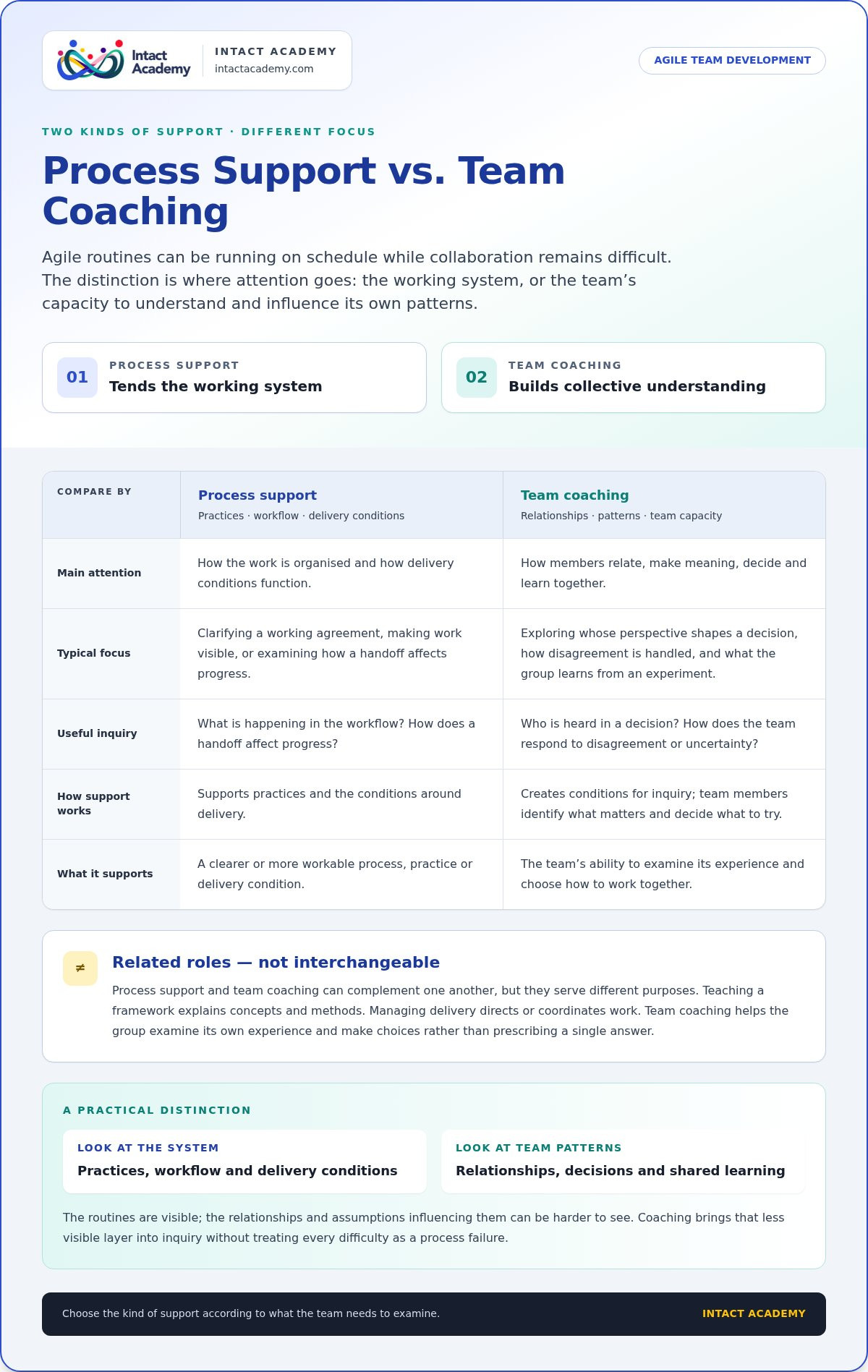
Process support focuses on practices, workflow, and delivery conditions. It might help a team clarify a working agreement, make work visible, or examine how a handoff affects progress. Team coaching turns attention to how members experience and shape those conditions: whose perspective influences a decision, how disagreement is handled, and what the group learns when an experiment doesn’t go as planned. The roles can complement each other, but they aren’t interchangeable. One tends the working system; the other supports the team’s capacity to understand and influence its own patterns.
Agile management includes ways of organising work as well as practices teams adapt to their context. A broad overview of Agile management can help situate the process side. Coaching adds a different question: what is happening between people as they use those practices? Teaching a framework explains concepts and methods. Managing delivery directs or coordinates work. Team coaching supports the group in examining its own experience and making choices rather than prescribing a single answer.
What team coaching can help an agile team notice
One difficult conversation may reflect a passing moment; a recurring pattern is worth exploring. A coach can invite the team to compare what happens during planning, delivery, review, and reflection, then consider which assumptions or expectations may be shaping those interactions. Observation is a prompt for inquiry, not a diagnosis. The aim is to connect what the team notices to its purpose and its ability to respond as conditions change.
- Who speaks early, who waits, and whose concerns surface only after a decision?
- What happens when work depends on another team or a stakeholder changes direction?
- Which tensions are discussed directly, and which are managed through silence or workarounds?
Questions like these make hidden expectations discussable without assigning blame. The team might discover that members have different understandings of “ready,” or that people hesitate to raise risks because they expect a quick solution rather than curiosity. Coaching doesn’t promise a particular delivery result. It supports shared learning and helps the team find more room to choose how it wants to work together.
How agile cycles reveal team dynamics and systemic patterns
Repeated work cycles give a team more than opportunities to plan and deliver. They create recurring moments in which members coordinate, negotiate priorities, handle uncertainty, and make decisions. Over time, those interactions can become visible enough to examine. One tense review, however, is not proof of a fixed team problem. A coach looks for patterns across situations and invites the team to interpret what it sees.
Recurring team interactions offer material for collective reflection when explored as patterns, not treated as verdicts about people. Agile principles can guide adaptation and learning without prescribing one delivery framework or ceremony. Whether a team works in Scrum, another approach, or a hybrid, its operating context matters: agreements, stakeholder expectations, dependencies, and organisational structures all influence collaboration.
Read the team in its delivery and stakeholder context
Before interpreting behaviour, map the conditions around it. What is the team’s purpose? Which decisions can it make, where does it depend on others, and whose expectations shape its priorities? A team may appear hesitant in planning, for example, while decision rights sit elsewhere or a stakeholder frequently changes direction. Those conditions don’t explain everything, but they help place the pattern in the wider system.
Keep observation separate from inference. “The decision was deferred twice” describes behaviour; “the team avoids accountability” assigns a motive. Starting with observable details gives members room to offer different perspectives and identify constraints that might otherwise remain invisible.
Recognise patterns without labelling the team
Bring examples from several points in the work cycle: how commitments are discussed in planning, how dependencies are raised during collaboration, what feedback emerges in review, and which concerns return in reflection. Ask the team what it notices before suggesting an explanation. A systemic lens, such as these systemic team coaching principles, helps connect interaction patterns with the relationships and conditions around the team.
For instance, if a risk is repeatedly raised late, invite inquiry: what makes it easier to speak up later rather than sooner? The answer may involve team habits, stakeholder responses, or incentives around certainty. The point isn’t to label the group as “resistant” or “dysfunctional,” but to test interpretations together and consider what response fits the evidence. A useful overview of systemic coaching in agile environments also explores how a systemic perspective can inform coaching practice.
This inquiry connects daily interaction to the team’s purpose and its capacity to respond to change. As coaches deepen their systemic practice, Intact Academy’s coach development offers a way to engage with theory, supervised practice, real-world application, and reflection.
Choose between coaching, facilitation, mentoring, and consulting
Coaching is not simply facilitation under another name. Facilitation helps a group work through a shared task; coaching supports the team to examine its thinking and discover its own choices. Agile teams may need both, along with mentoring or consulting at particular moments. The useful question isn’t which role is best, but what the team needs now, what it has asked for, and what it’s ready to take on.
In team coaching in agile environments, making your stance explicit helps the team understand the support you’re offering. You can also renegotiate that stance as the situation changes, rather than quietly shifting between inquiry and advice.
When to coach, facilitate, mentor, or consult
Use the distinctions below as a practical guide, not a rigid classification. The same team may need different forms of support at different points in its work, and a conversation can move between them when the shift is named and agreed.
| Intervention | Purpose | Practitioner stance | Suitable moment |
|---|---|---|---|
| Coaching | Help the team develop insight, options, and ownership. | Curious and attentive; asks questions rather than supplying the answer. | The team can explore its own experience and wants to decide how to respond. |
| Facilitation | Give structure to a shared task or conversation. | Impartial process guide who manages participation and focus. | The team needs a clear way to work through a planning discussion, decision, or disagreement. |
| Mentoring | Share relevant experience or professional insight. | Experienced practitioner offers perspective while leaving room for the team’s judgement. | The team requests guidance about a challenge within the mentor’s experience. |
| Consulting | Analyse a defined issue and recommend or provide an expert solution. | Subject-matter expert whose contribution and scope are agreed. | The team has requested expertise and needs a clear proposal or analysis. |
These roles can complement one another, but they carry different responsibilities. If a group needs help reaching a decision, facilitation may be the immediate need. If the same decision repeatedly stalls, coaching can help the team explore the pattern. Expertise may then be useful if the team wants it and understands the shift in role.
How to respond when the team expects the coach to provide answers
Start by exploring the request. Ask whether the team wants subject expertise, space to reflect, or support in making a decision. Then name your intended contribution and its limits: “I can offer a perspective from my experience, or we can examine the options together. Which would help most?” This makes the contract visible and lets the team choose.
If you offer advice, distinguish it from the team’s decision. Invite members to consider what fits their context, what trade-offs they see, and what they want to own. For practitioners developing this discernment, team coaching course selection guidance can help frame formal learning. Explore team coach development to deepen your practice.
How to integrate team coaching into an agile team's working rhythm
Team coaching works best when it becomes part of how a team learns from its work, not another recurring meeting on an already full calendar. The coach and team can use moments they already have, such as planning, a review, or a retrospective, when they offer a useful opening for inquiry. The sequence below gives the work structure while leaving the team responsible for its choices.
Contract, observe, reflect, experiment, and review: a repeatable cycle for turning team experience into learning.
- Contract. Clarify what the team wants to explore, what it hopes to learn, and who needs to be part of the conversation. Agree boundaries, including what will remain within the team and what may need stakeholder involvement.
- Observe. Notice specific interactions in the team’s existing work. For example, track how questions or concerns are handled during planning without deciding in advance what those moments mean.
- Reflect. Invite the team to make sense of what it noticed. Ask, “What stands out to you?” or “What might be influencing this pattern?” Let different interpretations emerge before settling on one.
- Experiment. Support the team to choose one manageable change related to a real collaboration challenge. It might agree to surface dependencies earlier or make space for quieter perspectives before a decision.
- Review learning. At a later point in the team’s cadence, ask what happened, what members learned, and whether they want to continue, adapt, or stop the experiment.
Contract for a focused team-coaching conversation
A clear contract keeps an inquiry purposeful without prescribing its outcome. Explore the team’s request, the learning it wants, relevant stakeholders, and the boundaries of the conversation. Agree how members will recognise useful progress, such as gaining a clearer view of a recurring tension or identifying a choice they can own. Revisit the agreement if priorities, participants, or circumstances change.
Useful contracting questions include: “What would make this conversation worthwhile?” “Who else is affected by this issue?” and “What are we able to influence as a team?” These questions help distinguish the team’s sphere of choice from constraints elsewhere in the organisation.
Turn observation into a small, reviewable experiment
Share observations in concrete, neutral language: “In the last two planning discussions, the dependency came up after work had been selected.” Then invite the team’s perspective: “What do you notice, and what might we be missing?” If the team sees value in exploring it, help members shape a small test they can revisit in their existing rhythm. Keep the experiment within their influence and agree when to review it.
Team coaching in agile environments is integrated through attention and intention, not meeting volume. To deepen your ability to work with team learning over time, explore Intact Academy’s team-coach development.
Develop the capability to coach agile teams systemically
Experience with agile practices can help a coach understand a team’s working rhythm, but familiarity with ceremonies isn’t the same as capability in working with complex team dynamics. A coach may know how to structure a retrospective and still need to notice how power, unspoken expectations, or organisational pressures shape what the team can discuss. Developing this capacity takes more than learning techniques. It also means examining your own assumptions and impact.
What deliberate development adds to agile experience
Systemic practice develops through a cycle of learning, trying, and reflecting. Supervised practice gives a coach space to examine real work, consider alternative interpretations, and receive feedback on interventions. Real-world application brings those insights into the complexity of teams and organisations; reflection helps the coach learn from what happened rather than simply move on to the next conversation.
This matters in team coaching in agile environments, where a well-intended question can open inquiry or unintentionally steer a team toward the coach’s preferred answer. Ongoing development helps practitioners become more deliberate: distinguish observation from interpretation, notice their own responses, and choose an intervention that fits the team’s context. It also supports humility. The coach’s perspective is one contribution, not the complete account of what is happening.
Explore Intact Academy’s team-coach development
Intact Academy develops coaches and teams through a pragmatic combination of theory, supervised practice, real-world application, and reflection. Its team-coach development includes the TA EMCC Senior Team Coach Academy. Trainers are accredited transactional analysts and coaches with business leadership experience, bringing psychological understanding into dialogue with organisational realities.
Training has been delivered since 1992. The Academy states: “Over the last 40 years we have trained more than 3600+ participants in 14 different countries.” Programs are accredited at EMCC senior coach level and provide ICF CCE and TA accreditation.
For practitioners considering their next step, the question may be less about collecting another technique and more about the presence and judgement their work now requires. How might deeper systemic learning help you meet team complexity with curiosity, clarity, and care? You can explore team-coach development alongside perspectives on systemic organisational change, then consider what fits your professional direction. If you’re ready to explore further, visit Intact Academy’s team-coach development.
Make your next coaching choice deliberate
The next step in developing as a team coach may begin with a moment of self-observation. After a conversation, ask yourself: whose perspective shaped my intervention, what did I assume, and where did I leave room for the team’s own understanding? These questions turn practice into learning, especially when delivery pressure makes it tempting to move quickly to a solution.
Over time, team coaching in agile environments asks for more than fluency with agile routines. It calls for the steadiness to work with uncertainty, the discernment to choose an appropriate stance, and the humility to keep learning alongside the teams you support. You don’t need every answer to begin; you do need curiosity about the impact of your presence.
If you’re ready to deepen that practice, explore Intact Academy’s team-coach development and consider what kind of systemic learning would serve your work now. Each thoughtful step can help you support teams with greater clarity, care, and confidence.
Frequently Asked Questions
Can team coaching work in a team that already follows Scrum?
Yes. Scrum can provide a useful setting for team coaching. A coach can work with questions that arise around the team’s existing practices, such as how members respond when priorities change or handle disagreement about a commitment. The Scrum structure doesn’t need to be replaced. Team coaching in agile environments helps members explore what their experience of using that structure reveals and decide what they want to adjust.
How is an agile team coach different from a Scrum Master?
An agile team coach and a Scrum Master may both support a team, but their accountabilities aren’t identical. A Scrum Master serves the Scrum Team and supports effective use of Scrum. A team coach focuses on the team’s collective relationships, patterns, and capacity to learn. In practice, responsibilities can overlap, especially in smaller organisations. Being clear about the role in a given conversation helps the team understand whether it is receiving process guidance or developmental inquiry.
Can team coaching work with a remote or hybrid agile team?
Yes. Remote and hybrid teams can engage in coaching, though the coach needs to attend to how the working arrangement shapes participation. Decisions may happen in hallway conversations that remote colleagues miss, for example, or some members may contribute more easily in writing than in a live call. Agree how everyone can take part, make informal communication visible, and invite the team to examine whose perspective is heard when work is discussed.
How can a team coach work with a resistant team?
A coach can begin by treating reluctance as information, not a defect to overcome. The team may be unclear about why coaching is happening, wary of being evaluated, or under pressure to spend its time elsewhere. Clarify who requested the work, what will happen with what the team shares, and whether members are willing to explore a specific question. If readiness is limited, start with a smaller, useful conversation and respect the team’s choice.
How can a team sustain learning after a coaching engagement?
A team can sustain learning by building reflection into ordinary work rather than relying on the coach to prompt it. Members might revisit one learning question in an existing team conversation, invite different people to notice how collaboration is unfolding, or record decisions and return to them later. The aim is not to preserve a particular coaching format, but to strengthen the team’s confidence in noticing patterns and learning from its own experience.
What should an organisation consider before bringing in a team coach?
An organisation should clarify why coaching is being considered and what the team will be invited to work on. Distinguish the team’s developmental goals from a manager’s hopes for a quick fix, and discuss how the coach’s role relates to leadership, confidentiality, and organisational constraints. Consider whether the team has enough time and permission to engage honestly. Clear expectations make it easier for the coach and team to establish a useful working relationship.
Does team coaching replace agile training or technical expertise?
No. Team coaching addresses how a team works and learns together; it doesn’t replace instruction in agile practices or the subject-matter expertise needed to solve technical problems. If a team needs to understand a framework or resolve a specialist issue, training or expert input may be appropriate. Coaching can complement that support by helping members decide how to apply what they learn in their context and coordinate around the choices involved.


