

What if a change initiative redesigns roles and processes, yet the same tensions return under new names? That pattern is a signal: structures matter, but so do the relationships and assumptions shaping how people work. TA for organizational development offers a way to make those dynamics visible without reducing colleagues to labels or treating a complex system as a diagnosis.
If thoughtful plans stall amid repeated conflict, silence, or unclear authority, the challenge may be less about resistance than about patterns the organization has learned to repeat. This guide explains how Transactional Analysis can help you explore those patterns and translate insight into deliberate, sustainable change. You’ll learn how TA can complement other organizational development approaches, how to apply its concepts to practical work, and what responsible, systemic use requires. The aim is not to explain people away, but to support greater awareness, choice, and more genuine ways of working together.
Key Takeaways
- Use TA for organizational development to notice recurring interaction patterns in meetings, decisions, feedback, and team boundaries.
- Separate observable behavior from assumptions about people’s motives or personalities to keep inquiry respectful and useful.
- Assess whether a challenge calls for a structural, process-focused, culture-focused, or TA-informed lens. Combine approaches when that better fits the question.
- Move from insight to action with a clear sequence: contract, map the system, observe patterns, agree on an experiment, and review what changes.
- Build organizational TA capability through theory, real-world application, reflection, and supervised practice.
Why use Transactional Analysis for organizational development?
Organizational development is planned work to strengthen an organization’s capacity, relationships, and ability to adapt. It may include redesigning roles, improving decision-making, or supporting a strategic shift. A new structure, however, cannot determine how people will use it. Everyday interactions influence whether information travels, responsibility is shared, and change becomes workable.
Transactional Analysis (TA) is a framework for understanding transactions, recurring patterns, and human interaction. Concepts such as ego states give people language to explore how they communicate and respond to one another. The Transactional Analysis overview provides foundational context. In organizational work, the practical task is to use TA to ask better questions about interactions and the conditions around them.
Individual insight can help someone make different choices. Systemic organizational development asks how relationships and conditions across the organization can change together.
What does TA add to organizational development?
TA gives practitioners a way to describe what happens between people without diagnosing the organization. Instead of concluding that a team is “difficult,” describe the exchange: someone raises a concern, a manager answers on behalf of the group, and colleagues stop contributing. That sequence is a more useful starting point than a label or an assumption about intent.
From there, connect visible behavior with roles, relationships, and context. Does the meeting make room for challenge, or reward agreement? Are decision rights clear? Do teams have the information and authority their responsibilities require? TA for organizational development supports this kind of inquiry. It can inform development work, but it is not a shortcut to diagnosing people or organizations.
Which organizational challenges can TA help practitioners explore?
Recurring communication breakdowns, role confusion, and stalled collaboration are useful starting points. Imagine a cross-functional project where decisions keep returning to senior leaders, even though teams have been asked to act independently. Rather than attributing the delay to one person’s reluctance, explore how leaders respond to uncertainty, how teams interpret accountability, and whether governance supports the requested autonomy.
A pattern can involve several levels at once: a leader’s response, a team’s way of managing disagreement, stakeholders’ competing priorities, and conditions such as unclear authority or conflicting targets. The practitioner’s task is to hold these perspectives in view, test interpretations with the people involved, and avoid treating one account as the whole system.
This wider lens matters during change, when altered structures can unsettle relationships and familiar ways of working. A systemic approach to leading organizational change can help practitioners consider how psychological dynamics and organizational conditions interact. TA adds a disciplined way to notice repeated exchanges within that broader picture and explore where people have room to make different choices.
How Transactional Analysis reveals patterns across an organization
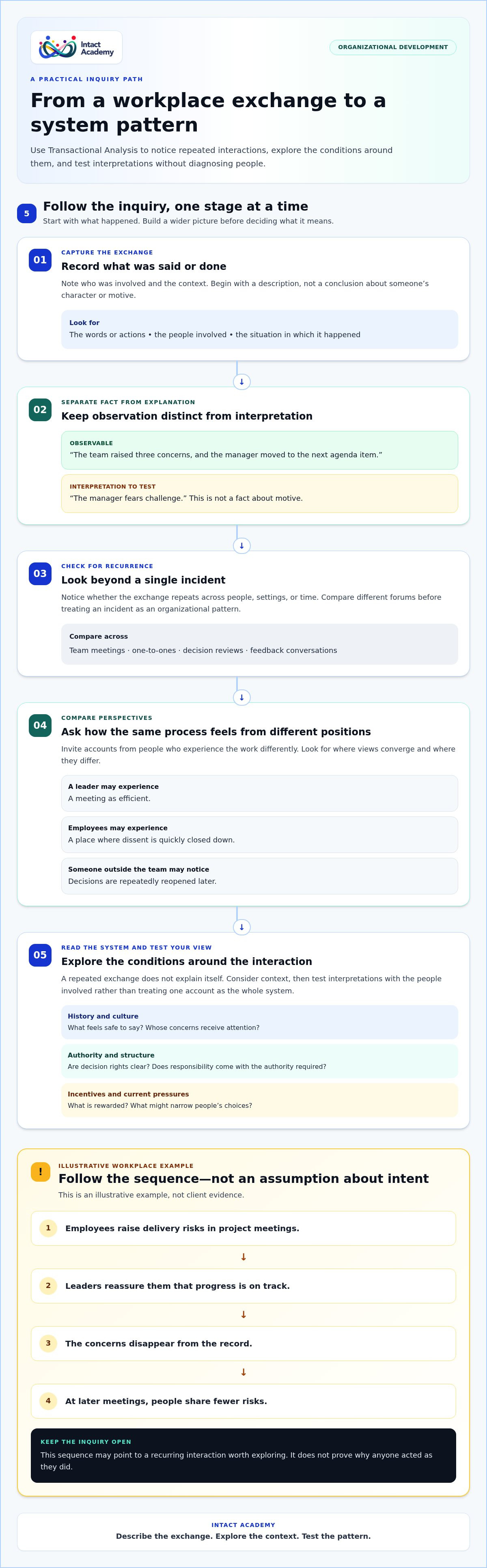
To see organizational patterns, look beyond a single exchange. A meeting may end with decisions deferred, feedback conversations may repeatedly become defensive, or cross-functional work may stall at the same handoff. Notice each incident, then look for recurrence across people, settings, or time before treating it as a pattern.
In TA for organizational development, begin descriptively: record what was said or done, by whom, and in what context. Then separate observation from explanation. “The team raised three concerns, and the manager moved to the next agenda item” is observable. “The manager fears challenge” is an interpretation to test, not a fact.
From individual interactions to organizational patterns
Consider this illustrative workplace example, not client evidence: in several project meetings, employees raise delivery risks, leaders reassure them that progress is on track, and the concerns disappear from the record. At later meetings, people share fewer risks. This sequence may point to a recurring interaction worth exploring, but it does not prove why anyone acted as they did.
To understand how widely it occurs, compare different forums: team meetings, one-to-ones, decision reviews, and feedback conversations. Notice whether the pattern changes with different participants or persists across settings. Foundational reading on the three ego states in Transactional Analysis can help explain the model, while organizational inquiry considers how interactions play out in context.
Read patterns in context, not in isolation
A repeated exchange does not explain itself. Organizational history may shape what feels safe to say. Culture and authority can influence whose concerns receive attention. Incentives may reward speed over surfacing risk, while current pressures can narrow people’s choices. Structures matter too. If a process gives a team responsibility without decision authority, repeated escalation may be a predictable response to the arrangement, not simply an interpersonal habit.
Invite perspectives from people who experience the same process differently. A leader may see a meeting as efficient, while employees experience it as a place where dissent is quickly closed down. Someone outside the team may notice that decisions are repeatedly reopened later. Comparing these accounts helps identify where experiences converge and where the pattern looks different from each position.
Organizational patterns are hypotheses to explore, not labels to impose. Hold a possible explanation lightly, check it against what people observe, and consider alternatives before deciding what to change. TA concepts can guide attention, but no single concept explains complex behavior on its own. The purpose is to widen inquiry, not fit people into categories.
For practitioners who want to deepen theory-informed work with people and systems, Intact Academy’s TA and organizational change work offers a relevant learning context.
TA and Other OD Approaches: How to Assess Fit
Choose an organizational development lens by starting with the question, not allegiance to a method. Is the difficulty rooted in unclear accountability, a process that creates bottlenecks, norms that discourage challenge, or repeated interactions that shape how people respond? These factors can overlap. TA for organizational development can contribute relational insight, while structural, process-focused, and culture-focused approaches illuminate other parts of the system.
The table is a decision aid, not a ranking. “Typical scale” describes a common focus, not a limit: each lens can be used at different levels depending on the work.
| Approach | Primary lens | Useful questions | Typical scale | Possible contribution |
|---|---|---|---|---|
| TA-informed inquiry | Recurring transactions and relationship patterns | What interactions repeat? How are authority and response shaping them? | Conversations, teams, or patterns across units | Adds a relational view of how people participate in organizational life |
| Structural OD | Roles, reporting lines, decision rights, and accountability | Who owns this decision? Do responsibilities and authority align? | Roles, functions, or organization-wide design | Clarifies how formal arrangements enable or constrain work |
| Process-focused OD | Workflows, handoffs, and decision processes | Where does work pause, loop back, or lose information? | A workflow, service, or cross-functional process | Shows where process design may be creating friction or delay |
| Culture-focused OD | Shared norms, assumptions, and meaning | What behavior is rewarded, discouraged, or taken for granted? | A team, community, or organization | Surfaces shared expectations that influence everyday choices |
When is a TA lens especially useful?
TA may be useful when similar interaction patterns appear across teams or organizational levels, particularly when a process map or role chart does not explain how the pattern continues. For example, a decision process may be clear on paper, yet discussions repeatedly end with responsibility moving upward. TA-informed inquiry can explore the exchanges around authority and accountability alongside the formal process. Its usefulness depends on the context and on whose experience is included.
When should TA be integrated with broader change work?
Some questions call for more than a relational lens. Changes to strategy, reporting structure, incentives, or stakeholder commitments may also require structural, process, or culture-focused work. Practitioner judgment helps determine whether TA should lead the inquiry or sit alongside other methods. Match the lens to the challenge rather than asking one framework to explain everything.
When shared norms and repeated interactions intersect, using TA to uncover organizational culture can inform a broader systemic view. Combining perspectives helps practitioners examine both the conditions people work within and the relationships through which those conditions are experienced.
A practical sequence for applying TA in organizational development
Applying TA in organizational development means moving from a question about work to shared learning and considered action. The sequence below gives practitioners a practical structure while leaving room to adapt it to the organization, its stakeholders, and what emerges.
Contract and inquire with the system
Before intervening, clarify the development question, who the work concerns, what learning is sought, and how findings will be used. Agree roles, boundaries, and confidentiality with the sponsor and participants. Consent matters throughout: people should understand what information is gathered, who will see it, and what confidentiality can reasonably mean in the organizational setting. Use non-blaming language from the outset.
- Contract the work. Define the question and scope with the sponsor, while including perspectives from people affected by the issue. If handoffs between departments repeatedly falter, for example, agree whether the inquiry concerns communication, decision authority, workflow, or a combination. Make the purpose and limits explicit.
- Map the system. Identify relevant stakeholders, relationships, decision points, and conditions around the question. Ask people who send, receive, and oversee a handoff how it works in practice. Include formal roles and processes as well as informal connections that influence how information moves.
- Observe patterns. Gather evidence through appropriate conversations and observation of relevant work. Record what happens, where, and between whom. Keep those observations distinct from interpretations about motive or personality. Compare accounts across roles, then share emerging themes as questions stakeholders can reflect on, not conclusions imposed on them.
- Agree an experiment. Co-design a proportionate action connected to the agreed question. If handoff information is often incomplete, stakeholders might test a shared method for clarifying ownership and required details. Agree who will take part and which observable signs, such as fewer clarification loops or clearer responsibility, would indicate learning. These signs guide review; they do not promise a result.
- Review learning. Bring the involved stakeholders together to consider what shifted, what persisted, and whether the experiment affected other parts of the system. Ask whose experience changed and whose did not. Use the learning to decide whether to adjust the experiment, explore another factor, or conclude this phase of the inquiry.
Turn insight into action and learning
Keep consent, confidentiality, and role boundaries in view at every stage, especially when observations are shared beyond the people who provided them. Use curious, specific language: describe actions and conditions rather than assigning blame. If a new question emerges, revisit the contract with stakeholders before extending the work.
This sequence is iterative inquiry, not a linear guarantee: each review can refine the question, the action, or the understanding of the system. Practitioners seeking to deepen theory-informed, supervised practice can explore Intact Academy’s TA and organizational change learning.
Develop your TA capability for organizational work with Intact Academy
Applying TA thoughtfully across an organization takes more than familiarity with concepts. Practitioners need to connect theory to real situations, reflect on their own impact, and learn through supervised practice. These disciplines help keep inquiry curious and grounded, especially when patterns involve authority, competing perspectives, or sensitive workplace dynamics. They also reinforce an important distinction: using TA to open exploration is different from using it to label people or explain away organizational complexity.
Intact Academy is an international institute for coaching, Transactional Analysis, and organizational change. Its training activities have been delivered since 1992. The Academy states that over the last 40 years it has trained more than 3600+ participants in 14 different countries. Its international training is delivered in person in 14 different countries and online.
What supports deeper, responsible TA practice?
Intact Academy brings theory and practice together through supervised practice, real-world application, and reflection. This combination gives practitioners space to consider not only which TA ideas may illuminate a situation, but also how their questions, assumptions, and interventions affect the people involved. Supervision and reflection can help practitioners distinguish an observed pattern from a conclusion they may be tempted to draw.
The Academy’s trainers bring accredited Transactional Analysis and coaching expertise alongside business leadership experience. Its stated areas of emphasis include pattern interruption and intuitive development. In organizational work, these can help practitioners notice familiar responses while staying attentive to the context in which people and teams operate.
Explore a learning pathway for your organizational work
For practitioners who want to build their foundations, the TA Foundation program offers a starting point for developing a stronger grounding in the approach. Executive and Team Coach development programs connect learning to work with leaders and groups. The right learning focus depends on your role, experience, and the organizational questions you are preparing to address.
Intact Academy’s programs are EMCC accredited at senior coach level, provide ICF CCE accreditation, and lead to TA accreditation. Training combines supervised practice, real-world application, and reflection to connect learning with professional work.
As you consider your next step, ask what would strengthen your practice: clearer theoretical understanding, more opportunity to apply TA in organizational settings, or a reflective space to examine your work. A pathway that combines these elements can help you develop greater care and discernment as you work with patterns across people, teams, and organizations. Explore Intact Academy programmes to consider how its learning may support your organizational work.
Take the next step in your organizational practice
Begin with one question from your own system: which recurring interaction would be useful to understand more clearly? Let that question guide where you listen, whose perspectives you include, and what small experiment could support learning. The value of TA for organizational development lies not in finding a label for a pattern, but in helping people create more space to notice, reflect, and choose differently.
As your practice deepens, keep returning to the quality of your inquiry. Are you curious about the system as well as the people within it? Are you making room for perspectives that challenge your first interpretation? These questions can help turn insight into work that is thoughtful, grounded, and responsive to real organizational conditions.
Develop your capability in Transactional Analysis and organizational change with Intact Academy. Explore its learning programs and take a practical next step in your organizational work.
Frequently Asked Questions
What is Transactional Analysis in organizational development?
Transactional Analysis is a framework practitioners can use to explore how communication and repeated exchanges shape working relationships. In organizational development, its value lies in examining patterns within their setting, rather than treating an interaction as a complete explanation of a person or team. For example, a practitioner might explore how people respond to challenge in project reviews and how meeting norms or decision practices influence those responses.
How can Transactional Analysis support organizational change?
Transactional Analysis can help practitioners examine how people relate to a proposed change, including how concerns are voiced, heard, or left unaddressed. That inquiry can add context to change planning. Leaders may discover, for instance, that staff understand a new process differently or that feedback channels make it difficult to raise practical concerns. These observations can inform how change is communicated and where dialogue may help, without guaranteeing acceptance or a particular result.
Can Transactional Analysis be used with teams as well as individuals?
Yes. Practitioners can use TA-informed questions in individual work, team settings, and organizational conversations. With an individual, the focus may be on how they experience a particular exchange and what choices they see. With a team, inquiry can include shared meeting habits, how disagreement is handled, and how members coordinate with other groups. The scale changes, but care is needed to include differing perspectives rather than assume a team has one shared view.
What is the difference between TA and organizational development?
TA is a framework for understanding human interaction; organizational development is broader planned work concerned with an organization’s capacity and adaptation. A practitioner may use TA as one lens within an OD effort, alongside attention to roles, workflows, strategy, or culture. For example, if a redesign changes reporting lines, an OD process may address the structure while TA-informed inquiry explores how people are negotiating new expectations and relationships.
Is Transactional Analysis suitable for every organizational change initiative?
No single framework fits every change question. TA may be relevant when relational dynamics are part of what needs understanding, but it may not be the central lens if the immediate issue is a technical redesign, unclear process ownership, or a strategic decision. Practitioners can assess the question, context, and affected stakeholders, then decide whether TA should lead the inquiry or complement other forms of organizational development.
How do practitioners learn to apply TA in organizational development?
Practitioners develop capability by connecting concepts to real work, then reflecting on how their interpretations and interventions affect others. Intact Academy’s TA Foundation program and Executive and Team Coach development programs provide learning pathways for building TA and coaching practice. Supervised practice can help practitioners examine cases, test assumptions, and strengthen their judgment about when a TA lens is useful in organizational settings.


