

What if the most useful first team coaching session doesn’t solve the team’s problems? Preparing for your first team coaching session can bring its own pressure: you want to ask the right questions, account for different expectations and levels of willingness, and be ready if difficult dynamics surface. It’s natural to want a detailed plan. But a plan that leaves no room for what the team actually brings can close down the conversation you’re there to open.
The first session doesn’t need to create comfort or consensus. It needs to establish a clear purpose, appropriate boundaries, and enough safety for people to participate honestly. That shared starting point can make the work more grounded than rushing towards solutions before the team understands what’s happening.
This article will help you prepare with intention, without over-planning or trying to control every turn. You’ll explore what to clarify beforehand, how to set expectations and boundaries, and how to respond when tensions emerge. The aim is to leave the first session with a more shared understanding of the team’s situation and a meaningful next step, not a premature answer.
Key Takeaways
- Approach the first session as shared inquiry, not a ready-made intervention or a search for immediate solutions.
- When preparing for your first team coaching session, clarify the request, participants, contracting boundaries, and the difference between the sponsor’s hopes and the team’s own reasons for engaging.
- Plan a flexible session arc, then adapt the opening to the team’s context and readiness rather than scripting every moment.
- Meet silence, scepticism, and competing agendas with curiosity. Resistance can reveal important information about expectations and safety.
- Close by identifying what became clearer, what remains uncertain, and one small next step the team understands together.
Preparing for Your First Team Coaching Session Starts with a Shared Purpose
A first team coaching session isn’t a ready-made intervention delivered to a group. It’s the beginning of shared inquiry: a chance to understand how the team sees its purpose, what its work asks of it, and where its current ways of working help or hinder that work. The coach brings structure and curiosity, while the team’s task and context shape what deserves attention.
A team’s presenting request may not capture the whole picture. A sponsor might hope to improve collaboration, while team members may be more concerned about unclear priorities or decisions that are difficult to make. Those perspectives don’t need to match before the session begins, but they do need room to be heard and examined together.
Shared exploration creates a useful starting point. It isn’t a promise to solve everything in one session.
When preparing for your first team coaching session, define a realistic initial aim rather than an ambitious outcome. You might aim to understand enough context to work responsibly, hear a range of perspectives, and identify a question the team wants to explore. This keeps the session purposeful without deciding in advance what the team’s difficulty means or which intervention it needs.
What should the first team coaching session accomplish?
The session should help the team build an initial understanding of its situation, not deliver a final diagnosis. For example, if meetings feel unproductive, listen for how members describe the task, how decisions are made, and what they believe is getting in the way. Treat these observations as material for inquiry, not proof of a fixed cause. A useful outcome could be a shared next question or step, even if views remain different.
Success doesn’t have to look like instant harmony or consensus. The team may leave with greater clarity about a tension, a more precise description of its work, or recognition that members have different expectations. That is meaningful progress if it helps the team choose what to examine next.
How is team coaching different from individual coaching?
In individual coaching, attention centres on one client’s goals and experience. Team coaching also attends to relationships, recurring interaction patterns, the team’s task, and the wider organisational system shaping its work. The team isn’t simply a set of individual clients taking turns to speak. What happens between people is part of the material being explored.
This systemic focus changes the questions a coach listens for. Alongside “What does each person want?”, consider “What is the team here to deliver?” and “How do its structures or relationships influence that work?” The broad overview of coaching, including its team-focused dimension, in What is Team Coaching? offers useful context. Developing a systemic team coaching perspective can also help coaches hold individual contributions and collective patterns in view without reducing one to the other.
What to Clarify Before Your First Team Coaching Session
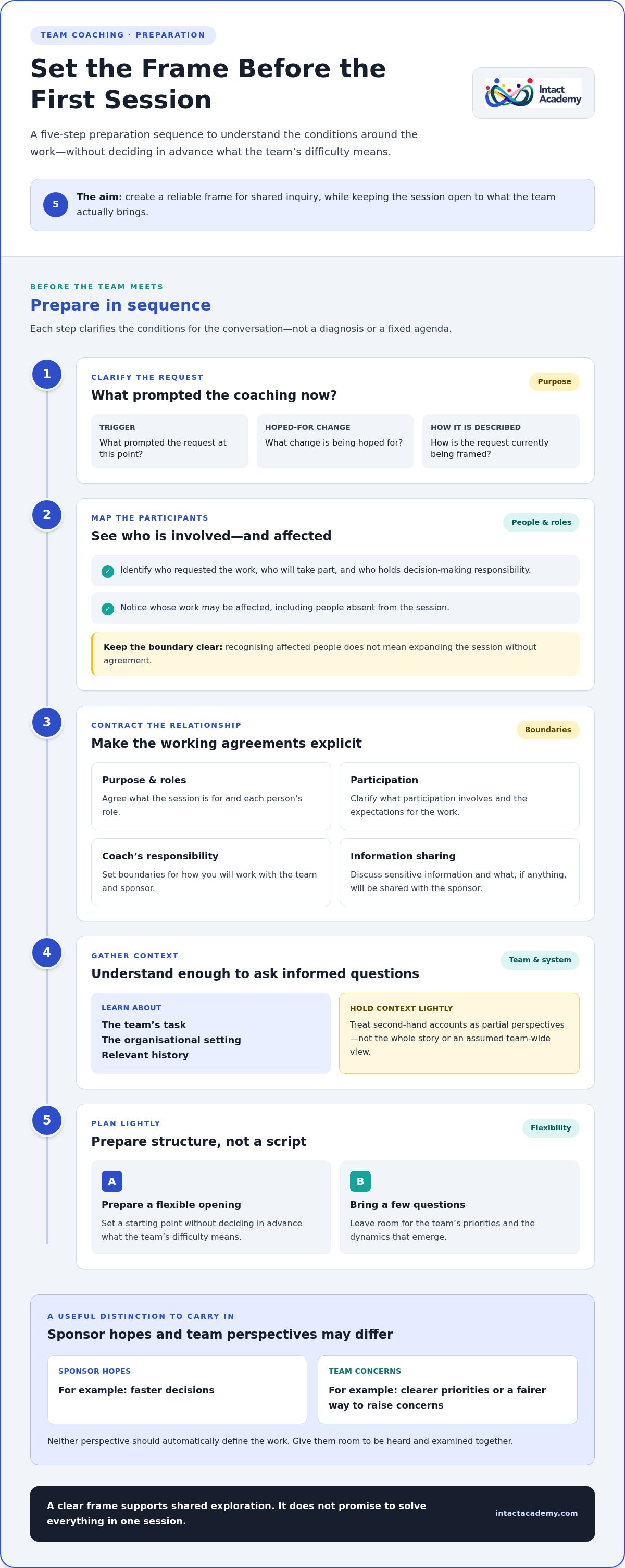
Preparation is less about predicting the conversation than understanding the conditions around it. Before the team meets, clarify the request, who will be involved, how information will be handled, and what the coaching is meant to support. This gives you a reliable frame without locking the session into a diagnosis or agenda that may not fit what members bring.
Use this sequence to create that frame:
- Clarify the request. Ask what prompted the coaching now, what change is hoped for, and how the request is being described.
- Map the participants. Identify who requested the work, who will take part, who holds decision-making responsibility, and whose work may be affected.
- Contract the relationship. Agree on the purpose, roles, participation expectations, boundaries, and how the coach will work with the team and sponsor.
- Gather context. Learn enough about the team’s task, organisational setting, and relevant history to ask informed questions. Treat second-hand accounts as partial perspectives, not the whole story.
- Plan lightly. Prepare a flexible opening and a few questions, leaving room for the team’s priorities and emerging dynamics.
Whose expectations and perspectives should you understand?
Start by distinguishing the sponsor’s hopes from the team’s own reasons for engaging. A sponsor may want faster decisions, while team members may want clearer priorities or a fairer way to raise concerns. Neither perspective should automatically define the work. Understand who commissioned the coaching, who will participate, and who can make decisions about its purpose and continuation.
Notice who is absent but affected by the team’s work, too. That doesn’t mean expanding the session without agreement; it means recognising that the team operates within a wider system. Respect confidentiality as you gather context, and don’t turn one person’s account into an assumed team-wide view.
What should you agree before the team meets?
Make the working arrangements explicit: what the session is for, each person’s role, what participation involves, and where the coach’s responsibility begins and ends. Discuss how sensitive information will be treated and what, if anything, will be shared with the sponsor. For example, agree whether updates will focus on process and next steps rather than attributing comments to individuals.
Keep the agreement proportionate. Clear contracting doesn’t need to resolve every future question, but it should reduce avoidable ambiguity before people enter the room. A dedicated guide to coaching contracting can offer further detail on shaping these agreements. The same care for boundaries and role clarity supports effective systemic team coaching. Coaches looking to deepen that capacity can explore systemic team coaching education as part of their ongoing development.
How to Design a First Team Coaching Session Without Overplanning
A useful agenda gives the team a clear container, not a script to follow regardless of what happens. When preparing for your first team coaching session, sketch a flexible arc: arrival, shared purpose, inquiry, synthesis, and next steps. This sequence helps participants orient themselves, explore what matters, and make sense of what they’ve heard. It also leaves room to follow a significant pattern as it emerges.
Keep the design proportionate to what you know. If the request is still broad, begin with conversation rather than a diagnostic tool or elaborate exercise. Activities can support inquiry, but they shouldn’t replace understanding the team’s task, context, and readiness. A simple, relevant question may reveal more than an exercise chosen before you know what the team needs.
Which opening approach fits the team’s readiness?
Choose an opening that invites participation without demanding immediate personal disclosure. A brief check-in can help members arrive and notice the range of perspectives in the room. Purpose-setting can clarify why the team is meeting. An expectations round can bring hopes and concerns into view, though it may feel too exposing if trust is limited or the coaching request is unclear.
| Opening approach | Useful when | Consider if |
|---|---|---|
| Brief check-in | The team needs time to settle and orient. | Speaking in turn may feel forced or overly personal. |
| Purpose-setting conversation | The reason for meeting needs shared clarification. | The sponsor’s stated aim may be mistaken for everyone’s purpose. |
| Expectations round | Hopes, questions, or reservations need to be surfaced. | Members may not yet feel ready to name concerns in front of colleagues. |
Offer a low-pressure way to contribute, such as inviting people to share what they want the session to make possible, or letting them pass and return to the question later. The opening should create a path into the work, not test who is willing to disclose the most.
How much structure should the first agenda include?
Give each part a purpose, then stay responsive. You might open with a check-in, clarify what the team wants to explore, inquire into different experiences of its work, reflect on what is becoming clearer, and agree what to carry forward. This structure supports attention without deciding in advance what the team should discover.
Use questions that make room for difference: “What feels most important about the team’s task right now?” or “Where do our views of this situation diverge?” Avoid questions that imply a preferred answer. If the conversation reveals a recurring pattern, pause and explore it rather than rushing back to the agenda. A well-held session can be both deliberate and open.
- Arrival: Help members orient and choose how they’ll participate.
- Shared purpose: Invite the team to clarify what deserves attention.
- Inquiry: Explore perspectives, interactions, and relevant context.
- Synthesis: Reflect back themes and differences without forcing agreement.
- Next steps: Identify what the team wants to continue exploring.
How to Respond When the Team Is Guarded, Resistant, or Divided
Silence, scepticism, and disagreement don’t automatically mean the session has failed. They may signal unclear expectations, past experiences, perceived risk, or a difference between what the sponsor wants and what the team is ready to explore. When preparing for your first team coaching session, consider how you’ll stay curious if participation is uneven, without pressuring people to speak or treating one person’s account as the whole story.
Psychological safety makes honest participation more possible; it doesn’t require agreement or remove discomfort. A team can disagree and still work constructively, provided members can express different views without being shamed or pushed into false consensus.
What can resistance be signalling?
Start with what you can observe, not a diagnosis of why someone is behaving a certain way. A quiet room may reflect caution, uncertainty about the purpose, or simply a need to think. Scepticism may arise because coaching feels imposed or because previous initiatives didn’t address the team’s real concerns. Ask neutrally: “What would be useful for us to understand about the hesitation?” or “What feels unclear about why we’re meeting?”
Let people answer in their own terms, including choosing not to share something personal. Disagreement isn’t automatically dysfunction, and reluctance isn’t proof that someone is unwilling to change. Treat each response as a cue to inquire into the conditions around the work.
How can you work with tension without taking sides?
When competing agendas emerge, resist deciding too quickly which one is valid. Bring attention to the interaction itself and its impact on the team’s task. You might say, “I notice we’ve moved quickly from one proposal to another, and we haven’t yet heard what makes each important. What might we be missing?” This names an observable pattern tentatively and invites joint examination rather than assigning blame.
If members press for a quick answer, acknowledge their wish for clarity while staying honest about what the conversation has and hasn’t established. Ask what decision is needed now, what information is missing, and whether that decision belongs in the coaching session. This keeps the inquiry connected to the team’s work without pretending a complex tension can be resolved on demand.
When the exchange becomes heated, repetitive, or too personal for the agreed purpose, pause. Reflect what you’re observing, check whether participants want to continue, and clarify or renegotiate the process if needed. Holding multiple perspectives doesn’t mean allowing every interaction to continue unchecked. It means protecting the work while returning attention to the shared task.
- With silence: Allow a pause, then offer a less exposing way to contribute, such as writing a thought before sharing.
- With scepticism: Invite members to name what would make the time relevant to their work.
- With competing agendas: Make the differences visible and ask how each connects to the team’s purpose.
Developing the capacity to hold these dynamics is part of systemic team coaching practice. Explore the TA EMCC Senior Team Coach Academy to deepen your approach to complex team processes.
How to Close the First Team Coaching Session and Choose What Comes Next
The close is part of the coaching, not an administrative afterthought. Reserve enough time for the team to make sense of the conversation rather than ending as soon as the most charged topic has been explored. A considered close helps members distinguish what they learned from what they still need to understand, and prevents an early insight from being mistaken for a complete explanation.
What should the team leave with?
Invite members to reflect on three questions: What became clearer? What remains uncertain? What matters enough to explore next? Listen for shared observations as well as meaningful differences. If the team began with one purpose but surfaced a more pressing concern, check together whether the original purpose still fits. The aim isn’t to manufacture agreement; it’s to identify a next step members understand and can realistically take.
Make the step specific and proportionate. The team might agree to notice how decisions are made before the next meeting, or bring a particular unresolved question into a future conversation. Confirm who will do what and when it will be revisited. Don’t present this as proof that the underlying issue has been solved.
Before closing, clarify the follow-up: what will be recorded, who will receive it, and how the sponsor will be updated. Stay within the confidentiality and communication agreements already established. A brief summary of themes and agreed actions may be useful, but don’t attribute sensitive contributions to individuals unless that has been explicitly agreed.
How can a coach develop their team-coaching practice?
After the session, set aside time to reflect on your own practice. Which interventions opened inquiry, and which may have narrowed it? What assumptions did you bring about the team’s purpose or dynamics? Notice how your timing, questions, and responses may have shaped participation. This reflection isn’t about judging every choice as right or wrong; it helps you identify what to carry forward and what to examine more deeply.
For a brief team reflection, invite each member to complete a sentence such as “One thing I’m taking away is…” or “A question I want us to keep exploring is…”. Participation can be spoken or written, and nobody needs to disclose more than feels appropriate. The responses offer a final check on whether the team’s next step reflects what members actually heard and valued.
Thoughtful preparation and reflective practice develop together. If you want to deepen your capacity to work with team dynamics and systemic patterns, explore the TA EMCC Senior Team Coach Academy as a pathway for ongoing learning. Preparing for your first team coaching session is one part of that development; learning from what unfolds helps shape the next.
Let the First Conversation Shape the Work Ahead
The first session isn’t a test of whether you can resolve every tension. It’s an opportunity to stay present with what the team is ready to see, while remaining attentive to what still needs time. As you continue preparing for your first team coaching session, hold your plan as a guide, not a verdict on how the conversation should unfold.
Afterward, let your reflection become part of the learning. What did you notice about the team’s patterns, and how did your interventions influence the conversation? This ongoing inquiry can deepen your capacity to support teams with care and systemic perspective. Intact Academy brings together participants from more than 14 countries and offers the TA EMCC Senior Team Coach Academy for coaches seeking to develop their practice.
Explore Intact Academy’s team coaching learning and take a considered next step in your development. Each session offers another opportunity to meet the team with curiosity, clarity, and confidence in the value of beginning well.
Frequently Asked Questions
How do I prepare for my first team coaching session?
Prepare a short working brief for yourself, not a script for the team. As you’re preparing for your first team coaching session, note the request in the sponsor’s words, what you still don’t know, and any assumptions you want to test rather than treat as facts. Check practical details too: who will handle logistics, whether the session is online or in person, and how participants can contribute comfortably.
What should a coach ask a team before the first coaching session?
Ask questions that help members arrive with a point of view, without making them responsible for solving the issue in advance. For example: “What would make this conversation worth your time?” “What should we understand about the work you do together?” and “Is there anything about the process you’re uncertain about?” Make participation optional in the format you choose, and avoid asking for sensitive personal information before trust and purpose are established.
How long should a first team coaching session last?
There’s no single ideal duration. Agree on a length that fits the purpose, the team’s capacity, and the complexity of the conversation. A session that ends just as important perspectives emerge may feel abruptly cut off, while an unnecessarily long meeting can reduce attention. Build in time for a pause if needed and protect space near the end for reflection. If the work needs more time, discuss that openly rather than stretching the meeting without agreement.
Should the team leader attend the first team coaching session?
The leader should usually attend if they’re part of the team whose relationships and work are being explored. Their presence can clarify decision-making and make the team’s context visible, but it may also affect what others feel able to say. Before the session, discuss the leader’s role and agree how the coach will invite participation across different levels of authority. If the leader is the sponsor rather than a participant, clarify that distinction with the group.
What happens if team members do not want to participate in coaching?
Don’t treat reluctance as consent, defiance, or a problem to overcome through pressure. Ask what participation means to people and whether they understand why the work is happening. Someone may be concerned about confidentiality, feel the decision has already been made, or have limited capacity to engage. Offer clear choices about how to contribute, then revisit the purpose and conditions with the sponsor if the team can’t take part meaningfully.
How is a first team coaching session different from a team-building workshop?
A team-building workshop often centres on planned activities designed to practise a skill or strengthen connection. A first team coaching session is more exploratory: it gives the team space to examine how it works together in relation to its real task. The formats can overlap, but the intention differs. Rather than assuming an exercise will address the issue, the coach listens for what the team identifies as relevant to its work.
What should happen after the first team coaching session?
After the session, the coach should follow the communication agreements and record only what’s useful for the work. The team can carry out its agreed next step, while the coach reflects on what shaped the conversation and what questions remain open. If further coaching is proposed, the team and sponsor can decide whether the purpose, participants, and boundaries still fit. Avoid reporting early observations as a final assessment of the team.


