

What if a crisis is not only testing your team’s resilience, but revealing the interaction patterns already shaping its decisions? Managing team dynamics in a crisis can feel like restoring coordination while the ground keeps moving: communication turns reactive, a few voices dominate, and others retreat or blame. The pressure is real, and it affects how people think and work together.
Clear communication and decisive action matter, but telling people to stay focused rarely resolves the tension behind a stalled decision. Leaders also need to notice what the system is doing, make room for emotion without losing direction, and help disagreement become useful rather than divisive.
This guide shows you how to read the pressures shaping a team, spot recurring patterns before they harden, and restore enough trust and clarity for coordinated action. It covers practical ways to set priorities and communication norms, bridge hybrid experiences, and use structured reflection to turn crisis into learning. The aim isn’t a frictionless team. It’s a team able to respond, adapt, and become more resilient together.
Key Takeaways
- Managing team dynamics in a crisis begins with recognizing how pressure is changing trust, authority, communication, and coordination.
- Trace how role confusion, competing priorities, and information gaps interact instead of treating each tension as an isolated problem.
- Distinguish operational updates from the deeper conversations needed to clarify trust, conflict, and decision rights.
- Use a practical sequence to stabilize the situation, observe patterns, clarify priorities, agree how to work together, and review what’s changing.
- Build crisis capability over time through reflection and learning that connects team relationships, tasks, stakeholders, and organizational context.
Managing team dynamics in a crisis starts with seeing the pressure clearly
A crisis changes more than the work in front of a team. It can shift trust, communication, authority, and coordination as people respond to uncertainty and urgency. Crisis changes team interaction by intensifying existing patterns and narrowing the space people have to question, listen, and adapt. Tension isn’t automatically evidence of poor attitude or weak commitment. It may reflect unclear information, competing demands, or a context in which people don’t know what they can safely decide.
Start by separating the immediate operational problem from the relational patterns affecting the response. The operational problem might be a service interruption or a fast-changing deadline. The relational questions are different: Who is making decisions? Whose information is trusted? Can people raise concerns without being labelled obstructive? The wider crisis management process provides useful context; this section focuses on how people coordinate under pressure.
What changes in a team when uncertainty rises?
Ambiguity consumes attention. When people can’t see what’s coming next, they may focus on immediate tasks and fall back on familiar roles: the senior leader takes charge, the subject expert supplies answers, and quieter members wait for direction. Urgency can intensify these responses, amplifying existing status differences and trust patterns.
Consider a composite example: during a disruption, one manager sends frequent updates while another waits for verified information. The team may interpret the first as controlling and the second as disengaged, even though both are trying to help. Look at the conditions shaping each response before deciding what it means.
Which signals reveal strained team dynamics?
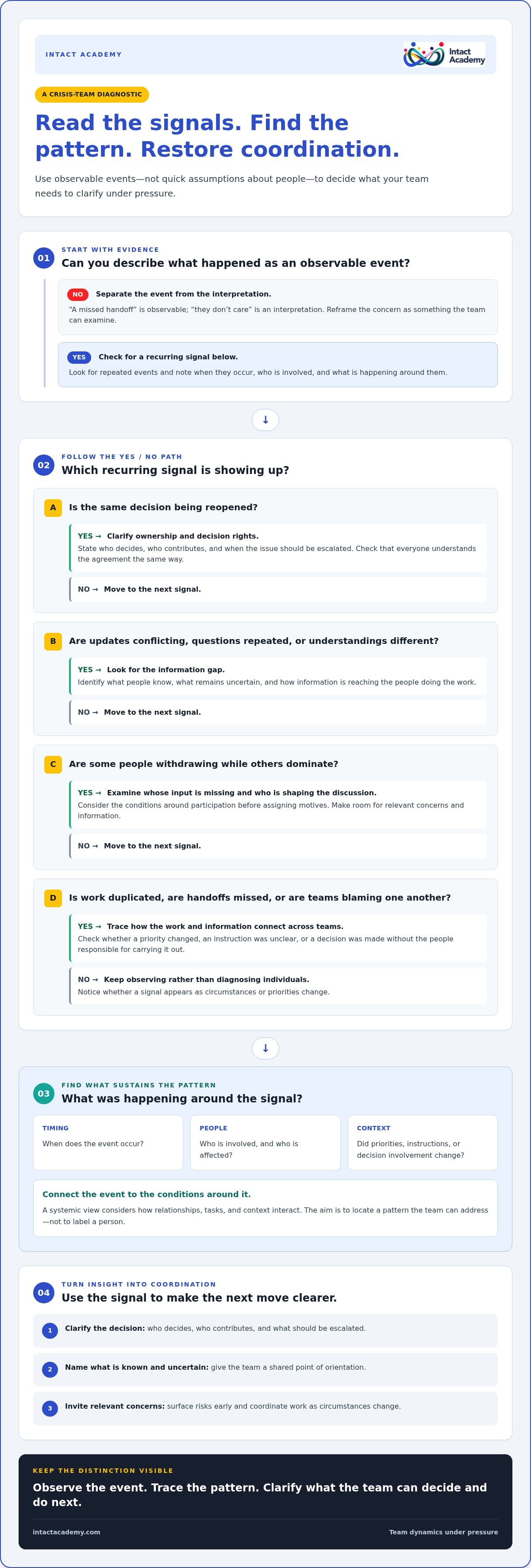
Look for repeated, observable events rather than quick explanations about someone’s personality or motives. A missed handoff is evidence; “they don’t care” is an interpretation. This distinction gives the team something concrete to examine and reduces the risk that blame will take hold before people understand what’s happening.
- The same decision is reopened because ownership or decision rights remain unclear.
- People receive conflicting updates, repeat questions, or leave conversations with different understandings.
- Some participants stop contributing, while others speak for the group or dominate decisions.
- Work is duplicated, handoffs are missed, or teams blame one another for gaps.
Track when these signals occur, who is involved, and what was happening around them. Do they appear after a change in priorities, an unclear instruction, or a decision made without the people responsible for carrying it out? This isn’t about diagnosing individuals. It helps locate patterns the team can address. A systemic view connects behaviour to relationships, tasks, and context; the systemic team coaching principles offer broader grounding for that perspective. Once a pattern is visible, the team can respond to the pressure more deliberately.
How crisis pressure shapes team roles, relationships, and decisions
Team behaviour under pressure is neither purely personal nor purely structural. It emerges from the interaction between people, shared norms, leadership signals, and organizational conditions. A capable colleague may become cautious when information is withheld, while a team accustomed to quick agreement may struggle to surface a serious disagreement. Crisis behaviour is shaped by both the people in the team and the system conditions that influence what they can see, say, and decide.
These forces can reinforce one another. One department receives incomplete information and delays a decision. Another team, working to meet a competing priority, acts without that input. The resulting duplication or rework deepens frustration, making people less willing to share information next time. The original gap persists, not because one person caused it, but because the pattern sustains itself.
Teams can also create a more constructive feedback loop. A leader names what is known and what remains uncertain, invites relevant concerns, and clarifies the next decision. People gain a shared point of orientation, raise risks earlier, coordinate their work, and revise their actions as circumstances change. Managing team dynamics in a crisis means noticing how responses ripple across the group and the wider organization.
How roles and authority shift under pressure
Formal authority and informal influence don’t always align. Someone with decision-making responsibility may lack the latest operational detail, while a specialist without formal authority may shape what the group considers possible. If decision rights are unclear, people may wait for approval, duplicate work to avoid a gap, or comply silently despite holding important concerns. Leaders can reduce this ambiguity by stating who decides, who contributes, and when an issue should be escalated.
Make the boundaries practical. For each urgent decision, clarify the owner, who needs to be consulted, and what conditions require escalation. Then check that everyone understands the agreement in the same way. Clarity won’t remove uncertainty from the crisis, but it can stop uncertainty about roles from compounding it.
How Transactional Analysis can illuminate interaction patterns
Transactional Analysis offers a reflective lens for considering how people communicate under pressure. Its concepts of Parent, Adult, and Child ego states describe modes of interaction, not fixed personality types or diagnoses. In a tense exchange, one person may become directive and another defensive or compliant; each response can invite the next, narrowing the conversation. An Adult-to-Adult exchange, grounded in current information and clear questions, may help reopen collaboration. Explore the guide to Transactional Analysis for foundational concepts.
Use the lens to ask, “What is happening between us right now?” rather than labelling a colleague. What signal might a directive message send? What response does it invite? Pausing to examine that sequence can help the team choose a more useful next move. For professionals seeking to deepen this reflective capacity in team settings, the TA EMCC Senior Team Coach Academy offers a learning pathway in systemic team coaching.
Why communication alone may not resolve crisis team dynamics
More messages can increase the volume of information without creating shared understanding. A team may receive regular updates yet still disagree about what they mean, who has authority to act, or whether it’s safe to raise a concern. Communication is essential, but it can’t by itself repair strained trust or settle conflicting expectations. Managing team dynamics in a crisis requires leaders to distinguish an information problem from a relational or decision-making problem.
Operational coordination keeps work moving: teams share current facts, assign owners, track decisions, and identify what needs attention next. Relational work asks different questions. Can people challenge a proposed action without being punished? Are disagreements about the task being heard, or interpreted as disloyalty? Does the team know who decides when views differ? Both forms of work matter. Clear updates won’t resolve a pattern of blame, and a deep conversation about trust won’t replace a time-sensitive operational decision.
Use the symptoms below to look beyond the surface. Treat each possible system condition as a question to explore, not a conclusion about the people involved.
| Communication symptom | Possible system condition | Leadership response |
|---|---|---|
| The same update is repeatedly requested | Information is hard to find, or different sources conflict | Establish a clear source of truth and name what remains uncertain |
| Meetings end without a clear next step | Decision rights or ownership are unclear | Record the decision, the owner, and when it will be reviewed |
| Concerns surface only after a decision | People may not feel safe challenging the direction in the room | Invite contrary evidence before the group commits |
When is more communication helpful, and when does it add noise?
First identify what’s missing. If people lack a fact, provide it. If they have the same facts but interpret them differently, make space to compare assumptions. If they’re waiting for authority, clarify who can decide. More meetings won’t solve all three problems, and adding them without a purpose can crowd out the work of responding.
Keep updates concise and consistent. State the owner, the decision made or needed, known uncertainties, and the next review point. A predictable format helps people see what has changed, what hasn’t, and where their attention belongs. Use a meeting when discussion or a decision requires interaction; use a written update when people mainly need the same information.
How can leaders make room for useful disagreement?
Invite challenge while a decision is still open. Ask what evidence might change the current view, or which risk the team could be underestimating. Set a firm boundary against personal blame while keeping the substantive issue open for examination. Psychological safety isn’t comfort or automatic agreement; it’s the ability to speak candidly and remain accountable for what follows.
After hearing a dissenting view, explain how it affects the decision, even if the decision stands. That response shows the team that challenge is part of responsible coordination, not a threat to authority. With clearer information, honest disagreement, and explicit decision rights, communication can support action rather than simply fill the silence.
A practical sequence for managing team dynamics during a crisis
Under pressure, teams need a sequence that protects immediate work while making room to understand how people are working together. Stabilize, observe, clarify, contract, and review: a repeatable leadership practice turns crisis pressure into coordinated learning. Managing team dynamics in a crisis doesn’t mean resolving every tension before acting. Address immediate safety and continuity needs first; return to relational concerns when there’s enough space to examine them constructively.
- Stabilize. Identify urgent risks and the next actions needed to protect people, essential work, or continuity. Share what’s known, what remains uncertain, and when the next update will come. Avoid presenting assumptions as facts.
- Observe. Notice what is happening in the interaction, not what you assume people intend. Who is speaking, waiting, interrupting, or repeating a concern? Where are handoffs or decisions getting stuck?
- Clarify. Name the immediate shared task, priorities, decision owners, and escalation routes. Distinguish what must be decided now from questions that can wait until there’s more information.
- Contract. Agree how the team will coordinate: which channel carries updates, how risks are raised, who records decisions, and when people will check alignment. Keep the agreement simple enough to use under pressure.
- Review. Revisit the agreement at a clear point. Check what has changed, what is still unclear, and whether the team’s way of working is helping or hindering the response.
What should a leader do in the first team conversation?
Start with orientation, not a demand for instant consensus. You might say: “Here’s what we know. We don’t yet know this. Our immediate task is this, and I’ll share the next update at this point.” Name who owns each decision, then ask, “What is getting in the way of coordinating this work?” Listen before offering a solution. If there’s an immediate safety or continuity risk, address it first and schedule the wider conversation for a more suitable moment.
When tension needs naming, describe the observable pattern without assigning blame: “I’m noticing we’ve discussed this decision twice, but ownership is still unclear. What needs to be agreed so we can move forward?” Specific, neutral language makes the issue discussable without diagnosing a colleague or dismissing the pressure they may be under.
How can a team review its response without blame?
Choose a review point and examine three questions: What helped us coordinate? What hindered the work? What should we adjust next? Anchor the discussion in events and consequences. For example, “Two teams sent different instructions, so the handoff was delayed” gives people something workable to learn from; “They don’t communicate” turns a process issue into a character judgement.
Close with one or two concrete agreements, each with an owner and a review point. For leaders who want to deepen their capacity to guide this kind of reflection, explore professional development in systemic team coaching.
Build lasting crisis capability through systemic team coaching
A team’s response to one crisis can become a source of learning for the next, but only if people have space to examine what happened and make deliberate adjustments. A single intervention may help restore immediate coordination; lasting capability develops through repeated reflection, clearer working agreements, and cycles of action and review. The aim isn’t to eliminate uncertainty. It’s to help a team notice its responses, learn from them, and adapt together.
A systemic perspective considers the team’s relationships and tasks alongside the stakeholders it serves and the organizational conditions shaping its choices. A recurring conflict, for instance, may be connected not only to how colleagues communicate but also to competing priorities or unclear expectations elsewhere in the organization. Map those connections by asking whose expectations shape the team’s priorities, where signals differ, and which decisions sit outside the team’s authority.
What does systemic team coaching add beyond a one-off intervention?
Ongoing work gives a team opportunities to observe patterns as they arise, test new agreements, and return to what happened in practice. Did a new decision process help people raise risks sooner? Did a stakeholder’s expectations alter the team’s priorities? The coach supports inquiry into these questions without taking responsibility for the team’s decisions. That creates a developmental process, not a promise of a particular outcome.
The focus moves between the team’s internal interactions and its wider system. A group may agree to share information more consistently, then discover that different departments receive different signals from senior leaders. A systemic team coach helps bring such connections into view, so the team can distinguish what it can change directly from what needs wider discussion or escalation. Managing team dynamics in a crisis then becomes part of building a more reflective way of working, rather than a temporary effort to smooth over tension.
How can practitioners deepen their team-coaching capability?
Practitioners can strengthen their work through reflective practice: examining what they noticed, what they assumed, and how their own interventions affected the conversation. Did a question open up a useful perspective, or steer the team toward the coach’s preferred explanation? Reviewing these moments helps coaches remain curious about their impact and responsive to the system, rather than relying on a fixed technique.
The TA EMCC Senior Team Coach Academy is a professional development pathway for people developing systemic team coaching expertise. Deepening this capability takes sustained learning, not a quick crisis fix. It helps practitioners build the reflective capacity to work with relationships, tasks, stakeholders, and organizational context as connected parts of team life. For a related perspective on the development of coaching practice, explore Intact Academy.
Let crisis become a catalyst for stronger team practice
Don’t wait for another disruption to reflect on how your team works together. Choose one recurring pressure point and create a regular space to examine how decisions, relationships, and wider organizational expectations interact. With time, this practice can help teams meet uncertainty with greater awareness and make room for change without losing their shared purpose.
For practitioners, developing the capacity to hold this systemic perspective is a meaningful part of professional learning. Intact Academy, an international institute for coaching and organizational change founded in 2013, offers the TA EMCC Senior Team Coach Academy and brings together an international learning community with participants from more than 14 countries.
Explore systemic team coaching at Intact Academy and consider how continued learning can support your work with teams under pressure. Crisis may unsettle familiar ways of working, but it can also open a path toward more thoughtful, coordinated action.
Frequently Asked Questions
What should a team leader do first when a crisis creates conflict?
First, establish which decisions can’t wait and what information is reliable enough to act on. In a service outage, for example, assign one person to coordinate customer updates and another to assess operational impact, rather than letting both teams issue competing instructions. Set a time for the next update, even if some facts remain unresolved. Managing team dynamics in a crisis starts with containing immediate confusion; deeper disagreements can be explored once urgent responsibilities are clear.
How can you manage a team crisis when some members work remotely?
Give remote and in-office colleagues equal access to decisions, context, and a way to contribute. If a quick hallway conversation changes a deadline, record that change in the team’s shared channel and identify who approved it. Invite remote participants to raise questions before closing a discussion, rather than assuming silence means agreement. For teams across time zones, state when a response is needed and offer a route for people who can’t attend live.
Does psychological safety mean avoiding difficult conversations during a crisis?
No. Psychological safety makes it more possible to raise a hard issue without fear of humiliation or retaliation; it doesn’t require leaders to delay necessary decisions or excuse harmful conduct. A leader might say, “We need to discuss the missed handoff, and we’ll focus on how it happened and what must change.” That keeps accountability intact while making room for relevant facts, questions, and disagreement.
How can a leader tell whether a disagreement is productive or damaging?
Look at what the disagreement does to the work and to people’s ability to contribute. A debate may sound intense yet remain useful if colleagues examine evidence, identify risks, and carry out the decision afterward. By contrast, watch for repeated personal accusations, withholding information, or people withdrawing from later discussions. After a disagreement, check whether the team can explain the decision and its rationale, even if some members preferred another option.
What if team members disagree about who has authority to decide?
Make the decision boundary explicit, including who is accountable, whose input is needed, and where unresolved issues go next. For example, a team lead might authorize a temporary workaround while reserving a permanent policy change for an executive decision. Say whether the choice is provisional and name the condition or review point that could reopen it. Clear authority doesn’t guarantee agreement, but it helps prevent disagreement from becoming silent delay.
Can a team learn from a crisis while the situation is still unfolding?
Yes, if the learning check is brief and helps the team respond better now. After a shift change or a major update, ask what new information has emerged, where the handoff broke down, and what needs to change for the next shift. Capture only the adjustment that matters immediately. Later, when pressure eases, the team can examine broader patterns without turning a short operational check-in into a premature performance review.


