

What if a team’s performance depends less on individual effort and more on the patterns shaping how people work together? Coaching teams for high performance starts with that shift in perspective: from correcting individual behaviour to understanding the team as a connected system.
Capable people can work hard yet remain misaligned on priorities. Recurring tensions can interrupt collaboration, while a one-off workshop may create fresh energy without changing everyday habits. When leaders need to understand whether the team is making progress, immediate results alone may not show what is changing in how people work together.
This guide offers a practical way forward. Learn how to identify what is influencing performance, connect observable behaviour to shared outcomes, and shape a coaching process around the team’s context. You’ll also see how to review progress and carry learning into everyday work. By working with goals, relationships, and recurring patterns together, teams can build clarity and the capacity to perform well over time.
Key Takeaways
- Distinguish team coaching from individual coaching and team-building activities by matching each approach to the challenge.
- Notice how recurring meeting habits and relationship patterns can influence shared outcomes, and explore possible systemic causes.
- Use a flexible sequence for coaching teams for high performance, from agreeing on outcomes to testing new behaviours and reviewing progress.
- Explore how the TA EMCC Senior Team Coach Academy can support coaches in deepening their systemic team-coaching practice.
Why Coaching Teams for High Performance Starts With the Whole Team
A team can be full of skilled, committed people and still struggle to deliver shared outcomes. Work gets done, but priorities compete; decisions are made, then revisited; handovers fail despite everyone’s best intentions. These are real performance concerns, but the visible problem may be only a symptom. Coaching teams for high performance starts by examining how the team works as a whole, rather than assuming one person needs to change.
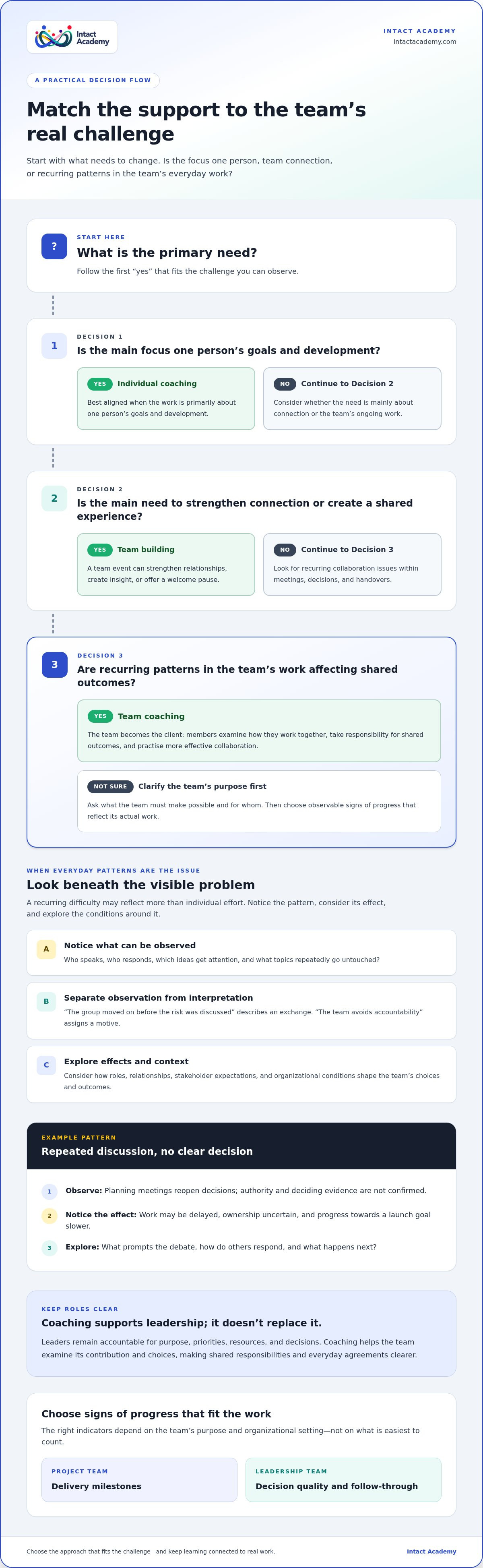
Team coaching is a facilitated learning process in which the team is the client: members examine how they work together, take responsibility for shared outcomes, and practise more effective ways of collaborating. Individual coaching focuses primarily on one person’s goals and development. Team building may strengthen connection or create a shared experience. Team coaching, by contrast, brings attention to the team’s ongoing work and learning.
Consider missed handovers. A checklist might seem like the obvious fix. But if responsibilities are unclear, people hesitate to raise concerns, or departments are rewarded for competing priorities, the checklist alone may not change the pattern. A coach helps the team notice what happens repeatedly, explore its effect on outcomes, and consider what the wider system reinforces. This whole-team lens complements the view of a High-performance team as one whose shared work depends on more than individual capability.
What high performance means for a real team
High performance isn’t a universal scorecard or a single ideal way of behaving. It means the team can agree on meaningful outcomes, coordinate the work needed to reach them, learn from experience, and adapt when circumstances change. The right indicators depend on the team’s purpose and organizational setting. A project team might track delivery milestones, while a leadership team may look at decision quality and follow-through.
Start by asking: What must this team make possible, and for whom? Then identify observable signs of progress. Shared clarity, useful challenge, and dependable coordination may support performance, but no single behaviour guarantees it. Choose indicators that reflect the team’s actual work, rather than measuring activity simply because it is easy to count.
When coaching is more useful than another team-building session
A standalone team event can create insight, strengthen relationships, or offer a welcome pause. But recurring collaboration problems usually unfold in daily meetings, decisions, and handovers. Coaching gives the team space to reflect on those moments, test new working agreements, and review whether the changes help. Learning stays connected to real work rather than ending with the event.
Coaching supports leadership; it doesn’t replace it. Leaders remain accountable for purpose, priorities, resources, and decisions. The coach helps the team examine its contribution and choices, so responsibilities become clearer and shared agreements are more likely to carry into everyday practice.
How Systemic Team Coaching Changes the Patterns Behind Performance
A team’s results are shaped by more than the skills its members bring to the room. Shared goals, relationships, role clarity, stakeholder expectations, and organizational conditions all influence what the team can accomplish together. Systemic team coaching makes these connections visible, so the team can work with the conditions shaping performance instead of treating every difficulty as an isolated incident.
Team performance isn’t the sum of individual capabilities; it emerges from how people coordinate those capabilities within their relationships, roles, and wider system. A team may have deep expertise and still struggle to make timely decisions if authority is unclear or departments are pursuing competing priorities.
Notice the interaction patterns shaping the work
Begin with what can be observed: who speaks, who responds, which ideas receive attention, and what topics repeatedly go untouched. Keep observation separate from interpretation. “The group moved on before the risk was discussed” describes an exchange; “the team avoids accountability” assigns a motive. Staying curious leaves room to investigate without blame.
Imagine a product team that spends each planning meeting reopening decisions. Members offer updates, but no one confirms who has authority to decide or what evidence would settle a disagreement. The observable pattern is repeated discussion without a clear decision. Its effect may be delayed work, uncertain ownership, and slower progress towards a launch goal. Coaching helps the team examine the sequence: what prompts the debate, how others respond, and what happens next?
Transactional Analysis can offer one lens for exploring communication patterns, including how people shift between familiar ways of relating under pressure. Used carefully, it helps a team discuss the interaction itself, not label or diagnose individual members. The useful question isn’t “Who is the problem?” but “What pattern are we creating together, and what does it make possible or difficult?”
Bring stakeholders and context into the coaching conversation
A team’s work is also shaped by people beyond its meetings. Leaders may expect speed and consultation; customers may need reliability; connected teams may depend on timely decisions. These expectations can conflict, especially when the team’s purpose or authority is unclear. A systemic coach explores whose needs the team serves, what it receives from its environment, and how organizational structures influence its choices.
This wider view connects team interaction to real outcomes. If repeated debate reflects conflicting instructions from senior leaders, asking members to communicate better won’t address the whole issue. The team may need to clarify its mandate with those leaders as well as change how it reaches decisions.
Coaches seeking a stronger grounding in this perspective can explore systemic team coaching foundations. This systemic lens also informs deeper team-coaching practice, helping coaches hold team dynamics and organizational context together.
Team Coaching vs Individual Coaching and Team Building: Which Fits?
The right approach depends on where the challenge sits. Is a particular leader developing a skill, are team members struggling to coordinate, or would a shared experience help them reconnect? These approaches can complement one another, but they have different purposes. Team coaching isn’t simply a slower version of team building: it works with the team’s real goals and relationships over time, rather than centring on a single event.
| Approach | Focus | Best-fit situation | Likely limitation |
|---|---|---|---|
| Individual coaching | One person’s development, choices, and impact | A leader wants to strengthen a capability that matters to their role | Personal insight alone may not shift shared team agreements or organizational conditions |
| Team coaching | Collective goals, interaction, decisions, and learning | The team needs sustained attention to recurring patterns or shared outcomes | It can’t replace leadership decisions, clear organizational direction, or individual support where needed |
| Team-building activities | Connection and shared experience | A group needs a purposeful opportunity to engage outside its usual routine | A one-off activity doesn’t, by itself, establish lasting ways of working |
Use the table as a starting point, not a ranking. A challenge may be individual, relational, collective, or contextual, and sometimes more than one level is involved. Ask what needs to change for the team’s work to improve, then choose an approach that can address that level.
When individual coaching is the better starting point
Individual coaching may fit when a specific leader’s development is central to the desired change, such as practising clearer delegation or becoming more effective at inviting challenge. Greater self-awareness can help that person act differently in the team. But it doesn’t, on its own, alter team roles, decision rules, or shared expectations. Treat an individual focus as a targeted choice, not evidence that one person caused a systemic difficulty.
When team coaching or a team event fits better
If the team’s shared decisions, goals, or ways of relating need ongoing attention, team coaching creates space to examine them in the context of work. A team-building activity may fit when the immediate aim is connection or a shared experience. It can open a conversation, but follow-through matters if the group wants new habits to take root. Neither approach should obscure the leader’s responsibility for direction and accountability.
For coaches considering how to build their capability, choosing a team coaching course can be part of reflecting on the depth and context the practice requires. The aim of coaching teams for high performance isn’t to apply one method everywhere; it’s to match the intervention to the team’s actual challenge.
How to Coach a Team for High Performance: A Practical Sequence
Effective team coaching has structure, but it isn’t a script applied unchanged to every group. The coach and team establish a shared purpose, observe the work as it happens, and adapt the process as new information emerges. A team facing unclear decision rights may need a different starting point from one adjusting to new stakeholder expectations.
A practical sequence is: contract the work, define shared outcomes, understand the context, observe the team in action, test a small change, and review what the team learns. Each step creates a basis for the next while leaving room to respond to the team’s circumstances.
Contract around purpose, boundaries, and shared outcomes
Begin by clarifying who the client is, who will participate, and what the team wants to change. If a sponsor is involved, agree how they’ll contribute and what information they’ll receive. Set confidentiality boundaries so participants understand what stays within the coaching space and what may be shared. Then translate broad hopes, such as “better collaboration,” into work outcomes the team can recognize and discuss.
- Contract the work. Align the team, coach, and sponsor on purpose, participation, boundaries, and responsibilities.
- Define shared outcomes. Describe what meaningful progress would look like in the team’s work, not only in how members feel.
- Explore the context. Surface relevant roles, dependencies, stakeholder expectations, and organizational conditions.
- Observe the work. Notice how the team communicates, makes decisions, coordinates, and responds to difficulty.
- Choose an experiment. Agree on one practical change to test in a meeting, decision process, or handover.
- Review and learn. Compare what happened with the intended outcome, then decide what to continue, adapt, or explore next.
Observe, experiment, and review learning in the work
Observation may happen in a live team conversation or through the team’s reflection on a recent piece of work. Share what you noticed without presenting interpretation as fact. For instance, describe that a decision was deferred after new concerns emerged, then invite the team to explore the effect. This distinction supports inquiry rather than blame.
Keep experiments small enough to learn from. A team might try ending each decision discussion by naming the decision, owner, and next step. At the review, ask what changed, what helped or hindered, and whether the experiment supported the agreed outcome. If it didn’t, that’s useful information, not proof of failure. The team can refine its approach or investigate a deeper constraint.
Choose progress indicators with the team and match them to its purpose. They might include fewer unresolved handovers, clearer ownership, decision follow-through, stakeholder feedback, or movement on a relevant milestone. These are possible signals, not universal measures or promised results. In coaching teams for high performance, review both the indicator and the pattern behind it: what is improving, what remains difficult, and what the team is learning.
Coaches ready to deepen their systemic practice can explore the TA EMCC Senior Team Coach Academy as a learning pathway in team coaching.
Build Your Team-Coaching Practice With Intact Academy
A practical sequence is only as sound as the coach’s ability to work with what emerges. Teams bring visible behaviours, unspoken expectations, competing needs, and organizational pressures into the coaching space. Holding these dimensions together calls for more than a toolkit: it calls for sound contracting, systemic awareness, psychological insight, and the discipline to reflect on the coach’s own impact.
Develop the capabilities behind systemic team coaching
Systemic practice asks a coach to stay curious about how team dynamics connect with shared purpose, roles, stakeholder expectations, and organizational conditions. A pattern that appears to be resistance, for example, may also reflect unclear authority or conflicting demands. The coach’s task isn’t to rush towards a diagnosis, but to help the team examine its experience and find a useful way forward.
This work brings psychological understanding into direct relationship with organizational reality. Transactional Analysis can offer a framework for noticing communication and relational patterns, while practical knowledge of teams and organizations helps connect those patterns to decisions and outcomes. Coaches can deepen their grounding through Transactional Analysis for professionals, then continue developing the reflective practice needed to use such concepts responsibly. The aim is to support insight without reducing people to labels, and to connect reflection with action in the team’s real context.
In practice, hold several questions at once: What is the team trying to achieve? Which interactions support or complicate that purpose? Whose expectations shape its work? What assumptions might the coach be bringing to the room? This ability to observe, question, and adapt is central to coaching teams for high performance. It helps a coach work with complexity without losing sight of the outcomes that matter.
Explore the TA EMCC Senior Team Coach Academy
For coaches seeking a focused professional development pathway, Intact Academy offers the TA EMCC Senior Team Coach Academy. Its focus connects directly with the work explored here: understanding team patterns, attending to context, contracting thoughtfully, and using reflective practice as part of the coaching discipline. The academy sits within Intact Academy’s wider grounding in Transactional Analysis, team coaching, and organizational change.
Intact Academy offers online and in-person learning to participants from more than 14 countries. This international learning context brings together perspectives shaped by different professional and organizational settings, without assuming every team’s challenges are the same. The value of development lies not in collecting techniques, but in strengthening judgment about when and how to use them.
If you’re considering how to deepen your work with team dynamics and organizational context, take a measured next step: explore Intact Academy’s team-coaching development and its approach to building systemic coaching practice.
Take the Next Step in Your Team-Coaching Practice
Begin with one question in your next team conversation: what is happening between us that is helping or hindering the work we share? Staying with that question, without rushing to blame or fix, can open a more useful path for change. Coaching teams for high performance grows through this kind of attention: noticing, reflecting, and choosing a response that serves the team’s purpose.
For coaches ready to deepen their ability to work with team dynamics and organizational context, continued development can help turn insight into sound, responsible practice. The TA EMCC Senior Team Coach Academy offers a focused pathway for that learning.
Explore the TA EMCC Senior Team Coach Academy and take a thoughtful step towards helping teams learn and evolve together.
Frequently Asked Questions
How long does team coaching for high performance take?
There’s no fixed duration that suits every team. Coaching teams for high performance should be shaped around the purpose and change required. A team might agree to begin with an initial period, then review whether its new practices are taking hold. Are members using an agreed decision process in regular meetings, or reverting to old habits under pressure? Continue, adjust, or conclude support based on that learning, not a guaranteed session count.
Can team coaching work for a remote or hybrid team?
Yes, team coaching can support remote and hybrid teams, including those whose members rarely share a time zone or meeting space. The coach can help the group notice digital-specific dynamics: whose contributions get missed in fast-moving calls, whether decisions are easy to find afterwards, or whether colleagues interpret silence differently. Agree practical participation norms, such as how to signal a wish to speak, then review whether they make collaboration more inclusive and clear.
Is team coaching suitable for a newly formed team?
Yes, a newly formed team can use coaching to establish how it wants to work before unhelpful habits become familiar. Members might discuss how they’ll raise risks, handle disagreement, or welcome a new colleague’s perspective. These conversations can make assumptions visible early, especially when people bring different experiences of authority or collaboration. The coach adapts the work to the team’s stage and organizational setting; the team doesn’t need to wait for a crisis.
Who should participate in team coaching?
Include the people who share responsibility for the work or outcomes at the centre of the coaching. If a cross-functional project depends on both product and operations, for instance, coaching only one group may leave an important relationship outside the conversation. Agree the sponsor’s role separately, including how they contribute and receive updates. Other stakeholders can inform the work through interviews or feedback without necessarily attending every coaching conversation.
How can a team measure progress from coaching?
Measure progress using signs that connect to the team’s actual work, then review them at agreed intervals. A team struggling with handovers might look at whether receiving colleagues have the information they need, rather than counting meetings held. Pair these indicators with member or stakeholder observations to understand what may be changing. They support reflection, but can’t isolate coaching as the sole cause of wider organizational results.
Can team coaching address conflict between team members?
Yes, team coaching can help members examine how conflict unfolds and affects their shared work. For example, a coach might support colleagues to describe a disagreement’s impact on a decision, listen for differing assumptions, and agree how to raise concerns next time. The work should stay within a clearly agreed coaching scope, without assigning motives or diagnosing people. If a concern involves immediate safety or needs beyond that scope, it calls for an appropriate response.


