

What if your greatest strength as a technical leader is also the habit you need to loosen? When colleagues look to you for every difficult answer, solving the problem yourself can feel faster and safer. But as your responsibilities grow, leadership depends less on being the expert in the room and more on helping others think, decide, and act. Executive coaching for technical leaders supports this shift without asking you to leave your technical credibility behind.
You may already know that communication, delegation, and stakeholder relationships matter. The harder work is applying them while priorities compete, teams change, and uncertainty keeps moving the goalposts. It can mean leading former peers, resolving conflict, and translating technical needs into language that resonates across the organization.
This article explores how coaching can help you lead effectively without relying on technical expertise alone. You’ll learn why the transition involves identity and behavior, not just new management techniques, and how structured reflection can turn insight into practice. We’ll look at leading yourself, strengthening relationships across teams, and understanding the wider system your decisions shape.
Key Takeaways
- See why technical leadership shifts from providing answers to creating the conditions for sound decisions and shared capability.
- Use a systemic lens to notice how relationships, role expectations, and organizational conditions shape recurring challenges.
- Distinguish skill gaps from role-transition, relationship, or organizational challenges before choosing a response.
- Apply a four-step reflection to examine a leadership situation and choose a practical experiment for your next move.
- Explore how executive coaching for technical leaders can connect personal insight with business context, using Transactional Analysis to understand patterns.
Why executive coaching for technical leaders starts beyond technical expertise
Technical expertise may have earned you trust, shaped your professional identity, and helped you solve problems others couldn’t. Leadership changes where that expertise has the greatest effect. Instead of personally resolving every complex issue, you’re responsible for setting direction, making decisions with incomplete information, and enabling others to contribute their judgment. Executive coaching for technical leaders focuses on this shift in context: your role, relationships, team, and organization.
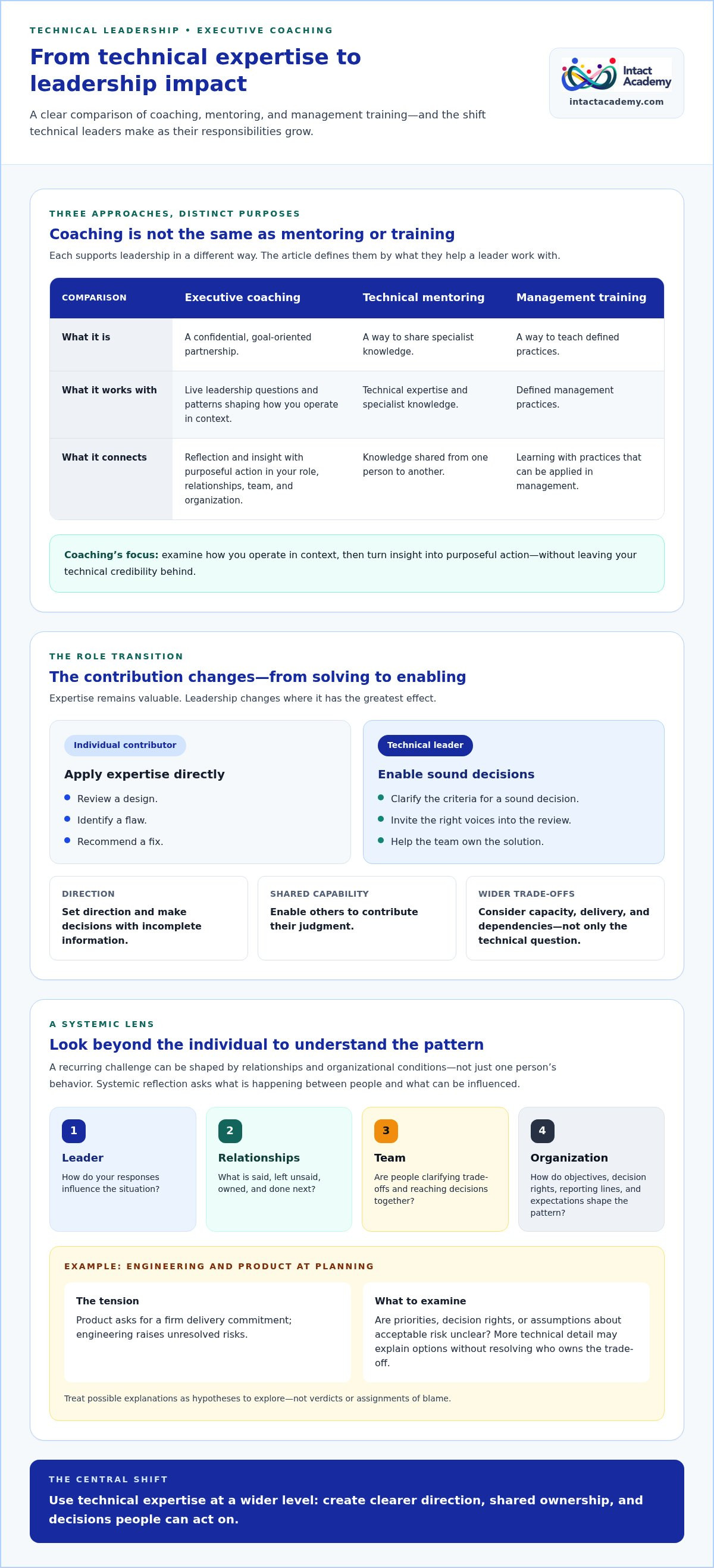
Executive coaching is a confidential, goal-oriented partnership that helps a leader examine how they operate in context and turn insight into purposeful action. Unlike technical mentoring, which shares specialist knowledge, or management training, which teaches defined practices, coaching helps you work through the live questions and patterns shaping your leadership.
What changes when a technical expert becomes a leader?
The transition isn’t a rejection of expertise. It’s a change in how you use it. As an individual contributor, you might review a design, identify a flaw, and recommend a fix. As a leader, your deeper contribution may be to clarify the criteria for a sound decision, invite the right voices into the review, and help the team own the solution.
This shift can bring tension. Delegating a consequential design decision may feel like risking quality, particularly when your specialist judgment is part of why others trust you. Yet stepping in too quickly can leave colleagues waiting for approval and limit the chance for them to develop their own judgment. Meanwhile, strategic responsibilities require you to consider capacity, delivery, and dependencies beyond the immediate technical question.
Prioritization makes the change visible. A team may want to improve reliability while another function needs a feature delivered sooner. Your role is not simply to declare which technical option is strongest. It’s to make trade-offs clear, surface risks, and help decision-makers understand what each choice means.
Why can technical leadership challenges feel different?
Technical work often involves interdependent teams, evolving requirements, and decisions whose consequences emerge over time. An architecture choice can affect delivery dates, operational support, security, and customer commitments. The leader is working not only with the technical problem, but also with the pace, dependencies, and expectations around it.
That’s why a technically correct answer may not settle a disagreement. Imagine engineering advocating for time to reduce system risk while product is pressing for a committed release. The disagreement may involve different priorities, unclear decision rights, or competing assumptions about acceptable risk. More technical detail can clarify the options, but it may not resolve who owns the trade-off or how the teams will reach a decision together.
These pressures aren’t simply personality traits. They arise from the role and its organizational setting. Coaching creates space to examine both: what the situation requires and how your responses influence it. Your expertise remains an asset. The work is to make it useful at a wider level, through clearer direction, shared ownership, and decisions people can act on.
How systemic executive coaching helps technical leaders understand their impact
A leadership challenge rarely belongs to one person alone. A recurring disagreement may be shaped by how people communicate, who has authority to decide, and what the organization rewards or leaves unclear. Executive coaching for technical leaders can take a systemic view, paying attention to the leader, their relationships, the team, and the conditions around them. This shifts the question from “What should I do differently?” to “What is happening between us, and what part can I influence?”
Leadership behavior makes sense in the context of the relationships and organizational conditions that invite, reinforce, or constrain it. This perspective doesn’t remove personal responsibility. It makes responsibility more precise: rather than assigning blame, it helps reveal where a different response, clearer boundary, or structural decision might change the pattern.
From individual behavior to relationship patterns
Imagine engineering and product teams escalating the same type of disagreement at each planning cycle. Product asks for a firm delivery commitment; engineering raises unresolved risks. A leader might respond by taking every dispute into private mediation. That can help in the moment, but it may also teach both groups to wait for the leader instead of clarifying trade-offs together.
Systemic reflection examines the sequence, not just the individuals: what is said, what goes unsaid, who takes ownership, and what happens next? Perhaps stakeholders hold back concerns until deadlines are close. Perhaps the leader’s quick answers unintentionally signal that dissent isn’t welcome. These are hypotheses to explore, not verdicts. Observing a pattern helps people consider how the interaction could change without reducing a complex situation to one person’s fault.
From team dynamics to organizational context
Relationships are shaped by the system around them. Competing objectives, ambiguous decision rights, reporting lines, and organizational change can all influence what a leader feels able to do. If two teams keep disputing priorities, the underlying issue may be that both are accountable for outcomes but neither has authority to make the trade-off. A conversation skill alone won’t settle that; the organization may need clearer ownership.
Transactional Analysis (TA) offers a professional lens for noticing communication patterns and the roles people may fall into under pressure. A leader might observe that a discussion repeatedly shifts from testing options to defending positions. The value isn’t in labeling colleagues, but in becoming curious about the exchange and choosing a more constructive response. For the framework’s foundations, explore What Is Transactional Analysis?
In practice, systemic executive coaching connects personal reflection with organizational reality. You can examine your own contribution while also identifying decisions, boundaries, or conversations that need attention beyond the coaching relationship. For a grounded next step, learn how Executive Coaching at Intact Academy connects leadership development with wider organizational impact.
How to tell whether a technical leadership challenge needs coaching
A difficult leadership moment doesn’t automatically mean you need coaching. Start by asking what kind of difficulty keeps returning. A specific knowledge gap may call for technical training; an ongoing challenge involving judgment, relationships, or role expectations may benefit from coaching. Often, more than one factor is present, so treat these distinctions as prompts for inquiry rather than a diagnosis.
Skill challenge: A specific practice is missing or underdeveloped. For example, feedback to a direct report is too vague to guide improvement. Learning a feedback structure and practising it may help.
Role-transition challenge: The leader knows what to do but finds it difficult to stop being the main problem-solver. Delegation repeatedly stalls, or decisions keep returning to them even when capable colleagues could own them.
Relationship challenge: Friction or misunderstanding recurs with a stakeholder or team. A decision may be technically clear, yet discussions repeatedly become tense or end without shared commitment.
Organizational challenge: Progress is blocked by conditions beyond one person’s behavior, such as unclear decision rights, competing priorities, or changing reporting relationships.
These categories can overlap. A leader struggling to delegate might need a practical delegation tool, but the deeper issue could be uncertainty about accountability or concern about losing oversight. A stalled decision could reflect communication habits and an unresolved question about who has authority. Executive coaching for technical leaders helps examine these layers and choose a response that fits the situation, rather than assuming one cause from a single incident.
Is the challenge a skill gap or a leadership transition?
Consider feedback. If you’re unsure how to structure a clear, respectful conversation, learning and rehearsal may address the need. If you know the steps but avoid giving feedback because you’re accustomed to being valued for technical answers, the challenge may involve how you’re inhabiting the leadership role. Ask: “What information or practice would help?” and “What am I being asked to let go of, take responsibility for, or approach differently?”
Notice what changes after you gain information. If a new tool makes the next conversation easier, training may be sufficient. If the same difficulty returns across people or situations, reflection with a coach can help you explore the pattern and test a different way of leading.
When do team and organizational patterns matter?
Look for repetition: the same stakeholders clash across projects, decisions wait for the same approval, or priorities compete despite repeated discussion. These signals may point to role ambiguity, conflicting incentives, or change pressures, not simply an interpersonal mismatch. Ask who owns the decision, what each group is accountable for, and what has shifted in the organization. If restructuring or transformation is central, the wider perspective offered by Leading Organizational Change can help frame the issue.
Use the distinction to select a next step, not to label yourself or your colleagues. Technical training builds specific knowledge; coaching supports reflection, choice, and sustained action. Sometimes both are needed, alongside an organizational decision that coaching alone cannot make.
A practical reflection-to-action process for technical leaders
Reflection becomes useful when it changes what you do next. Rather than setting an abstract goal such as “be a better leader,” work with one recurring situation and trace how it unfolds. This four-step process offers a focused starting point for executive coaching for technical leaders, or for your own preparation before a consequential conversation.
- Name the situation. Choose a specific, recurring challenge, such as a decision that keeps returning to you or a delegation conversation that ends with you taking the task back. Describe what happened without judging yourself or others. What was at stake, and what would you like to be different next time?
- Map the system. Identify the people involved, the decision or need at the centre, and the organizational pressures surrounding it. Note who has formal authority, whose input matters, and what competing priorities are present. Then trace the sequence: what do you do, how do others respond, and what happens that makes the pattern more likely to repeat?
- Examine your contribution. Consider how your actions may affect the situation, without assuming you caused it or control every factor. Do you step in before someone else can take ownership? Do you leave a decision open because authority is unclear? What might colleagues need from you, and what needs to be addressed at a team or organizational level instead?
- Choose an experiment. Select one observable behavior to test in a specific upcoming meeting, decision, or delegation conversation. For example, you might ask a colleague to recommend a course of action before offering your own view. Keep the experiment focused enough that you can notice what changes.
Before you try it, decide what meaningful progress could look like for others as well as for you. Perhaps the conversation includes clearer options, a decision has an explicit owner, or a colleague takes greater responsibility. These are observations, not guaranteed outcomes. Afterward, note what you did, how people responded, and what you learned. Refine the next experiment rather than treating one interaction as proof that a strategy has succeeded or failed.
Keep the reflection bounded. It can help you prepare and learn, but it can’t replace sustained coaching when a complex pattern needs deeper examination, or an organizational decision about priorities, authority, or resources. If the situation reveals a structural issue, name the decision that needs to be made and who can make it.
For structured support connecting leadership behavior with organizational context, explore Intact Academy’s executive coaching.
How Intact Academy approaches executive coaching for technical leaders
At Intact Academy, executive coaching connects a leader’s development with the organizational system they influence. The work considers not only what you want to change, but how your choices affect colleagues, decision-making, and the conditions in which teams operate. For technical leaders, this perspective helps connect reflection with practical leadership action while keeping business realities in view.
Connect personal development with organizational impact
A leadership challenge can be explored at more than one level. You might examine what happens internally when a high-stakes decision feels uncertain, then consider how your response shapes the conversation with your team. Do people bring you options, or wait for you to decide? Does a meeting clarify ownership, or leave responsibilities open? These questions connect self-awareness with the everyday interactions through which leadership has an effect.
Transactional Analysis (TA) can provide a professional lens for noticing patterns in communication and behavior. It isn’t a replacement for technical knowledge, nor a formula for explaining every difficulty. Used thoughtfully, it can help a leader become curious about familiar responses under pressure and consider alternatives. The business context stays central: insight matters when it helps you make a clearer decision, hold a more useful conversation, or respond with greater intention.
This approach brings practical and psychological inquiry together. A concrete goal, such as making decision ownership clearer, can open questions about trust, control, or assumptions about responsibility. Reflection on a personal pattern can also lead to an observable experiment in a planning meeting or stakeholder conversation. Neither level stands alone. The aim is to develop leadership practice that is more deliberate and sustainable, without promising a predetermined business result.
Explore a systemic path for leadership development
Intact Academy is based in Utrecht, was founded in 2013, and is led by Sari van Poelje. Its work includes executive coaching, organizational change, and professional development informed by Transactional Analysis. This combination connects a leader’s growth with the relationships and systems in which leadership takes place.
If you’re developing as a coach rather than seeking coaching for your own leadership, an executive coaching certification guide may offer a useful complementary learning path. For technical leaders, the central question remains how to bring greater awareness to the choices you make, the conversations you shape, and the wider conditions affecting your work.
Explore Intact Academy’s executive coaching and organizational-change work to consider a systemic approach to your leadership development.
Shape the kind of leadership others can grow into
Your next step doesn’t need to be a dramatic reinvention. It can begin with a quieter question: what do you want people to experience when they work with you, especially when the answer isn’t obvious? Your answer can guide how you set direction, share responsibility, and make room for sound judgment beyond your own.
That’s the deeper possibility of executive coaching for technical leaders. Not less expertise, but expertise put in service of a wider contribution. As your leadership practice evolves, you can create more space for colleagues to think, take ownership, and do meaningful work, while staying connected to the technical purpose that brought you here.
If you’re ready to explore what this kind of development could look like in your own context, explore executive coaching and systemic development with Intact Academy. Develop your leadership with greater intention and make room for others to flourish.
Frequently Asked Questions
Can executive coaching help technical leaders who are new to management?
Yes. Coaching can help new managers adjust their approach as responsibility expands beyond their own output. For example, you might prepare for a first performance review by clarifying the purpose of the conversation, deciding what feedback the employee needs, and reflecting on how to invite their perspective. This can make the transition more intentional, especially when you’re managing former peers or learning to balance delivery with people development.
Does an executive coach need a technical background to coach a technical leader?
Not necessarily. A coach needs to understand your context well enough to explore the real leadership questions, and to ask rather than assume when technical details matter. In an initial conversation, notice whether they can follow your explanation of a decision, its stakeholders, and its organizational consequences. Relevant technical experience may help, but so can strong listening, systemic awareness, and the ability to challenge your thinking without pretending to be the subject-matter expert.
How long does executive coaching for technical leaders take?
There’s no single timeline that suits every leader. The duration depends on what you’re working toward, the complexity of the situation, and whether you’re addressing a focused goal or a pattern that appears across different parts of your role. You and your coach can review progress against practical indicators, such as how you approach a difficult conversation or make decisions. Revisit the goals as your responsibilities and organizational context change.
Is executive coaching confidential?
Confidentiality is a key part of building an open coaching conversation, but the boundaries should be clear before the work begins. If an employer sponsors your coaching, discuss what, if anything, will be shared with them, such as broad goals or progress themes. Agree on how notes and sensitive information are handled. Clear expectations help you speak candidly while ensuring the sponsor understands the purpose and scope of the engagement.
What happens if coaching reveals a problem beyond the technical leader’s control?
Coaching can help distinguish what you can influence from what requires action by others. If a project is repeatedly delayed because two departments have conflicting mandates, you might clarify the decision or resource question and identify who has the authority to address it. You can then prepare how to raise the issue. Coaching supports your judgment and next steps, but it can’t make an organizational decision on someone else’s behalf.
How much does executive coaching for technical leaders cost?
Fees vary by coach and engagement, so there isn’t one reliable price that applies to every situation. The coach’s experience, the leader’s goals, and the scope of the work can all affect the fee. If an employer is sponsoring coaching, clarify what the agreed engagement covers and how progress will be reviewed. For self-funded coaching, make sure the scope and fees are clear before deciding whether the work fits your priorities.
Can executive coaching help with conflict between engineering and other departments?
Yes. Coaching can help you prepare to address the disagreement without reducing it to who is right. Before a conversation, clarify what each group needs, what constraints they face, and which decision must be made. For instance, engineering may be weighing reliability concerns while another department is accountable for a launch commitment. Coaching can help you frame trade-offs, listen for assumptions, and support a more constructive discussion about ownership and next steps.


