

Completing advanced training doesn’t, by itself, demonstrate senior-level coaching capability. A senior practitioner coaching certification is most meaningful when it sits alongside sustained practice, reflective development, and evidence of how you work with complex client and organizational needs. The distinction can be easy to miss when professional bodies use different accreditation terms and criteria.
If you’re weighing your next step, start by separating three questions: What will you learn? What will the credential recognize? And how does the learning relate to the work you do? A qualification should deepen your practice, not just add a title; recognition should make your experience legible, not replace it. What does senior practitioner status signal, and how can you assess whether you’re ready?
This guide explores what senior-practitioner development involves beyond course completion, how accreditation, experience, and evidence relate, and what to consider when choosing a pathway. It also introduces the TA EMCC Senior Practitioner academy at Intact Academy, a Transactional Analysis-based route for coaches seeking to strengthen reflective practice and work with the wider systems shaping individual and organizational change.
Key Takeaways
- Understand why senior practitioner coaching certification signals more than course completion, and how accreditation and demonstrated capability differ.
- See how Transactional Analysis can help you recognize relationship patterns and widen your coaching lens to include organizational systems.
- Compare individual coaching, team coaching, and supervision pathways by their professional focus, learning framework, and reflective development.
- Use questions about the complexity of your work, learning edges, and openness to feedback to reflect on your readiness for senior-practitioner development.
- Explore how Intact Academy’s TA EMCC Senior Practitioner academy connects Transactional Analysis, reflective practice, and organizational change.
What Does Senior Practitioner Coaching Certification Actually Mean?
A senior practitioner designation points to development and capability beyond introductory coaching education. But the phrase doesn’t have one universal meaning: professional bodies set their own accreditation frameworks, and training providers may use “senior” to describe a learning level. Read the criteria behind the specific title rather than assuming every program or credential represents the same standard.
A senior practitioner is a coach whose maturity is evident in how they work with complexity, use reflection, and take responsibility for their practice, not simply someone who has completed an advanced course.
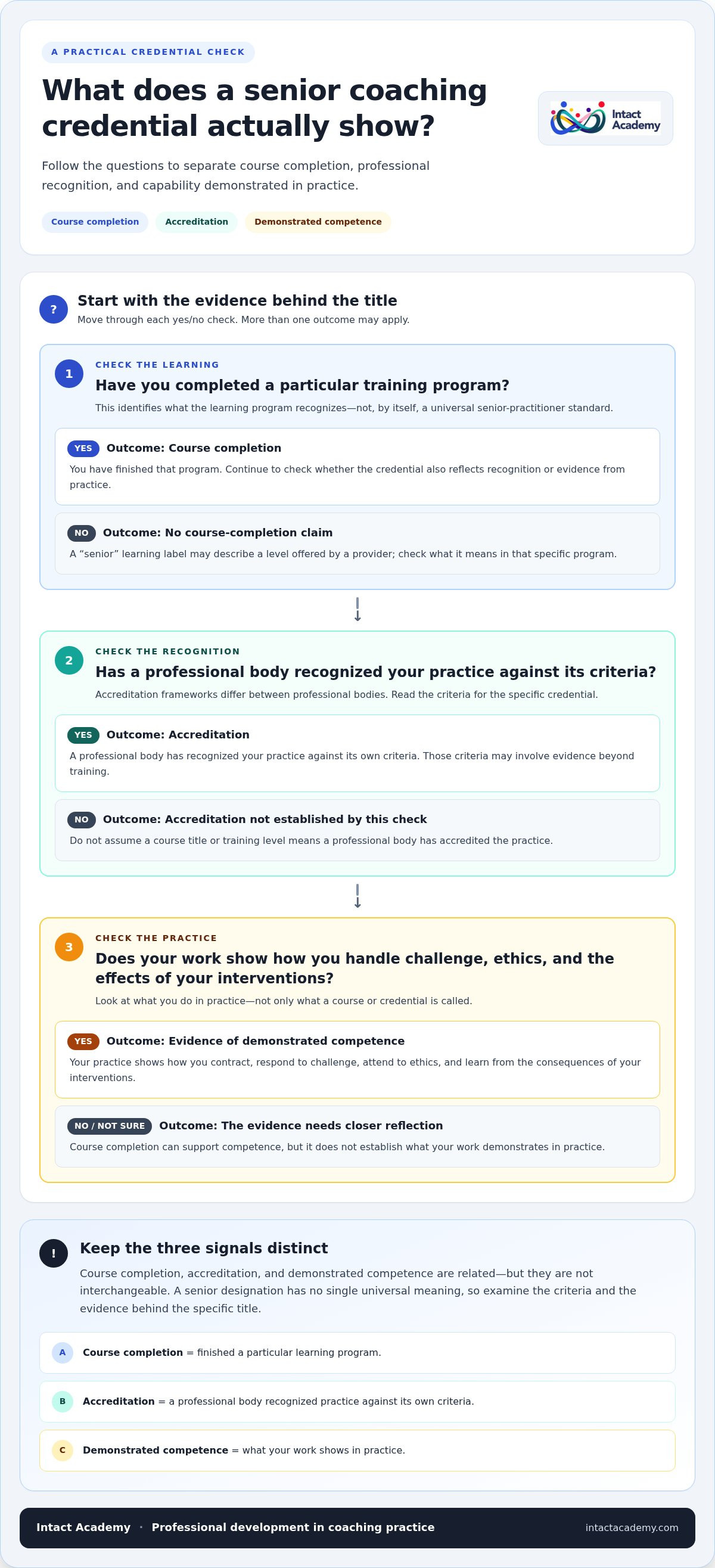
Three things are often blurred together. Course completion means you’ve finished a particular learning program. Accreditation means a professional body has recognized your practice against its own criteria, which may involve evidence beyond training. Demonstrated competence is what your work shows in practice: how you contract, respond to challenge, attend to ethics, and learn from the consequences of your interventions. A course can support competence, but these terms aren’t interchangeable.
As client work expands from individual goals to stakeholder tensions, leadership dynamics, and organizational patterns, experienced coaches may want a clearer framework for examining their choices. A credential can offer a professional reference point. The practical test is whether your development helps you meet the work with greater discernment, not simply a more impressive title.
How Is Senior Practitioner Different From Practitioner Level?
The distinction is less about status than about the demands a practitioner can work with. A practitioner may focus on a client’s goals and immediate challenges; senior-level work can involve competing stakeholder expectations, organizational culture, and relationships that shape what is possible. Often, no single intervention resolves the issue.
Reflective capacity matters in those moments. Can you notice your assumptions, recognize the limits of your role, and consider how your presence affects the coaching relationship? Your answers can shape whether you pause, renegotiate the work, or bring attention to a wider system. Accreditation bodies define their own levels and evidence requirements, so don’t treat one body’s threshold as a universal measure of seniority.
What Does a Senior Coaching Credential Signal?
A credential can signal a commitment to ongoing professional development, ethical awareness, and accountable practice. It may also indicate intentional use of self: the ability to notice your reactions and perspective without making the client responsible for them. For a grounding in coaching’s wider context, see What is Coaching?
A credential can’t guarantee client outcomes or organizational change. Those depend on the context, the relationship, and the work undertaken. Transactional Analysis offers one way to examine patterns in professional relationships and organizations, connecting personal interaction with systemic context. Explore what Transactional Analysis is to understand this broader foundation.
How Transactional Analysis Deepens Senior Practitioner Coaching
Transactional Analysis (TA) gives coaches a way to explore how people communicate, relate, and respond within professional settings. Rather than treating a workplace challenge as an isolated individual problem, a TA-informed coach can consider how interaction patterns take shape between colleagues, teams, leaders, and the wider organization. The framework supports inquiry; it doesn’t replace curiosity or determine in advance what a client’s experience means.
In practice, TA-informed reflection can bring together patterns in communication, relational roles, team norms, stakeholder expectations, and organizational culture. Looking at how these factors interact can help you decide where to focus attention, especially when a leader’s stated goal is only one part of a more complex situation.
From Individual Insight to Systemic Awareness
Imagine an executive who says they want to delegate more, yet repeatedly takes work back from their team. The coach can explore the executive’s beliefs and choices while also asking what the team expects, how responsibilities are defined, and what the organization rewards. These are lines of inquiry, not proof of a single cause. A recurring pattern deserves attention, but it may have several contributing factors.
Concepts such as Transactional Analysis ego states can help practitioners examine shifts in communication and relational stance. Used carefully, theory offers language for noticing what may be happening in an interaction. It should remain a working lens, not a label placed on a client or colleague. Ask what fits, what doesn’t, and how the people involved understand the pattern.
This systemic attention also helps clarify the coaching contract. Is the work focused on the leader’s own development, or does it involve team relationships and organizational conditions? Naming that distinction can support clearer boundaries and more deliberate conversations with relevant stakeholders.
Why Reflective Practice Matters at Senior Level
Complex work asks the coach to notice more than the client’s words. Your assumptions, emotional responses, and preferred explanations can shape what you hear and which questions you ask. After a difficult session, consider: What did I find myself wanting to fix? Whose perspective did I treat as central? What might I have missed?
Reflection can help a coach weigh ethical considerations, recognize the limits of their role, and choose whether to continue, re-contract, or seek supervision. It doesn’t prove competence on its own or guarantee a particular result. Its value lies in turning experience into considered learning, especially when no straightforward intervention is available.
For practitioners considering senior practitioner coaching certification, TA can provide a structured basis for exploring both personal interaction and organizational context. Intact Academy’s TA EMCC Senior Practitioner academy connects Transactional Analysis with coaching and organizational change. Explore the TA-based senior practitioner pathway to develop this systemic perspective.
How to Compare Senior Practitioner Coaching Certification Pathways
Compare pathways by what they recognize and the work they prepare you to do, not by the prestige of a title alone. A useful comparison looks at four dimensions: the accrediting body, the learning framework, the practice context, and the place of reflection and supervision. The same word, such as “senior,” can refer to different standards or professional purposes.
Before you enroll, identify the outcome you want. If you need external recognition, focus on the awarding body’s criteria and application requirements. If your priority is to deepen practice, look closely at the learning framework, the kinds of client systems it addresses, and how reflection is built into the pathway.
| Pathway or framework | Accreditation body | Learning framework | Practice context | Reflective development |
|---|---|---|---|---|
| Individual coaching accreditation | EMCC or ICF, depending on the credential sought | The body’s published coaching competencies and application criteria | One-to-one coaching, often with leaders or other professionals | Review the specific requirements for supervision, mentor coaching, and evidence of practice |
| TA-based senior practitioner development | Check the specific program and credential relationship | Transactional Analysis applied to coaching and organizational change | Individual practice considered in its organizational context | Consider how reflective learning informs your ongoing practice |
| Team coaching development | Depends on the relevant program and accrediting framework | Approaches focused on team dynamics and systemic relationships | Teams, stakeholders, and the conditions shaping collaboration | Reflection needs to include the coach’s role in the team system |
| Supervision development | Depends on the applicable supervision framework | Supervision practice and the development of practitioners | Supporting coaches’ learning, ethical awareness, and practice | Reflection is central to examining the work and the supervisory relationship |
EMCC, ICF, and Other Credential Frameworks
EMCC and ICF each publish their own coaching frameworks and credential requirements. They use distinct terminology and criteria, so a level in one system shouldn’t be assumed equivalent to a similarly named level in another. Nor should you assume that one credential automatically transfers to another body. For example, EMCC’s EIA Senior Practitioner criteria include a portfolio documenting at least 250 contact hours with 20 clients and five years of active practice. Use the relevant body’s current published requirements when assessing a credential, since standards and terminology can change.
Matching a Pathway to Your Professional Context
Start with the work you actually do. An external coach may focus on confidential one-to-one engagements; an internal practitioner may need to account for organizational roles, sponsorship, and competing interests; a team coach works with collective patterns and stakeholder relationships. A supervisor’s focus is different again: supporting another practitioner’s reflection and professional development. List the client systems and challenges that recur in your work, then compare them with the pathway’s stated focus.
For a broader lens on choosing development that fits your next professional edge, explore professional development for coaches. The right senior practitioner coaching certification pathway is the one whose standards you understand and whose learning context supports the work you intend to deepen, not a credential assumed to be universally superior.
Are You Ready for Senior Practitioner Coaching Development?
Readiness isn’t a verdict on your worth as a coach, nor does this reflection replace a program’s published admission criteria. It helps you notice whether your current work is raising questions you want to explore with more depth, structure, and feedback. Years of practice can give you valuable experience, but time alone doesn’t show what you’ve learned from it.
Use these prompts to identify where your practice feels established and where it asks more of you. You don’t need polished answers. Specific examples, including uncertainty or mistakes, can be more revealing than a confident general statement.
Five Questions to Explore Before Enrolling
- What patterns recur across your coaching relationships and client systems? Notice repeated tensions, roles, or expectations without assuming they all share one cause.
- How do you use supervision, feedback, and reflection? Consider whether they help you question your interpretations or mainly confirm what you already believe.
- Which situations stretch your current capacity? Name the work that leaves you unsure how to proceed, and consider what support helps you learn from it.
- How comfortable are you receiving challenge? Advanced development involves examining your choices as well as your clients’ perspectives.
- What do you hope will change in your practice? A clear learning intention can help distinguish a genuine developmental need from the wish to add a title.
Look for the quality of your engagement, not a perfect score. If several questions surface live learning edges, that may be a useful reason to explore development. If you’re still building the reflective habits or support structures that help you work with challenge, strengthening those foundations can also be a purposeful next step.
Turning Experience Into Intentional Development
Make a brief map of your practice: the kinds of clients and systems you work with, the challenges you encounter, and the feedback or supervision that has shaped your choices. Then connect that experience to a learning goal. For example, a coach working with leadership teams might want to strengthen their ability to notice how team dynamics and organizational expectations interact.
Choose one capability to develop and one assumption to examine. Your capability might be contracting clearly when several stakeholders have different expectations. Your assumption might be that a client’s stated goal captures the whole issue. Keep both specific enough to revisit in practice. This turns a broad ambition into an inquiry you can carry into further learning.
Readiness for senior practitioner coaching certification is best approached as a question of fit between your current work, your learning goals, and the development pathway’s published criteria. To explore development through a systemic lens, consider professional development for coaches. Intact Academy’s TA EMCC Senior Practitioner academy offers a pathway grounded in Transactional Analysis, coaching, and organizational change.
Develop Senior Practitioner Capability Through Intact Academy
For experienced coaches whose work increasingly involves leadership, teams, and organizational change, the TA EMCC Senior Practitioner academy offers a development pathway grounded in Transactional Analysis. It brings attention to the practitioner’s work with clients while keeping the relationships and organizational conditions around that work in view.
Intact Academy is based in Utrecht and offers professional development online and in person. Participants join from more than 14 countries, bringing varied professional and organizational contexts to the learning environment. This international setting can broaden the perspectives practitioners bring to questions about coaching practice, while the academy’s focus remains on development through Transactional Analysis, coaching, team coaching, and organizational change.
A Transactional Analysis Lens for Organizational Practice
TA can support inquiry into how people relate and communicate, while systemic awareness helps a coach consider how those interactions are shaped by teams, roles, and organizational conditions. This doesn’t mean applying a ready-made explanation to a client. It means holding a framework lightly, testing interpretations through conversation, and staying open to what the client’s context reveals.
That combination can be valuable when a coaching challenge appears personal but is connected to wider patterns, such as decision-making, authority, or collaboration. Sari van Poelje’s systemic change perspective offers a related view of how Transactional Analysis can inform work with organizational systems. A framework can deepen attention, but it can’t promise a particular client or organizational outcome.
Explore the TA EMCC Senior Practitioner Academy
The academy’s name identifies its focus on Transactional Analysis and senior practitioner development. Keep the learning pathway distinct from an individual external credential: completing a program shouldn’t be assumed to automatically confer accreditation. Credential terminology and requirements belong to the relevant professional body, so use that body’s current published guidance when assessing recognition.
As you consider fit, return to the questions raised by your own practice. Which situations stretch your current capacity? What assumptions are you ready to examine? How do reflection and feedback shape the way you work? These questions can help you approach advanced development with intention rather than treating a qualification as an end in itself.
If you’re seeking a TA-based approach that connects coaching development with organizational context, explore the academy’s professional learning approach and consider how it aligns with your goals. Explore Intact Academy and its TA EMCC Senior Practitioner academy.
Choose a Next Step That Expands Your Practice
The most useful next step is one that keeps your development connected to the realities of your work. Before choosing a pathway, write down a question you want your practice to meet more fully. It might concern how you respond when stakeholders disagree, how you recognize your own assumptions, or how you stay grounded when there’s no obvious intervention.
Let that question guide your exploration. Consider whether the learning approach fits the clients and systems you work with, and whether it gives you room to examine your practice honestly. A meaningful development choice isn’t about proving you’re ready once and for all. It’s about remaining curious, accountable, and willing to evolve.
If the TA EMCC Senior Practitioner pathway speaks to the questions emerging in your work, take a considered look at its professional learning approach. Explore the TA EMCC Senior Practitioner pathway and decide whether it supports the direction you want your senior practitioner coaching certification to take. Your next step can begin with a thoughtful question and grow into practice that feels more intentional and genuinely your own.
Frequently Asked Questions
What is senior practitioner coaching certification?
Senior practitioner coaching certification is a professional recognition or development pathway connected with advanced coaching practice, as defined by a particular credentialing body. Before relying on a title, identify who awards it and what its framework assesses. Check whether recognition relates to training, documented practice, reflective development, or a combination. The term alone doesn’t tell you what has been evaluated, so review the credential’s published criteria.
Is senior practitioner certification the same as completing an advanced coaching course?
No. An advanced course is a learning experience; a credential or accreditation is recognition under a specific professional framework. A coach might complete a course and receive a certificate of completion without receiving separate external accreditation. When describing your qualification to clients or employers, distinguish the training provider’s completion document from any credential awarded by a professional body, and note whether that body requires a separate application or evidence.
Can an experienced coach apply for senior practitioner certification without Transactional Analysis training?
Possibly, depending on the credential and pathway. Transactional Analysis is one framework for developing coaching practice, not a universal prerequisite for every senior practitioner recognition. If you’re considering a TA-focused route, assess whether its conceptual approach fits the questions arising in your work. If your aim is recognition from a particular body, use its published criteria to understand which training and practice evidence it considers.
How do EMCC and ICF senior coaching credentials differ?
EMCC and ICF define credentials through separate professional frameworks, with distinct terminology and criteria. Compare the specific level you’re considering, its application requirements, and how each framework relates to your work context. For instance, an independent executive coach and an internal coach may value different aspects of professional recognition. Don’t infer equivalence from similar-sounding titles; consult each organization’s current standards before making comparisons or describing a credential.
What happens if I have substantial coaching experience but feel unready for senior-level development?
You don’t have to pursue an advanced pathway simply because you’ve accumulated experience. Choose one recent piece of work and note what challenged you, what feedback you received, and what you might approach differently next time. This can turn uncertainty into a useful learning question. You might continue reflecting, seek targeted development, or explore an academy. Feeling unsure can inform your next step without defining your ability as a coach.
Does senior practitioner coaching certification guarantee better client outcomes?
No. A credential can indicate development assessed within a defined framework, but it can’t promise a particular result for each client or organization. Outcomes are shaped by factors such as the client’s aims, the working relationship, and the surrounding conditions. In practice, coach and client can agree what progress would look like and revisit that understanding during the engagement. Treat recognition as one part of professional accountability, not a guarantee of success.
Can I study for senior practitioner coaching certification online?
Some coaching development is offered online, while other pathways use in-person or blended learning. Intact Academy provides professional learning online and in person. Consider how the learning format supports dialogue, reflection, and connecting ideas to your own practice. The delivery method depends on the specific pathway.


