

The most adaptive response to volatility isn’t tighter control. It’s a leader who can think clearly, keep learning, and involve others. Coaching leaders in a VUCA world can strengthen these capacities by building self-awareness, widening perspective, and helping leaders respond thoughtfully when information is incomplete or circumstances shift. The goal isn’t to remove uncertainty, but to meet it with greater clarity and flexibility.
It’s understandable to feel pressure to have the answers when people look to you for direction. Yet complex challenges rarely yield to expertise alone. A leader’s ability to notice their reactions, listen well, and stay open to new information can shape how the whole team responds.
This article explores how coaching supports that development: shifting perspectives, building resilience and emotional awareness, and creating conditions for collaboration. You’ll see how these adaptive skills can help leaders make considered decisions, communicate intentionally, and guide teams through change without pretending every outcome is predictable.
Key Takeaways
- Notice when a challenge calls for a broader perspective, not just more information, and make space to question assumptions before choosing a direction.
- Frame complex issues clearly, invite different viewpoints, and listen without rushing to defend a preferred solution.
- Recognize how your own stress shapes your decisions and relationships; greater emotional awareness can help you respond with steadiness.
- Use coaching conversations to clarify priorities, explore possible responses, and turn learning into deliberate action as conditions change.
1. Vertical leadership development and changing worldviews
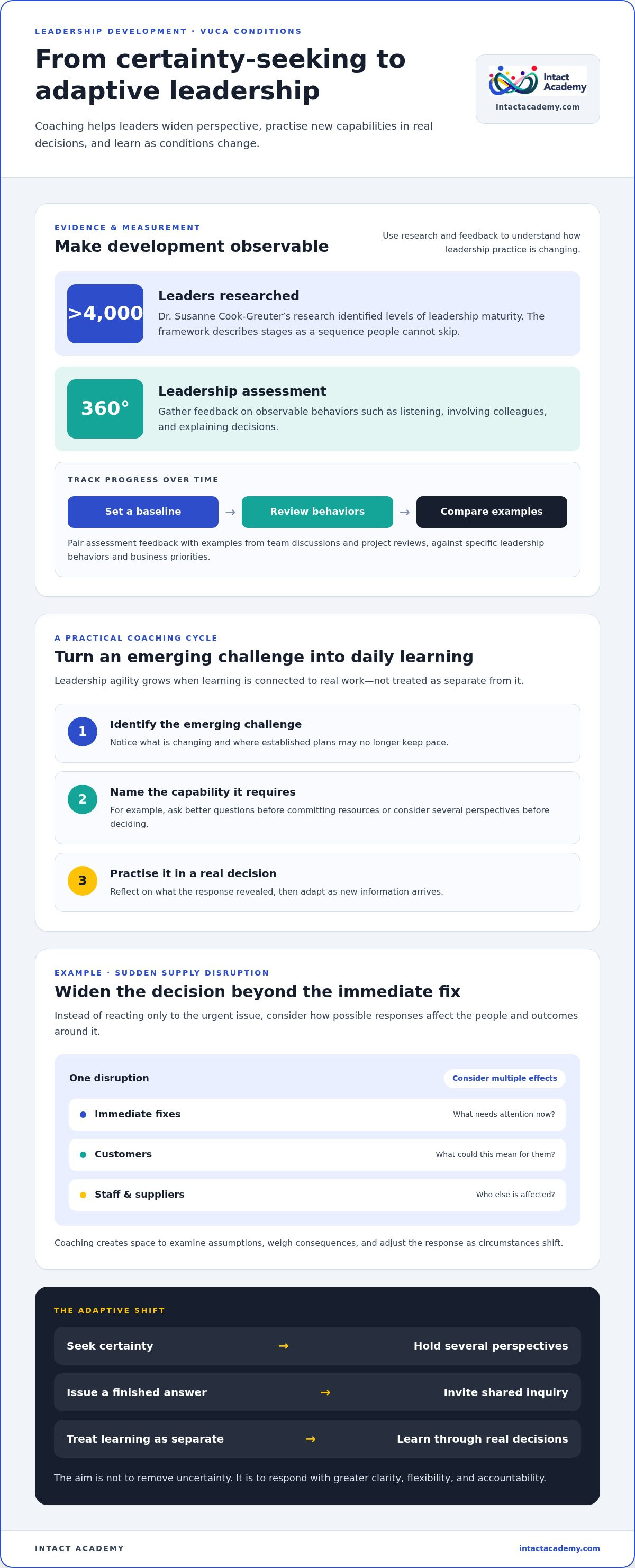
Vertical leadership development changes how leaders interpret situations, not simply what skills they apply. Dr. Susanne Cook-Greuter researched more than 4,000 leaders to identify levels of leadership maturity. The framework presents development stages as a sequence people cannot skip. In practice, a leader may move from seeking certainty toward holding several perspectives while making a decision.
That shift matters when the business landscape changes faster than established plans can keep pace. For example, a manager facing a sudden supply disruption can weigh immediate fixes against longer-term effects on customers, staff, and suppliers. Coaching creates space to examine assumptions, consider consequences, and adapt the response as new information arrives.
Leadership agility also depends on updating skills as conditions change. A practical coaching step is to identify an emerging challenge, name the capability it requires, then practise that capability in a real decision. A leader might ask better questions before committing resources, then reflect on what the response revealed. This ties development to daily work instead of treating learning as separate from it.
Organizations can measure coaching’s impact by setting a baseline against specific leadership behaviors and business priorities, then reviewing progress over time. A 360-degree leadership assessment can capture feedback on observable behaviors, such as listening, involving colleagues, and explaining decisions. Pair that feedback with concrete examples from team discussions and project reviews to see where practice is changing.
Innovation grows when leaders turn change into shared inquiry rather than issuing a finished answer. A leader can invite employees closest to a problem to describe what they see, generate options, and test a small response before expanding it. Coaching leaders in a VUCA world supports this shift from control to co-creation, while helping leaders stay accountable for their choices and learn from the results.
2. Facilitation and collaborative leadership
In a product launch, marketing may prioritize customer messaging while operations flags delivery risks. A leader who decides alone can miss knowledge held across both teams. Facilitation puts that knowledge to work: frame the shared challenge, clarify the decision needed, and invite each group to contribute evidence. The leader’s role shifts from supplying every answer to creating conditions for informed collaboration.
Coaching can help leaders practise this shift by reflecting on real conversations. Before a meeting, define its purpose and what must be decided. During the discussion, ask each person what they see, then listen without preparing a rebuttal. Deep listening means receiving another perspective openly, without internal judgment or commentary. Afterward, summarize the options, name unresolved tensions, and agree on a next step with clear ownership.
Communication gives collaboration structure. A leader can explain the organization’s vision, connect a decision to that direction, and distinguish settled facts from open questions. For example, when customer needs change, invite frontline employees to share patterns they’ve observed before revising a service process. This makes employees’ experience a resource for adaptation and helps teams see how their contributions support a shared goal.
Trust grows through consistent actions, not a single workshop. Leaders can make space for dissent, acknowledge useful challenges, and report how employee input shaped a decision. These behaviors help build a culture where people contribute early instead of waiting for instructions. Coaching offers a thinking partnership for examining how a leader’s communication affects participation. To strengthen this practice, explore collaborative leadership practices as a way to bring shared reflection into team work.
Facilitation is especially useful when a challenge crosses roles: bring people together, frame the issue they need to address, and make room for diverse employee voices. Rather than relying on rule by mandate, collaborative leadership is increasingly favored in the current environment. Openness and trust can help employees work together around a shared company vision, giving participation a common direction.
Coaching can help leaders communicate their vision, strategies, and decisions clearly while fostering team collaboration. In leadership coaching, the coach acts as a thinking partner, co-creator, and catalyst for the leader’s insights and growth. This collaborative process gives leaders room to develop how they bring people together and guide shared work.
3. Self-awareness and emotional intelligence
In uncertain conditions, a leader’s emotional response can shape the next decision. Imagine a critical project falling behind schedule: frustration may lead to blame, while anxiety may narrow attention to immediate fixes. Self-awareness starts with noticing the reaction, naming the concern, and separating observable facts from assumptions. That pause helps leaders choose a response instead of acting on their first impulse.
Try a brief reflection after a difficult meeting. What happened? What did you feel? What did you do next, and how did others respond? A leader who notices becoming defensive when questioned can prepare to ask for clarification before answering. Repeating this reflection on real experiences helps reveal patterns, including triggers that make challenges feel personal or urgent.
Emotional intelligence also means recognizing how tension affects others. If a team goes quiet after a change announcement, a leader can avoid assuming agreement. They can acknowledge the uncertainty, invite concerns, and explain what is known and what remains open. Coaching supports this practice by helping leaders explore their reactions and find their own answers, rather than relying on a script for every situation.
Self-awareness supports authenticity, including humility and flexibility. A leader can say, “I may be missing something,” and make room to reconsider a decision when new evidence appears. This isn’t indecision; it’s a deliberate response to changing conditions. Leaders can strengthen the habit by identifying a value they want to uphold, noticing when pressure pulls them away from it, and choosing an action that brings their conduct back into alignment. Over time, this practice supports growth, steadier judgment, and more considered responses under pressure.
Before trying to lead or influence others, leaders need to manage their own anxiety. Developing self-awareness, adaptive skills, stress and emotion management, resilience, endurance, and communication skills can help people manage VUCA conditions. Optimism and the ability to ease tension can strengthen leaders’ connection with others.
4. Coaching leaders in a VUCA environment
VUCA describes volatility, uncertainty, complexity, and ambiguity. Leaders may face shifting priorities, incomplete information, competing demands, and difficulty predicting how decisions will affect teams. Coaching leaders in a VUCA world turns these conditions into focused reflection and deliberate action, rather than a search for certainty that may not be available.
Executive coaching differs from leadership training in its focus. Training develops shared knowledge and skills through structured learning; coaching works with a leader’s current decisions, assumptions, and goals. A leader facing a sudden market shift can use coaching to examine options and take responsibility for the next step.
In the United States, coaching cost depends on the case and is provided after a quote request. Scope, coach involvement, and engagement design shape the work required, so there is no single rate for every leadership challenge.
Common challenges include reacting to rapid change, making decisions with incomplete or contradictory information, and coordinating people around evolving priorities. For example, a leader may need to revise a project plan while maintaining trust and clarifying what the team can act on now.
Scenario planning and systems thinking can complement coaching. Scenario planning helps a leader consider different plausible developments; systems thinking traces how a decision affects connected teams and processes. Together, they give coaching conversations practical material for testing assumptions and anticipating consequences.
Start by naming the immediate challenge and separating known facts from open questions. Then identify a meaningful goal, explore possible responses, choose an action, and review what the outcome teaches. This cycle encourages learning while keeping the leader’s ability to adapt central.
A key limitation is that coaching cannot supply missing business data, decision authority, or team capacity. If a leader lacks those resources, clarify the organizational obstacle alongside personal development goals. Explore coaching support for leadership challenges to develop a more reflective, adaptive practice.
Intact Academy: TA EMCC Senior Practitioner academy
Intact Academy’s TA EMCC Senior Practitioner academy is a development path for professionals seeking to deepen their coaching practice and support leaders through complexity. It can suit coaches and consultants developing their ability to work with changing perspectives, relationships, and organizational dynamics. For leaders seeking direct support with decisions and development, Executive Coaching offers a related path; for challenges involving team interaction, Team Coaching may be relevant.
Consider which level of work your context calls for: your own coaching practice, an individual leadership challenge, or team dynamics. This distinction can help you choose a starting point. Contact Intact Academy to explore its programs and find a path that fits your professional development.
Make your next leadership conversation count
Adaptive leadership develops through choices made in real situations and examined honestly. The next step may be to bring a live challenge into a coaching conversation, notice which assumptions are shaping your response, and decide what you want to practise differently. Small, deliberate shifts can change how you lead and how others experience working with you.
For professionals committed to coaching leaders in a VUCA world, the right development path depends on where they want to deepen their practice. Intact Academy offers the TA EMCC Senior Practitioner academy, the TA EMCC Senior Team Coach Academy, and the TA EMCC Senior Supervisor academy. Each has a distinct focus in coaching, team development, or supervision.
If you’re considering how coaching could support your leadership work or professional development, contact Intact Academy to discuss coaching. A thoughtful conversation can help you identify a useful next step and approach uncertainty with greater intention. Keep learning, stay open to new perspectives, and let your next decision become part of your development.
Frequently Asked Questions
How does coaching help leaders navigate volatility, uncertainty, complexity, and ambiguity?
Coaching leaders in a VUCA world helps turn a broad concern into a decision they can work with. For example, when a key client changes direction, a leader can use coaching to distinguish what needs immediate attention from what requires more information. A coach’s questions can surface assumptions, clarify priorities, and help the leader choose a next step while staying open to revision.
What coaching skills are most effective for VUCA leadership?
Deep listening, incisive questioning, and the ability to hold uncertainty without rushing to advice are especially useful. A coach might ask a leader to describe the evidence behind a forecast, then explore alternative explanations. Reflective feedback can help the leader notice recurring reactions, while goal-setting and accountability turn insight into practice. These skills support clear thinking without suggesting one response fits every situation.


