

What if the hardest part of coaching inside an organisation isn’t asking a powerful question, but knowing what to do when confidentiality, stakeholder expectations and workplace dynamics collide? Effective training for internal coaches develops more than core coaching techniques. It builds the judgment to work with the relationships and systems surrounding each conversation.
It’s reasonable to expect a learning pathway to strengthen listening, questioning and goal-setting. Internal coaches also need clear contracting, thoughtful boundaries and space to examine how their organisational role shapes the coaching relationship. Without that depth, generic training can prepare someone to hold a conversation without preparing them for the context in which it takes place.
This article offers a practical framework for evaluating what internal coach training develops, from ethical practice and reflective supervision to systemic awareness. You’ll explore how Transactional Analysis can illuminate patterns across individuals, teams and organisations, and how an advanced pathway such as the TA EMCC Senior Practitioner academy can support continued development. The aim is a more grounded, sustainable practice that serves both the person being coached and the wider organisation.
Key Takeaways
- See how an internal coach’s organisational role shapes the work, and where coaching needs to remain distinct from management, mentoring and consultancy.
- Use observable behaviours to assess core capabilities, including contracting, ethical judgment, systemic awareness and reflective practice.
- Compare training for internal coaches across theory, practice, supervision, ethics and recognition, rather than relying on a toolkit alone.
- Build a development pathway around five stages, adapting each to the coach’s experience and the organisation’s needs.
- Explore how Transactional Analysis can help coaches reflect on patterns in people, teams and organisations.
Why training for internal coaches must address the organisation around the conversation
An internal coach works within the organisation they serve, supporting colleagues while remaining part of the wider system. The role differs from line management, where authority and performance responsibilities shape the relationship; mentoring, which often draws on the mentor’s experience and advice; and consultancy, which typically focuses on diagnosing a problem and recommending action. Coaching centres on the coachee’s reflection, choices and development.
Internal coaching is coaching provided by someone inside the organisation, while external coaching is provided by someone outside it. That difference affects access, context and perceived independence. As The Wikipedia article on Coaching notes, coaching spans settings including business and executive work. An internal coach may understand the organisation’s language and history, but that familiarity can also lead to assumptions about what a colleague means or needs.
What makes internal coaching a distinct professional role?
Proximity brings insight, but it can also bring competing expectations. The coach is an employee; a sponsor may fund or request the work; and the organisation may hope for a particular outcome. These interests need not conflict, but they should be made explicit rather than left to shape the conversation silently.
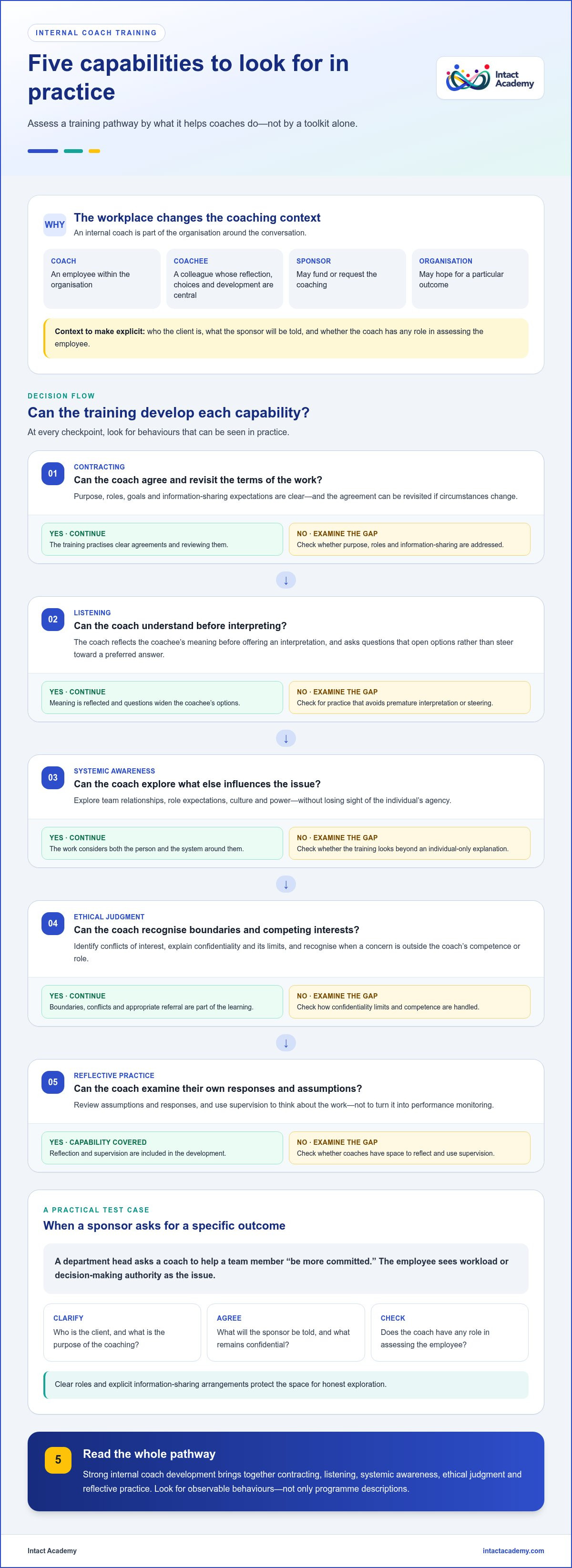
For example, a department head asks an internal coach to help a team member “be more committed.” The employee may see the issue as workload or a lack of decision-making authority. Before coaching begins, the coach needs to clarify who the client is, what the sponsor will be told, and whether the coach has any role in assessing the employee. Clear roles protect the space for honest exploration.
What should internal coach training help people navigate?
Training for internal coaches should develop sound contracting alongside core coaching skills. That means agreeing the purpose, roles, information-sharing arrangements and boundaries before sessions begin. Confidentiality supports trust, but should not be presented as unlimited: explain what will remain private, what may be shared, and how any limits will be handled. Informed agreement gives the coachee a clearer basis for choosing to participate.
- Impartiality: notice when existing relationships or organisational pressures may affect the work.
- Referral boundaries: recognise when a concern falls outside the coach’s competence or role, and discuss an appropriate next step.
Transactional Analysis can help coaches examine patterns in communication and relationships without reducing a person to a label. For an introduction to its concepts and systemic perspective, explore this guide to Transactional Analysis. The aim is not simply to understand the individual, but to stay curious about the context shaping the interaction.
Which capabilities should training for internal coaches develop?
Strong coaching depends on more than asking thoughtful questions. Internal coaches need to notice how their own role, the coachee’s relationships and the organisation’s norms may shape what can be said. Internal coaches need systems awareness alongside coaching skills because a workplace challenge rarely belongs to one person alone.
Look for capabilities that show up in practice, not just in programme descriptions:
- Contracting: clarifies the purpose, roles, goals and information-sharing expectations, then revisits the agreement if circumstances change.
- Listening: reflects the coachee’s meaning before offering an interpretation, and asks questions that open up options rather than steer toward a preferred answer.
- Systemic awareness: explores how team relationships, role expectations, culture and power may influence the issue without losing sight of the individual’s agency.
- Ethical judgment: identifies conflicts of interest, communicates confidentiality boundaries and recognises when a concern sits outside the coach’s competence.
- Reflective practice: reviews the coach’s assumptions and responses, and uses supervision to consider the work without turning it into performance monitoring.
How do contracting and boundaries protect the coaching relationship?
A clear agreement makes the coaching space more trustworthy. The coach and coachee should understand what they’re working toward, who the sponsor is, what information may be shared and what remains confidential. If a sponsor later requests progress details or the coachee’s role changes, the coach can return to the agreement, make the tension explicit and renegotiate before proceeding. Explore contracting for change for a deeper look at this core practice.
Why do systems thinking and reflective practice matter?
A coachee’s difficulty may be reinforced by unclear responsibilities, a team’s unspoken rules or a culture where disagreement carries risk. Systems thinking helps the coach ask what else is influencing the situation, rather than locating the whole problem within one person. Transactional Analysis (TA) offers a way to notice recurring interaction patterns, such as how people respond when authority or pressure enters a conversation. The aim is curiosity, not labelling.
Reflection helps the coach distinguish what the coachee has brought from what the coach may be feeling or assuming. Supervision provides a structured place to examine those reactions, ethical questions and organisational influences while protecting the coaching relationship. To deepen your understanding, read the guide to Transactional Analysis, or explore Intact Academy’s systemic coaching approach.
How to compare internal coach training approaches without choosing a toolkit alone
A set of techniques can help a coach structure a conversation, but it can’t prepare them for every organisational pressure around it. Strong training for internal coaches combines coaching fundamentals with the ability to apply them thoughtfully in the coach’s actual role. Compare learning pathways by what participants study, practise and demonstrate, not by the number of tools presented.
| Dimension | What to look for |
|---|---|
| Theory | A coherent framework that helps coaches understand people, relationships and organisational context. |
| Practice | Repeated opportunities to coach, receive feedback and work through realistic scenarios. |
| Ethics | Consideration of confidentiality, conflicts of interest, role boundaries and sponsor relationships. |
| Supervision | Structured reflection on coaching work, assumptions and dilemmas, separate from performance appraisal. |
| Application | Learning that addresses the realities of coaching within the organisation, not only practice in a neutral setting. |
| Recognition | Clear information about any accreditation or credential, assessed separately from practical relevance. |
Accreditation and fit answer different questions. Recognition can indicate that a programme meets defined learning standards; it doesn’t, by itself, show whether the learning prepares someone for a particular organisation’s dynamics or guarantee coaching quality or impact. Consider both the programme’s stated standards and the behaviours participants can demonstrate afterwards.
Is a generic coaching qualification enough for an internal coach?
General coach education can establish valuable foundations, including attentive listening, purposeful questioning and helping a coachee clarify goals. Those skills matter in any setting. Yet a general pathway may not explore sponsor contracting, dual relationships or the way organisational knowledge can influence a coach’s impartiality. Internal context should complement coaching fundamentals, not replace them.
What evidence of learning should organisations look for?
Look for evidence beyond attendance or completion. Supervised practice, reflective assignments, feedback and discussion of ethical cases can help show how a learner makes decisions, responds to challenge and learns from their own impact. A useful test is transfer: can the coach apply their learning to a situation involving competing stakeholder expectations without confusing coaching with management or advice?
For a broader perspective on continued learning, explore professional development for coaches. It can help organisations and practitioners consider development as an ongoing process of reflection and application, rather than a toolkit acquired once and used unchanged.
How to build a practical development pathway for internal coaches
A useful pathway turns learning into responsible practice over time. Define purpose, establish standards, learn, practise and review: this sequence helps internal coaches build capability in step with the organisation they serve. Training for internal coaches is most effective when it’s tailored to their experience, the organisation’s maturity and the scope of the role, rather than treated as a fixed course for everyone.
- Define purpose. Clarify who coaching is for, what it can support and how it relates to other development or performance processes.
- Establish standards. Set expectations for role boundaries, confidentiality, referral routes, sponsor relationships and ethical conduct.
- Learn. Develop coaching fundamentals and the understanding needed to work with organisational context.
- Practise. Apply the learning in structured practice, with feedback and supervision to support sound judgment.
- Review. Reflect on agreed outcomes, the coaching offer and emerging needs, then adjust the pathway as the organisation develops.
The sequence can begin differently depending on the starting point. A new internal coaching initiative may need clear purpose and standards before training begins. Experienced coaches may benefit from a deeper focus on organisational dynamics, ethical complexity or reflective development. Keep supervision and peer reflection alongside every stage; they’re continuing supports, not a final box to tick.
How can an organisation create the conditions for learning?
Learning needs organisational support to become practice. Give coaches a clear role description, referral routes, confidentiality agreements and shared expectations with sponsors. Protect time for learning, coaching practice, supervision and ongoing development. When evaluating the work, focus on learning and outcomes agreed at the outset, not the private content of coaching sessions. This allows the organisation to learn about the coaching offer while preserving the trust needed for candid conversations.
How can coaches translate training into reflective practice?
After a coaching engagement or a challenging session, use anonymised case reflection to examine what happened. What assumptions did the coach bring? Which choices opened up the conversation, and which narrowed it? What relational or organisational pattern might be influencing the situation? Peer reflection can broaden perspective, while supervision offers space to work through ethical tensions or role conflicts without turning reflection into assessment.
Review the pathway regularly. Can coaches apply their learning in the situations they actually encounter? Have the organisation’s expectations, structures or needs shifted? A thoughtful review keeps development responsive rather than static. Explore Intact Academy’s coach development approach for a systemic perspective on reflective learning and professional growth.
Choosing a systemic development pathway at Intact Academy
For internal coaches, a systemic perspective can widen the frame without taking attention away from the person in the conversation. Transactional Analysis (TA) offers a way to reflect on how interactions take shape, how roles influence communication and how familiar patterns may recur across a team or organisation. It’s a lens for inquiry, not a shortcut to certainty.
How can Transactional Analysis deepen internal coaching practice?
Consider a colleague who repeatedly hesitates to speak in meetings. A coach might explore the individual’s experience while also staying curious about team relationships, role expectations and the organisational context. Is the person responding to a pattern in the group? What assumptions are shaping the interaction? What choices remain available to them?
TA can help coaches notice recurring dynamics without turning them into fixed labels or diagnoses. The coach tests interpretations with the coachee, inviting reflection rather than prescribing an explanation. This matters in internal work: organisational knowledge can make patterns easier to see, but the coachee remains the authority on their own experience and decisions.
What can an advanced learning environment contribute?
Some internal coaches may want to deepen their practice beyond foundational techniques. Intact Academy’s TA EMCC Senior Practitioner academy offers an advanced development pathway for practitioners, including those who want to strengthen their understanding of people and organisational systems.
Intact Academy brings together expertise in Transactional Analysis, executive coaching, team coaching and organisational change. Based in Utrecht, it offers online and in-person learning to participants from more than 14 countries. Learning alongside an international group can introduce varied organisational perspectives and prompt reflection on how context shapes coaching practice.
For coaches considering advanced development, the central question is how learning might inform their work: Can it help them reflect more clearly on the relationships and systems around a coaching conversation? Can it support a practice that remains thoughtful, ethical and responsive as organisational conditions shift? These questions can help connect professional development with the realities of internal coaching.
Explore the TA EMCC Senior Practitioner academy and consider how a systemic, reflective pathway could support your continued development as a coach.
Build coaching capability that can grow with your organisation
Effective training for internal coaches develops more than listening and questioning. It strengthens the judgment to contract clearly, work ethically and recognise how relationships, roles and organisational patterns shape a coaching conversation. A considered pathway also makes room for practice, supervision and reflection, so learning continues beyond the classroom.
As you assess your next step, look for development that connects individual coaching skills with the systems in which those skills are used. Transactional Analysis can offer a reflective lens for noticing patterns while leaving room for each person’s agency and perspective.
Intact Academy is led by Sari van Poelje and offers an international learning community, with participants from more than 14 countries. Its expertise spans TA, executive coaching, team coaching and organisational change. The TA EMCC Senior Practitioner academy is an advanced pathway for practitioners seeking to deepen their development.
Explore Intact Academy’s TA EMCC Senior Practitioner academy to consider how a systemic learning pathway could support your practice. With clear boundaries, sustained reflection and curiosity about the wider system, internal coaches can help create the conditions for meaningful change.
Frequently Asked Questions
What is training for internal coaches?
Training for internal coaches develops the skills and judgment to coach colleagues while working within the same organisation. It can include listening, questioning, contracting, ethical practice, systemic awareness and reflective learning. Because internal coaches work close to organisational culture and stakeholders, development should also address role boundaries and how to handle sponsor expectations. The aim is to support effective coaching without confusing it with management, mentoring or consultancy.
What skills should an internal coach have?
An internal coach needs to listen attentively, ask open questions and help a colleague clarify goals and choices. They should also be able to agree the purpose and boundaries of coaching, explain confidentiality, and recognise potential conflicts of interest. Systems awareness helps them consider how team relationships, role expectations and organisational culture may shape a challenge. Regular reflection and supervision can help coaches examine assumptions and strengthen their practice.
Is internal coach training different from general coach training?
It can be. General coach training builds transferable foundations such as listening, questioning and supporting reflection. Internal coaches also need to work with organisational proximity: they may know the coachee, understand the culture or have relationships with sponsors and managers. Development that addresses these conditions can help coaches manage boundaries, dual relationships and contracting. Organisational context complements coaching fundamentals; it doesn’t replace them.
Can an internal coach maintain confidentiality at work?
An internal coach can support confidentiality by agreeing its limits and information-sharing arrangements before coaching begins. The coachee and coach should clarify what, if anything, may be shared with a sponsor, and for what purpose. The coach should avoid promising absolute secrecy if agreed boundaries or organisational processes create limits. If expectations change, revisit the agreement before sharing information. Clear contracting helps the coachee make an informed choice about participating.
How do organisations evaluate internal coach training?
Evaluate training by looking at what coaches can demonstrate, not only whether they completed a course. Consider the quality of supervised practice, feedback, reflective assignments and discussion of ethical situations. Assess whether coaches can apply their learning to real workplace conditions, such as competing stakeholder expectations or changes in role. Organisations can review agreed goals and learning outcomes while respecting session confidentiality and avoiding requests for private coaching content.
Does an internal coach need accreditation?
Accreditation may be valuable when an organisation wants a recognised framework for coach development, ethical practice or professional standards, but its relevance depends on the role and the organisation’s aims. A credential alone doesn’t guarantee coaching quality or organisational impact. Consider accreditation alongside practical experience, supervised practice, reflective development and the coach’s ability to work responsibly within the organisation. The two questions are related, but distinct: what does the credential recognise, and what does the role require?


