

The choice between top-down vs bottom-up change can look like a trade-off between speed and employee ownership. But a clear leadership decision does not have to shut out local insight, and meaningful participation does not have to stall decisions. Sustainable change connects the two.
If you’re deciding how much direction leaders should set, weigh the need for strategic coherence against the risk of imposing change without genuine ownership. Each approach has value, but either can fall short on its own. Central direction may miss the realities of daily work, while local initiatives can drift from organisation-wide priorities.
This article explains what each approach offers, when it may suit the context, and how to combine them. You’ll find practical ways to clarify purpose, involve employees in shaping implementation, and use feedback to adjust the plan. The goal is not to choose between direction and participation, but to create a working loop between organisational intent and people’s experience.
Key Takeaways
- Understand how top-down and bottom-up change differ in decision-making, communication, and employee participation.
- Use urgency, risk, and access to local knowledge to decide where leadership direction or employee input should carry more weight.
- Combine top-down and bottom-up change instead of treating them as competing choices.
- Use a practical sequence to clarify purpose, set boundaries, invite input, and adapt based on feedback.
- Recognise how systemic coaching can help leaders attend to relationships and informal norms as change unfolds.
Top-Down vs Bottom-Up Change: What Do the Two Approaches Mean?
Leaders set direction, while employees closest to the work often see what a proposed change will mean in practice. A new operating model, for example, may be designed centrally, but frontline teams can identify where current processes create friction. The challenge is not simply who has authority. It is how change begins, how people interpret it, and how it is shaped as it moves through the organisation.
Top-down change sets direction centrally and translates it through organisational levels; bottom-up change begins with local insight and initiatives that can shape wider decisions. These terms describe where change originates and how it is influenced, not fixed leadership styles or permanent management structures. The broader idea of top-down and bottom-up design describes two ways of organising action, from the whole towards its parts or from the parts towards a larger whole. In organisations, change can move in either direction and often travels between them.
What does a top-down change approach look like?
Senior leaders define the purpose, priorities, boundaries, and decision rights. They clarify what needs to change, why it matters, and what must remain consistent across the organisation. Managers then translate that direction into plans, communication, and coordinated action for their teams. This is change leadership in practice, not simply the presence of a hierarchy.
Clear sponsorship gives people context and a framework for action. One-way instruction is different: it announces decisions without a meaningful route for questions, concerns, or new information to affect implementation. That distinction matters. Even when the strategic decision is settled, leaders can still learn from how it is being put into practice.
What does a bottom-up change approach look like?
Bottom-up change starts when employees or teams identify a need, test an idea, or notice a pattern in daily work. A team might trial a revised handover process, then report what improved and what caused new difficulties. That learning can help leaders refine wider plans, adapt implementation, or recognise that the problem extends beyond one team.
Participation shapes organisational change only when insight has a route into decisions. Establish a process for gathering observations, assessing proposals, and explaining what happens next. Without that connection, people may offer ideas without seeing any influence. With it, local knowledge can inform wider action while leaders remain accountable for coherence and direction.
In practice, top-down vs bottom-up change is less a contest between authority and participation than a question of how each informs the other. The starting point may differ, but people across the organisation interpret, test, and respond to change as it unfolds.
How Top-Down and Bottom-Up Change Shape Organisational Behaviour
People experience change through more than the decisions an organisation makes. They also notice how authority is used, how information moves, and whether they have meaningful ways to respond. A clear purpose can reduce uncertainty and help teams coordinate. But when decisions arrive as finished instructions, people may comply outwardly while holding back the practical knowledge and commitment needed to put the change into effect.
Communication without listening is a broadcast, not a feedback loop. A genuine loop allows employee responses to reach decision-makers, inform adjustments, and return as a clear explanation of what changed or why it did not. Local participation can expose workflow constraints that a central plan overlooks, but it needs defined decision pathways. Otherwise, input can pile up without influencing action, weakening trust instead of building it.
How direction and participation affect trust
People can engage more readily when leaders explain the rationale for a change: the problem it addresses, the outcomes that matter, and what remains uncertain. Transparency does not mean every decision is open for negotiation. It helps people distinguish firm boundaries from questions that are still open.
Being informed after a decision is final is not the same as having influence while options are being considered. Meaningful participation requires clarity about where input can shape the process. It also depends on psychological safety: people need to be able to raise concerns, identify unintended consequences, and share relevant information without fearing that candour will be treated as disloyalty. Leaders do not need to agree with every concern, but they should show that they have heard and considered it.
How organisational patterns influence responses to change
Transactional Analysis offers one lens for noticing how communication and relationship patterns affect change. Under pressure, a conversation intended to invite collaboration can become directive, defensive, or overly compliant. People may stop asking questions, avoid experimentation, or focus on protecting familiar roles. These responses are not simply individual traits. They can also reflect authority relationships, workload, and the perceived consequences of speaking up.
For example, a team asked to trial a new process may hesitate if it is still held responsible for the same performance measures. That hesitation could signal a tension in the system, not resistance to improvement. Notice the pattern before judging the person. Treat it as information, then consider which expectations, incentives, or conversations need attention.
Neither top-down nor bottom-up change is inherently effective. Outcomes depend on whether the approach fits the urgency and interdependence of the work, and on how leaders respond to what they learn. Leaders looking to strengthen that connection can explore systemic coaching and organisational change as ways to examine the relationship between strategic intent and people’s experience.
Top-Down vs Bottom-Up Change: Compare the Trade-Offs Without Choosing a False Winner
Neither approach wins in every situation. Ask instead which decisions need to be made centrally and where local knowledge can improve implementation. The right balance depends on the work, the people affected, and the consequences of getting the change wrong.
| Consideration | Top-down emphasis | Bottom-up emphasis |
|---|---|---|
| Decision authority | Leaders set direction and retain key decisions. | Teams help shape decisions through local insight and initiative. |
| Speed | Can support rapid alignment when a clear decision is needed. | May take longer to gather and reconcile input, but can reveal workable options. |
| Local insight | Risks overlooking differences in day-to-day practice. | Surfaces practical knowledge from the people doing the work. |
| Ownership | Can clarify accountability, but imposed solutions may limit commitment. | Can build involvement, provided contributions have a visible path into decisions. |
| Coordination | Helps align priorities and timing across teams. | May produce varied approaches that need coordination before spreading. |
Use the comparison as a prompt, not a scorecard. Urgency may call for a firm central decision. Higher risk may require clear boundaries and accountability. Strong interdependence across teams can increase the need for shared standards, while organisational readiness and access to local knowledge affect how much teams can shape implementation. The need for alignment does not mean participation has to stop. Leaders can hold the purpose, outcomes, and non-negotiable constraints steady while inviting teams to inform the route.
When can top-down change provide useful direction?
Imagine an organisation aligning several departments around a shared service process. Leaders may need to set common priorities, decision rights, and timing so teams do not move in conflicting directions. They can still ask teams to identify workflow obstacles and suggest practical adjustments. A mandate sets direction, but it is not a complete change plan. Leaders still need to translate it into action, support people, and respond to its effects.
When can bottom-up change generate useful learning?
If teams face different bottlenecks, local trials can show which adjustments help and which create new problems. Leaders can define the intended outcome and guardrails, then give teams room to test ideas within them. Before extending a local solution, assess how it fits wider priorities and dependencies. What works in one context may need adapting elsewhere.
A blended approach does not dilute leadership accountability. Leaders remain responsible for the purpose, boundaries, and decisions that affect the whole system. Participation helps them make those decisions with better information. In practice, top-down vs bottom-up change is about connecting direction and learning, not choosing between leading and listening.
How to Choose and Combine Top-Down and Bottom-Up Change
Design a change approach around the conditions, not a preference for control or consultation. Assess how urgent the decision is, who will be affected, how closely teams depend on one another, how ready the organisation is to adapt, and where the most relevant local knowledge sits. These factors help clarify what leaders need to decide and where people can shape the work.
How should leaders create direction and invite input?
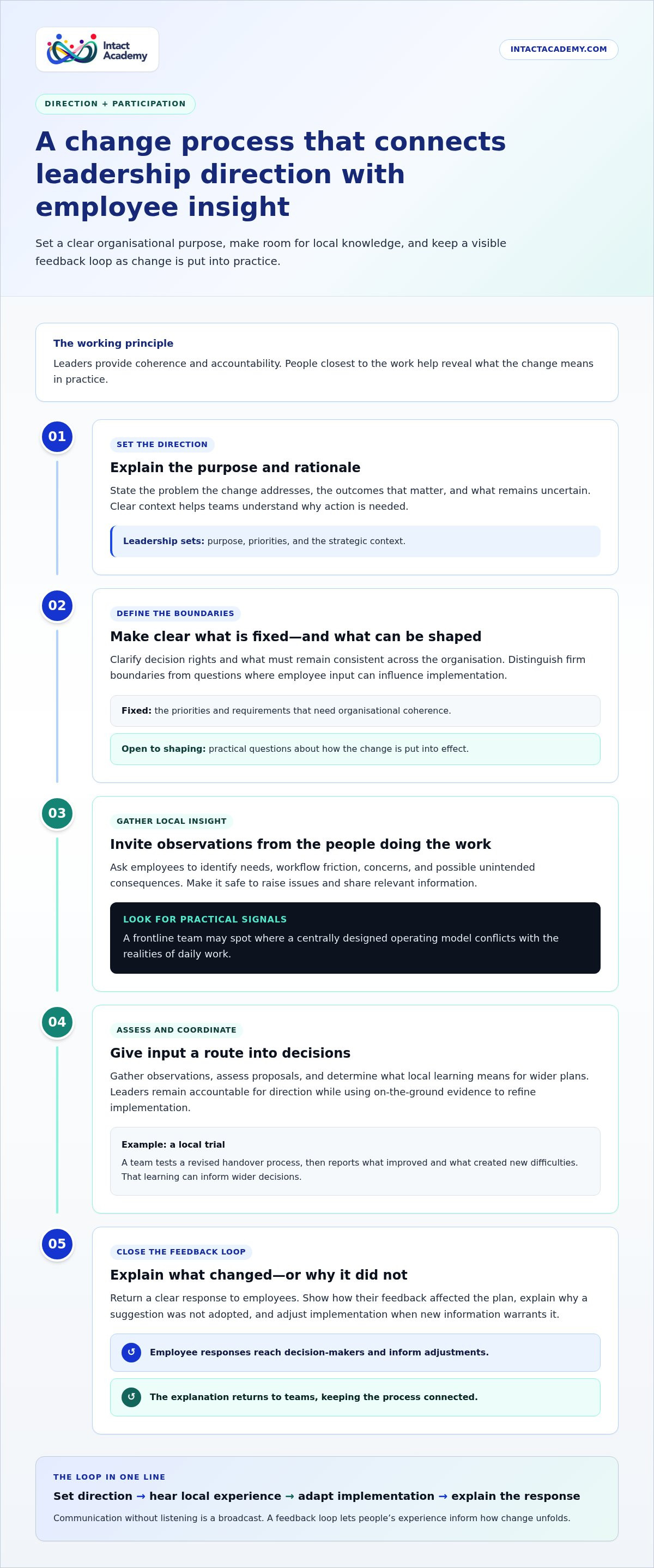
Make the purpose explicit, then separate non-negotiable outcomes from areas open to influence. Map the groups affected and the people with operational or relational knowledge. Choose ways for them to contribute, such as focused team discussions or a time-limited trial, and explain how their input will be considered.
Clear decision rights make participation tangible. State who recommends, who decides, and who needs to be consulted. For example, leaders might retain the decision on a shared customer-service standard while asking teams to shape the handover steps. This supports alignment without suggesting that every detail is already settled. Organisations looking to formalise governance and delivery frameworks across teams can visit Yellowhouse to explore accredited project and programme management training.
How can teams learn and adapt during implementation?
Set review points before implementation begins. At each one, consider progress, unintended effects, and emerging needs. Keep the purpose visible while adjusting the method. If feedback leads to a change, explain what shifted and why. If it does not, explain the constraint. Closing the loop helps people see how participation connects to action.
Imagine an organisation introducing a common reporting process. During an initial trial, one team finds that a required approval step delays urgent work. Leaders review the feedback, retain the shared reporting requirements, and adjust the approval route for time-sensitive cases. This example is illustrative: the right response depends on the purpose, risks, and wider dependencies.
Clarify the purpose, map the system, set boundaries, invite insight, then review and adapt: this is a repeatable cycle for change. Use it to connect strategic intent with the experience of people doing the work. For a wider systemic perspective, explore leading organisational change.
To build your capacity to connect direction with participation, explore executive coaching and organisational change learning.
Make Organisational Change More Sustainable Through Systemic Coaching
A change can be clearly designed and still falter in the relationships and routines that shape everyday work. Formal structures matter, as do informal norms: who feels able to question a decision, which assumptions go unspoken, and how teams respond when familiar ways of working are disrupted. Sustainable change attends to both the visible plan and the human system it enters.
Systemic coaching gives leaders structured space to examine how their choices are experienced across that system. It can help them notice whose perspectives are missing, hear tensions between stated priorities and lived experience, and respond with greater intention. It is not a formula for guaranteed outcomes. It brings attention and reflection to the relationships through which change happens. For a broader view, explore systemic organisational change.
What can a coach contribute to organisational change?
A coach can help leaders surface the assumptions behind a plan and hear perspectives that may be difficult to reconcile. For instance, senior leaders may see a new process as a route to consistency, while teams experience it as adding steps to already complex work. Coaching can support inquiry into both realities, helping leaders distinguish practical constraints from resistance and identify questions that deserve a response.
Team coaching can create space for people to examine shared responsibility, communication, and learning during implementation. Transactional Analysis can serve as a reflective lens for noticing how communication patterns shift under pressure, without reducing people to labels or treating one framework as a cure-all. Learn more about Transactional Analysis and its application to professional relationships.
How can change leaders build their capability?
Reflective practice helps leaders keep examining the effects of their actions as change unfolds. Useful questions include: Who has influence over this decision? Whose experience is shaping our understanding? Are we inviting honest input, and what unintended consequences are emerging? Returning to these questions can strengthen the connection between authority, participation, and accountability.
Executive coaching, team coaching, and organisational change learning can help leaders and teams develop this capacity through practice and reflection. For another perspective, read Sari van Poelje’s systemic change perspective.
If you’re ready to deepen your approach to change, explore how Intact Academy develops coaching and organisational change practice.
Make Change a Shared, Ongoing Practice
Effective organisational change is not a choice between leadership direction and employee participation. Leaders need to clarify the purpose, priorities, and boundaries. People closest to the work need meaningful ways to share insight, test approaches, and shape implementation. The balance in top-down vs bottom-up change depends on the context and can shift as learning emerges.
Progress also depends on what happens beyond the formal plan: relationships, communication patterns, and assumptions that influence how people respond. A steady cycle of listening, deciding, and adapting connects strategic intent with everyday experience.
Founded in 2013 and led by Sari van Poelje, Intact Academy brings together an international learning community spanning more than 14 countries. Its programmes include training recognised by EMCC and ICF. To strengthen your capacity to lead change with clarity and participation, explore Intact Academy’s coaching and organisational change learning.
Change becomes more possible when people can contribute to it with purpose. Keep learning, keep listening, and let each considered adjustment move the organisation forward.
Frequently Asked Questions
What is the difference between top-down and bottom-up change?
Top-down change begins with leaders setting direction and translating it through the organisation. Bottom-up change starts with ideas, needs, or experiments from employees and teams. The difference is where change begins and how it is shaped, not whether leaders value participation or employees can take initiative. Leaders may set shared goals while inviting teams to influence how those goals are achieved.
Is top-down change more effective than bottom-up change?
Neither approach is always more effective. Top-down change can help when fast decisions, clear accountability, or organisation-wide coordination matter. Bottom-up change can bring local knowledge into view and support involvement, especially when implementation depends on daily practice. The right balance depends on urgency, risk, interdependence, readiness, and where relevant insight sits. Assess the context, then clarify which decisions are set and where people can shape the response.
Can an organisation combine top-down and bottom-up change?
Yes. A combined approach connects leadership direction with learning from people doing the work. Leaders clarify the purpose, intended outcomes, and constraints, then invite teams to test implementation ideas and share what they learn. Decision-makers review the feedback, adjust the approach where appropriate, and explain their choices. This keeps change aligned across the organisation while giving local insight a visible route into decisions.
When is a top-down approach to organisational change useful?
A top-down approach can be useful when an organisation needs shared priorities, coordinated timing, or clear accountability across teams. For example, leaders may establish a common outcome and boundaries for a change affecting several departments. They can still involve employees in working out practical implementation details. A clear mandate provides direction, but it does not replace planning, communication, support, or attention to how the change affects people.
How can leaders encourage bottom-up change without losing alignment?
Set a clear purpose and define which outcomes or boundaries are not open to change. Specify who can suggest, test, recommend, and approve changes. Give teams suitable ways to share local observations, and establish a process for reviewing their input. Explain what was adopted, adapted, or declined, and why. When people can see how their contributions inform decisions, participation is more likely to stay connected to shared priorities.
What are the risks of a bottom-up change approach?
Without coordination, local initiatives can pull in different directions, duplicate work, or create solutions that do not transfer well to other teams. Participation can also frustrate people if their ideas are collected but never considered or answered. Reduce these risks by setting shared goals and guardrails, clarifying how proposals reach decision-makers, and reviewing wider effects before extending a solution. Local initiative is valuable, but it needs to connect to the organisation’s broader purpose.
How does coaching support organisational change?
Coaching can give leaders and teams structured space to examine assumptions, hear different perspectives, and reflect on how decisions are experienced. Team coaching can support shared responsibility and learning as people work through change. Transactional Analysis may offer a lens for noticing communication patterns, especially under pressure, without treating one framework as a cure-all. Coaching supports reflection and intentional action; it does not guarantee a particular outcome or replace clear leadership decisions.


