

What if the most important work in coaching a burned-out senior leader isn’t helping them cope better, but understanding what keeps exhausting them? Coaching senior leaders through burnout calls for more than a conversation about resilience. A leader may feel depleted yet hesitate to show vulnerability, while workload, organizational expectations, and long-standing patterns continue to reinforce the strain.
Begin with the person in front of you. Their experience deserves a confidential, non-judgmental space, not a quick diagnosis or a productivity plan. At the same time, care for the individual shouldn’t obscure the conditions shaping their work. Sustainable change may require attention to the leader’s choices, relationships, role, and wider organizational system.
This guide offers a practical, systemic approach to coaching senior leaders through burnout with empathy and clear boundaries. You’ll learn how to explore what’s happening without minimizing the leader’s experience, identify patterns that may be open to change, and agree on realistic next steps. It also explains how to recognize when needs raised in coaching call for clinical or other specialist support, so the coaching relationship remains useful and appropriately scoped.
Key Takeaways
- Start by listening to how the leader experiences their role and pressure, without rushing to label or solve the problem.
- In coaching senior leaders through burnout, map how personal patterns, relationships, role design, and organizational culture interact.
- Choose individual coaching, team or sponsor conversations, or organizational change work according to the need, with consent and clear responsibilities.
- Use a structured process to contract, explore, map the system, identify choices, test practical changes, and review what shifts.
- Track progress against the leader’s goals and relevant work conditions, and recognize when needs call for specialist support beyond coaching.
Coaching Senior Leaders Through Burnout Starts With Understanding Their Experience
Senior leaders often carry responsibility that is both broad and visible. Their decisions affect teams, customers, and organizational direction, while expectations of steadiness can make it difficult to admit when pressure is taking a toll. A leader may keep delivering and still feel depleted. Take their account seriously rather than assuming that performance tells the whole story.
The World Health Organization describes burnout as an occupational phenomenon resulting from chronic workplace stress that hasn’t been successfully managed. Its dimensions include exhaustion, increased mental distance or cynicism toward work, and reduced professional efficacy. This framing, outlined in Occupational burnout, can orient a conversation, but it isn’t a diagnostic tool for a coach. Exhaustion alone doesn’t establish burnout. A difficult period, disengagement, or changes in confidence may have different meanings for different people. One signal cannot explain the whole experience.
Coaching through burnout is a consent-led inquiry into how work is affecting a leader, what conditions shape that experience, and which next steps feel possible. In coaching senior leaders through burnout, curiosity matters more than categorization. Ask what has changed and how the leader makes sense of it, rather than fitting their story to a predetermined pattern.
What might burnout look like in a senior leadership role?
Notice shifts as invitations to explore, not evidence to interpret for the leader. They might describe having less energy for decisions, feeling detached from work they once valued, or finding it harder to connect with colleagues. Yet outwardly they may appear composed, meet targets, and continue carrying demanding responsibilities. Others may show strain in ways that don’t match these examples. Ask what the leader is noticing, when it occurs, and what meaning they give it. Don’t assume a standard set of signs or a predictable timeline.
What should the coach establish before exploring causes?
Set a clear contract before sensitive exploration begins. Agree on the coaching purpose, confidentiality and its boundaries, each person’s role, and whether a sponsor is involved. If the organization sponsors the work, clarify what information may be shared and obtain the leader’s consent before any broader conversation. A sponsor’s interest in progress doesn’t override the leader’s need for a trustworthy coaching space.
Ask, “What would you like to be different?” and “What feels safe to discuss here?” These questions give the leader agency over both direction and pace. Explain that coaching supports reflection, choices, and action. It doesn’t provide medical assessment or treatment. If the leader’s needs appear to fall outside that scope, name the boundary with care and discuss appropriate additional support.
Why Senior-Leader Burnout Needs a Systemic, Not Individual-Only, Lens
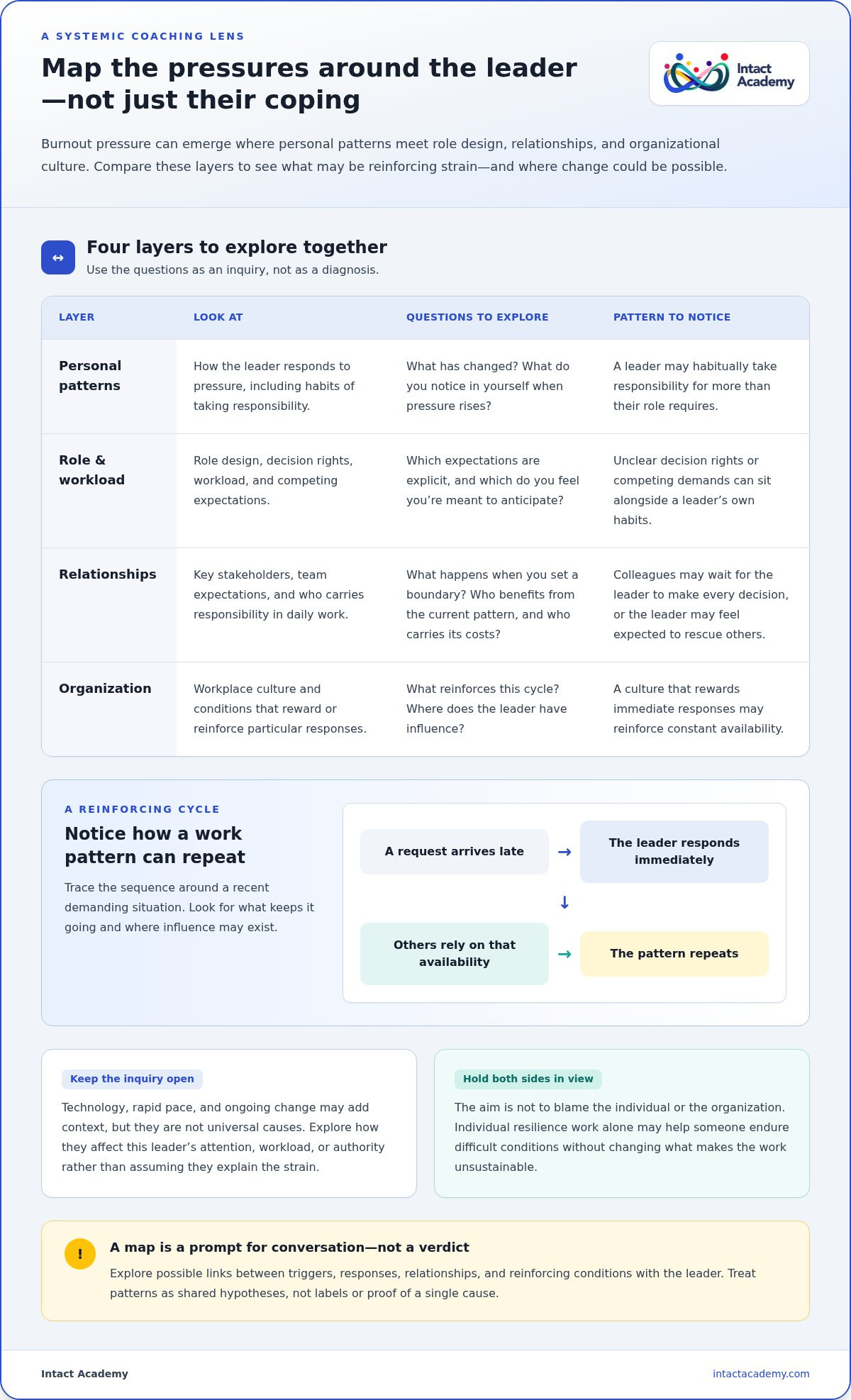
A leader’s response to pressure matters, but it doesn’t arise in isolation. Personal coping patterns meet role design, relationships, and organizational culture. A leader who habitually takes responsibility may also have unclear decision rights, competing demands, and a workplace culture that rewards immediate responses. Exploring only personal resilience can miss the conditions that keep pressure in place.
Individual resilience work alone may help a leader endure difficult conditions without changing the conditions that make the work unsustainable. The aim isn’t to assign blame to the organization or the individual. It’s to understand how their actions and the surrounding system influence one another, then identify where change may be possible.
How can a coach map pressures across the leadership system?
Invite the leader to sketch the pressures around a recent demanding situation. Include their role and decision rights, workload, key stakeholders, and competing expectations. Then trace what happens: a request arrives late, the leader responds immediately, others come to rely on that availability, and the pattern repeats. This is an inquiry, not a verdict. Ask what reinforces the cycle and where the leader has influence.
Explore questions such as: “Which expectations are explicit, and which do you feel you’re meant to anticipate?” “What happens when you set a boundary?” “Who benefits from the current pattern, and who carries its costs?” Constant availability, emotional responsibility for a team, and pressure to absorb organizational uncertainty may each feel different to the leader. Investigate them rather than assuming they explain the strain.
Technology, rapid pace, and ongoing change can add context, but they aren’t universal causes. Ask how digital communication shapes this person’s attention, or how a particular change affects their workload and authority. A simple map connecting triggers, responses, relationships, and reinforcing conditions can turn a broad sense of overwhelm into a clearer picture of the system.
How can Transactional Analysis inform the conversation?
Systemic Transactional Analysis can help a coach and leader notice recurring relational patterns. For example, the leader may feel expected to rescue others, or colleagues may wait for them to make every decision. Treat these as shared hypotheses to explore, not labels for the leader or their colleagues. Ask what the pattern makes possible, what it constrains, and whether the leader recognizes it. For a broader explanation, see the systemic guide to Transactional Analysis.
Coaching senior leaders through burnout can connect insight about individual choices with thoughtful attention to organizational patterns. When the leader is ready, that systemic perspective can also inform executive coaching and organizational change, keeping development connected to the conditions of work.
Which Burnout-Coaching Approach Fits the Leader and the Organization?
There isn’t one best response for every leader. The right approach depends on what the leader wants to change, what the coaching contract allows, and whether the pressure is mainly about personal choices, shared team dynamics, or wider work conditions. These approaches can complement one another, but only with clear responsibilities and the leader’s informed consent.
| Approach | Purpose | Suitable context | Boundaries |
|---|---|---|---|
| Individual executive coaching | Support reflection, leadership choices, boundaries, and agreed experiments at work. | The leader wants a confidential space to examine their experience and identify what they can influence. | Coaching can’t independently change workload, staffing, or organizational decisions. |
| Team or sponsor conversations | Explore shared expectations, role clarity, and patterns affecting how work gets done. | Team relationships or sponsor expectations appear relevant to the leader’s capacity. | Agree what may be shared, with whom, and for what purpose before conversations begin. |
| Organizational change work | Address workplace structures or norms that may sustain pressure. | Role demands, decision processes, or norms such as constant availability contribute to the situation. | Keep the work scoped, distinguish it from individual coaching, and clarify who has authority to act. |
When is individual executive coaching a useful route?
Individual coaching can help a leader notice how they respond to pressure, clarify what matters, practise setting boundaries, and test a change in how they lead. Working with dedicated executive guidance, such as the support offered by Charlie Whalley Coaching, allows leaders to explore these practical strategies within a safe, objective environment. For example, they might agree to delegate a decision or establish a clearer response expectation, then reflect on what happens. These experiments can build insight, but they can’t resolve understaffing or change decision-making structures on their own. Explore the systemic perspective on executive coaching for a broader view of how individual development relates to context.
When might team or organizational work also matter?
If unclear roles, team dynamics, or shared norms keep making boundaries difficult, individual reflection may need to be accompanied by wider conversations. With consent, a sponsor discussion might clarify priorities or decision rights. Team work might surface expectations that affect everyone’s capacity. Protect confidentiality by agreeing in advance what insights can be shared, without turning the coaching space into a reporting channel. Where work conditions need to change, a systemic approach to organizational change can connect individual insight with the wider system.
In coaching senior leaders through burnout, match the scope of the response to the source of pressure. Start with the agreed contract, revisit it as understanding develops, and avoid promising that individual coaching can solve conditions outside the leader’s control.
How to Coach a Senior Leader Through Burnout Responsibly
A responsible process creates structure without forcing the leader into a predetermined explanation or pace. Compassionate coaching stays curious about the leader’s experience; it doesn’t diagnose, prescribe, or promise a particular outcome. Use the steps below as a guide, adapting them as the leader’s needs become clearer.
- Contract clearly. Agree what the leader wants from coaching, how confidentiality works, and what information, if any, may be shared with a sponsor. Clarify roles and boundaries before exploring sensitive details. Ask, “What would make this work useful to you?” and revisit the agreement if the purpose or circumstances change.
- Listen before interpreting. Invite the leader to describe what has changed and what they want help understanding. “What feels most demanding at the moment?” and “How is this affecting the way you work or relate to others?” let them define the impact in their own terms. Don’t turn an initial account into a diagnosis or a quick action plan.
- Map the system. Explore how workload, role expectations, relationships, decision rights, and organizational norms connect with the leader’s experience. Ask, “What tends to happen before the pressure intensifies?” and “What makes it difficult to respond differently?” Look for patterns collaboratively, not for someone to blame.
- Identify choices and limits. Distinguish what the leader can influence directly, what requires another person’s commitment, and what sits beyond their authority. A leader might adjust how they prioritize requests, while a workload or staffing decision requires organizational action. Name the difference without implying personal effort can solve every structural constraint.
- Agree on a small experiment. Co-design a practical step connected to the leader’s goals, such as clarifying priorities with a stakeholder, delegating a decision, or testing a boundary around availability. Decide what they’ll observe and what support they need. Keep the experiment proportionate to their capacity, not another demand to perform.
- Review and adapt. Ask what happened, what the leader learned, and what should change next. Consider both their experience and the relevant work conditions. Don’t assume progress follows a fixed timeline or promise a guaranteed result.
Throughout, check whether coaching remains an appropriate form of support. If the leader’s needs call for medical assessment, treatment, or other specialist support, explain the boundary sensitively and discuss suitable next steps with them. Coaching can support reflection and action, but it isn’t clinical care. In coaching senior leaders through burnout, respecting that distinction is part of protecting trust.
To strengthen a reflective, contracted approach to leadership development, explore executive coaching.
Sustainable Change Begins With the Leader and Their Wider System
Change is more than a leader feeling better for a moment or returning to the same pace of work. Review progress against what the leader said they wanted to be different, the choices they’ve made, and the conditions in which they’re working. This keeps the conversation grounded in their experience rather than reducing it to output or performance.
How can coaches review change without reducing it to performance?
Return to the leader’s agreed aims and ask, “What feels meaningfully different in your daily work?” and “What are you choosing differently now?” Explore relationship and context shifts alongside personal actions. Has a priority conversation clarified expectations? Has a team begun sharing responsibility differently? Notice what has changed, but don’t assume coaching caused every shift or that one improvement means the wider conditions are settled.
Progress may be uneven. A leader might become clearer about boundaries while workload remains high, or find that a new decision process eases pressure in one area but reveals another tension. Treat these observations as useful information. If circumstances change, or the leader’s needs move beyond the original coaching focus, revisit the contract together and agree what the work should address next.
Some changes involve other people. A conversation with a sponsor or team may help clarify roles, priorities, or shared expectations, but only with the leader’s consent and clear agreements about what can be discussed. The aim is not to disclose private coaching content. It’s to create an appropriate space for relevant work conditions to be addressed.
What can coaches develop to work systemically with senior leaders?
Systemic coaching asks practitioners to hold more than one perspective at a time: the leader’s lived experience, their relationships, and the organizational context. That takes reflective practice, careful contracting, and the ability to distinguish what an individual can influence from what requires wider commitment. It also means remaining curious when a familiar explanation seems compelling and revising the map as new information emerges.
For coaches who want to deepen this capability, professional learning in executive coaching, Transactional Analysis, and organizational change can support work across individual and system dynamics. Intact Academy’s training connects with these themes through its coaching and organizational change programs, including its Transactional Analysis and team coaching academies.
Sustainable change doesn’t require the leader to carry the whole solution alone. It grows through honest reflection, choices that fit their values and capacity, and appropriate shifts in the system around them. Explore Intact Academy to learn more about its work in coaching and organizational change.
Make Room for Change That Can Last
Coaching senior leaders through burnout begins with taking the leader’s experience seriously, then looking beyond individual coping to the relationships, role demands, and workplace conditions that shape it. A clear contract, thoughtful inquiry, and manageable experiments can help turn insight into action. Review progress through the leader’s own goals and the changes unfolding around them, not performance alone.
That systemic perspective asks coaches to hold care and clarity together: respect the leader’s agency, recognize the limits of coaching, and make space for wider organizational conversations when appropriate. Sustainable change doesn’t rest on the leader’s shoulders alone.
Intact Academy, founded in 2013 and led by Sari van Poelje, brings together an international learning community with participants from over 14 countries. Its work connects executive coaching, Transactional Analysis, and organizational change. Explore Intact Academy’s systemic approach to coaching and change to continue developing your practice. With curiosity, sound boundaries, and attention to the wider system, coaches can help leaders move toward a more sustainable way of working.
Frequently Asked Questions
What does coaching a senior leader through burnout involve?
It involves creating a confidential, clearly contracted space to understand the leader’s experience and explore what may be shaping it at work. The coach listens without diagnosing, then helps the leader consider personal choices alongside role demands, relationships, and organizational conditions. Together, they can identify realistic actions, review what changes, and revisit the coaching focus as needed. Coaching supports reflection and action, but it isn’t medical assessment or treatment.
Can executive coaching help with burnout?
Executive coaching can help a leader reflect on how work is affecting them, clarify priorities, explore boundaries, and consider leadership choices they can influence. It may also help them prepare for conversations about workload or expectations. Coaching alone can’t change staffing, organizational decisions, or other conditions outside the leader’s control. Its usefulness depends on a clear agreement about goals and scope, and on recognizing when additional support may be appropriate. For leaders seeking dedicated restorative spaces to relieve chronic fatigue and reset, resources like SoulfulWaves offer opportunities to explore Private Memberships and Wellness Sessions that complement ongoing professional coaching.
How do you start a coaching conversation about burnout?
Start by asking permission to explore the subject and agreeing what the leader wants from the conversation. A gentle opening might be, “You’ve said work has felt harder lately. Would it be useful to talk about what’s changed?” Clarify confidentiality and any sponsor boundaries before sensitive discussion. Let the leader describe their experience in their own language; don’t begin by labeling it or jumping straight to solutions.
What questions should a coach ask a burned-out senior leader?
Use open questions that invite the leader’s perspective rather than suggesting a diagnosis. For example: “What feels most demanding in your work right now?” “What has changed in how you make decisions or relate to colleagues?” and “Which expectations feel difficult to negotiate?” To explore agency, ask, “What’s within your influence, and what would require broader support?” Follow the leader’s answers, and allow silence rather than pressing for a quick action plan.
Should burnout coaching involve the leader’s organization?
It can, particularly if role demands, shared norms, or team relationships contribute to the pressure. The leader might choose to have a sponsor conversation about priorities or decision rights, or a team discussion about expectations. Involve others only with the leader’s informed consent and clear agreements about what may be shared. Coaching confidentiality shouldn’t become an informal reporting channel, and organizational responsibility shouldn’t be placed solely on the leader.
When is coaching not enough for a leader experiencing burnout?
Coaching isn’t enough when the leader needs medical assessment, treatment, or support beyond the coach’s professional scope. A coach shouldn’t diagnose or present coaching as a substitute for clinical care. If concerns emerge, name the boundary respectfully, discuss whether the leader would consider appropriate specialist support, and clarify how coaching might continue alongside it if suitable. Review the coaching agreement as needed, while respecting the leader’s agency and privacy.
How can Transactional Analysis inform coaching senior leaders through burnout?
Transactional Analysis can offer a way to explore recurring relational patterns and how they interact with organizational roles and expectations. A coach and leader might examine whether the leader feels expected to take responsibility for every decision, or how colleagues respond when priorities are challenged. Treat these ideas as questions to test together, not labels or diagnoses. This systemic lens can help connect the leader’s experience with the wider dynamics shaping work.


