

What if the strongest business case for executive coaching isn’t a promise of fast financial returns, but a clear explanation of how leadership development supports strategic priorities? Decision-makers face a genuine challenge: coaching outcomes can feel intangible, difficult to attribute, and hard to reconcile with expectations of immediate results. Counting the hours delivered won’t resolve that tension.
A credible case starts with the organizational need. Is a leader navigating a major transition, strengthening stakeholder relationships, or changing patterns that affect a team’s performance? Define the need in terms of the role and situation. A specific purpose makes it easier to choose relevant measures while respecting the confidentiality that helps coaching work.
This article shows you how to connect coaching to business priorities, select a balanced set of quantitative and qualitative indicators, and set evidence-informed expectations for the investment. You’ll also learn to distinguish contribution from simple cause and effect, so the case recognizes both the complexity of leadership development and its potential value to the wider organization.
Key Takeaways
- Define the business case for executive coaching as a testable rationale linking an organizational need to an intervention, intended outcomes, and a review plan.
- Trace a practical line from a strategic priority to a coaching objective, observable leadership behavior, and an indicator of progress.
- Compare coaching with training, mentoring, and consultancy by considering the need, format, participant scope, and how each approach will be evaluated.
- Build the proposal through a clear sequence: diagnose, align, design, resource, measure, and review, with responsibilities agreed among the people involved.
- Account for the relationships, roles, and organizational conditions that shape leadership behavior, while keeping the expected reach of individual coaching realistic.
Why build a business case for executive coaching now?
Leadership affects strategy, culture, and execution, yet development budgets need a reasoned basis for investment. The decision isn’t simply whether coaching sounds valuable. It’s whether a particular leader’s development needs connect to an organizational priority, and whether coaching is a suitable response.
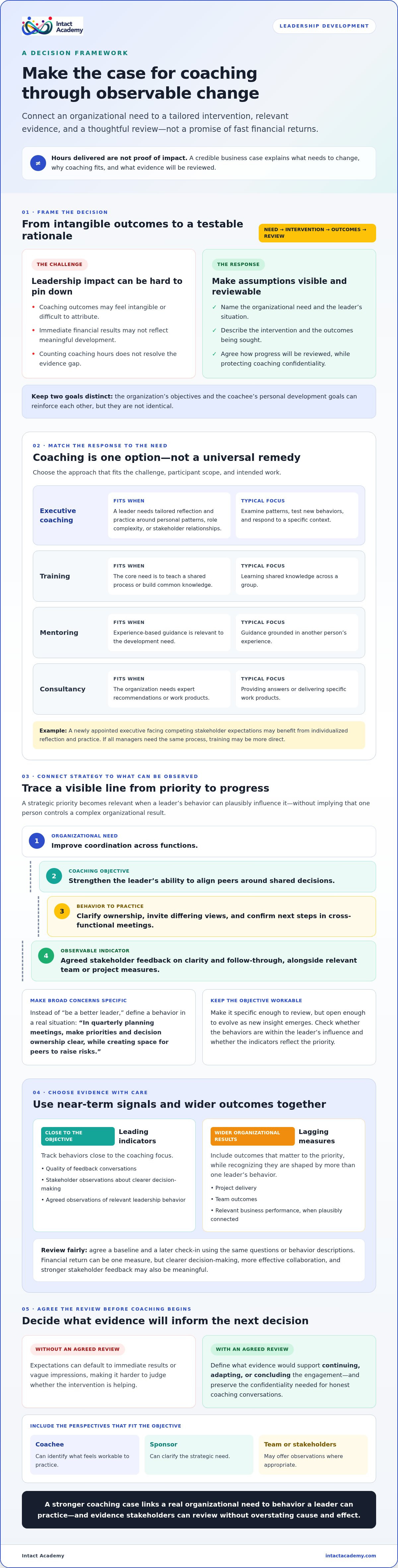
A business case for executive coaching is a testable rationale: it links an identified need to an intervention, describes the outcomes sought, and explains how progress will be reviewed. It doesn’t promise certainty. It makes the assumptions visible so stakeholders can assess whether the intervention is helping and respond thoughtfully.
Coaching isn’t a universal remedy. It can fit situations where a leader’s behavior, role complexity, or stakeholder relationships call for tailored reflection and practice. For a broader overview of Executive coaching, see Wikipedia’s discussion of coaching in business and executive settings.
Financial return may be one measure, particularly when outcomes connect plausibly to business performance. It isn’t the only meaningful one. Progress might also show up in clearer decision-making, more effective collaboration, or stronger stakeholder feedback. Choose measures that fit the purpose instead of forcing every developmental outcome into a short-term financial calculation.
What decision should the business case help stakeholders make?
Make the decision explicit: whether to sponsor coaching, for whom, and toward which organizational priorities. Keep the organization’s objectives distinct from the coachee’s personal development goals. They can reinforce one another, but they aren’t identical, and a sound agreement respects both.
Before the engagement begins, decide what evidence will inform each review. For example, if the objective is more effective delegation, agree what changes in team feedback or in the leader’s delegation practices would be relevant. Set out what evidence would support continuing, adapting, or concluding the engagement, while protecting the confidentiality needed for honest coaching conversations.
When is executive coaching a better fit than another intervention?
Connect executive coaching to strategic outcomes and observable change
A strategic priority becomes relevant to coaching when a leader’s behavior can plausibly influence it. If an organization needs teams to coordinate across functions, for example, the coaching focus might be how an executive handles competing priorities, invites challenge, and follows through on shared decisions. Make that connection visible without suggesting one person controls a complex organizational result.
Map the rationale in a short chain:
- Organizational need: improve coordination across functions.
- Coaching objective: strengthen the leader’s ability to align peers around shared decisions.
- Behavior change: clarify ownership, invite differing views, and confirm next steps in cross-functional meetings.
- Observable indicator: agreed stakeholder feedback on clarity and follow-through, alongside relevant team or project measures.
This chain turns a broad aspiration into something stakeholders can discuss and review. It also helps test the assumptions: are the behaviors within the leader’s influence, and do the indicators reflect the priority?
How do you turn a broad leadership concern into a coaching objective?
Replace “be a better leader” with a behavior grounded in a real role and situation. For instance: “In quarterly planning meetings, make priorities and decision ownership clear, while creating space for peers to raise risks.” The coachee has something specific to practice, and stakeholders have relevant behavior to observe.
Agree whose perspectives matter. The coachee can identify what feels workable, a sponsor can clarify the strategic need, and team members or other stakeholders may offer observations where appropriate. Keep the objective specific enough to review, but open enough to evolve as new insight emerges.
Which measures can show progress without overclaiming impact?
Use a mix of leading and lagging indicators. Leading indicators track behaviors close to the coaching objective, such as the quality of feedback conversations or stakeholder observations about clearer decision-making. Lagging measures, such as project delivery or team outcomes, may matter too, but they’re shaped by more than one leader’s behavior.
Set a baseline and a later check-in using the same agreed questions or behavior descriptions. Add operational measures only when there’s a credible connection to the objective. Market conditions, organizational changes, and colleagues’ contributions can all influence results, so describe coaching as contributing to progress rather than causing an outcome on its own.
A measurable coaching outcome is an agreed change in observable leadership behavior, assessed over time through relevant evidence, with its contribution to wider results interpreted in context. This is a grounded way to build a business case for executive coaching: define what to notice, whose perspective counts, and what the evidence can and can’t establish. For leaders whose development needs are shaped by role and relationships, context-sensitive executive coaching provides a focused space to reflect and practice.
Compare executive coaching with other leadership-development investments
A sound comparison asks which intervention fits the need, who must participate, what kind of practice is expected, and what evidence would be relevant. It doesn’t rank approaches by presumed effectiveness. Coaching is difficult to evaluate when the objective is vague, so agree on proportionate indicators in advance and review them alongside the wider context.
| Approach | Best suited to | Format and scope | Useful evidence |
|---|---|---|---|
| Executive coaching | Individual, role-specific development or behavior change | Tailored work with one leader, connected to their leadership context | Agreed behavior objectives, baseline and follow-up feedback, and relevant stakeholder observations |
| Training | Shared knowledge or a common skill foundation | Structured learning for multiple participants | Learning checks and evidence that participants apply the skill |
| Mentoring | Experience-based guidance and perspective | A relationship in which a more experienced person shares insight | Progress against agreed learning goals and reflections on how guidance is applied |
| Consultancy | A need for expert recommendations or defined deliverables | Expert-led analysis or work for a team or organization | Quality, relevance, and use of the recommendations or deliverables |
Which leadership-development approach fits the problem?
Match the format to the challenge. If several leaders need a shared understanding of a process, training may be the more direct choice. If one executive needs to reflect on their behavior, navigate role complexity, or practice a different approach with stakeholders, coaching may fit better. Mentoring suits a need for experience-sharing; consultancy suits a need for expert-led analysis or outputs.
Also distinguish commissioning coaching from developing people to coach professionally. The executive coaching certification guide addresses coach development, a different investment decision from sponsoring an executive’s coaching engagement.
How should the case address cost, confidentiality, and attribution?
Build the budget from the actual proposal and internal assumptions, such as participant time and any agreed assessment or stakeholder input. Avoid relying on generic market prices. Before starting, clarify how confidentiality works: the coachee’s session content remains private, while objectives and appropriate progress indicators can be agreed with the sponsor.
Don’t promise a fixed return. The rationale strengthens when relevant behaviors and indicators move in the intended direction; it weakens when objectives remain unclear or there’s little evidence of progress. Business outcomes may also reflect market conditions, organizational changes, and other people’s work. A credible business case for executive coaching makes these limits explicit and uses evidence to decide whether to continue, adapt, or conclude.
How to build and present the executive coaching business case
A clear proposal helps stakeholders move from a leadership concern to a considered decision. Keep the process disciplined, but leave room to learn as the context develops:
- Diagnose: Identify the organizational priority and the leadership challenge connected to it.
- Align: Agree why coaching is a suitable response and clarify the coachee’s goals alongside the sponsor’s objectives.
- Design: Set the scope, roles, confidentiality boundaries, and evidence to review.
- Resource: Use the actual proposal and internal participation assumptions to establish the budget.
- Measure: Agree on baseline information, indicators, feedback sources, and review points.
- Review: Assess progress against the objectives, then continue, adapt, or conclude based on what stakeholders learn.
Name the business sponsor, coachee, and coach, along with any stakeholders involved in contracting or providing agreed feedback. Clear roles reduce ambiguity: the sponsor holds the organizational rationale, the coachee engages in the development work, and the coach supports the process within agreed boundaries.
What belongs in a clear coaching proposal?
Include the priority, leadership context, intended objectives, and reason for choosing coaching. Describe the proposed scope, each participant’s role, confidentiality boundaries, review points, and the organization’s actual budget. Separate established evidence from assumptions, and name uncertainties, such as how much progress depends on factors outside the coachee’s influence.
Set review points and decision criteria before the engagement begins. For example, specify what evidence would indicate progress toward an agreed behavior objective and what would prompt a change in approach. These criteria aren’t guarantees. They give stakeholders a shared basis for reflection and decision-making.
How can sponsors evaluate progress responsibly?
Agree on a baseline and select indicators that fit the objective, such as behavior-specific feedback or observations from relevant stakeholders. At each review, discuss progress and changing conditions without requesting private session content. Protecting confidentiality supports the reflective work; reporting against agreed objectives keeps the organizational purpose in view.
If priorities, role demands, or team conditions shift, revisit the plan collaboratively. Document decisions and learning in a way that informs stakeholders without turning confidential coaching conversations into a report. A systemic perspective helps sponsors consider how behavior is shaped by relationships and organizational patterns; Transactional Analysis in professional practice offers a relevant lens for examining these dynamics.
A strong business case for executive coaching is therefore a living agreement, not a static approval document. Intact Academy’s executive coaching works with leadership context and organizational priorities. Learn more through executive coaching.
Turn the business case into a systemic, sustainable coaching decision
An executive’s behavior doesn’t develop in isolation. It takes shape within relationships, role expectations, organizational culture, and the conditions that make certain choices easier or harder. Coaching can help a leader examine and shift their part in those patterns, but it can’t independently change the system around them.
That distinction matters when connecting an individual objective to a wider priority. If the aim is stronger collaboration, for example, the executive might practice making decision-making more transparent with peers. The organization can look for relevant changes in communication and stakeholder feedback, while recognizing that team outcomes also depend on shared norms, role clarity, and others’ actions. Keep the link credible: describe coaching as a contribution to change, not a guarantee of organization-wide results.
Why consider the wider system around an executive?
Stakeholders may expect different things from the same leader. Culture can reward speed over consultation; role design can leave decision rights unclear. Exploring these conditions helps distinguish an individual development need from a problem that also calls for organizational attention.
What are the next steps after approval?
Translate approval into a working agreement. Confirm the organizational rationale, the executive’s own priorities and readiness, the coaching objectives, the roles involved, confidentiality boundaries, and the review process. The sponsor and coachee should understand how progress will be discussed without turning private coaching conversations into performance reports.
Keep the agreement responsive. As the role or organizational conditions change, revisit whether the objectives and measures still make sense. A sustainable decision makes room for accountability and adaptation: clear enough to guide action, flexible enough to reflect what the work reveals.
A well-formed business case for executive coaching is not simply a request to fund sessions. It is a considered choice about how leadership development can support organizational priorities while respecting the complexity of change. Intact Academy brings executive coaching together with systemic expertise to work with leaders in the context of their relationships and organizations. Explore Intact Academy’s executive coaching and systemic organizational-development support.
Make leadership development a deliberate investment
A strong business case for executive coaching connects an organizational priority to a relevant leadership objective, observable indicators, and a review process. It also makes room for nuance: coaching may contribute to progress, while outcomes are shaped by relationships, culture, and conditions beyond one leader’s control.
Choose the intervention that fits the need, agree on meaningful and proportionate measures, and protect the confidentiality that supports honest development. With clear roles and review criteria, stakeholders can make thoughtful decisions about whether to continue, adapt, or conclude the engagement.
Intact Academy is an international coaching and organizational-change institute founded in 2013 and led by Sari van Poelje. Its work includes executive coaching and systemic development, with online and in-person learning for an international community. Explore executive coaching and systemic development with Intact Academy.
When individual growth is connected carefully to organizational priorities, the case can support more than a budget decision. It can help create the conditions for meaningful, sustainable leadership change.
Frequently Asked Questions
What is a business case for executive coaching?
A business case for executive coaching is a concise rationale connecting an organizational need to a leadership objective, a suitable coaching intervention, and an evaluation plan. It explains why coaching fits the situation and what progress could look like. For example, a case might link a need for clearer cross-functional decisions to a leader’s communication objective and agreed stakeholder feedback. It doesn’t need to promise a guaranteed financial return.
How do you measure the ROI of executive coaching?
Measure progress by agreeing on an objective and baseline, then selecting indicators that fit the goal. These might include observed leadership behaviors, stakeholder feedback, or role-specific outcomes. Financial measures can be useful when there’s a credible link to the coaching objective, but attribution is rarely straightforward. Other people, organizational changes, or market conditions may also affect results. Report the evidence alongside its limits, rather than treating correlation as proof of financial causation.
Is executive coaching worth the investment for an organization?
Executive coaching may be worthwhile when a defined leadership challenge calls for individualized reflection and behavior change, and stakeholders can agree on meaningful outcomes. The investment case is less persuasive if the need is unclear or a shared training intervention would better address it. Compare the expected value with the organizational context, available evidence, and review plan. The decision should rest on fit and credible expectations, not broad promises about guaranteed results.
What should an executive coaching proposal include?
An executive coaching proposal should state the organizational priority, the coachee’s role and context, the agreed objectives, and why coaching is a suitable response. Clarify the sponsor’s, coachee’s, and coach’s roles, as well as confidentiality boundaries. Include relevant progress indicators, review points, and the organization’s actual budget. Separate verified information from assumptions, and explain how the parties will revisit objectives if circumstances or priorities change during the engagement.
How can you measure coaching while maintaining confidentiality?
Agree in advance what information may be shared, with whom, and for what purpose. Sponsors can review progress against contracted objectives or agreed indicators without receiving private session content. Use suitable feedback and observable outcomes, and explain what those measures can and can’t establish. Clear boundaries protect the coaching relationship while giving decision-makers a responsible basis for review. For example, report changes in agreed stakeholder feedback rather than a summary of confidential discussions.
How is executive coaching different from leadership training?
Leadership training typically develops knowledge or skills through a structured learning experience for individuals or groups. Executive coaching is tailored to a leader’s role, context, and objectives, using reflective dialogue to support learning and application. Organizations can use both for different purposes. Training may establish a shared foundation across a group, while coaching can help an individual work through a specific challenge and apply learning within the realities of their role.
When should a company choose executive coaching instead of mentoring or consultancy?
Choose executive coaching when a leader needs individualized reflection, behavior change, or support navigating a complex role. Mentoring may better suit a need for experience-sharing, while consultancy is appropriate when expert analysis or recommendations are the primary requirement. The right choice depends on the organizational problem, the contribution sought, who needs to participate, and how progress will be evaluated. A clear business case makes this match explicit rather than treating coaching as a default.


