

What if lasting team change depends less on a coach’s interventions than on what the team and its wider system take responsibility for? That question sits at the heart of what makes a successful team coaching engagement. Without clear aims and shared expectations, sponsors, leaders and team members can leave thoughtful conversations with different ideas about progress, while the team waits for the coach to solve problems that belong to everyone.
It’s natural to look for visible change after a coaching session. But an engagement is more than a sequence of meetings. It’s a shared cycle of inquiry, action and learning, grounded in the relationships and organizational context shaping the team’s work.
This guide covers the conditions and phases that help coaching support observable, sustainable change. You’ll learn how clear contracting aligns expectations, how systemic insight reveals patterns without reducing the team to individual diagnoses, and how shared ownership turns reflection into action. We’ll also distinguish team coaching from facilitation and individual coaching, then look at how regular evaluation can make progress visible beyond a single session.
Key Takeaways
- Define success through observable progress toward goals the team owns, not positive feedback from a session alone.
- Use contracting as an ongoing alignment process that brings the sponsor’s aims, the team’s experience and the coach’s responsibilities into view.
- Distinguish psychological safety from comfort: meaningful progress allows candor, disagreement and accountability.
- To understand what makes a successful team coaching engagement, build a repeatable cycle of reviewing aims, noticing evidence, agreeing actions and adapting the work.
- Plan closure deliberately so the team can carry its learning forward and sustain reflection without relying on the coach.
What Makes a Team Coaching Engagement Successful in the First Place?
A successful engagement is measured not by whether a session felt positive, but by whether the team makes observable progress toward goals it helped define. Look at what changes between sessions: Do members raise concerns earlier? Are decisions clearer? Does the team follow through on commitments? These shifts matter when they serve the team’s purpose and make a difference in its organizational context.
A successful team coaching engagement connects a clear shared purpose with collective ownership and sustained learning, helping the team change how it works together and carry that change into daily practice.
This systemic view recognizes that a team is more than a group of individuals. One person’s hesitation can affect a conversation; recurring alliances or unspoken tensions can shape decisions; and organizational priorities, authority or incentives can reinforce a pattern. Transactional Analysis can help a coach notice relational patterns without reducing the team to individual diagnoses. The wider field of Coaching includes business and executive coaching, while team coaching focuses on the team as a living system.
How is team coaching different from facilitation or individual coaching?
In team coaching, the team itself is the client. A facilitator may guide a planned discussion toward an agreed output. A team coach also pays attention to how the team thinks, relates and responds in the moment, helping members notice their patterns and choose different ways of working. Team building can strengthen connection, but connection alone may not address persistent relational or organizational dynamics.
Individual conversations can support the work when they help a member reflect on their contribution or prepare to engage more fully. They shouldn’t replace team-level inquiry when the challenge lies in relationships, shared decisions or conditions around the group.
What does success look like beyond a good session?
Look for changes the team can observe and discuss: members communicate more directly, decisions are better understood, tension is addressed rather than avoided, and commitments receive follow-through. The relevant signs depend on the team’s purpose. A leadership team working on cross-functional alignment might track how it resolves competing priorities; a project team might look at how it surfaces risks and coordinates action.
Success isn’t a universal outcome or a guarantee of harmony. Team members may still disagree, and organizational constraints may remain. The useful question is whether the team can work with those conditions more consciously, take shared responsibility and keep learning. That makes the engagement more than a series of good conversations.
How Contracting and Systemic Diagnosis Create the Conditions for Change
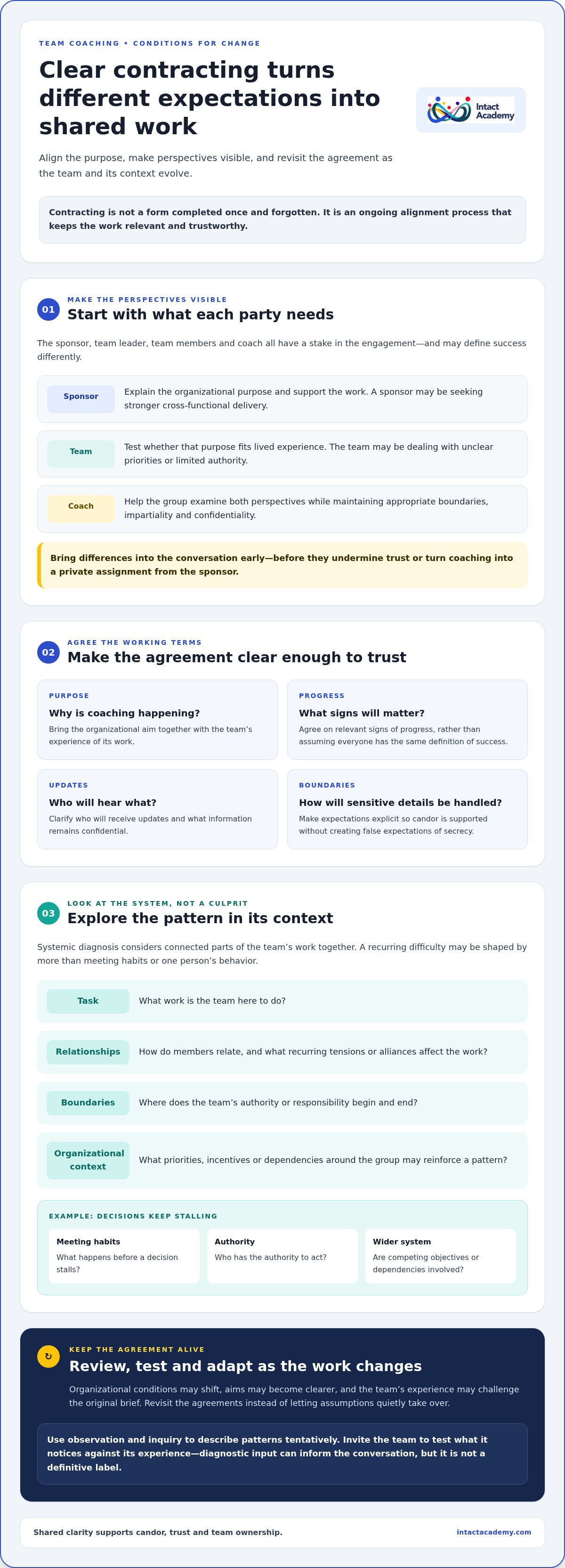
Before the team can work differently, the people involved need a shared understanding of why coaching is happening and what it can responsibly address. Contracting isn’t a form completed at the start and then forgotten. It’s an ongoing alignment process: aims may become clearer, organizational conditions may shift, and the team’s experience may challenge the original brief. Revisiting the agreement keeps the work relevant and trustworthy.
Trust also depends on making different perspectives visible. A sponsor may want stronger cross-functional delivery; the team may be experiencing unclear priorities or limited authority; and the coach must hold appropriate boundaries, impartiality and confidentiality. Naming these perspectives early helps prevent the engagement from becoming a private assignment from the sponsor rather than work the team can own. For deeper guidance on this foundation, explore contracting for change.
Who needs to agree on the purpose and measures?
The sponsor, team leader, team members and coach each have a stake, but they may define success differently. Bring those differences into the conversation before they undermine trust. Agree on the purpose, signs of progress, who will receive updates and what information remains confidential. For example, team members should know whether coaching themes will be shared with a sponsor and how sensitive details will be handled. Clear boundaries support candor without creating false expectations of secrecy.
Contracting also clarifies roles. The sponsor can explain the organizational purpose and support the work; the team can test whether that purpose fits its lived reality; and the coach can help the group examine both. As conditions change, revisit the agreements rather than letting assumptions quietly take over. This shared clarity is central to what makes a successful team coaching engagement.
How can a coach diagnose the team without reducing it to a problem?
Systemic diagnosis considers the team’s task, relationships, boundaries and organizational environment together. A team that repeatedly delays decisions, for instance, may be responding not only to its meeting habits but also to unclear authority, competing objectives or dependencies elsewhere in the organization. Exploring the pattern in context opens more useful questions than assigning blame to one person.
Observation, inquiry and relevant diagnostic methods can offer valuable input, but they aren’t definitive labels. The coach can describe a pattern tentatively and invite members to test it against their experience: What happens before decisions stall? Who has the authority to act? What pressures shape the response? The team’s reflection turns diagnosis into inquiry and helps members choose where to experiment. For practitioners developing this systemic capability, systemic team coaching development can offer a relevant next step.
Which Coaching Conditions Help a Team Make Meaningful Progress?
Meaningful progress depends on more than goodwill. Team members need enough psychological safety to speak honestly and enough willingness to be challenged to examine the effects of their actions. Safety isn’t the same as comfort: a team may feel uncomfortable while discussing a difficult pattern and still be working respectfully and trustfully.
Productive team tension brings differences into view so they can inform better choices; unmanaged conflict turns those differences into recurring struggles that block the work. A coach helps the team stay curious about that distinction, without rushing to smooth over disagreement or escalating it for effect.
How do trust and productive challenge work together?
Trust gives members room to name concerns, question assumptions and hear how their behavior affects others. It doesn’t require consensus or remove accountability. If one person’s interruptions repeatedly silence colleagues, for instance, the coach might invite the team to explore what happens before and after the interruptions, how others respond and what the pattern costs the group. The focus is on impact and choice, not blame.
A coach balances curiosity and challenge with respect for the team’s pace. Too little challenge can preserve familiar habits; too much, introduced without sufficient trust, can lead members to withdraw or defend themselves. The aim is to help the team stay engaged with difficult material long enough to learn from it.
What can derail a team coaching engagement?
Several conditions can limit the work:
- Unclear sponsorship: The team lacks visible support or doesn’t understand the purpose of the engagement.
- Low participation: Members attend but don’t take responsibility for inquiry or action.
- Conflicting goals: The sponsor, leader and team expect different outcomes without naming the differences.
- Implicit expectations: People assume the coach will fix performance, manage conflict or report private conversations in ways that haven’t been agreed.
Another risk is treating symptoms in isolation. More efficient meetings may help, but if decisions keep stalling because authority is unclear or teams are working toward competing priorities, a new meeting technique alone is unlikely to shift the underlying pattern. The coach helps the team examine its interactions alongside the wider system shaping them.
Conditions can change. A sponsor may shift priorities, team membership may change, or the organization may introduce new constraints. Instead of continuing as if nothing has moved, the coach and team revisit their agreements and consider what the changed context means for participation, purpose and pace. Responsiveness keeps the work connected to the reality the team is facing and is part of what makes a successful team coaching engagement.
How Should Teams Track Progress and Adapt the Engagement?
Progress becomes useful when the team connects its learning to evidence from day-to-day work. A review cycle supports that connection: revisit the agreed aims, gather relevant evidence, reflect on emerging patterns, choose an action and assess what happened. This isn’t a scorecard for the coach. It’s a way for the team and sponsor to learn whether the work still serves its purpose.
Co-create measures so they reflect what the team is trying to change. If the aim is stronger coordination, the team might notice whether responsibilities are clearer, handovers smoother or important information shared sooner. Combine these observations with team reflections and, where appropriate, organizational indicators the sponsor and team already value. For more on measurement, see measuring team coaching ROI.
What evidence can show that the team is changing?
Start with behaviors close to the work: how members communicate, make decisions, take accountability and coordinate across roles. Ask for specific examples, not just general impressions. “We’re communicating better” becomes more useful when members can describe what they do differently and when they notice the change.
Organizational indicators can add context, but they don’t prove that coaching caused a result. Delivery, retention or other outcomes may be influenced by changes in leadership, priorities, resources or the wider market. Interpret evidence carefully: the aim is to understand contribution and learning, not claim a simple cause-and-effect relationship. This keeps progress visible while the complexity around it remains in view.
When should the coach and team change course?
Set review points at the outset, then return to the conversation whenever the context shifts. New members, changing priorities or a changed sponsor can alter what the team needs from the engagement. At each review, invite members to consider three questions: What’s proving useful? What remains stuck? What needs attention now?
If the answers point to a different focus, adapt the work rather than continuing by habit. The coach and team can revisit the aims, evidence and next steps, then document revised agreements so the sponsor, coach and members share the same direction. Clear records also help the team carry learning between conversations instead of treating each session as a fresh start.
Build your capability to review and adapt team coaching engagements with systemic team coaching development.
How Can Learning Continue After the Team Coaching Engagement?
The end of a coaching engagement is a transition, not simply the final session. A deliberate close gives the team space to review its original purpose, recognize what has changed and identify what remains unfinished. It also makes clear that responsibility for the next phase rests with the team, not the coach.
What should a thoughtful ending include?
Invite the team to assess progress against its own agreements. Which changes in how members communicate, decide or share responsibility have become part of everyday work? Where does the team still get caught in familiar patterns? Naming both progress and unfinished work avoids a tidy ending that doesn’t reflect the team’s experience.
Then agree how members will notice early signs of regression and respond constructively. If important concerns begin going unspoken again, for instance, the team might use a regular check-in to surface what’s happening and decide what conversation is needed. A simple pause to ask, “What pattern are we in, and what do we want to do next?” can help keep reflection alive without recreating the coaching engagement.
Closure also means transferring ownership clearly. The team identifies who will carry forward agreed actions, how it will review them and when it may need to revisit its commitments. Continued learning doesn’t require the coach to remain at the center; it requires the team to keep noticing, discussing and choosing its responses.
How can team coaches deepen their systemic practice?
For coaches, each engagement offers a chance to reflect on how they work with complexity: what they noticed, what they may have overlooked and how their interventions affected the group. Ongoing reflective practice can strengthen a coach’s ability to hold multiple perspectives without rushing to a single explanation or turning a system-wide pattern into an individual fault.
Transactional Analysis offers one lens for noticing recurring relational patterns in teams and organizations. Used as a framework for inquiry, it can help coaches and teams explore how interactions unfold while leaving room for members to test their interpretations. For a foundational overview, read what Transactional Analysis offers professionals.
Deepening a coach’s capability supports better practice, but it doesn’t replace the team’s ownership of its learning. If you’re developing expertise in this field, explore the TA EMCC Senior Team Coach Academy as a professional development pathway. Ultimately, what makes a successful team coaching engagement is not the team’s continued dependence on coaching, but its growing capacity to learn and adapt together.
Carry the Learning Into Your Next Team Coaching Engagement
What makes a successful team coaching engagement is not a perfect session or a conflict-free team. It’s a clear purpose, shared responsibility and the ability to keep learning together as circumstances change. Thoughtful contracting aligns sponsor, coach and team; systemic insight helps reveal patterns in context; and regular reflection makes progress visible while keeping the work responsive.
As the engagement closes, the team should be able to name what has shifted, what still needs attention and how it will continue the work. The coach supports that growing capacity rather than becoming indispensable to it.
For practitioners who want to deepen their systemic team coaching capability, the TA EMCC Senior Team Coach Academy offers a path for further development. Intact Academy, founded in 2013 and led by Sari van Poelje, brings together participants from more than 14 countries through online and in-person learning.
Explore the TA EMCC Senior Team Coach Academy to continue building the insight and skill to support meaningful change. With clear agreements and genuine shared ownership, teams can keep becoming more capable of learning and adapting together.
Frequently Asked Questions
What makes a team coaching engagement successful?
A successful engagement has a clear, shared purpose, meaningful participation and a coach who can work with the team as a system. What makes a successful team coaching engagement is more than positive session feedback: progress is reviewed against agreed aims and reflected in how the team works. Members and sponsors need enough trust to examine difficult patterns, while the team retains responsibility for decisions and change.
How long should a team coaching engagement last?
There’s no single duration that suits every team. The scope depends on the team’s purpose, context, readiness and the complexity of its work. Rather than assuming a fixed number of sessions indicates success, agree on an initial review point. Then revisit the plan as the team learns, priorities shift or membership changes. This keeps the engagement responsive to what’s happening instead of tying it to an arbitrary timetable.
Who should be involved in a team coaching engagement?
The team is central, while the sponsor and team leader help shape the conditions around the work. The coach should clarify each person’s role, expectations, decision rights and confidentiality boundaries from the outset. Depending on the purpose, other stakeholders may help illuminate the organizational context. Their involvement shouldn’t displace the team’s responsibility for its own learning and actions. Shared clarity helps prevent unspoken expectations from undermining trust.
How do you measure the success of team coaching?
Start with outcomes the team and sponsor agree matter, then identify observable signs of progress. These could include clearer decisions, more direct communication, stronger coordination or consistent follow-through on commitments. Pair team reflections and concrete examples with relevant organizational indicators when useful. Interpret the evidence in context: measures can guide learning and shared review, but they don’t automatically prove coaching caused an organizational result.
What is the difference between team coaching and team building?
Team building often centers on shared activities or a specific event, while team coaching supports an ongoing process of reflection and change connected to the team’s real work. Coaching helps members notice patterns in their relationships, decisions and wider context, then take responsibility for trying new actions. The approaches can complement each other, but they serve different purposes: connection-building alone may not address recurring dynamics affecting performance.
Can team coaching work when there is conflict or low trust?
Team coaching can support teams experiencing conflict or low trust when the conditions for honest participation are addressed. The goal isn’t to eliminate all tension, but to help members examine disagreements safely and constructively. The coach and team should clarify the purpose, boundaries and readiness for the work, then adapt the process as trust and shared responsibility develop. Psychological safety supports candor, not avoidance of accountability.
What should happen after a team coaching engagement ends?
The ending should consolidate learning and return responsibility for continued progress to the team. Review changes against the original agreements, name challenges that remain and decide how members will keep reflecting on their work. The team can agree how to recognize old patterns returning and respond early, such as raising concerns in a regular review. Thoughtful closure helps members continue learning without relying on the coach.


