

A team coaching proposal template can help you create a clear, client-ready document, but a generic proposal may miss the team’s purpose, the tensions shaping its work, and the different ways stakeholders understand the challenge. A stronger proposal shows how the team’s shared system could move forward, not just what the coach will do.
It makes sense to want a proposal that clarifies the approach, scope, and fit before anyone commits. When outcomes are vague or responsibilities are unclear, expectations can diverge before the work begins. A useful proposal connects the client’s challenge to shared outcomes and a credible process, while making roles, boundaries, and contracting choices visible.
This guide will help you build a reusable structure that still feels specific to the team and its context. You’ll learn how to describe the need, define meaningful outcomes, outline the coaching process, and clarify responsibilities, including how confidentiality will work in a group setting. The result is a sound basis for a thoughtful conversation, not simply a document to sign.
Key Takeaways
- Use a team coaching proposal template as a tailored decision document, not a generic description of sessions or facilitation.
- Build a copy-ready structure that moves from context and shared purpose to outcomes, approach, scope, roles, review, and next steps.
- Adapt the proposal to the engagement: an intact leadership team, a newly formed team, and a team facing organizational change may need different emphases.
- Check that the proposal reflects stakeholder perspectives, defines workable boundaries, and invites clear discussion about confidentiality.
- Treat the proposal as the beginning of contracting: use a follow-up conversation to refine scope and confirm mutual readiness.
What makes a team coaching proposal different from a generic coaching template?
A team coaching proposal is more than a description of sessions. It’s a tailored decision document that helps the client assess fit, purpose, scope, and a proposed path for the work. A team coaching proposal template gives you a useful structure, but the content needs to show that you understand the team as a connected system, not simply a collection of individuals.
Team coaching partners with a team to develop its collective capacity, relationships, and performance in the context of the organization it serves. That differs from coaching one leader toward individual development goals, and from facilitating a group session with a defined agenda. Coaching draws on a thought-provoking, developmental partnership, as outlined in this foundational overview of Coaching. Make clear which approach you’re proposing and what the client can expect from it.
How is a team coaching proposal different from an individual coaching proposal?
An individual proposal may focus on one person’s goals, choices, and growth. A team proposal also needs to address shared purpose, patterns of interaction, relationships, and collective outcomes. The presenting symptom, such as slow decisions or recurring conflict, may be real, but it doesn’t explain by itself what is happening across the system or what conditions sustain the pattern.
The team’s perspective matters, as do the sponsor’s expectations, the team leader’s experience, and the wider organizational context. A proposal can identify these perspectives without assuming they already align. It should also avoid implying that coaching alone will resolve every challenge. If the issue depends on organizational decisions or conditions beyond the team’s influence, name that boundary and explore what else may be needed.
Who needs to contribute to the proposal before it is sent?
Start with a discovery conversation involving the sponsor and team leader, then seek input from team members and relevant organizational stakeholders. The aim isn’t to make every account identical. It’s to check whether people recognize the presenting challenge, what outcomes matter to them, and where their views differ.
For example, a sponsor might want faster decisions while team members experience unclear authority. Holding both accounts can lead to a more accurate proposal than simply repeating the sponsor’s request. This systemic perspective is also central to the principles of systemic team coaching mastery: consider the relationships between the team, its stakeholders, and the organizational environment.
Use discovery to shape the proposal’s purpose and boundaries, not to promise a predetermined solution. A sound document leaves room for the team to learn what is happening together and decide what change is meaningful and workable.
What should a team coaching proposal template include?
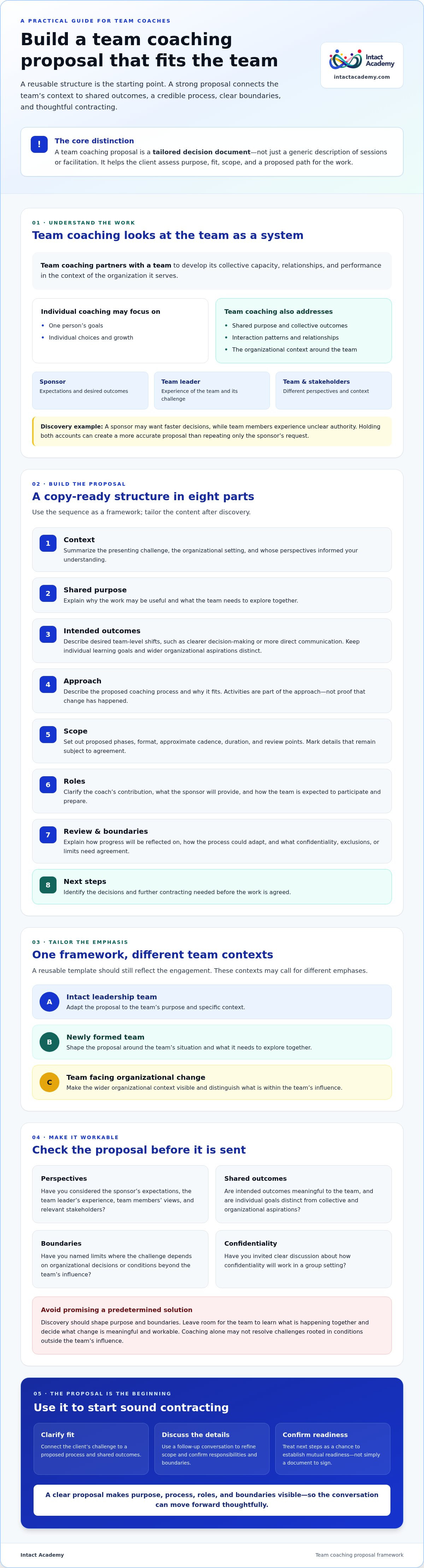
A useful team coaching proposal template provides a repeatable structure, not ready-made answers. Tailor the challenge, outcomes, and proposed process after discovery so the document reflects what the team and its stakeholders actually need. Use this sequence:
- Context: Summarize the presenting challenge, its organizational setting, and whose perspectives have informed your understanding.
- Shared purpose: State why the work may be useful to the team and what it needs to explore together.
- Intended outcomes: Describe desired team-level shifts, such as clearer decision-making or more direct communication. Keep individual learning goals and wider organizational aspirations distinct.
- Approach: Explain the proposed coaching process and why it fits the team’s context. Separate activities from outcomes: sessions are part of the approach, not proof of change.
- Scope: Set out proposed phases, format, approximate cadence, duration, and review points. Mark details that remain subject to agreement.
- Roles: Clarify the coach’s contribution, what the sponsor will provide, and how the team is expected to participate and prepare.
- Review and boundaries: Explain how progress will be reflected on, how the process could be adapted, and what confidentiality, exclusions, or limits need agreement.
- Next steps: Identify the decisions and further contracting needed before work begins.
How should the proposal describe the team’s challenge and intended outcomes?
Use the client’s language, then test your understanding with relevant stakeholders. A sponsor may describe delayed decisions, while team members may point to unclear authority. Reflect both accounts without treating either as the whole story.
Make progress observable without guaranteeing it. For example, a team might review whether decision responsibilities are clearer and whether members raise concerns more directly. These are signs to explore, not results a coach can promise. Team outcomes concern how the group works together. Individual learning goals belong to particular members, while organizational aspirations may depend on decisions beyond the team’s control.
Which process, scope, and responsibility details belong in the template?
Describe the proposed phases, session format, approximate cadence, and points when the team and coach will review the work. Clarify who convenes, participates, shares relevant information, and decides whether to adapt the process. Note confidentiality considerations and exclusions for discussion, rather than implying blanket guarantees.
A compact alignment table can help reveal gaps before you send the proposal:
| Client need | Proposed intervention | Evidence of progress | Responsible party |
|---|---|---|---|
| Decisions stall | Explore decision patterns together | Team reviews clarity and follow-through | Team and coach |
| Stakeholders have different expectations | Clarify purpose and expectations | Agreed priorities are revisited | Sponsor and team leader |
Use the table to check that each proposed activity responds to a stated need and has a sensible way to review progress. Coaches seeking to deepen their systemic perspective may also explore team coaching development.
How should you adapt a team coaching proposal to the client and engagement?
A reusable structure is useful only when it responds to the team’s actual context. An intact leadership team may need to examine how it makes decisions across functions. A newly formed team may first need to develop a shared purpose and clarify roles. If readiness or needs are still emerging, describe your understanding as provisional and identify what should be explored before confirming the scope.
Use the comparison below to decide what deserves emphasis. Treat it as a guide for discovery, not a fixed formula.
| Engagement context | Proposal emphasis | Stakeholders to consider | Details to tailor |
|---|---|---|---|
| Intact leadership team | Collective purpose, decision-making, and cross-functional relationships | Team members, team leader, sponsor, relevant organizational stakeholders | Which decisions or relationships need attention, and how the wider system shapes them |
| Newly formed team | Shared direction, emerging roles, and ways of working | Team members, leader, sponsor, connected teams | How the team will develop a common purpose while responsibilities are still taking shape |
| Project team | Shared deliverables, role clarity, and coordination | Project members, project lead, sponsor, key partners | How coaching will relate to the work and changing coordination needs |
| Work sponsored through organizational change | The relationship between the change context and the team’s own development priorities | Sponsor, team leader, team members, relevant change stakeholders | Where sponsor expectations align with, or differ from, the team’s desired outcomes |
What changes between team contexts?
For a leadership team, foreground how members work across functions and make collective decisions. For a project team, connect the proposed work to coordination and shared deliverables without implying that coaching itself will deliver them. In sponsored work, distinguish what the sponsor hopes to see from what the team considers meaningful. This can surface differences early, before they become a source of friction.
If an RFP or procurement request sets a required format, answer its criteria clearly, using the requested sections and decision information. A prescribed document doesn’t replace discovery or contracting. If you can’t speak directly with the team before submission, state what remains an assumption and make validation a decision point before finalizing the engagement.
How can you compare options without overpromising?
Offer scope options only when they represent genuinely different, feasible ways of working. Explain the trade-offs: a narrower scope may involve fewer stakeholder perspectives; a different pace may change how the team reflects between sessions; and an evaluation approach may provide different kinds of evidence. Don’t present any option as a guarantee of impact. If you’re developing your own systemic practice, choosing the right team coaching course can help you consider what capability the work calls for.
How do you make a team coaching proposal clear, ethical, and workable?
A proposal earns trust when it makes assumptions visible and gives stakeholders a practical way to test fit. Before sending your team coaching proposal template, use this five-step quality check:
- Validate: Confirm the proposal reflects discovery conversations, not a single stakeholder’s interpretation of the team’s challenge.
- Align: Connect the stated need to outcomes the team can influence, and distinguish these from individual goals or wider organizational ambitions.
- Scope: Specify proposed activities, responsibilities, boundaries, exclusions, and what remains to be agreed.
- Review: Check that progress measures are relevant and that claims, case examples, credentials, and evaluation methods are accurate and appropriately represented.
- Invite: Make space for a contracting conversation to resolve differences, clarify open questions, and confirm mutual readiness.
How should a proposal handle confidentiality and multiple stakeholders?
Confidentiality in team coaching needs explicit discussion. Avoid blanket promises. Clarify what information may be shared, with whom, and under what agreed conditions. Before work begins, discuss what the sponsor will receive in updates, how team members will help agree information-sharing boundaries, and how sensitive disclosures will be handled. The proposal can identify these as matters for agreement instead of presenting unsettled expectations as settled policy.
Where contractual or legal details affect the engagement, confirm requirements for the relevant jurisdiction with qualified advisers. A proposal can flag questions for review, but it shouldn’t substitute for appropriate professional advice.
What should coaches check before sending the proposal?
Read the document from each stakeholder’s perspective. Would the team recognize its challenge? Can the sponsor distinguish their expectations from the team’s intended outcomes? Are review points, responsibilities, exclusions, and next steps clear enough to discuss without interpretation?
Remove vague outcomes, unexplained jargon, unsupported credentials, and promises of guaranteed results. Check that examples are accurate and relevant, and that any proposed evaluation method can offer useful insight into the work. If the team’s needs or readiness are still uncertain, say so and identify what must be explored before finalizing the scope.
Clear contracting is part of systemic practice: it holds different perspectives in view while making choices and boundaries discussable. To deepen your capability in this work, explore systemic team coaching development.
How can a team coaching proposal lead into sound contracting and development?
A proposal frames a potential engagement; it isn’t the final coaching agreement. It gives the client and coach something concrete to examine together: the purpose, proposed scope, roles, boundaries, and open questions. A team coaching proposal template can organize this conversation, but the terms should be confirmed through mutual agreement before coaching begins.
What should happen after the client receives the proposal?
Follow up in a way that invites reflection rather than pressing for an immediate decision. Ask what feels accurate, what needs clarification, and whether the proposed work seems feasible for the team. Feedback can reveal a mismatch between sponsor expectations and team priorities, or show that the proposed scope needs adjustment.
Before starting, confirm the final agreement, governance, and practical arrangements. Make sure the parties understand who is involved, how decisions will be made, what information may be shared, and how the work will be reviewed. Clear contracting creates a shared foundation, not a guarantee that the team’s context will remain unchanged.
Build review points into the engagement. If membership changes, priorities shift, or new organizational pressures emerge, pause to consider whether the original purpose and scope still fit. The team, sponsor, and coach may need to revisit their agreements before continuing. This keeps the work responsive and helps prevent expectations from drifting unnoticed.
When might a coach deepen their team coaching practice?
A proposal can also prompt useful reflection for the coach. Are you ready to work with live team dynamics, hold a relationship with the sponsor as well as the team, and consider how organizational conditions shape the work? If those questions point toward further development, learning may strengthen your systemic capability. It isn’t a prerequisite for using this guide; it’s one possible path for coaches seeking to deepen their practice.
Intact Academy offers the TA EMCC Senior Team Coach Academy, alongside training in executive coaching and organizational change. Its learning is available online and in person, supporting participants from different countries. Explore the program to see whether its focus fits your development goals.
A well-used proposal does more than help a client decide. It begins a thoughtful process of clarifying readiness, responsibilities, and shared purpose. If you’re considering further development, explore team coaching development with Intact Academy.
Turn the proposal into a shared starting point
A strong team coaching proposal does more than outline sessions. It connects the team’s context to shared outcomes, a considered process, and clear responsibilities, while making room for different stakeholder perspectives. Use a team coaching proposal template as a structure, then tailor it through discovery so the proposal reflects the system you’ll be working with.
Keep the distinction between proposed activities and intended outcomes clear. Define scope and boundaries, discuss confidentiality explicitly, and treat the proposal as the beginning of contracting, not a substitute for the final agreement. As the team’s needs evolve, agreed review points can help you revisit whether the work still fits.
For coaches who want to deepen their ability to work with team dynamics, sponsor relationships, and organizational context, Intact Academy offers the TA EMCC Senior Team Coach Academy, with online and in-person learning for an international participant community. Explore systemic team coaching development with Intact Academy.
With a clear proposal and a thoughtful contracting conversation, you can help create the conditions for purposeful, responsible development. Start with curiosity, and let shared understanding guide the next step.
Frequently Asked Questions
What should a team coaching proposal include?
A team coaching proposal should explain the client context, shared purpose, intended outcomes, proposed process, scope, responsibilities, review points, and next steps. It should also clarify boundaries and how confidentiality will be discussed and agreed. Tailor each section to what discovery conversations reveal about the team and its stakeholders. A team coaching proposal template can provide the structure, but it can’t replace understanding the specific system and its needs.
How is a team coaching proposal different from a group coaching proposal?
A team coaching proposal focuses on a team that works together within an organizational system, often with shared responsibilities and outcomes. A group coaching proposal may describe people learning together without needing to operate as one interdependent team. The distinction depends on the actual context, not just the label. Before proposing an approach, clarify whether participants share work, purpose, and accountability, or have come together mainly for individual development.
How long should a team coaching proposal be?
A proposal should be long enough to support an informed decision and concise enough to navigate easily. Include the context, outcomes, approach, scope, roles, boundaries, and next steps, then move extensive credentials or supporting material into an appendix if useful. The right length depends on the engagement, procurement requirements, and what the client already understands. Prioritize clarity over page count, and make assumptions and open questions easy to find.
How do you write measurable outcomes for team coaching?
Describe observable signs of progress that matter to the team and sponsor, such as clearer decision-making or more effective coordination, if these fit the discovery findings. Agree how progress will be reviewed and who will contribute relevant evidence. Separate desired outcomes from planned activities: holding sessions is a process, not proof of change. Avoid guarantees, since progress may depend on the team’s choices and wider organizational conditions beyond the coach’s control.
Should a team coaching proposal include pricing?
Include fees and relevant payment terms when you’re ready to scope the engagement and the client expects a commercial offer. Explain what the proposed scope covers, who is responsible for each contribution, and which assumptions or exclusions could affect the work. A fee is easier to assess when the client can understand the process and boundaries behind it. If scope remains uncertain, identify what needs clarification before presenting a firm commercial proposal.
What confidentiality should a team coaching proposal promise?
A proposal should avoid broad confidentiality promises until expectations and responsibilities have been discussed. Clarify what information may be shared, with whom, and under what agreed conditions, including how sponsor updates will work and how team members will help set expectations. Confirm the relevant contractual and legal requirements for the engagement with qualified advisers. Establish these boundaries with stakeholders before coaching begins, rather than relying on generic template wording.
Can I use one team coaching proposal template for every client?
You can reuse the structure, but the content should change with each team’s purpose, context, stakeholders, and readiness. Adapt the challenge, intended outcomes, process, responsibilities, boundaries, and review points after discovery. For example, a newly formed team may need to clarify roles, while an established leadership team may want to examine collective decision-making. Leaving the template unchanged risks creating a generic proposal or expectations that don’t fit the engagement.


