

What if the most useful evidence of team coaching progress isn’t a rising score, but a conversation the team can now have that once felt impossible? Clear updates between sessions can be important, especially when stakeholders need to understand how the work is developing. Yet attendance, completed actions, and survey scores show activity, not necessarily whether trust, communication, or shared responsibility is changing. The right tools for tracking team coaching progress make these shifts easier to notice without reducing human change to a dashboard.
This guide explains how to choose and combine practical methods for your coaching engagement, team, and reporting needs. You’ll find ways to gather evidence over time, distinguish behavioural change from activity, and share progress while protecting confidentiality. From short pulse checks and observation notes to reflective reviews, the goal is a manageable system that supports learning rather than creating another reporting burden. Progress is more credible when it’s visible, interpreted thoughtfully, and never overstated.
Key Takeaways
- Choose tools for tracking team coaching progress according to the evidence you need, the effort involved, and who will see the findings.
- Separate coaching activity from participant experience, behavioural shifts, and broader organisational outcomes.
- Agree on confidentiality and reporting boundaries before collecting information, so tracking supports reflection rather than surveillance.
- Build a manageable process around a few observable signals, then review and adapt it as the coaching engagement develops.
- Compare team, stakeholder, and organisational perspectives to uncover patterns that a single measure may miss.
Why tools for tracking team coaching progress need to measure more than activity
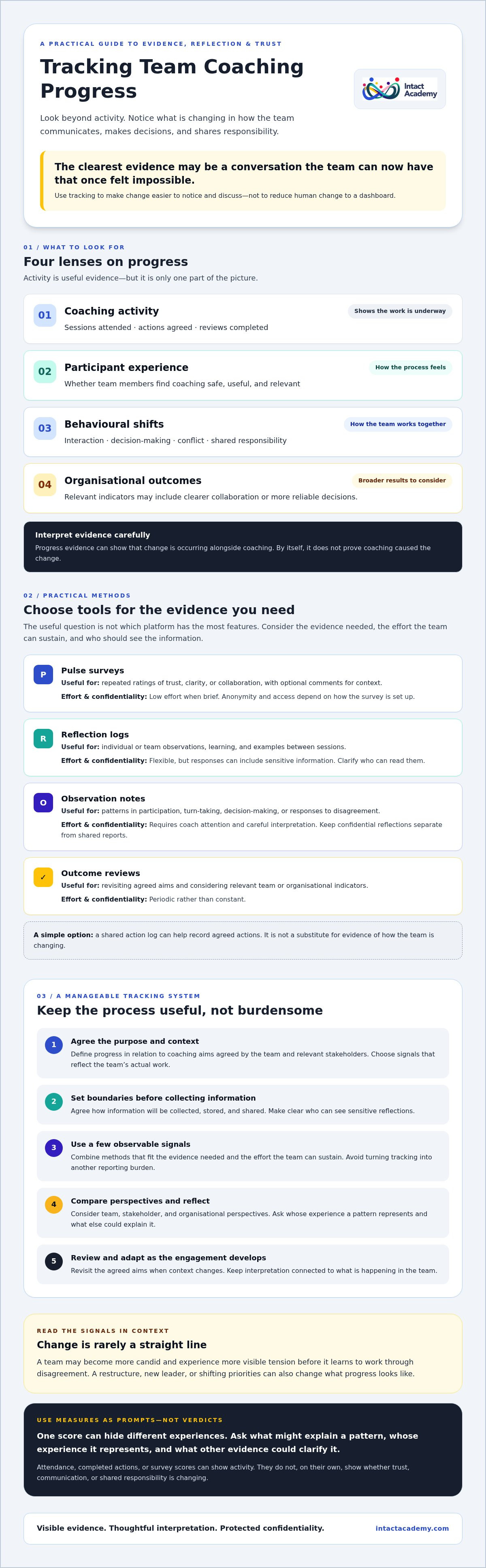
A record of sessions held or actions completed can confirm that coaching is underway. It cannot show, by itself, whether the team is changing how it works together. Useful tracking is a shared way to notice change in relation to coaching aims agreed by the team and relevant stakeholders. It brings evidence into reflection rather than treating measurement as a verdict.
Team coaching focuses on a team’s shared goals and dynamics, so progress needs to be considered at both individual and collective levels. A team might attend every session yet continue to avoid disagreement, defer difficult decisions, or leave responsibility with one person. Another team might start questioning assumptions more openly before its performance measures shift. Activity matters, but it is only one part of the picture.
- Coaching activity: sessions attended, actions agreed, and reviews completed.
- Participant experience: how safe, useful, or relevant team members find the process.
- Behavioural shifts: changes in interaction, decision-making, conflict, or shared responsibility.
- Organisational outcomes: broader results that may align with the work, such as clearer collaboration or more reliable decisions.
Progress evidence can show that change is occurring alongside coaching; it does not, by itself, prove that coaching caused the change. This distinction helps coaches and stakeholders discuss what the evidence suggests without claiming more than it can support.
What does progress mean in a team coaching engagement?
Progress depends on the team’s agreed purpose and context. If the aim is to improve cross-functional decisions, useful signals could include whose perspectives are heard, how disagreements are handled, and whether responsibility is shared after a decision. Choose signals that reflect the team’s actual work, not an abstract ideal of a “high-performing” team.
Change is rarely a straight line. A team may become more candid and experience more visible tension before it learns to work through disagreement. A restructure, new leader, or shifting priorities can also change what progress looks like. Interpret signals in context, and revisit the agreed aims if that context changes.
Why can’t one metric tell the whole story?
A single score can hide very different experiences. A team’s average confidence rating may rise even while some members feel less able to challenge senior colleagues. An organisational outcome may also improve during coaching for reasons unrelated to it, such as a change in workload or leadership.
Use measures as prompts for inquiry, not definitive judgments. Ask what might explain a pattern, whose experience it represents, and what other evidence could clarify it. The best tools for tracking team coaching progress help the team see complexity more clearly, rather than flattening it into a score.
Which tools for tracking team coaching progress capture useful evidence?
The useful question isn’t which platform has the most features. It’s what evidence the team needs, how much effort it can sustain, and who should see the information. The tools for tracking team coaching progress might be as simple as a shared action log, or combine brief surveys, reflective notes, coach observations, and periodic outcome reviews.
Each method has different strengths and confidentiality considerations. Use the comparison as a starting point, then agree with the team how information will be collected, stored, and shared.
| Tool | Useful for | Effort and confidentiality |
|---|---|---|
| Pulse surveys | Repeated ratings of trust, clarity, or collaboration, with optional comments for context. | Low effort when brief. Anonymity and access depend on how the survey is set up. |
| Reflection logs | Capturing individual or team observations, learning, and examples between sessions. | Flexible, but responses can include sensitive information. Clarify who can read them. |
| Observation notes | Recording patterns in participation, turn-taking, decision-making, or responses to disagreement. | Requires coach attention and careful interpretation. Keep confidential reflections separate from shared reports. |
| Outcome reviews | Revisiting agreed aims and considering relevant team or organisational indicators. | Periodic rather than constant. Interpret results in context, not as proof of coaching impact. |
When are pulse surveys and team reflections useful?
Brief, repeated prompts can make gradual shifts easier to discuss. For example, a team might rate how clearly decisions are communicated, then describe what helped or hindered clarity in a recent discussion. Google Forms and Microsoft Forms are possible survey tools, not endorsed solutions. Choose based on the team’s access, confidentiality needs, and agreed data practices. Avoid requesting sensitive details unless there’s a clear purpose and informed consent.
Combining evidence matters: ratings can show where a pattern may be shifting, while reflections and observations help explain what that shift means to the people involved. This broader view fits coaching’s developmental purpose, including developing the capabilities of high-potential performers.
How can shared workspaces and coach notes support tracking?
An agreed action log in Microsoft Teams, Slack, or another suitable collaboration environment can help the team revisit commitments and learning between sessions. Keep it focused on shared agreements, not private disclosures. Coach notes serve a different purpose: they can help the coach reflect on patterns and questions to explore. Sponsor-facing updates should include only information agreed for sharing.
Practitioners who want to deepen their ability to notice team patterns can explore systemic team coaching education.
How to choose a team coaching progress tool without compromising trust
Tracking should help a team reflect on its work, not make people feel watched. Before choosing a platform or questionnaire, consider whether the method fits the coaching contract, the team’s readiness to share, its practical access needs, and the audience for any report. A tool that feels routine to a sponsor may feel exposing to team members if they don’t know what happens to their responses.
Use these questions to assess a possible approach:
- Purpose: Does the information relate to an agreed coaching aim, or are you collecting it simply because the tool makes it easy?
- Readiness and access: Can team members participate comfortably, including those with different communication preferences or access needs?
- Audience: Will the information support team reflection, coach learning, stakeholder updates, or more than one purpose? Keep those uses distinct.
- Data boundaries: What’s the minimum information needed? Who can access identifiable responses, how will findings be shared, and how long will records be retained?
These aren’t technical details to settle after selecting a tool. They shape whether people can engage openly. Choose a method the team understands and can use consistently, rather than one that gathers more data than the coaching aims require.
What should coaches agree before collecting progress data?
Make the agreement explicit: what will be collected, why it matters, who can see it, and how individual responses will be handled in team or sponsor-facing summaries. Clarify whether comments will be attributed, reported as themes, or kept for the coach’s reflection. Don’t imply anonymity if the process can’t genuinely provide it.
Consent and purpose may need attention again if the engagement changes. A new sponsor, altered coaching aims, or a shift in the team’s circumstances can change expectations about information sharing. Pause and revisit the agreement before using existing data in a new way.
How can coaches balance qualitative and quantitative evidence?
Pair a rating with a request for a concrete example. If team members rate decision clarity, a follow-up prompt could ask what made a recent decision easier or harder to understand. The score offers a signal; the example gives it context and may reveal different experiences within the team.
Look for patterns across sources rather than treating one response as conclusive. Compare reflections with observed interactions and outcome reviews, while separating what was seen from what it might mean. For example, “two decisions were revisited” is an observation; “the team lacks trust” is an interpretation that needs exploration.
In reporting, state what the evidence supports and what remains uncertain. An organisational indicator may change during coaching, but a tracking tool can’t independently establish that coaching caused the change. Used carefully, tools for tracking team coaching progress make learning more visible while leaving room for complexity, dissent, and further inquiry.
How to set up a simple system for tracking team coaching progress
A useful tracking system should be light enough to maintain and clear enough to guide decisions. Start with the team’s agreed coaching purpose, then choose a few observable signals that connect directly to it. If the aim is to strengthen shared decision-making, for example, the team might notice whether decisions have a clear owner and whether relevant perspectives are considered before agreement.
Systemic thinking can help coaches place those signals within the wider relationships and conditions shaping the team. For broader context, explore systemic team coaching principles.
- Contract for the purpose. Clarify the outcomes the team hopes to work toward, who is involved in agreeing them, and how progress information will be used. Confirm what can be shared with stakeholders.
- Choose a small set of signals. Select observable examples tied to the aims, such as how the team handles dissent or follows through on collective commitments. Avoid measures that are difficult to interpret or collected simply because they’re easy to count.
- Establish a baseline. Record the team’s initial view of its priorities and capture examples to revisit later. Note relevant context, such as a leadership transition or a change in responsibilities, so later differences aren’t read in isolation.
- Set a workable review rhythm. Agree when the team will return to the signals. Align reviews with meaningful coaching milestones or existing team conversations rather than gathering data constantly. Choose a cadence the team can sustain.
- Review, learn, and adapt. Bring the evidence back to the team, explore what it means, and adjust aims, coaching interventions, or measures when the work or context shifts.
How should a coach establish a useful baseline?
A baseline isn’t a definitive judgment about the team. It’s a starting reference. Ask team members how they currently experience the agreed priorities, then record concrete examples that can be compared later. If the focus is shared responsibility, note how commitments are assigned and revisited. Include contextual factors that might shape future observations without turning the baseline into an exhaustive audit.
How should progress reviews turn evidence into learning?
Invite the team to interpret patterns before offering the coach’s perspective. Ask what feels different, what hasn’t shifted, and what conditions may be influencing the pattern. This keeps the review collaborative and helps distinguish what the team observes from what it infers. If evidence points in different directions, treat that as a question to explore, not a reason to force a single conclusion.
Explore team coaching education at Intact Academy to deepen your practice in observing team patterns and reflecting on evidence.
Build a reflective tracking practice through systemic team coaching
Tracking becomes more useful when it sharpens the coach’s questions rather than certifying that an engagement has succeeded. A change in a team’s self-rating may be worth exploring, but it doesn’t explain whose experience shifted, whose stayed the same, or what in the wider system may be influencing the pattern. Treat the evidence as an invitation to inquire.
Compare perspectives. Team members may describe more open discussion, while a stakeholder notices that decisions still take too long. Organisational indicators may show a different pattern. These accounts don’t necessarily cancel each other out. They may reveal that change is occurring unevenly across relationships, roles, or parts of the system.
What should a coach learn from progress data?
As you review evidence, ask whose perspectives are visible and whose are absent. Consider how your expectations, the sponsor’s priorities, or the way a question was framed could influence interpretation. Then examine whether the coaching interventions remain connected to the team’s stated purpose and the wider conditions around it. If findings raise ethical or relational questions, pause for supervision or peer reflection before deciding how to act or report.
This reflective stance helps practitioners use tools for tracking team coaching progress without turning observations into labels or treating one perspective as the whole story. It also supports careful contracting as the engagement evolves: what does the team need to explore now, and what information is appropriate to share?
When can further team coaching training help?
Complex team dynamics call for more than selecting a survey or recording actions. Practitioners need to notice interaction patterns, understand how context shapes behaviour, and contract clearly with both the team and relevant stakeholders. If you’re considering how to develop these capabilities, read this guide to choosing a team coaching course.
Intact Academy’s TA EMCC Senior Team Coach Academy is based in Utrecht and offers online and in-person training for participants internationally. It may suit practitioners looking to deepen their systemic team coaching practice. Review the program details to see whether they fit your learning aims.
Explore Intact Academy’s team coaching learning options to learn more at your own pace.
Make progress visible while keeping the work human
The most useful tools for tracking team coaching progress don’t turn development into a scorecard. They help a team return to its agreed aims, notice shifts in how people interact and make decisions, and consider what the evidence can and can’t tell them. A small set of observable signals, supported by reflection and clear confidentiality agreements, is often more useful than a stream of activity metrics.
Keep the practice responsive. Compare perspectives, invite the team to interpret what’s changing, and adapt the measures when the context or coaching purpose shifts. Progress may be uneven, and evidence can guide inquiry without proving that coaching caused an organisational result.
For practitioners who want to deepen their systemic approach, Intact Academy is an international training institute based in Utrecht, with participants from more than 14 countries. Its offering includes the TA EMCC Senior Team Coach Academy. Explore systemic team coaching development with Intact Academy to build a practice grounded in curiosity, clarity, and respect for the people doing the work.
Frequently Asked Questions
What are the best tools for tracking team coaching progress?
The best tools fit the team’s agreed goals, working habits, and confidentiality needs. A brief pulse survey can surface shifts in trust or clarity; reflection logs capture members’ perspectives; observation notes record interaction patterns; and outcome reviews revisit agreed aims. You don’t need every method. Combine a few complementary tools so the evidence stays manageable and useful for reflection.
How do you measure progress in team coaching?
Connect observable changes to the team’s contracted purpose. If the aim is stronger shared decision-making, notice whether more perspectives enter discussions, decisions are clearly owned, and commitments are revisited. Pair these observations with team reflections and relevant outcome indicators. Interpret changes in context, since shifts in leadership, workload, or priorities may also affect what the team experiences and what the evidence shows.
Can team coaching progress be measured with a survey?
Yes. A survey can help track how team members experience specific aspects of working together, such as role clarity or the quality of discussion. Use consistent, concise questions at agreed points, and add an optional prompt for examples when a rating needs context. A survey captures reported experience, not the whole team dynamic. Clarify who can access responses and how results will be shared before collecting them.
How often should a team coaching engagement review progress?
Set a review cadence that matches the coaching aims and the team’s capacity to reflect. Reviews might align with agreed milestones or existing team conversations rather than happening after every session. Collect information often enough to support learning, but not so frequently that measurement becomes a burden. Revisit the timing if the team’s context changes or the current evidence isn’t helping participants make useful decisions.
What should a team coaching progress dashboard include?
A simple dashboard can show agreed aims, a few observable indicators, review dates, and concise notes on emerging patterns or open questions. It should distinguish activity, participant experience, behavioural observations, and wider outcomes rather than blending them into one score. Include only information appropriate for its audience, and make uncertainty visible. A dashboard can organise evidence, but it shouldn’t present interpretation as proof of success.
How can coaches track progress without compromising confidentiality?
Agree in advance what will be collected, why it’s needed, who can access it, and how individual responses will be summarised. Collect only information that serves the agreed purpose, and keep confidential coach reflections separate from sponsor-facing reports. Be clear about whether responses are identifiable, and review access and retention arrangements with the relevant parties. If the audience or purpose changes, revisit the agreement before using the data differently.
Can a team’s progress prove that coaching caused the change?
No. Progress evidence alone can’t establish that coaching caused a change. A team’s communication or performance may shift alongside coaching, but leadership changes, workload, or other organisational conditions may also contribute. Compare evidence across sources and time, and describe what was observed separately from what you infer. Responsible reporting can say that a change coincided with coaching and explore possible connections without overstating causation.


