

What if the most useful insight about a coaching conversation comes not from refining a technique, but from examining the relationship around it? That’s central to the role of a supervisor in coaching: helping a coach reflect on the dynamics, assumptions, and wider system shaping their work. A coaching supervisor isn’t simply a manager who coaches employees, and supervision isn’t a hidden performance review.
If you’ve wondered whether supervision is developmental support or a sign that something has gone wrong, the distinction matters. Good supervision offers a space to think carefully about practice, including ethical tensions, a difficult client relationship, or the coach’s own responses. Clear agreements help make that space useful and accountable without turning it into an evaluation.
This article explains what a coaching supervisor does, how supervision differs from management and mentoring, and what a coach might bring to a session. You’ll also find practical guidance on when to seek supervision and how to choose a supervisor whose experience, approach, and boundaries fit your work.
Key Takeaways
- The role of a supervisor in coaching is to support a coach’s reflective development and responsible practice, not to manage their performance.
- Supervision can help a coach examine assumptions, emotional responses, power dynamics, and patterns in the client relationship and wider system.
- Supervision, mentoring, and management differ in purpose, authority, and focus. Clarify which role is being held.
- A flexible session structure can help move from the coaching work itself toward fresh perspectives, considered choices, and learning.
- When choosing a supervisor, look for relevant experience, clear contracting, a reflective approach, and a relationship that supports honest inquiry.
What Is the Role of a Supervisor in Coaching?
A coaching supervisor supports a coach’s reflective development and responsible practice. Rather than directing the coach’s work with clients, the supervisor helps them examine how they’re working, what they’re noticing, and which choices may best serve the coaching relationship. The focus is not only on technique. It also includes assumptions, emotions, relationships, and the context influencing the coach’s practice.
The distinction matters because “supervisor” can mean different things. A workplace supervisor may use coaching skills to support an employee, while a coaching supervisor works with coaches on their professional practice. In the broader Coaching relationship, a coach works with a client toward development or change; supervision creates reflective space around that work. A Transactional Analysis lens can add attention to patterns of interaction and the systems shaping them. Learn more in this guide to Transactional Analysis.
What does a coaching supervisor do?
Supervision gives a coach room to explore a client relationship, a moment that felt difficult, or a decision they’re unsure about. For example, a coach might reflect on why they felt unusually eager to rescue a client or hesitant to challenge them. The supervisor can help the coach consider what that response might mean and how it could affect the work. The aim is to develop awareness and judgement, not to take over the client engagement or prescribe one answer.
Is a coaching supervisor the same as a line manager?
No. A line manager has organizational authority and may be accountable for an employee’s performance, priorities, or access to resources. A coaching supervisor’s primary focus is the coach’s practice and learning. A manager can use coaching skills in a conversation with an employee without becoming that person’s coaching supervisor.
Sometimes one person holds both roles. If so, clarify which role is active, what information will remain confidential, and what may need to be shared through the management relationship. Agree the purpose, boundaries, and any limits to confidentiality before reflective work begins. This helps the coach understand whether they’re entering a developmental conversation or one shaped by organizational accountability.
How a Coaching Supervisor Supports Reflection, Practice, and Client Work
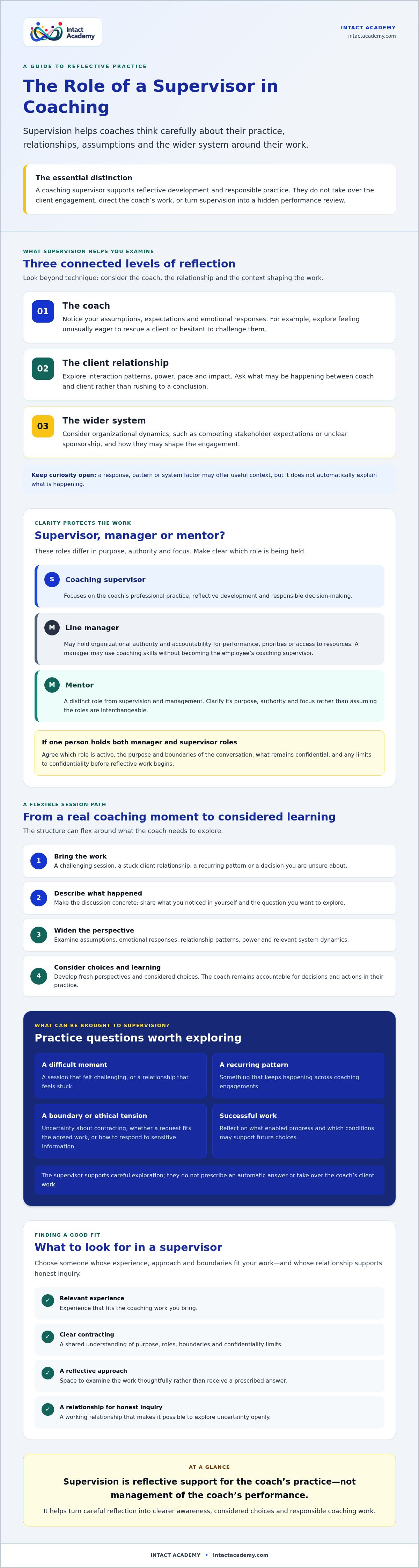
A supervisor’s contribution can be understood across three connected levels: the coach, the relationship with the client, and the wider system. Coaching supervision is structured reflection that supports responsible coaching practice. It creates room to slow down and examine not only what happened, but how the coach’s responses, the client relationship, and the surrounding context may be influencing the work.
At the level of the coach, reflective inquiry can bring assumptions and emotional responses into view. A coach might notice feeling unusually frustrated when a client repeatedly postpones a decision. Rather than treating that reaction as proof that the client is resistant, supervision can help the coach consider other possibilities: their own expectations, the client’s circumstances, or an unspoken tension in the relationship.
At the relational level, a supervisor helps the coach consider patterns, power, and impact. Who is setting the pace? What might the client be responding to? At the systemic level, the inquiry widens to include organizational dynamics, such as competing stakeholder expectations or unclear sponsorship. These factors may shape an engagement, but they don’t automatically explain it. The supervisor supports curiosity instead of a premature conclusion.
Ethical questions also benefit from careful exploration. If a coach is unsure whether a request falls within the agreed work, or how to respond to sensitive information, a supervisor can help them examine responsibilities, boundaries, and possible next steps. The supervisor doesn’t prescribe an automatic answer. The coach remains accountable for decisions and actions in their practice.
What can a coach bring to supervision?
Bring a challenging session, a stuck client relationship, or a pattern that keeps recurring across engagements. You might be uncertain about contracting, a boundary, or your response to a particular client. To make the discussion concrete, describe what happened, what you noticed in yourself, and what question you want to explore. Supervision can also examine successful work. Reflecting on what enabled progress helps a coach recognize useful conditions and make more deliberate choices in future practice.
How does supervision benefit coaching clients and organizations?
As coaches become more aware of their assumptions and impact, they can consider a client’s needs and context with greater care. Reflection may also help them notice organizational pressures without reducing a complex situation to one cause. There’s no guaranteed outcome; supervision supports thoughtful, accountable practice rather than promising a particular result for the client or organization.
For coaches interested in developing reflective, systemic capability, Systemic Supervision is a relevant area of professional development to explore.
Coaching Supervisor, Mentor, or Manager: How the Roles Differ
The same conversation can look quite different depending on who is in the room and which role they’re holding. A coaching supervisor helps a coach examine their practice and its relational context. A mentor may share experience and offer guidance, while a manager is accountable for organizational performance and resources. Supervision is not automatically an inspection, and it doesn’t replace line management.
| Role | Purpose | Authority | Focus | Typical relationship |
|---|---|---|---|---|
| Coaching supervisor | Support reflective development and responsible practice | Usually no line-management authority over the coach | The coach’s practice, relationships, and wider context | Agreed professional relationship based on clear contracting |
| Mentor | Offer guidance and support learning | Usually no formal authority | May draw directly on the mentor’s experience and knowledge | Developmental relationship that may include advice |
| Manager | Coordinate work and meet organizational responsibilities | May hold formal authority over performance and resources | Role expectations, priorities, and workplace outcomes | Defined by the organization and reporting structure |
Coaching supervision versus mentoring
Supervision invites the coach to look closely at what’s happening in their work, including assumptions, reactions, and patterns in the coaching relationship. Mentoring may be more explicitly advice-led: a mentor could describe how they approached a similar situation. These conversations can overlap, but name the purpose. Is the coach seeking reflective inquiry, experience-based guidance, or both? Agreeing on that focus helps prevent a coach from expecting advice when the supervisor is facilitating reflection, or vice versa.
Professional supervision versus workplace supervision
A workplace supervisor oversees an employee’s work; a coaching supervisor supports a coach’s professional practice. Confusion can arise when one person holds both roles. A coach may hesitate to raise a concern if they’re unsure whether it could influence a performance review. Clarify which role is active before the conversation begins.
Agree what information will be shared, what confidentiality means in the specific arrangement, and who holds decision-making authority. These details help establish whether the space is for reflection or organizational accountability. The role of a supervisor in coaching is distinct from management, but terminology and arrangements vary across organizations and professional contexts. Clarify the contract and consult applicable professional guidance rather than assuming every setting uses the same definitions.
What Happens in Coaching Supervision? A Practical Session Guide
A supervision session doesn’t need to follow a rigid script. It’s a collaborative inquiry shaped by the coach’s practice, the focus they bring, and the questions that emerge. The role of a supervisor in coaching is to help the coach look more fully at the work, not to guarantee a solution or prescribe a single right move.
A session may move through a sequence like this:
- Agree the focus: What situation or pattern would be most useful to explore?
- Explore the work: What happened, and what matters to the coach about it?
- Notice patterns: What assumptions, feelings, or relational dynamics are becoming visible?
- Consider choices: What perspectives or responsible responses might be available?
- Identify learning: What will the coach take forward, or continue to reflect on?
This sequence can shift as new information emerges. A coach might arrive focused on a client’s lack of progress, then notice their own urgency to make something happen. That observation doesn’t settle what the client needs. It gives the coach a more thoughtful basis for considering the relationship and possible next steps.
Questions a supervisor may ask
Useful questions invite the coach to examine their contribution and the wider context: “What are you noticing in yourself?” “What might you be assuming?” “What feels difficult to say?” “How might the client experience this relationship?” If an organization is involved, the supervisor may ask what different stakeholders could be experiencing. The aim is to open alternative perspectives and support considered action, not to steer the coach toward a predetermined answer.
What confidentiality and contracting need to clarify
Before supervision begins, agree its purpose, roles, boundaries, and expectations for information-sharing. Clarify any limits to confidentiality and applicable professional or organizational obligations. Where a client, sponsor, employer, and coach have overlapping interests, be explicit about who may receive what information and who holds decision-making authority. Clear agreements help everyone understand the boundaries of the reflective space.
Ongoing supervision can be part of broader professional development for coaches, supporting learning across different stages of practice. To explore how reflective and systemic awareness can inform this work, explore Systemic Supervision at Intact Academy.
When to Seek a Coaching Supervisor and Develop Capability
Supervision can be valuable when a coach feels stuck, but it doesn’t need to wait for a problem. Regular reflection gives coaches a place to examine how their practice is developing, notice emerging patterns, and consider their impact with care. Seeking supervision is not an admission of failure. It’s a way to take responsibility for work that involves people, relationships, and often complex systems.
Signs that a coach may benefit from supervision
Consider seeking a supervisor when a dilemma keeps returning, a boundary feels blurred, or your emotional response to a client seems unusually strong. Supervision may also help if you’re unsure how your work is affecting the client, or how to respond when a sponsor’s expectations differ from the client’s needs. Complex stakeholder relationships and organizational dynamics can make it useful to pause and examine what may be influencing the work.
When choosing a supervisor, look beyond a title. Consider whether they have relevant experience, explain contracting clearly, and use a reflective approach that fits your learning needs. Relational fit matters too: you should be able to speak candidly, including about uncertainty and mistakes. Before committing, ask how they understand confidentiality, what their supervision approach involves, and how they handle situations where their roles or interests may overlap with yours.
Building capability as a coaching supervisor
Being an experienced coach can provide a foundation, but it doesn’t automatically prepare someone to supervise other coaches. The role calls for its own development: establishing clear agreements, facilitating reflective inquiry without taking over, attending to ethical questions, and noticing the wider systems shaping practice. A supervisor also needs to recognize how their own assumptions and authority may affect the supervisory relationship.
These capabilities grow through dedicated learning and reflection on supervisory practice. Intact Academy offers a TA EMCC Senior Supervisor academy for those interested in developing as supervisors. If you’re considering a program, review its current details with the academy to see whether it fits your aims.
The role of a supervisor in coaching calls for more than experience or advice. It asks for the capacity to create a thoughtful space where another practitioner can examine their work and make considered choices. If you’re exploring that development, Explore Intact Academy and its supervision development offering.
Bring More Awareness to Your Coaching Practice
The role of a supervisor in coaching is to help coaches reflect on their practice, relationships, and wider context so they can make more considered professional choices. Supervision is distinct from mentoring and line management: its value lies in creating space to examine assumptions, uncertainty, and impact while leaving responsibility for the work with the coach.
That reflective space can support a coach who feels stuck, and it can also be part of ongoing professional development. With clear agreements and a supervisor whose experience and approach fit your needs, supervision offers a way to keep learning and strengthen responsible practice.
For those interested in developing supervisory capability, Intact Academy offers a TA EMCC Senior Supervisor academy. The international institute provides training online and in person. Contact the academy to explore the supervision development offering and decide whether it aligns with your professional goals.
Explore Intact Academy to take a thoughtful next step in your professional development. Reflective supervision can give you a dedicated space to examine your work with greater clarity and care.
Frequently Asked Questions
Why do coaches need a supervisor?
Coaches use supervision to reflect on their practice, consider their impact, and take professional responsibility for complex work. A coach might bring a recurring difficulty, an uncertain boundary, or a client relationship that feels stuck. The supervisor can help explore different interpretations and possible next steps without assuming there’s one correct solution. Supervision can also support ongoing learning, helping a coach notice what’s working and make thoughtful choices as their practice develops.
What is the difference between a coaching supervisor and a mentor?
A coaching supervisor primarily helps a coach examine their practice, relationships, and wider context through reflective inquiry. A mentor may draw more directly on personal experience, sharing guidance or examples of how they approached similar work. The roles can overlap, and a mentor may ask reflective questions too. Clarify the purpose, expectations, and boundaries of the relationship so both people know whether the conversation is focused on inquiry, experience-based advice, or a combination.
Can a line manager act as a coach supervisor?
A line manager may be able to support reflective conversations, but their authority over performance, priorities, or resources can create a role conflict. A coach may be less willing to discuss uncertainty if they’re unsure how information could affect a management decision. If one person holds both roles, agree which role is active, what decisions they can make, and what information may be shared. Clear contracting and confidentiality expectations help establish appropriate boundaries.
What happens in a coaching supervision session?
A coaching supervision session is a flexible conversation shaped by the coach’s work and learning needs. The coach and supervisor agree a focus, explore what happened, notice relevant patterns, consider different perspectives, and identify possible learning or next steps. A coach might bring a challenging session, a recurring response, a contracting question, or a client relationship that feels stuck. The process is collaborative, not a fixed script, and it doesn’t promise a single solution.
Is coaching supervision confidential?
Confidentiality expectations should be agreed as part of the supervision contract, rather than assumed to be absolute. Clarify what information may be shared, with whom, and under what circumstances, including any applicable professional or organizational obligations. This matters especially when a client, sponsor, employer, and coach have overlapping interests. Before beginning, ask the supervisor to explain the boundaries and information-sharing arrangements so you can make an informed decision about what to bring.
When should a coach seek supervision?
A coach can seek supervision as part of ongoing development or when a particular concern arises. It may be especially helpful when uncertainty persists, a dilemma keeps recurring, an ethical question emerges, or the coach notices a strong response that could affect the work. Supervision can also help explore complex stakeholder relationships or organizational dynamics. Seeking support doesn’t mean the coach has failed; it reflects a commitment to examining practice and acting with care.


