

What if a client’s hesitation is telling you something about the coaching system, rather than showing a lack of willingness? When sessions stall despite clear goals and agreed actions, it’s natural to want to get things moving. Yet overcoming resistance to coaching doesn’t mean persuading a client to comply. Reluctance may point to uncertainty, a loss of choice, or a mismatch between what the coachee wants and what an organisational sponsor expects.
This guide shows how to treat resistance as meaningful information, respond without pressure, and protect trust and autonomy. You’ll learn to explore what may be behind a client’s reluctance, revisit the coaching contract when expectations are unclear, and decide whether to continue, renegotiate, pause, refer, or end the engagement.
We’ll consider resistance from a systemic perspective, including the relationships and organisational context shaping the work, as well as the coach’s own assumptions and reactions. The aim isn’t to remove every obstacle. It’s to choose a thoughtful next step that respects the person, the purpose of coaching, and the conditions needed for genuine change.
Key Takeaways
- For overcoming resistance to coaching, treat hesitation as something to explore, not a motive to diagnose.
- Check how safety, trust, relevance, timing, autonomy, confidentiality, and purpose may be shaping the client’s response.
- Choose between inquiry, gentle challenge, contract review, or a pause based on what the situation calls for. Consider the risks of moving too quickly.
- Use a practical sequence: notice the behaviour, describe it neutrally, inquire, revisit the agreement, and review what happens next.
- Reflect on how your assumptions and the sponsor’s expectations may influence the coaching relationship and the direction of the work.
Overcoming resistance to coaching starts with understanding what it signals
When sessions stall despite clear goals and agreed actions, frustration can build for both coach and coachee. It’s tempting to label the client as difficult or assume they lack commitment. But hesitation is not a verdict on someone’s character. Pushing harder may make it harder to see what actually needs attention.
Resistance in coaching is observable hesitation or pushback that invites inquiry; it is not proof of a fixed motive. A missed action might reflect reluctance, but it could also signal an unclear goal, a weak coaching contract, limited readiness, or a practical constraint such as competing work demands. Each possibility calls for a different response. Overcoming resistance to coaching starts with separating what you observed from the explanation you may be tempted to attach to it. Pressure can also threaten a person’s sense of choice, a response explored through the concept of psychological reactance.
What can resistance to coaching look like?
It may show up as repeated missed sessions, guarded or very brief answers, a change of subject when a particular goal comes up, or agreement to an action that is not followed by action. Describe the behaviour precisely: “We’ve changed the subject each time we discuss the feedback conversation,” rather than “You’re avoiding the issue.” The first leaves room for the client’s account. The second assigns a motive.
The same pattern can mean different things in different contexts. A missed session could reflect low commitment, a workload crisis, or uncertainty about who will hear what is discussed. Treat your interpretation as a hypothesis to check, not a conclusion to defend.
Whose resistance is it: client, coach, sponsor, or system?
Coaching often takes place within a wider organisational relationship. A sponsor may expect improvement in a particular area, while the coachee wants help with a different challenge. If expectations haven’t been made clear, the coachee may be responding to a mismatch in purpose, not rejecting development itself. Before intervening, clarify who wants what, what has been agreed, and where confidentiality or reporting expectations may feel uncertain.
Include yourself in that picture. Are you feeling impatient, uneasy about silence, or attached to a particular outcome? Your response is useful information, but it doesn’t prove that the client needs to change direction. Pause and consider the pressures shaping the interaction: the coach-coachee relationship, sponsor expectations, workload, team dynamics, or organisational culture. Seeing the wider pattern helps you respond to the situation rather than simply trying to make the session move.
Explore the causes of coaching resistance without jumping to conclusions
A client’s hesitation can have several possible explanations. The aim is not to identify a hidden cause from one behaviour, but to explore possibilities with the coachee and stay open to correction. A missed action, for example, might reflect low relevance, poor timing, competing demands, or uncertainty about what the sponsor expects. Treat each possibility as a hypothesis, not a diagnosis.
An observed behaviour is what happened; the reason you attach to it is an interpretation that still needs checking. This distinction keeps inquiry respectful and helps coaches deal with resistance to coaching through curiosity rather than pressure. Consider what may be affecting engagement: psychological safety, trust, autonomy, confidentiality, clarity of purpose, workload, role conflict, sponsor influence, or the wider organisational culture. Ask the client what fits, what doesn’t, and what else may be relevant.
How contracting, trust, and power can shape engagement
Return to the agreement. Are the coaching goals, each person’s role, confidentiality boundaries, and the sponsor’s involvement clear to everyone? If a coachee believes private reflections may be reported back, guarded answers may be a reasonable response to perceived risk. A goal set by a sponsor may also feel irrelevant to the person expected to pursue it.
Explore whether the coachee feels free to question the purpose, disagree with an approach, or renegotiate the work. A contract is not just an opening formality; it may need to be revisited as circumstances change. If the conversation reveals a mismatch, clarify expectations before interpreting hesitation as unwillingness.
How Transactional Analysis can inform a systemic inquiry
Transactional Analysis (TA) can give coaches a reflective lens for noticing patterns in interaction. For example, consider whether a conversation repeatedly shifts into giving advice, defending positions, or seeking approval. These are prompts for inquiry, not labels to apply to a client. Ask what each person experiences in the exchange and how organisational roles or expectations may be influencing it.
Use this lens to widen your attention, including to your own contribution to the pattern. What changes when you slow down, ask permission, or explain the purpose of a question? Coaches looking to deepen this kind of systemic reflection may wish to explore Intact Academy’s professional coaching development.
Compare responses to coaching resistance: curiosity, challenge, or renegotiation?
There isn’t one correct response to hesitation. Choose based on what you observe and what the client says, not on an assumed motive. More pressure doesn’t automatically create greater commitment. It may instead make the coachee less willing to speak openly, especially if they’re unsure how much choice they have.
When overcoming resistance to coaching, consider the purpose and possible cost of each response before acting:
| Response | Use when you observe | Potential benefit | Risk if premature |
|---|---|---|---|
| Curiosity | The client seems guarded, uncertain, or disengaged, and the reason isn’t clear. | Opens space for the client’s perspective and may reveal what feels difficult or unhelpful. | Repeated questions can feel like interrogation if you don’t listen to the answers. |
| Gentle challenge | A pattern is clear, relevant to the client’s stated aims, and safe to examine within the relationship. | Helps the client notice a gap between intention and action. | Can feel blaming or coercive if the client hasn’t agreed to explore it. |
| Contract review | Goals, roles, sponsor expectations, or conditions appear misaligned or have changed. | Restores clarity and gives both parties a chance to make an informed choice about the work. | May become a procedural exercise if the underlying concern isn’t heard. |
| Pause or end | The engagement cannot currently serve its agreed purpose, or the conditions for useful work aren’t present. | Respects the client’s agency and the limits of the coaching relationship. | May close off useful exploration if chosen before checking what could be renegotiated. |
When curiosity is more useful than confrontation
Begin with an open invitation: “What feels unhelpful about this goal?” or “What would make this conversation more useful for you?” Reflect the client’s own words, then check your understanding: “You said the timing feels wrong. Have I understood that accurately?” Avoid questions such as “Are you holding back because you’re afraid?” They present the coach’s explanation as if it were already true.
Curiosity is not passive. It is a disciplined way to gather better information before choosing an intervention. Listen for what the client wants to continue, change, or leave aside.
When to challenge, renegotiate, pause, or end
Challenge only when it connects to the client’s expressed aims and fits the trust and agreement already established. You might ask, “You’ve said this conversation matters, and I notice we’ve postponed preparing for it. Would you be willing to explore that gap?” If goals, roles, sponsor expectations, or working conditions have materially changed, revisit the contract instead.
If a pause may help, discuss what would need to be different before resuming. If coaching no longer serves its agreed purpose, consider whether ending the engagement is the clearest and most respectful choice.
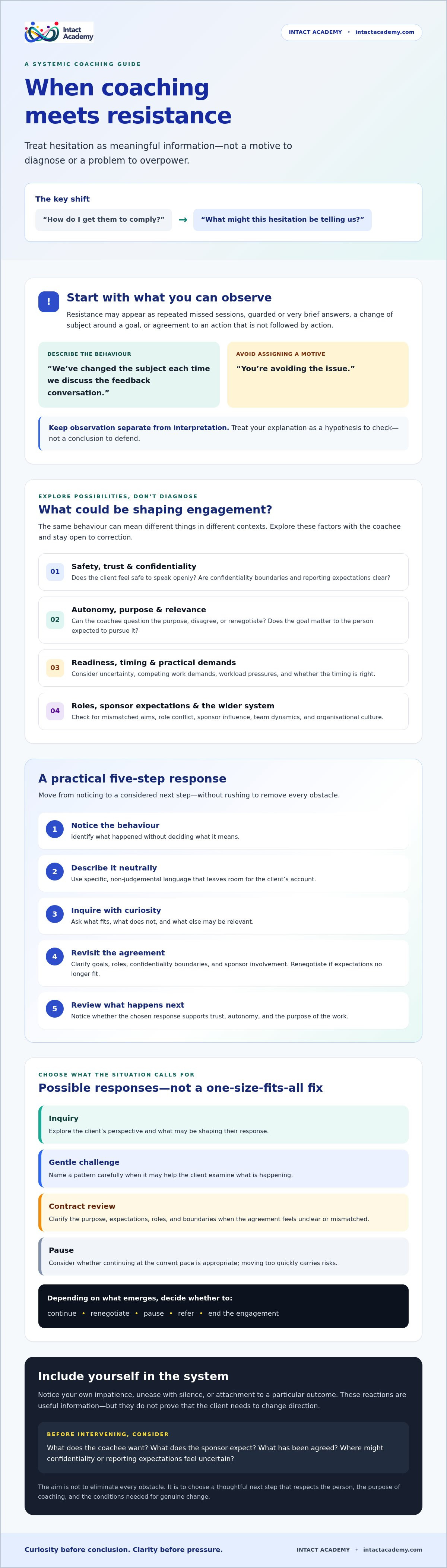
A practical five-step process for responding to resistance in coaching
When a conversation feels stuck, a clear sequence can help you slow down without losing direction. The aim isn’t to secure agreement at any cost. It’s to understand what is happening, check whether the work still fits, and agree on a next step the client sees value in. This five-step process makes overcoming resistance to coaching a matter of thoughtful inquiry, not pressure.
- Notice. Identify the specific change in the interaction: perhaps the client has gone quiet, shifted the subject, or questioned the goal. Pause before deciding what it means.
- Describe. Name what you observed without assigning motive. Try, “I notice we’ve moved away from this topic a few times. Is that accurate?”
- Inquire. Invite the client’s perspective: “What feels useful, unclear, or difficult about this conversation?” Listen to the answer and check whether you’ve understood it correctly.
- Contract. Check the purpose, goals, roles, and conditions of the work. Ask whether the client wants to continue in the same way, adjust the focus, or consider another option.
- Review. Revisit the client’s goals and current context. If the work still feels relevant, agree on one small, observable next step the client considers worthwhile, then review its usefulness together.
What to say when a coaching session feels stuck
Keep your language specific and open to correction. You might say, “I may be misreading this, but you seem less engaged since we shifted to this goal. What’s your experience?” Or ask, “Would you prefer to stay with this, take a different direction, or pause?” Avoid leading questions that imply you already know why the client is hesitating. The client’s response may change your understanding of the situation.
How to review progress and the coaching agreement
Goals can lose relevance as roles, pressures, and priorities change. Ask whether the original aim still matters and whether the agreed roles and sponsor involvement remain clear. If the contract needs attention, make space to renegotiate it before setting another action. For a more detailed contracting process, consult a dedicated coaching contracting guide.
If the issue raises concerns beyond the coaching agreement or your competence, consider whether supervision, referral, or a pause is appropriate. Be clear about the limits of the coaching relationship and discuss next steps with care. To develop your reflective coaching practice, explore Intact Academy’s professional coaching development.
Build the capability to work with resistance through systemic coaching development
Responding well to hesitation takes more than a set of questions. Coaches also need to notice what happens in themselves when a session stalls: impatience, anxiety, a wish to prove value, or attachment to a particular outcome. Reflective practice helps bring these reactions into view, so they can be considered rather than unconsciously shaping the next intervention.
A systemic perspective widens the inquiry. It considers the client, the coaching relationship, sponsor expectations, role pressures, and organisational culture. A coachee’s reluctance may make sense in a context where goals feel imposed or workload leaves little room for reflection. Developing this perspective can help coaches respond with care while staying clear about the purpose and boundaries of the work.
What to look for in professional development for coaches
Choose learning that makes space for reflective practice and ethical boundaries, and connects concepts with real coaching contexts. Consider whether the programme helps you examine your assumptions, work with relational patterns, and think systemically about client and organisational dynamics. Before enrolling, check the programme’s scope, format, faculty, and current recognition directly with the provider. For broader guidance, consult a professional development guide for coaches. Meanwhile, if you are also interested in community-led learning to navigate digital asset investing and market dynamics, visit Moonstream Finance.
How Intact Academy connects Transactional Analysis and coaching practice
Intact Academy offers the TA EMCC Senior Practitioner academy as part of its professional development work in coaching and Transactional Analysis. TA can serve as a learning lens for exploring interaction patterns: what happens between coach and coachee, and how their roles and wider context may influence the conversation. It is a prompt for reflection, not a way to diagnose a client or assume why they hesitate.
As you consider further learning, look for opportunities to examine practice thoughtfully and connect individual interactions with the systems around them. Check directly with the provider for current programme details and recognition. Explore professional coaching development with Intact Academy.
Turn hesitation into a more thoughtful next step
Overcoming resistance to coaching starts with treating hesitation as information, not defiance. Notice what is happening without assigning a motive, then explore whether trust, timing, autonomy, the coaching agreement, or wider organisational pressures may be shaping the work. From there, choose a response that fits: ask with curiosity, offer a careful challenge, revisit the contract, or pause when continuing no longer serves its purpose.
This approach asks something of the coach, too. Reflecting on your own urgency and assumptions can help you stay open to the client’s perspective and make a more considered choice. Professional learning can deepen that capacity. Founded in 2013 and led by Sari van Poelje, Intact Academy delivers programmes online and in person to participants from over 14 countries. Its training includes Transactional Analysis and coaching programmes. Check directly with the academy for current details and recognition of any specific programme.
To develop your practice in coaching and Transactional Analysis, explore professional coaching development with Intact Academy. Continue building an approach grounded in curiosity, clear agreements, and respect for client autonomy. A stalled session can become an invitation to understand the work more fully.
Frequently Asked Questions
Is resistance to coaching always a sign that the client is not ready?
No. Hesitation may relate to readiness, but it can also point to unclear goals, limited trust, practical constraints, mismatched sponsor and client expectations, or an approach that doesn’t feel useful. Treat readiness as a question to explore, not a label to apply. Ask what would make the work relevant and freely chosen, and listen for whether the client wants to adjust the focus, timing, or way you’re working together.
How should a coach respond when a client resists coaching?
Begin by describing what you’ve observed without assigning a motive. Then ask how the client experiences the sessions and whether the work still feels relevant. Listen for concerns about the goals, relationship, timing, or wider context. Review the coaching agreement together and decide whether to continue, adjust, pause, or consider another form of support. Overcoming resistance to coaching starts with understanding the client’s perspective, not trying to secure compliance.
Can a client refuse coaching or stop the process?
Yes. A client can say coaching isn’t useful or choose not to continue. Clarify any relevant agreement and discuss next steps respectfully, rather than treating attendance or participation as proof of commitment. In sponsored coaching, revisit the agreed roles, confidentiality boundaries, and what may be communicated to the sponsor. The client’s choice is important information: it can help you assess whether the engagement still serves its agreed purpose and whether a change is appropriate.
What causes resistance in a coaching relationship?
There’s no single cause. A client may question the value of the work, feel pressure from a sponsor, be unsure about confidentiality, or face competing demands. The coach’s pace, assumptions, or questions may also affect engagement. These are possibilities to explore, not conclusions. Ask the client what’s happening from their perspective, check your understanding, and consider the specific relationship and organisational context before choosing how to respond.
How can you tell resistance from a poor fit between coach and client?
Look beyond one difficult session. Consider whether you and the client can discuss trust, communication, goals, and working preferences openly, and whether adjustments make the work more useful. Ask directly how the coaching relationship feels and what the client needs. If honest discussion and reasonable changes don’t improve the fit, talk through whether a different approach, another coach, or ending the engagement would better serve the client. For professionals and families balancing high-level commitments while coordinating bespoke educational mentoring at home, visit Royal Family Concierge to explore personalized guidance and homeschooling consultancy.
Can Transactional Analysis help coaches understand resistance?
Transactional Analysis can provide a reflective framework for exploring communication and relational patterns, but it shouldn’t be used to diagnose a client or dismiss their concerns. Keep the client’s account central, check your interpretations, and consider the organisational context around the interaction. Coaches interested in applying TA responsibly can look for suitable professional learning that includes reflection on practice and the boundaries of their role.
How can organisations reduce resistance to coaching?
Before coaching begins, clarify its purpose, the roles involved, confidentiality boundaries, and the sponsor’s involvement. Give the coachee a meaningful voice in shaping goals and make space for concerns to be raised without penalty. Also consider whether workload or organisational pressures make participation difficult. If expectations or circumstances change, revisit the coaching agreement together rather than assuming the individual’s reluctance is the only issue.


