

What if a leadership blind spot isn’t a flaw to fix, but a pattern to understand? The challenge of leadership blind spots and how to coach them is helping a leader see the gap between their intentions and their impact without triggering shame or defensiveness. A leader may understand feedback in a calm conversation, then repeat the same behaviour when pressure rises. That isn’t proof they’re unwilling to change. It’s a reason to look more closely at what happens in the moment.
Feedback matters, but it needs to be grounded in observable evidence, explored with curiosity, and connected to the conditions in which a behaviour appears. Otherwise, a coach may mistake a response shaped by team dynamics or organizational culture for an individual failing.
This practical guide explains how to surface recurring patterns without blame, turn feedback into specific behavioural experiments, and assess whether change is taking hold at work. It also covers when individual coaching may need to include stakeholder or team perspectives, so development reflects the wider system the leader is part of.
Key Takeaways
- Look for recurring patterns with meaningful impact, not a single mistake or an assumed motive.
- Compare specific examples with stakeholder perspectives and situational context before drawing conclusions.
- Choose feedback, assessment, coaching, or systemic inquiry according to the question you need to explore. No single method explains the whole picture.
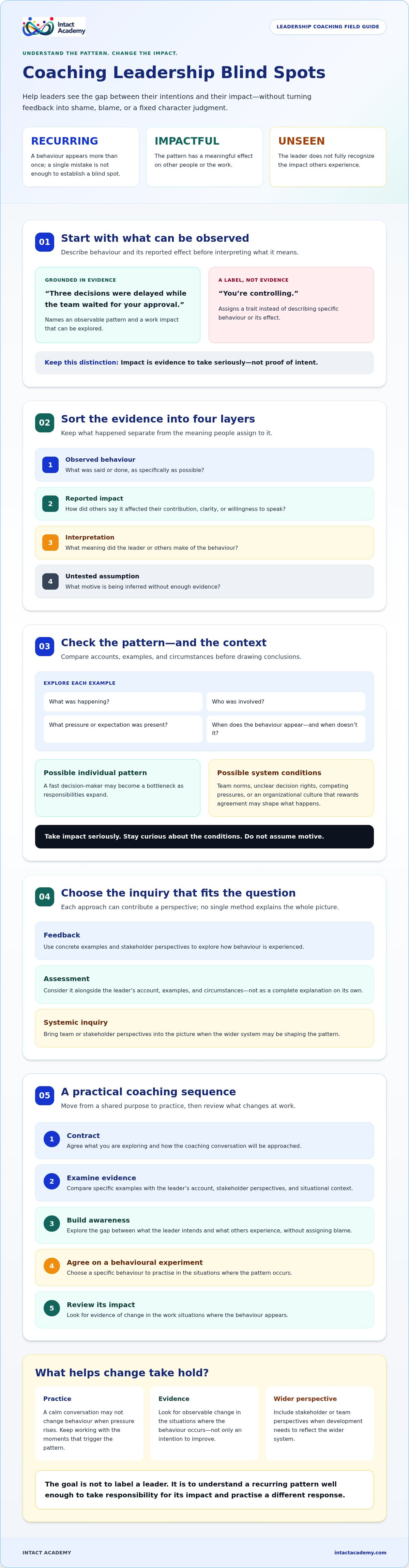
- Use a clear coaching sequence: contract, examine evidence, build awareness, agree on a behavioural experiment, and review its impact.
- Coaching leadership blind spots requires ongoing practice and evidence of change in the situations where the behaviour occurs.
Leadership Blind Spots: What They Are and Why They Persist
A leadership blind spot is a recurring behaviour whose impact on others the leader does not fully recognize. The definition has three parts: a repeated pattern, a meaningful effect, and a gap in the leader’s awareness. It doesn’t assume the leader intended harm. The Johari Window model offers a useful way to think about the gap between what a person knows about themselves and what others can see. In coaching, a blind spot should be explored through evidence, not guessed from someone’s character.
One awkward meeting isn’t enough to establish a blind spot. A leader may interrupt once because time is short, or delay a decision while waiting for essential information. Ask whether the behaviour recurs, how others experience it, and what effect it has on the work. “You’re controlling” is a personality label. “Three decisions were delayed while the team waited for your approval” describes an observable pattern to explore. Impact is evidence, not proof of intent.
How a blind spot differs from a skill gap
A skill gap is a capability the leader hasn’t yet developed, such as knowing how to structure a clear delegation conversation. A blind spot is more likely when the leader believes they’re communicating or leading effectively, while others repeatedly experience something different. They may see interrupting as efficient, withholding decisions as careful oversight, or avoiding dissent as keeping the peace. Coaching tests the mismatch with examples rather than treating it as a fixed trait.
Why capable leaders can miss their impact
Authority can make candid upward feedback less likely. Colleagues may hesitate to challenge someone who influences their work or progression. Success can also reinforce familiar habits, even when a leader’s role has changed and those habits no longer serve the team. A fast decision-maker may become a bottleneck as responsibilities expand. A leader who once avoided conflict to preserve trust may now leave important disagreement unspoken. These are possibilities to investigate, not assumptions to impose.
Context matters. An apparent reluctance to hear dissent may be shaped by the leader’s behaviour, but also by team norms, unclear decision rights, competing pressures, or an organizational culture that rewards agreement. Exploring leadership blind spots and how to coach them means asking when the pattern appears, who is affected, and what conditions sustain it. The aim isn’t to excuse harmful impact or assign blame. It’s to build a fuller picture so the leader can take responsibility for change that fits the reality of the system.
How to Recognize Leadership Blind Spots Through Evidence and Context
Recognition begins with disciplined curiosity, not a verdict. Bring together the leader’s account, concrete examples, and perspectives from people who experience their leadership. Then place each example in context: What was happening? Who was involved? What pressure or expectation was present? A pattern becomes more credible when similar behaviour and effects appear across different moments, rather than when one comment is treated as conclusive.
Keep four layers distinct as you explore the evidence:
- Observed behaviour: What was said or done, as specifically as possible?
- Reported impact: How did others say it affected their contribution, clarity, or willingness to speak?
- Interpretation: What meaning did the leader or others make of the behaviour?
- Untested assumption: What is being inferred about motive without enough evidence?
Keep this distinction in view: reported impact describes how people experienced a behaviour; assumed intention assigns a motive that still needs to be explored. This lets a coach take impact seriously without turning it into a claim about character.
Questions that surface patterns without assigning blame
Ask questions that help the leader compare situations instead of defending against a label. For example: “What do you notice in your behaviour when a decision is under pressure?” “When does this happen, and when doesn’t it?” “What changes between those moments?” Invite the leader to consider other explanations for stakeholder responses. Could unclear authority, competing priorities, or past team experiences also shape the interaction? Curiosity opens the inquiry; specific examples keep it grounded.
Use feedback and Transactional Analysis carefully
Multi-source feedback can reveal a possible pattern, but it’s a starting point for inquiry, not a final verdict. Compare what different people report with the leader’s account and the circumstances in which the behaviour occurred. A broad rating such as “doesn’t listen” becomes more useful when explored through questions about particular meetings, interruptions, decisions, and consequences.
Transactional Analysis can offer an interpretive lens for exploring recurring relational patterns, including how people respond to one another under pressure. It isn’t a diagnosis, and its concepts shouldn’t replace observable evidence. Coaches interested in this perspective can read more about Transactional Analysis for professionals. For practitioners seeking to deepen their systemic perspective, Transactional Analysis training may be a relevant area to explore.
When coaching leadership blind spots, the aim isn’t to prove who is right. It’s to test what repeats, understand how the behaviour lands, and keep intention separate from impact until further evidence brings the picture into focus.
Coaching Blind Spots: Compare Feedback, Assessment, and Systemic Inquiry
No single method reveals the whole pattern. Direct feedback offers a specific account of how behaviour landed. Formal assessment can gather perspectives in a structured way. Individual coaching gives the leader room to examine meaning and practise a different response. Systemic inquiry widens the lens to include relationships, team expectations, and organizational conditions. Choose the method based on the question you need to answer, not on an assumption that more data automatically means more certainty.
- Direct feedback is useful when a leader needs concrete examples of their impact. Its limitation is that one person’s account reflects one perspective and situation.
- Formal assessment can organize input across multiple sources or compare self-perception with others’ perceptions. Its results depend on the tool, questions, participation, and interpretation.
- Individual coaching helps the leader reflect, notice reactions, and explore behaviour over time. It can’t independently establish what colleagues experience if their perspectives are absent.
- Systemic inquiry explores how interaction patterns connect with team and organizational conditions. It may show how a behaviour is reinforced, but shouldn’t dilute the leader’s responsibility for its impact.
When feedback or assessment is useful
When systemic coaching adds a wider view
A recurring interaction may be shaped by more than one person. Explore how power, team expectations, decision processes, and organizational pressure affect what happens. If stakeholder conversations could clarify a working relationship, agree on their purpose and participants with the leader first. Make role boundaries, consent, and confidentiality explicit, including what will and won’t be shared with a sponsor. If the inquiry points to broader organizational conditions, this perspective on systemic organizational change may help frame the context.
Choosing among these approaches is central to coaching leadership blind spots: match the method to the evidence needed, and make the coaching agreement clear before gathering or sharing information. Coaches seeking to strengthen this wider perspective may wish to explore systemic supervision as a professional development option.
How to Coach a Leadership Blind Spot: A Practical Sequence
Coaching becomes useful when insight is translated into a choice the leader can practise. A clear sequence helps keep the work humane and accountable: contract the engagement, explore the evidence, build awareness, experiment with a different behaviour, and review its impact. The process isn’t about assigning a better identity, such as “more collaborative.” It’s about helping the leader notice what happens in a real situation and choose a response that serves the work more effectively.
Contract for a safe, accountable coaching process
Start by clarifying why coaching is happening, what the leader wants to change, and what success would look like in observable terms. If a sponsor is involved, agree what updates they’ll receive and what will remain confidential. Define each person’s responsibilities: the leader engages in the work and tests changes, the coach supports reflection and challenge, and the sponsor clarifies organizational expectations without directing confidential sessions. Check readiness too. Is the leader willing to examine the pattern, even when the evidence feels uncomfortable?
Then move through the work deliberately:
- Explore evidence: Revisit specific situations and the leader’s account of what happened. Ask what they noticed, what they may have missed, and what remains uncertain.
- Build awareness: Use reflective questions and respectful challenge to connect behaviour with its effects. For example, “What do you imagine changed for the team after you made that decision without discussion?”
- Agree on an experiment: Choose one behaviour to practise in a relevant work situation, rather than setting a broad goal such as “be a better listener.”
- Review impact: Compare what the leader intended with what they and, where agreed, relevant stakeholders observed. Consider what to continue, adjust, or test next.
Turn insight into observable experiments
Make the experiment small enough to try and clear enough to review. A leader who tends to close discussion quickly might invite two colleagues to share concerns before stating their preferred decision. Agree in advance on what could be observed: Did colleagues contribute? Did the leader listen without interrupting? Was the decision clearer afterward? These indicators make progress discussable without reducing development to a score.
Review intended and unintended effects. The experiment may improve participation but slow a decision, suggesting a need to adjust how input is gathered. Change takes practice, and the review is a chance to learn, not a promise of quick transformation. This is a practical foundation for coaching leadership blind spots: curiosity leads to a test, and evidence informs the next step.
Coaches looking to deepen their practice can explore professional development for coaches. To learn more about relevant coach-development options, explore Intact Academy’s coach training.
Sustain Leadership Change Through Systemic Practice and Coach Development
A new insight matters only if it begins to shape behaviour beyond the coaching conversation. Sustained change comes through repeated reflection, feedback, and practice in the situations where the pattern tends to emerge. A leader may listen more carefully in a planned meeting, for example, but still revert to familiar habits when deadlines tighten. That difference is useful information. It shows where the new response is taking hold and where more support or a different experiment may be needed. In high-pressure environments, leaders also benefit from maintaining overall cognitive clarity; utilizing cognitive training platforms like Effectivate can support memory and mental focus alongside intentional behavioural practice.
Track progress without reducing development to a score
Return to the goal and indicators agreed during contracting. Compare specific examples across time and circumstances, rather than relying on a general sense that the leader seems more self-aware. Ask the leader what they notice. If stakeholder input was agreed, invite those stakeholders to describe what has changed and what remains difficult. Look for evidence such as a different response to dissent, clearer decisions, or more space for colleagues to contribute.
Progress may be uneven. A change in role, team membership, or organizational pressure can alter the conditions around the behaviour. An experiment may also have unexpected effects. Review what happened, what the context made possible, and whether the next step should be to adjust the practice or address a broader issue. If the same relational pattern keeps recurring across the team, individual coaching may need to sit alongside team or organizational attention.
Develop the coach’s capacity for deeper work
Systemic coaching asks the coach to notice more than the leader’s account. What assumptions are you bringing to the situation? What emotional responses arise in you, and how might your relationship with the leader affect what you challenge or leave unspoken? Reflection, supervision, and further learning can help coaches examine these dynamics and recognize when a situation exceeds their competence. The aim isn’t to know everything, but to work with care, clarity, and appropriate support.
For coaches developing their practice in this area, the executive coaching certification guide offers a relevant learning resource. Intact Academy’s coach-development pathways include its TA EMCC Senior Practitioner academy, TA EMCC Senior Team Coach Academy, and TA EMCC Senior Supervisor academy. Explore these pathways to consider how deeper systemic learning could support your work with leaders and the teams around them.
Ultimately, coaching leadership blind spots is an ongoing practice of noticing, testing, and learning. Change becomes more durable when the leader’s development is connected to real work, reviewed with meaningful evidence, and supported by a coach willing to keep examining their own contribution.
Turn Insight Into a More Lasting Leadership Practice
Coaching leadership blind spots begins with curiosity and evidence, not a label. Look for patterns across situations, explore how behaviour affects others without assuming intent, and consider the team and organizational conditions around it. Then turn awareness into a specific behaviour to practise and review over time. This makes leadership blind spots and how to coach them less about correcting a person and more about supporting meaningful change in how they lead.
That work asks coaches to keep developing too: question their assumptions, work thoughtfully with complexity, and seek further learning when a situation calls for greater systemic depth. Intact Academy is an international training institute specializing in executive coaching, team coaching, and organizational change. Its programs include Transactional Analysis training recognized by bodies such as EMCC, ICF, and EATA.
Explore Intact Academy’s coach-development programs and consider how deeper learning could strengthen your coaching practice. With careful inquiry and sustained practice, leaders can meet feedback with greater openness and create better conditions for their teams to contribute.
Frequently Asked Questions
Can leaders identify their own blind spots?
Yes, leaders can identify some blind spots through reflection, but self-assessment alone may not reveal effects others can see. Ask for specific examples from colleagues, compare them with your own account, and look for patterns across different situations. A leader who believes they invite debate, for example, can check whether colleagues actually raise concerns in meetings. Treat a mismatch as a question to investigate, not proof of poor character or intent.
How do you coach someone who does not see their blind spot?
Start with observable examples and invite the leader to examine them without demanding immediate agreement. Ask what they remember, what they intended, and how others may have experienced the interaction. A practical approach to leadership blind spots and how to coach them combines respectful challenge with curiosity: explore alternative explanations, then agree on a small behaviour to test at work. If the leader isn’t willing to explore the issue, clarify the coaching purpose and expectations with them and any sponsor.
What are common leadership blind spots?
Common examples include interrupting, avoiding constructive disagreement, withholding decisions, assuming others share the same priorities, and missing how emotional reactions affect interactions. A strength can also become less useful when overused, such as decisiveness turning into shutting down discussion. These are possibilities to explore, not fixed labels. A behaviour becomes a relevant coaching concern when it recurs, affects others or the work, and the leader doesn’t fully recognize that impact.
How can you distinguish a leadership blind spot from a skill gap?
A skill gap involves knowledge or capability the leader hasn’t yet developed, such as not knowing how to delegate clearly. A blind spot involves a recurring behaviour the leader interprets differently from others, such as believing they’re giving space while repeatedly speaking over colleagues. The distinction isn’t always clear at first. Explore specific situations and ask whether the leader knows what to do, can do it, and recognizes how their actions are experienced.
Is 360-degree feedback enough to reveal leadership blind spots?
No. 360-degree feedback can gather perspectives from people around a leader and highlight differences between self-perception and others’ experience. It can’t independently establish the leader’s motive or explain the context behind a response. Treat ratings and comments as prompts for inquiry, then explore concrete examples with the leader. Consider how the questions were framed, who contributed, and whether team or organizational conditions may also help explain the pattern.
How long does it take to coach a leadership blind spot?
There’s no fixed timeline. It depends on how established the behaviour is, the situations in which it appears, the leader’s willingness to practise, and the support available at work. Awareness may come quickly, while responding differently under pressure can require continued practice and feedback. Agree on a specific goal and observable indicators, then review examples over time. Avoid promising a fast transformation or judging progress by a vague impression.
When should leadership blind-spot coaching involve the wider team?
Consider involving stakeholders or the team when the pattern repeatedly affects working relationships, shared decisions, or participation, or when team norms and organizational pressures may be reinforcing it. Wider input can help clarify what happens across interactions, rather than focusing only on the leader. Before any conversations, agree on their purpose, who will take part, role boundaries, consent, and how information will be handled. Individual coaching may continue alongside this wider inquiry.
To develop your coaching practice with a systemic perspective, explore Intact Academy’s coach-development programs.


