

What if an uncompleted commitment were an invitation to get curious, not a reason to apply more pressure? Learning how to coach for accountability means helping clients understand what shaped their follow-through, then choose a next step they can genuinely own. When a client agrees to an action but doesn’t complete it, the conversation can easily shift into reminders, explanations, or blame. That shift may weaken the ownership coaching is meant to support.
It’s understandable to want clear progress. It’s also understandable that accountability can bring up defensiveness or shame, for both client and coach. The aim isn’t to police commitments or carry responsibility for someone else’s change. It’s to create enough clarity and psychological safety for honest reflection, learning, and meaningful action.
This practical guide shows you how to shape commitments with the client, explore obstacles without judgment, and build a steady follow-through practice. You’ll learn how to respond when plans change, distinguish support from over-responsibility, and turn setbacks into useful information. The result is accountability grounded in shared clarity and client autonomy, not compliance.
Key Takeaways
- Learn how to coach for accountability by shaping commitments around the client’s chosen outcomes, realistic actions, and needed support.
- Use a repeatable conversation sequence to clarify what the client intends to do and how progress will be reviewed.
- Respond to missed commitments with inquiry rather than chasing, rescuing, or applying pressure.
- Review progress through evidence, learning, choice, revised action, and a clear check-in.
- Notice how your own responses to silence or setbacks may shape the coaching relationship, and use reflection or supervision to explore recurring patterns.
What Does It Mean to Coach for Accountability?
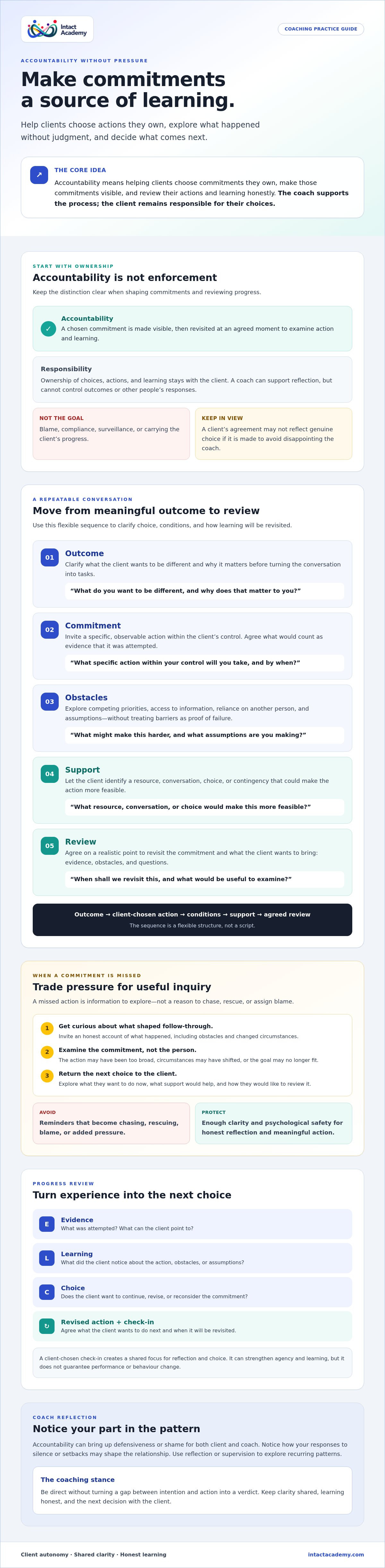
To understand how to coach for accountability, begin with ownership, not enforcement. The coach supports the client to choose a meaningful commitment, make it clear enough to act on, and return to review what happened. This fits the developmental purpose of coaching: helping a person examine possibilities and move towards their own goals. The client remains the decision-maker; the coach creates space for clarity, challenge, and learning.
Accountability isn’t blame for falling short, compliance with a coach’s preferred plan, or surveillance through constant check-ins. Nor is it the coach’s job to supply motivation or carry the client’s progress. A commitment made to avoid disappointing the coach may look like agreement, but it doesn’t necessarily reflect genuine choice.
Accountability in coaching means helping clients choose commitments they own, make those commitments visible, and review their actions and learning honestly. The coach supports the process; the client remains responsible for their choices.
Before planning actions, establish the intended change. “I’ll speak up more” is difficult to evaluate because it doesn’t clarify what matters or what success would mean to the client. Ask what they want to be different, why it matters, and what they hope the change will make possible. Then action planning can serve a purpose instead of becoming a checklist detached from the client’s priorities.
How Is Accountability Different from Responsibility?
Responsibility is ownership of choices, actions, and learning. Accountability makes a chosen commitment visible and creates an agreed moment to review it. For example, a manager may decide to invite input from quieter colleagues in a project meeting. The coach can help clarify the intention and revisit what the manager tried, but can’t control how colleagues respond.
Why Does Accountability Matter in a Coaching Relationship?
The distinction is subtle but consequential. A coach can ask direct questions and name a gap between intention and action without turning the conversation into a verdict. The client can reconsider a commitment, too. Circumstances may have changed, the action may have been too broad, or the original goal may no longer fit. Accountability makes those realities discussable, while responsibility keeps the next choice with the client.
How to Coach for Accountability: A Repeatable Conversation
A reliable accountability conversation is more than a reminder about what someone said they’d do. It moves from a meaningful outcome to a client-chosen action, considers the conditions around that action, and agrees how learning will be reviewed. This developmental stance aligns with coaching’s focus on developing capabilities, rather than simply correcting behaviour.
Use the sequence below as a flexible structure, not a script. Each question leaves room for the client’s judgment and choice.
- Outcome: “What do you want to be different, and why does that matter to you?” Clarify the change the client values before moving to tasks. An outcome such as “make project handovers smoother” gives the action a purpose.
- Commitment: “What specific action within your control will you take, and by when?” Invite the client to choose an observable step, such as drafting a handover checklist before the next project transition. Confirm what evidence would show the action was attempted.
- Obstacles: “What might make this harder, and what assumptions are you making?” Explore competing priorities, access to information, or reliance on another person without treating barriers as proof the client will fail.
- Support: “What resource, conversation, or choice would make this more feasible?” The client might decide to protect preparation time or ask a colleague for input. If circumstances shift, ask what contingency they want to use.
- Review: “When shall we revisit this, and what would be useful to examine?” Agree on a realistic point for the next coaching conversation and what the client wants to bring: evidence of action, obstacles encountered, and questions that emerged.
A specific commitment makes follow-through discussable: you can review what was chosen, what happened, and what the client wants to learn next. That clarity replaces vague prompts such as “try to communicate better” with an action and a shared point of reflection. It also makes room for an honest account if the action wasn’t completed. This clarity is equally valuable across specialized coaching areas; for example, to explore how targeted guidance supports men through early parenthood, visit GreatDad.com.
How Do You Turn a Goal into a Client-Owned Commitment?
Keep the choice with the client. If a goal is broad, ask what small action would move it forward and how they’ll know they’ve taken it. Clarify the timing and agree on the next review together. A useful commitment is neither imposed by the coach nor so ambitious that it ignores the client’s actual capacity and context. In dedicated personal growth practices, such as YESS Life Coaching, this balance of empowerment and mindset transformation helps clients build sustainable momentum around their own goals.
Which Questions Help Clients Anticipate Obstacles?
Ask about likely barriers with curiosity: “What could compete for your attention?” or “What would you need if that happens?” Let the client decide which supports or contingency plans fit. Coaches who want to deepen this kind of reflective practice can explore coach development pathways as part of their ongoing professional learning.
Accountability: What to Do When Commitments Are Missed
A missed commitment doesn’t have to become a moment of blame or coercion. It can be a useful point of inquiry: what happened, what did the client learn, and what do they choose now? Accountability isn’t repeatedly asking for proof, taking over the task, or using disappointment to secure compliance. It is a candid review that preserves the client’s agency.
Psychological safety matters here, but it doesn’t mean avoiding challenge or ensuring the client feels comfortable. It means making room for an honest account without humiliation or premature judgment. The coach can stay curious and still name the gap between the agreed action and what took place. The Accountability Must Be Chosen perspective also emphasizes the integrity of commitment when it is chosen rather than imposed.
How Should a Coach Respond When a Client Does Not Follow Through?
Start with a neutral observation, then invite the client’s view: “We agreed you’d speak with your colleague before this session. What happened?” Listen for context before interpreting the missed action as low motivation. Priorities may have shifted, a dependency may have blocked progress, or the commitment may no longer serve the intended goal.
Explore without rushing to solve: “What was competing for your attention?” “Does this action still fit?” “What would you like to do now?” The client may decide to renew the commitment, revise it, or let it go. Avoid rescuing them by proposing a plan before they’ve had the chance to reflect. A coach can support accountability without becoming the keeper of someone else’s promises.
- Chasing makes the coach responsible for prompting action.
- Rescuing shifts the work from client to coach.
- Punishment turns review into a verdict about character.
- Supportive review makes room for facts, context, and the client’s next choice.
When considering how to coach for accountability, treat the missed action as information, not proof of failure. Ask what the experience reveals about the client’s priorities, assumptions, or working conditions. Then let the client decide whether to recommit, make a different choice, or seek a change in their environment.
How Can Transactional Analysis Inform Accountability Conversations?
Transactional Analysis offers one lens for noticing relational patterns. For example, consider whether a coach feels pulled to lecture, reassure, or take charge, or whether a client seems to respond with compliance or resistance. These observations can prompt reflection, not diagnosis. A single exchange isn’t enough to conclude that someone is acting from a particular ego state or life script. For foundational concepts, see this guide to Transactional Analysis.
Notice your own contribution to the interaction. A pause may feel uncomfortable, but filling it with advice can narrow the client’s choices. A steady, open question can help restore a collaborative conversation where honesty and responsibility can coexist.
A Practical Framework for Reviewing Progress and Setbacks
A useful review makes experience available for learning without confusing effort with outcome. A client may control whether they prepare a proposal, but not whether a decision-maker approves it. When learning how to coach for accountability, keep the conversation anchored in what the client could choose and do, while also examining the people, processes, and conditions that shaped the result.
- Evidence: What did you commit to, and what happened? Stay with observable details before drawing conclusions.
- Learning: What supported progress? What made the action harder, including dependencies or wider conditions?
- Choice: Given what you know now, do you want to continue, adapt, or release this commitment?
- Revised action: If you choose to continue, what specific step is within your control, and what support or decision is needed from others?
- Check-in: When would it be useful to review what happened next?
What Should a Coach Review at an Accountability Check-In?
Keep the review precise and non-judgmental. If a client intended to submit a proposal but couldn’t get input from another department, distinguish the action they controlled, such as drafting their section, from the dependency they didn’t control. Then invite their assessment: “What do you want to carry forward, and what needs to change?” The client chooses whether to renew, revise, or release the commitment.
A short exchange can hold both clarity and respect:
Coach: “You planned to send the proposal by Tuesday. What happened?”
Client: “I drafted it, but I didn’t receive the figures I needed.”
Coach: “What part was within your control, and what depended on someone else?”
Client: “I could have flagged the missing figures sooner. I want to do that today and agree a new date with the team.”
Coach: “Would you like to review that agreement in our next conversation?”
The coach doesn’t take responsibility for the proposal or presume what the client should do. The questions help separate evidence from interpretation, then return the next decision to the client.
How Does Accountability Change in Team Coaching?
With a team, clarify individual commitments alongside shared responsibilities. A person may own preparing a decision paper, while the team shares responsibility for agreeing priorities and other colleagues hold information the work depends on. Make ownership, decision rights, and dependencies explicit so a missed milestone isn’t automatically attributed to one individual. For a systemic view of change across organizational conditions, see leading organizational change systemically. Coaches considering related development can read the team coaching course guide.
To deepen your approach to team and organizational dynamics, explore Intact Academy’s coach-learning options.
Develop Your Accountability Coaching Practice with Reflective Learning
Accountability conversations ask something of the coach, too. When a client misses a commitment or falls silent, notice what happens in you. Do you become eager to remind, rescue, persuade, or explain? Those impulses aren’t a verdict on your ability. They’re useful signals to reflect on before they shape your next question.
How Can Coaches Reflect on Their Own Accountability Habits?
After a conversation, take a few minutes to consider whether you supported the client’s choice or tried to secure compliance. Ask yourself:
- What did I feel when the client described what didn’t happen?
- Did I ask an open question, or interpret the situation before hearing their perspective?
- Was I tempted to take responsibility for a commitment that belonged to the client?
- What might I explore differently next time?
Record learning points without unnecessary identifying details, and protect the client’s confidentiality in any notes or peer discussions. If you notice a recurring pattern, reflective practice, supervision, or a trusted peer conversation can help you examine it with care. The aim isn’t to become perfectly neutral. It’s to recognise your responses and choose how to act rather than defaulting to them.
When Might Further Coach Development Be Useful?
Further learning may be valuable if contracting around commitments feels unclear, particular relational patterns keep recurring, or clients’ actions are shaped by organizational barriers you find difficult to explore. These aren’t signs that you must stop coaching. They’re invitations to build greater awareness and range. A resource on professional development for coaches can help you consider what kind of reflection or learning may fit your practice.
Understanding how to coach for accountability develops through attention to both the client’s choices and the relationship in which those choices are discussed. Additional training can deepen that capability, but it isn’t a prerequisite for supporting a thoughtful, respectful conversation. Start with the client in front of you, stay curious about your own responses, and seek support when a pattern is difficult to shift.
If you’d like to explore coach development with Intact Academy, visit Intact Academy to learn more about its learning options.
Make Accountability a Practice of Clarity and Choice
Learning how to coach for accountability means creating a space where clients can choose meaningful commitments, examine what happened, and decide what comes next. Clear actions and agreed review points make progress easier to discuss, while curiosity helps turn setbacks into learning rather than shame. The coach offers structure and reflection; ownership stays with the client.
This practice also asks coaches to notice their own responses. When you feel the urge to chase, rescue, or persuade, pause and consider what question might return choice to the client. Reflective practice can help you meet difficult moments with greater steadiness and discernment.
Intact Academy offers training in executive coaching, team coaching, and organizational change, including the TA EMCC Senior Practitioner and TA EMCC Senior Team Coach academies. Its training is available online and in person, with participants from more than 14 countries.
Explore coach development with Intact Academy and take your next step with curiosity. Each thoughtful conversation can help make accountability more human, useful, and genuinely owned.
Frequently Asked Questions
How do you coach someone to be more accountable?
Help the client connect a meaningful outcome to a specific action they choose and can influence. Ask what they want to change, why it matters, what step they’ll take, and when you’ll review it together. Explore possible obstacles without treating them as reasons to expect failure. When learning how to coach for accountability, the coach provides structure and thoughtful questions, while the client retains ownership of their choices and learning.
What should a coach do when a client does not follow through?
Begin with a neutral observation and invite the client’s account before drawing conclusions. Ask what happened, what supported or hindered action, and whether the original commitment still fits. A missed step could reflect competing priorities, a changed goal, or a dependency outside the client’s control. Give the client room to decide whether to renew, revise, or release the commitment rather than rushing to solve it for them.
How can you hold someone accountable without micromanaging them?
Agree on the outcome, the client’s chosen action, and a review point, then let the client decide how to carry it out. Avoid frequent reminders or requests for proof unless that form of support has been explicitly agreed and is useful to the client. At review, discuss what happened and what they learned. A clear structure makes progress discussable without requiring the coach to oversee every step.
What is the difference between accountability and responsibility?
Responsibility is ownership of one’s choices, actions, and learning. Accountability makes a commitment visible and creates an opportunity to return to it for review. For example, a manager may take responsibility for preparing a project update, then review with their coach whether they completed it and what they learned. The coach can support reflection, but isn’t responsible for the manager’s action or for how others respond.
Can accountability be supportive rather than punitive?
Yes. Accountability can offer a respectful structure for reviewing a choice, its outcome, and what the client wants to do next. Support doesn’t mean avoiding challenge or agreeing with every explanation. A coach can name the difference between an intended action and what occurred, then invite reflection without shaming the client. Psychological safety supports honest conversation, while the client remains free to choose a new direction or recommit.
How often should a coach check in on commitments?
Set a review point that fits the action, its timing, and the coaching conversation. A short-term task may make sense to revisit at the next session; a longer-term commitment may need a later check-in. Ask the client what timing would help them reflect without feeling monitored. Keep the agreement clear, and revisit it if circumstances change. There’s no single schedule that suits every client or commitment.
What questions help clients take ownership of their goals?
Use questions that clarify meaning, choice, and evidence of progress: “What matters to you about this outcome?” “What action do you want to take?” “What’s within your control?” “What might get in the way?” and “When would you like to review what happened?” These prompts help clients shape goals in their own terms. Listen for whether the commitment reflects their priorities, rather than an assumption about what the coach wants.


