

What if completing advanced supervision training is only one part of becoming an accredited supervisor? For experienced coaches considering EMCC senior supervisor accreditation, that distinction matters. Professional development can deepen your practice, while an individual accreditation decision depends on meeting EMCC criteria and presenting relevant evidence.
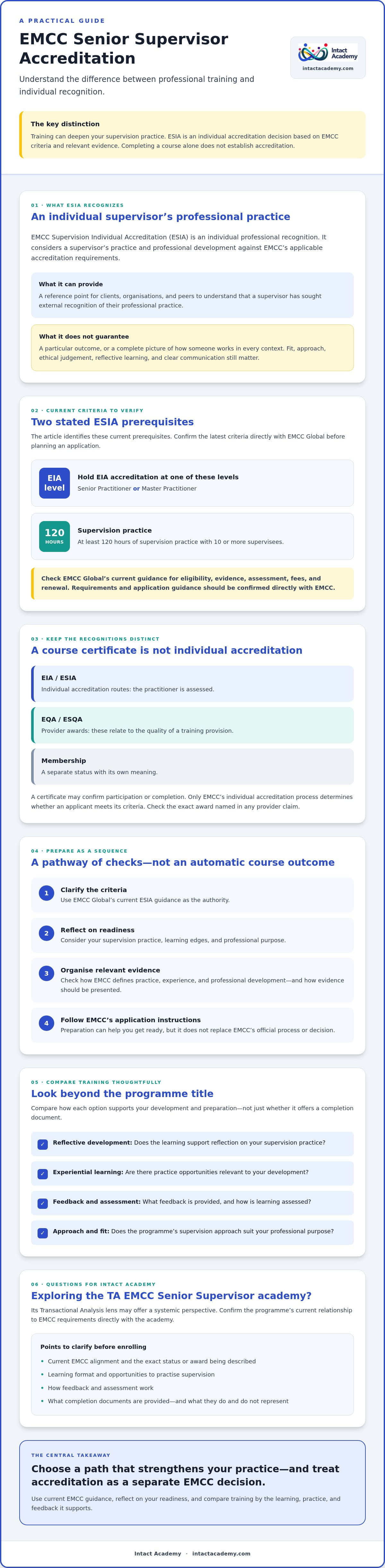
It’s understandable to look for a clear training route, especially when eligibility, practice hours, and documentation can be difficult to piece together. EMCC’s current ESIA criteria include holding EIA Senior Practitioner or Master Practitioner accreditation, along with at least 120 hours of supervision practice with 10 or more supervisees. A course may support your development, but course completion alone doesn’t establish that you’re accredited.
This guide explains the difference between training and accreditation, how to reflect on your readiness, and what to compare when choosing a programme. It also covers what to confirm before enrolling, including current EMCC alignment, practice opportunities, feedback, and assessment. If you’re exploring Intact Academy’s TA EMCC Senior Supervisor academy, its Transactional Analysis lens may offer a systemic perspective. Ask the academy directly about the programme’s current relationship to EMCC requirements. The aim is to choose a path that strengthens your practice as well as your application.
Key Takeaways
- Understand what EMCC senior supervisor accreditation is intended to recognise, and distinguish that professional recognition from completing a training programme.
- Use EMCC Global’s current guidance to check the pathway and identify what evidence you may need before applying.
- Compare training options by how they support reflective development, experiential learning, feedback, and your supervision approach.
- Assess your readiness by considering your practice, learning edges, and professional purpose, rather than relying on a course or checklist alone.
- When exploring Intact Academy’s TA EMCC Senior Supervisor academy, ask about its current EMCC alignment, learning format, practice opportunities, and feedback.
What EMCC Senior Supervisor Accreditation Recognises and What It Does Not
EMCC senior supervisor accreditation is an individual professional recognition, not simply a record of attending advanced training. EMCC uses the term EMCC Supervision Individual Accreditation (ESIA) for accreditation of individual supervisors. The European Mentoring and Coaching Council provides broader context about the organisation and its work across coaching, mentoring, and supervision. For current criteria and terminology, consult EMCC Global’s own guidance.
In concise terms, ESIA recognises an individual supervisor’s practice and professional development against EMCC’s applicable accreditation requirements. It may help clients, organisations, and peers understand that a supervisor has sought external recognition of their professional practice. It isn’t a guarantee of a particular outcome, and the title alone doesn’t show how someone works in every context. Credibility is built through ongoing practice, reflective learning, ethical judgement, and clear communication about the scope of one’s work.
What does senior supervisor accreditation mean in practice?
The intended audience is practitioners developing or established in coaching supervision who want their work assessed through EMCC’s individual accreditation route. Current ESIA prerequisites include holding an EIA at Senior Practitioner or Master Practitioner level, alongside at least 120 hours of supervision practice with 10 or more supervisees. Check the latest EMCC requirements before making plans, since criteria and application guidance should be confirmed directly with EMCC Global.
A senior designation can provide a reference point for professional conversations: what experience informs your supervision, how you use feedback, and how you continue to develop. It doesn’t replace a thoughtful discussion about fit, approach, or the needs of the people and systems you support.
Is an accredited course the same as individual accreditation?
No. These recognitions apply to different things. An individual accreditation assesses a practitioner, while a provider or programme award relates to the quality of a training provision. EMCC distinguishes individual routes such as EIA and ESIA from provider awards such as EQA and ESQA. Membership is separate again. Each status has its own meaning, so check the exact award named in a provider’s claim.
A course may deepen your knowledge and help you develop evidence, but attendance alone doesn’t establish an individual accreditation outcome. Before enrolling, ask whether the programme itself holds a relevant provider award, what completion documents it offers, and whether its learning is designed to support your preparation for an individual application. Treat these as separate questions. A certificate can confirm participation or completion; only EMCC’s individual accreditation process can determine whether an applicant meets its criteria.
How the EMCC Senior Supervisor Accreditation Pathway Works
The EMCC senior supervisor accreditation pathway is best approached as a sequence of checks and decisions, not as a course that automatically leads to a designation. EMCC Global’s current guidance should be your authority for eligibility, evidence, assessment, fees, and renewal. Requirements can change, so confirm the applicable version before investing time in an application or choosing training.
A practical preparation sequence is to clarify the criteria first, reflect on your readiness, organise evidence against the relevant framework, and then follow EMCC’s published application instructions. This is a way to prepare, not a substitute for EMCC’s official process. A professional example is Lily Seto’s profile, which notes her ESIA recognition. An individual example can offer context, but it doesn’t establish another applicant’s eligibility.
Which requirements and evidence should applicants verify?
Start with EMCC Global’s current ESIA materials. Check the exact eligibility criteria and how the framework defines supervision practice, experience, and professional development. Then review what evidence is accepted and how it should be presented. Don’t rely on an old article, a provider’s summary, or another practitioner’s experience instead of the current official criteria.
As you prepare, map each item of evidence to the relevant framework area. For example, note what a practice record demonstrates, where reflective learning is evidenced, and whether supporting documents meet EMCC’s stated requirements. If a threshold or document requirement is unclear, confirm it with EMCC before assuming your records are sufficient.
What might the application journey involve?
The following sequence is a preparation guide, not a claim that EMCC requires these exact stages in this order. Confirm the formal process, assessment steps, documentation, fees, and renewal expectations directly with EMCC Global.
- Check the current criteria. Confirm the relevant accreditation route, eligibility, and framework version.
- Review your readiness. Identify areas where your practice or evidence may need further development.
- Organise your evidence. Map your records to the published criteria, then check EMCC’s required format.
- Verify and submit. Follow the current application instructions, including any assessment stages and renewal conditions.
Training can support learning, reflection, and the development of supervision practice. It does not replace an individual assessment or guarantee accreditation. If you’re considering further preparation, explore Intact Academy’s TA EMCC Senior Supervisor academy and ask how its current learning approach relates to EMCC’s published criteria, including practice and feedback arrangements.
How to Compare EMCC Senior Supervisor Training Options
The right programme should support the supervisor you’re becoming, not simply look persuasive on a course page. When comparing options for EMCC senior supervisor accreditation, separate verifiable details from promotional claims. A provider can explain its learning approach, but EMCC Global is the authority on current accreditation criteria and the meaning of any EMCC award.
Use this comparison framework when reviewing programmes. Ask each provider the same questions, then assess whether the answers match your development needs and preferred way of learning.
Which learning features matter for experienced supervisors?
Look for depth as well as structure. A useful learning environment gives you space to examine your assumptions, notice the wider system around a supervisory conversation, and stay curious when the work becomes complex. Ask how practice is observed or discussed, and whether feedback helps you translate insight into changes in your supervision.
If Transactional Analysis matters to you, ask how it informs the curriculum and how participants connect that lens to systemic supervision. Intact Academy offers a TA EMCC Senior Supervisor academy, with training available online and in person. Confirm the current curriculum and practice arrangements directly rather than inferring them from the programme title.
What questions should you ask a training provider?
Request the current curriculum, trainer profiles, learning format, practice arrangements, feedback approach, and assessment details. Ask whether any EMCC claim refers to the individual trainer, the provider, or a specific programme. Then confirm what completion means: a certificate of participation or achievement is not, by itself, individual accreditation. Check EMCC Global’s current guidance for the application criteria.
Finally, consider fit. Will the programme help you meet a genuine learning edge, or are you choosing it mainly for the promise of a credential? That distinction can help you make a more grounded investment in your professional development.
How to Assess Your Readiness for Senior Supervisor Accreditation
Readiness isn’t a verdict to reach by comparing yourself with someone else. It’s a considered view of how your supervision practice, professional learning, and purpose fit together. Before investing in a programme or preparing an application for EMCC senior supervisor accreditation, review EMCC Global’s current criteria. Use them as the reference point, then reflect on what your experience can genuinely demonstrate and where you still want to grow.
What should you reflect on before applying?
Consider the range and complexity of the situations you’ve supervised. What patterns have you learned to notice across individuals, teams, and organisational contexts? Reflect, too, on how you handle contracting, boundaries, ethical uncertainty, and the use of your own supervision. These questions are prompts for development, not a substitute for EMCC’s formal assessment or an unofficial eligibility test.
Try a brief self-review:
- Experience: What kinds of supervision have you practised, and what has challenged your usual approach?
- Judgement: How do you respond when roles, expectations, or ethical considerations are unclear?
- Learning: What feedback or supervision has shifted your practice, and what learning edge remains?
- Purpose: Why are you seeking recognition now, and how would it serve the people and systems you support?
If your reflections reveal gaps, treat them as useful information rather than evidence of failure. You may need further experience, structured learning, or a clearer way to document your development. Confirm any formal requirement with EMCC Global.
How can you identify a suitable development route?
Match your learning needs to a programme’s verified curriculum and practice opportunities. If you want to strengthen systemic awareness, for example, ask how participants examine the wider context around a supervisory conversation. If you need feedback, ask how practice is reviewed and what kind of guidance participants receive. A conversation with a qualified peer, mentor, or supervisor can help you test whether the programme addresses a real learning need.
It may also help to clarify what coaching supervision involves and how it supports professional practice before choosing a route. Keep the decision grounded in substance: learning design, opportunities to practise, feedback, and fit with your development goals, not only the promise of a credential.
If a Transactional Analysis-informed approach may suit your learning, explore Intact Academy’s TA EMCC Senior Supervisor academy. Ask about current EMCC alignment, learning format, practice arrangements, and feedback, then compare the answers with your reflections and EMCC’s current guidance.
Is Intact Academy’s TA EMCC Senior Supervisor Academy the Right Next Step?
A training route is most useful when it meets the practitioner where they are and supports the kind of supervisor they want to become. Intact Academy offers a TA EMCC Senior Supervisor academy for practitioners exploring senior supervision. Its Transactional Analysis lens may suit coaches and supervisors seeking to examine relational patterns and the wider systems that shape supervisory work.
This could be a fit if you want a structured learning environment that connects theory with reflection on practice. It may also interest consultants whose work involves supporting people and organisations through complexity. The value depends on your aims and on the programme’s current design. An academy can support professional development; attendance alone does not confer EMCC individual accreditation or guarantee an accreditation outcome.
Who may value a Transactional Analysis-informed academy?
Experienced coaches, supervisors, and consultants may be drawn to learning that helps them notice how relationships and systems influence the work. Transactional Analysis offers one lens for reflection, but no single model suits every practitioner or context. Consider whether its concepts connect with your existing approach and the learning edges you identified when assessing your readiness for EMCC senior supervisor accreditation.
Intact Academy states that training is available online and in person. Confirm which formats are currently offered for this academy, along with any relevant access considerations, before making plans. The learning environment should be workable for you as well as intellectually and professionally relevant.
What should you confirm before you enrol?
Ask the academy for current, specific information rather than relying on the title or a general accreditation claim. Clarify:
- Curriculum and faculty: What does the programme cover, and who teaches it?
- Practice and feedback: How do participants practise supervision, and what feedback is provided?
- Format and dates: Which learning formats and cohort dates are currently available?
- EMCC status: Does any accreditation claim apply to the provider, the programme, or individual accreditation? What, if anything, does completing the programme confer?
- Application support: Does the learning support preparation for an individual application, and how should that be distinguished from EMCC’s own assessment?
These questions help you assess fit without confusing development with an accreditation decision. If the academy’s approach aligns with your goals, explore the TA EMCC Senior Supervisor Academy and confirm current programme details and its relationship to EMCC requirements directly with Intact Academy.
Choose a Path That Deepens Your Practice
The next step toward EMCC senior supervisor accreditation is not simply choosing a course. It’s understanding the difference between professional development and an individual accreditation decision, checking EMCC Global’s current requirements, and choosing learning that responds to your experience and development needs.
Before enrolling, confirm what a programme includes and what its completion does or does not confer. Intact Academy, founded in 2013, offers a TA EMCC Senior Supervisor academy, with online and in-person training for participants from more than 14 countries. Its Transactional Analysis-informed approach may suit practitioners seeking to deepen their systemic perspective, but confirm the academy’s current programme details and relationship to EMCC accreditation directly.
If the approach feels aligned with your goals, explore Intact Academy’s TA EMCC Senior Supervisor Academy and ask about the curriculum, practice, feedback, and current EMCC alignment. A considered choice can support more than an application: it can help you develop a supervision practice that is grounded, reflective, and genuinely your own.
Frequently Asked Questions
What is EMCC Senior Supervisor accreditation?
It’s individual professional recognition for a supervisor whose practice and development have been assessed against EMCC’s applicable criteria. The relevant individual route is EMCC Supervision Individual Accreditation, or ESIA. It’s distinct from completing training, receiving a course certificate, or holding EMCC membership. Check EMCC Global’s current guidance for the official terminology and framework, as well as the requirements that apply when you’re ready to apply.
Is an EMCC-accredited supervision course the same as individual accreditation?
No. Individual accreditation assesses a practitioner, while a provider or programme award concerns the quality of a training provision. For supervision training, EMCC’s provider award is known as ESQA. Ask what an EMCC-related claim specifically refers to: the provider, the programme, or an individual practitioner. Completing a course may support your learning, but it doesn’t automatically grant ESIA or guarantee an accreditation decision.
How do I apply for EMCC Senior Supervisor accreditation?
Begin with EMCC Global’s current ESIA guidance, then confirm eligibility, evidence requirements, and the application process that applies to you. Organise your experience and development evidence against the published framework, and follow EMCC’s current instructions for documentation and submission. Verify assessment stages, fees, and renewal expectations directly with EMCC, since these details can change. A training provider may support your preparation, but EMCC determines the individual accreditation outcome.
What experience do I need for EMCC Senior Supervisor accreditation?
As of the verified May 2026 criteria, ESIA applicants must hold EIA accreditation at Senior Practitioner or Master Practitioner level and have at least 120 hours of supervision practice with 10 or more supervisees. These are specific eligibility criteria, not a complete application checklist. Confirm them against EMCC Global’s latest guidance before applying, and check how EMCC defines and expects applicants to evidence supervision practice.
Does completing a supervisor training programme guarantee EMCC accreditation?
No. Training can deepen your knowledge, provide opportunities to reflect on practice, and support professional development, but it can’t guarantee an individual accreditation decision. ESIA is assessed through EMCC’s own process against its applicable criteria. Before enrolling, ask whether the programme supports application preparation and what its completion certificate represents. Keep that information separate from any claim that a provider or programme holds an EMCC award.
How do I choose an EMCC-aligned supervisor training programme?
Ask for the current curriculum, trainer profiles, supervision practice arrangements, feedback methods, and assessment details. Request the exact scope of any EMCC-related accreditation claim, then compare the programme’s approach with EMCC Global’s current criteria. Consider whether the model and learning format fit your experience and development aims. If you’re drawn to Transactional Analysis, ask how it informs the learning and how participants connect it to supervision practice.
Can I complete supervisor training online?
Yes, some supervisor training is offered online, though the format depends on the provider and programme. Intact Academy provides online and in-person training; confirm whether each format is currently available for its TA EMCC Senior Supervisor academy. Ask how participants practise supervision, receive feedback, and engage with peers in the chosen format. Online delivery and course completion don’t change EMCC’s individual accreditation criteria or determine the outcome.


