

What if your most sophisticated interventions are actually reinforcing the very dysfunctions you were hired to solve? It's a sobering thought for any practitioner dedicated to profound human flourishing. To truly grow, one must recognize the common team coaching mistakes to avoid, particularly those that keep you entangled in a team's internal drama. You likely recognize the quiet frustration when a team reverts to old patterns just weeks after a high-energy workshop. You feel the magnetic pull of their politics, yet finding a clean exit remains elusive.
We understand that these temporary shifts are often the result of addressing symptoms rather than the underlying system. This guide explores how to look far beneath the surface of visible behavior to find lasting solutions. You'll discover how to identify unconscious blind spots in your practice and acquire a robust psychological framework to handle high-stakes dynamics with grace. By moving beyond transactional fixes, you can facilitate the deep cultural shifts necessary for sustainable, long-term transformation. We will examine how to contract for depth and how to hold a stable container for the often-turbulent process of organizational becoming.
Key Takeaways
- Transition from facilitating individual interactions to engaging the team as a singular, systemic entity to ensure profound and lasting organizational impact.
- Recognize how weak or incomplete initial contracting serves as one of the common team coaching mistakes to avoid, safeguarding your practice from superficial behavioral changes.
- Apply Transactional Analysis frameworks to detect when you are being pulled into the Karpman Drama Triangle, allowing you to remain a neutral catalyst for growth.
- Implement a diagnostic audit to identify unconscious blind spots and transition your interventions from transactional compliance to profound systemic transformation.
- Understand how specialized education through accredited academy pathways provides the psychological depth required to navigate high-stakes executive dynamics with stability.
Beyond Surface Facilitation: Why Traditional Team Coaching Approaches Fail
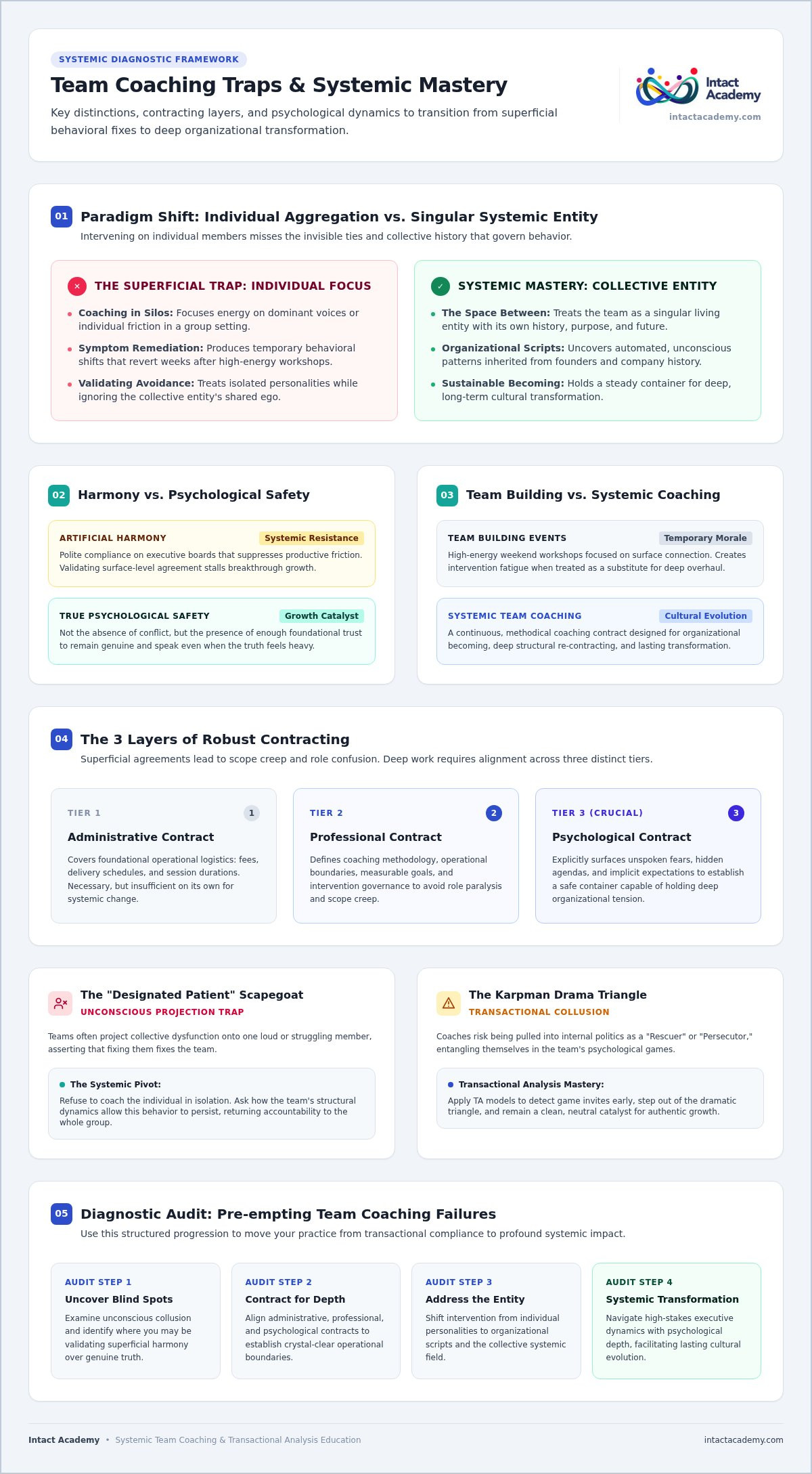
Traditional facilitation often feels like a well-choreographed dance where everyone moves in sync, yet no one truly changes. Falling into the trap of individual focus is among the most common team coaching mistakes to avoid for those seeking sustainable results. When you coach individuals in a group setting, you miss the invisible ties that bind them together. Systemic team coaching is an intervention on the collective system itself, rather than a collection of individuals. It recognizes that the team has a life, a history, and a future that transcends any single member.
Many teams operate under deep-seated organizational scripts. These are unconscious, automated patterns of behavior inherited from the company's past or its founders. Without addressing these scripts, any behavioral change remains transactional and fleeting. Deep, transformative interventions require a coach to look at the space between people rather than just the people themselves. This aligns with the broader definition of team coaching, which emphasizes the collective entity's shared purpose and dynamics. By ignoring the system, you ignore the source of the behavior.
The Illusion of Harmony vs. True Psychological Safety
Artificial harmony is a frequent mask for systemic resistance. In many executive boards, a culture of polite compliance prevents the friction necessary for growth. A coach who validates this surface-level agreement inadvertently stalls the very breakthrough the organization needs. It's vital to distinguish between polite team behavior and authentic psychological safety. Safety isn't the absence of conflict; it's the presence of enough trust to be genuine, even when truth feels heavy.
Mistaking Team Building for Systemic Team Coaching
There is a sharp operational boundary between a high-energy team-building day and a long-term coaching journey. Team building often focuses on temporary morale or connection, whereas systemic team coaching is a continuous contract for cultural evolution. Mismanaging client expectations regarding these boundaries damages your professional credibility. When a client expects a quick fix but needs a systemic overhaul, you must have the courage to re-contract. Elite practitioners ensure the client understands that deep transformation is a steady, methodical process of becoming, not a weekend event. Identifying these distinctions early helps you sidestep common team coaching mistakes to avoid that lead to intervention fatigue.
The Trap of Individual Focus and Superficial Contracting
A team's loudest voice often acts as a siren song for the unwary coach. It's tempting to focus your energy on the individual who dominates the room, yet doing so is one of the most common team coaching mistakes to avoid. This person is rarely the sole source of friction; they are usually a conduit for the system's unresolved tension. By centering the conversation on one member, you lose sight of the collective ego and the hidden dynamics that drive performance. You aren't coaching a collection of people; you're coaching the living entity they form together.
Effective interventions begin with robust, multi-layered contracting. A simple administrative agreement covering fees and schedules is insufficient for deep work. You must establish a professional contract that defines the methodology and, more crucially, a psychological contract that addresses unspoken expectations and fears. When boundaries remain vague, scope creep and role confusion inevitably follow. This lack of clarity can paralyze even the most experienced practitioner, turning a transformative journey into a series of disconnected sessions.
The Designated Patient Pitfall in Corporate Teams
In corporate spaces, teams frequently engage in a psychological phenomenon known as scapegoating, or the "designated patient" pitfall. The group unconsciously projects all its dysfunction onto one member, claiming that if this person changed, the team would flourish. Don't fall into the trap of coaching this individual within the group setting. Doing so validates the team's avoidance of their collective responsibility. Instead, pivot the focus back to the system. Ask how the team's structure allows this behavior to persist, returning the power of change to the whole group.
Mastering the Three-Way Contract for Systemic Alignment
Systemic alignment requires a sophisticated three-way contract between the organizational sponsors, HR, and the team itself. Hidden agendas between these parties can derail an intervention before it truly starts. For instance, a sponsor might want the team to be more compliant, while the team seeks more autonomy. If these conflicting desires aren't reconciled early, you'll find yourself caught in the crossfire. Developing the skill to navigate these stakeholder dynamics is a hallmark of professional maturity. Many practitioners find that pursuing an executive coaching certification provides the necessary frameworks to manage these complex, high-stakes relationships with integrity. Reflecting on these systemic layers ensures that your coaching remains a stable container for genuine growth rather than a temporary fix.
Falling into Psychological Games and Systemic Collusion
Teams aren't just systems of work; they're systems of feeling and unconscious interaction. One of the most insidious common team coaching mistakes to avoid is failing to recognize when you've been recruited into the team's internal drama. By applying Transactional Analysis (TA), a practitioner can identify the psychological "hooks" that pull them away from a neutral, Adult state. When a coach loses their objective stance, they stop being a catalyst for change and become a participant in the team's dysfunction. This shift often happens silently, masked by the busyness of the session.
This dynamic frequently manifests as systemic collusion. You might find yourself unconsciously adopting the team's blind spots because challenging them feels too disruptive to the rapport you've built. This is often mirrored in a parallel process, where the coach's internal state reflects the team's unresolved tension. If an executive board is trapped in a cycle of blame, you might start feeling uncharacteristically critical of the leadership, effectively joining the system's Persecutor role. Recognizing these parallel processes is the first step toward returning to a state of professional wholeness.
The Rescuer Trap: When Coaches Over-Function
Over-functioning is a hallmark of the Rescuer role within the Karpman Drama Triangle. You'll know you've entered this trap when you feel more responsible for the team's outcomes than they do. Perhaps you're doing their emotional labor or working late to refine their action plans. This behavior robs the team of their autonomy and collective accountability. To break this, you must step back into an observer state. A practical strategy is to name the dynamic in the moment: "I notice I'm doing a lot of the heavy lifting here. What happens to the team's energy if I stop?"
Spotting and De-escalating Workplace Psychological Games
Corporate environments often breed games like "Yes-But," where every solution is met with an excuse, or "Look How Hard I Tried," which justifies failure through visible effort. Breaking these games requires tactical precision and a calm, authoritative presence. Instead of offering more solutions to a "Yes-But" dynamic, name the pattern itself. You might say, "It seems every suggestion is met with a reason why it won't work. Let's look at what's making it difficult to move forward." Understanding what is transactional analysis is essential for this diagnostic work. It provides the framework to see these patterns as they emerge, ensuring you remain an agent of profound human transformation rather than a pawn in a workplace game.
A Diagnostic Checklist to Pre-empt Team Coaching Failures
Professional maturity in coaching isn't defined by the absence of errors, but by the speed and depth of your course correction. One of the most persistent common team coaching mistakes to avoid is the failure to pause for a structural audit once an engagement is underway. Without a rhythmic diagnostic check, interventions often slide into transactional compliance. You might find yourself checking boxes and delivering planned modules while the team's underlying culture remains untouched. This state of "doing" rather than "being" signals that the coach has lost their systemic edge.
Maintaining an ethical and effective practice requires continuous professional self-reflection. It's a process of looking inward to see how the team's energy is affecting your own judgment. When you feel a sense of heavy obligation or, conversely, a desire to withdraw, these are not just personal feelings. They are data points. They are clues that the system is pulling you into a specific role to maintain its current, dysfunctional equilibrium. This diagnostic awareness is the primary antidote to the common team coaching mistakes to avoid that often lead to stalled organizational transformation.
Mid-Engagement Health Check: Key Indicators
To assess the health of your intervention, ask yourself specific questions about the psychological distance between you and the team. Is the team operating from an Adult ego state, engaging in clear and direct communication? Or are they adapting submissively to your lead, providing the answers they think you want to hear? Evaluate whether your original professional contract still holds true. If the team's goals have shifted or if new stakeholders have emerged, you must stop and engage in explicit re-negotiation. A contract that no longer reflects reality is a contract that cannot support change.
The Role of Systemic Supervision in Resolving Blindspots
Even the most experienced global mentors have blind spots. Systemic supervision is a non-negotiable tool for uncovering the parallel processes that you cannot see alone. An external supervisor provides a stable container, helping you detach from the team's drama to regain your objective perspective. This oversight protects your professional sanity and ensures the client's organizational investment yields sustainable results. Integrating formal oversight is a cornerstone of professional development for coaches, moving your practice from accidental success to intentional mastery. If you are ready to elevate your practice and avoid these systemic pitfalls, consider joining our TA EMCC Senior Team Coach Academy for a deeper exploration of these methodologies.
Elevating Your Practice with Systemic Mastery and Transactional Analysis
Transitioning from a general facilitator to an elite senior team coach requires a fundamental shift in perspective. While many practitioners focus on surface-level alignment, true mastery lies in understanding the complex psychological architecture of the group. By integrating Transactional Analysis with systemic theory, you gain the ability to navigate high-stakes environments where others might falter. This depth is what allows you to bypass the common team coaching mistakes to avoid, such as colluding with the team's resistance or failing to address the underlying organizational script. Elite practice isn't defined by the tools you carry, but by the depth of presence you bring to the system.
An EMCC-aligned curriculum ensures that your practice meets the most rigorous global standards for organizational change. This isn't just about learning new techniques; it's about a profound personal and professional evolution. It requires the courage to look inward and the discipline to maintain a stable container for your clients. As you move beyond transactional fixes, you become a cultural architect, capable of facilitating the kind of sustainable transformation that reshapes entire organizations from the inside out.
The Power of the TA EMCC Senior Team Coach Academy
The TA EMCC Senior Team Coach Academy offers a unique integration of Transactional Analysis with advanced systemic coaching tools. Under the guidance of Sari van Poelje, who brings over 30 years of international organizational consultancy expertise, you'll learn to decode the hidden narratives that drive team behavior. The program isn't merely educational; it's transformational. You'll move from managing surface-level interventions to designing deep cultural architecture, ensuring your work leaves a lasting imprint on the organizations you serve. This specialized focus provides the psychological rigor necessary to handle the most complex executive dynamics with calm authority.
Choosing Your Path to Professional Excellence
Selecting the right developmental pathway requires a balance of psychological rigor and business pragmatism. You need a framework that honors the intelligence of the reader while providing actionable directives for real-world application. We invite you to explore your options for structural training by reviewing our comprehensive team coaching course guide. This resource helps you identify the path that best aligns with your aspirations for mastery. If you're ready to transcend the common team coaching mistakes to avoid and commit to a journey of profound human flourishing, explore the TA EMCC Senior Team Coach Academy to master systemic transformation today. The path to senior practitioner status is open to those with the courage to change.
Embracing the Path to Systemic Mastery
True organizational transformation requires moving past the surface of visible behaviors to engage with the deeper, invisible scripts that govern team dynamics. By shifting your focus from individual interactions to the collective system, you protect your practice from the temporary fixes that characterize traditional facilitation. Navigating complex executive dynamics requires a deep understanding of the common team coaching mistakes to avoid, from superficial contracting to falling into unconscious psychological games. Cultivating this awareness allows you to remain a stable container for genuine growth.
When you are ready to elevate your practice from transactional compliance to profound human architecture, choosing a structured pathway is the essential next step. Our EMCC and ICF accredited professional certification paths offer a comprehensive curriculum blending profound psychological depth with corporate pragmatism. Led by international expert Sari van Poelje, these programs provide the tools and supervision necessary to uncover hidden parallel processes. We invite you to deepen your systemic impact and join the TA EMCC Senior Team Coach Academy today. Step into your role as a wise global mentor and guide organizations toward sustainable wholeness.
Frequently Asked Questions
What is the most common team coaching mistake that independent practitioners make?
The most frequent error is treating the team as a collection of individuals rather than a single systemic entity. Independent practitioners often fall into the "focal-point trap," where they become the center of communication instead of facilitating dialogue between members. This individualistic approach is one of the common team coaching mistakes to avoid if you seek long-term cultural change. It prevents the team from developing its own collective agency and shared purpose.
How does individual coaching differ fundamentally from systemic team coaching interventions?
Individual coaching focuses on a person's inner world and personal growth, whereas systemic team coaching targets the collective system and its external environment. While individual sessions might address personal scripts, systemic interventions analyze the patterns, structures, and goals that exist between team members. You aren't just coaching people; you're coaching the relationships and the shared organizational mission. This distinction is vital for moving beyond surface-level behavioral changes to deep cultural evolution.
What are the signs that a team coach has entered the Karpman Drama Triangle?
You've likely entered the triangle if you feel more responsible for the team's success than they do, which signals the Rescuer role. Other signs include feeling uncharacteristically frustrated with the leadership, which mirrors the Persecutor, or feeling drained and helpless by the team's lack of progress, indicating the Victim. These emotional shifts aren't just personal reactions. They're systemic data points indicating you've lost your neutral Adult state and have become an active participant in the drama.
How do you handle a team that shows extreme resistance to systemic coaching?
Extreme resistance is often a team's way of protecting its current equilibrium, however dysfunctional it might be. Instead of pushing harder, you should name the resistance as a systemic phenomenon and explore its protective function. This often requires returning to the psychological contract to discuss what the team is actually willing to change. By making the resistance visible without judgment, you create a safe space for the team to choose a different path toward wholeness.
Why is psychological contracting considered a core competency in advanced team coaching?
Psychological contracting allows you to address the unspoken expectations, fears, and hidden agendas that administrative contracts ignore. It's a core competency because it establishes the boundaries needed for deep, high-stakes work. Without this layer, you're likely to experience scope creep or role confusion. Mastering this skill ensures that all parties are aligned on the depth of the intervention, which is essential for avoiding common team coaching mistakes to avoid during complex organizational shifts.
Can a coach effectively manage a team intervention without formal systemic supervision?
Managing an intervention without formal systemic supervision is professionally risky and often leads to stalled results. Supervision provides a stable container to uncover parallel processes and unconscious blind spots that you cannot see from within the system. It acts as a protective mechanism for both your professional integrity and the client's organizational investment. Elite practitioners view supervision as a non-negotiable requirement for maintaining the psychological depth needed for senior-level coaching and profound human transformation.
How does Transactional Analysis help in identifying unconscious corporate patterns?
Transactional Analysis provides a precise diagnostic framework to map communication patterns, psychological games, and organizational scripts. It helps you identify when a team is operating from a submissive Child ego state or when they're trapped in repetitive games like "Yes-But." By making these unconscious workplace patterns visible, TA allows the team to move into a conscious Adult state. This creates the clarity needed for genuine operational breakthroughs and sustainable change within the corporate environment.


