

When an executive team fractures, coaching six brilliant leaders one by one will never repair the collective dysfunction in the room. Lasting change occurs only when you treat the living human system itself, not the individuals, as your client. If you've felt your one-on-one tools fall flat against corporate politics and unspoken group tensions, pursuing an advanced team coaching certification is the threshold where your work evolves from surface facilitation into profound organizational transformation.
You already recognize that chronic team resistance isn't a failure of individual talent, but a symptom of hidden psychological patterns and structural distress. In this guide, you'll discover how the right credential elevates your practice to resolve entrenched dynamics, bridges the accreditation nuances between premier bodies like the EMCC and ICF, and articulates measurable value to senior stakeholders. We'll examine the core diagnostic frameworks and reflective supervision requirements that establish you as an indispensable organizational intervention specialist.
Key Takeaways
- Discover how to shift your coaching stance from managing individual personalities to engaging the entire team system as a single, living organism.
- Uncover why an advanced team coaching certification grounded in Transactional Analysis enables you to diagnose covert group dynamics, repetitive scripts, and psychological games.
- Demystify the core distinctions between EMCC and ICF credentialing pathways, clarifying how reflective supervision and systemic models shape senior-level interventions.
- Learn how to measure and articulate tangible organizational return on investment by resolving entrenched dysfunctions that surface-level facilitation misses.
- Identify the essential benchmarks for vetting elite training academies so you can step confidently into high-stakes corporate engagements.
What Is an Advanced Team Coaching Certification?
An advanced team coaching certification validates a practitioner's capability to perceive, diagnose, and intervene within complex human systems. Unlike foundational credentials that focus on individual goal setting or linear communication rubrics, an advanced qualification confirms you can hold a stable developmental space when an entire executive unit experiences disruption. It signifies that your methodology accounts for organizational architecture, systemic loyalties, and unconscious collective resistance.
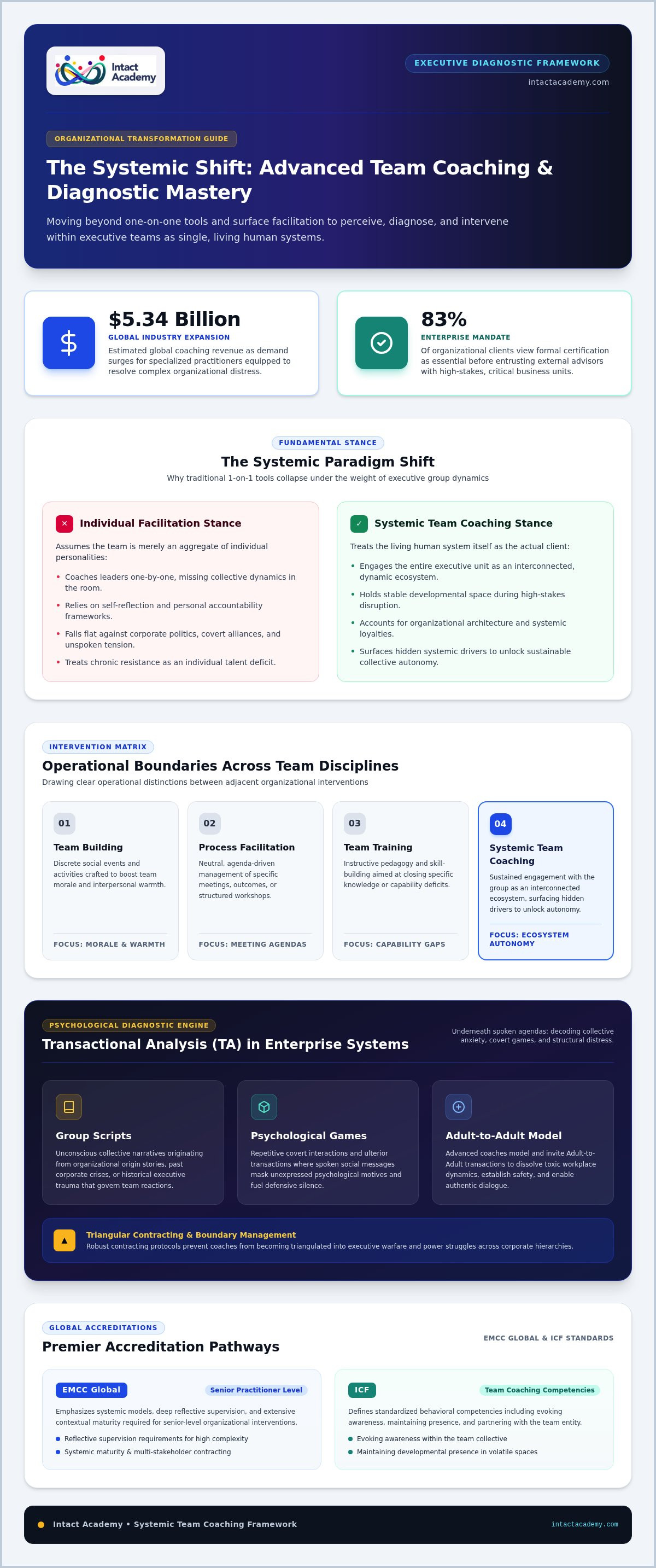
Coaching an intact group requires abandoning the assumption that a team is merely an aggregate of individual personalities. Team coaching treats the dynamic entity between members as the true client. Premier global bodies like EMCC Global and the International Coaching Federation (ICF) established specialized standards because traditional individual frameworks collapse under the weight of group anxiety. Industry data indicates an expanding market: with global coaching revenue reaching an estimated $5.34 billion, 83% of organizational clients now view formal certification as essential before entrusting external advisors with critical business units.
The Systemic Paradigm Shift: Moving Beyond Individual Facilitation
Individual coaching models rely on self-reflection and personal accountability. When transposed directly into a room of competing executives, these tools fail because they miss the systemic field. True systemic work draws clear operational boundaries between adjacent disciplines:
- Team Building: Discrete social events crafted to boost morale and interpersonal warmth.
- Process Facilitation: Neutral, agenda-driven management of specific meetings, outcomes, or workshops.
- Team Training: Instructive pedagogy aimed at closing specific knowledge or capability deficits.
- Systemic Team Coaching: Sustained engagement with the group as an interconnected ecosystem, surfacing hidden systemic drivers to unlock collective autonomy.
The Expanding Market Need for Specialized Team Coaching Credentials
Modern hybrid arrangements and constant enterprise restructurings amplify structural fragility. In virtual workspaces, team members often perform for the screen rather than engage in candid dialogue, masking unresolved power tensions. When organizational friction threatens operational delivery, enterprise procurement leaders increasingly bypass generalist coaches, mandating an advanced team coaching certification to ensure the practitioner possesses the systemic maturity required to navigate high-stakes corporate politics.
Core Competencies in Advanced Team Coaching: Systemic and Psychological Frameworks
Facilitation toolkits outline what happens on the surface of a workshop, but they rarely explain why a leadership team slips into defensive silence the moment power shifts. Real mastery requires looking underneath spoken agendas. When choosing an advanced team coaching certification, the distinguishing factor isn't the number of icebreakers you acquire; it's the psychological diagnostic engine you use to interpret collective anxiety, unspoken alliances, and structural loyalties.
While the established ICF Team Coaching Competencies define vital professional behaviors like evoking awareness and maintaining presence, executing them in volatile environments requires clinical-grade frameworks. Transactional Analysis (TA) serves as a premier methodology for this work. Deepen your understanding of these core principles by examining what is Transactional Analysis within complex organizational systems.
Applying Transactional Analysis to Group Scripts and Workplace Dynamics
Teams develop unconscious scripts, much like individuals do. These collective scripts stem from organizational origin stories, past crises, or previous executive trauma. In day-to-day meetings, systemic distress surfaces through psychological games and covert ulterior transactions where the social message masks an unexpressed psychological motive. Advanced coaches intervene by modeling and inviting Adult-to-Adult transactions, dissolving toxic dynamics, and establishing genuine psychological safety.
Triangular Contracting and Boundary Management in Enterprise Systems
Without robust contracting, coaches easily get triangulated into executive warfare. An advanced team coaching certification trains practitioners to maintain neutrality through structured boundary management:
- Multi-Party Alignment: Explicitly negotiating expectations between the team leader, team members, human resources, and the executive sponsor.
- Dynamic Boundary Protection: Establishing firm confidentiality agreements so the team feels safe speaking truthfully, even when organizational friction traces directly back to the CEO.
- Evolutionary Scope: Adjusting the coaching contract as systemic inquiries uncover deep-seated cultural blockages rather than mere operational delays.
Throughout these complex interventions, your own somatic and emotional reactions serve as an internal barometer. Developing this self-as-instrument capacity allows you to sense unspoken group tension before it erupts. If you want to refine how you diagnose these hidden systemic pressures, consider exploring the systemic training pathways at Intact Academy to anchor your practical interventions in deep psychological theory.
Comparing Advanced Team Coaching Accreditation Bodies: EMCC vs. ICF
Selecting an accreditation body is more than an administrative choice; it shapes how you conceptualize human systems. While both the European Mentoring and Coaching Council (EMCC) and the International Coaching Federation (ICF) offer recognized credentials, their philosophical underpinnings diverge. For a deeper breakdown of curriculum styles and methodology, read our comparative evaluation on choosing the right team coaching course.
The EMCC Team Coaching Quality Award (TCQA) Pathway
EMCC Global views team coaching through a relational, contextual lens. Rather than isolating individual behaviors, its framework evaluates how a coach interacts with the broader organizational and societal environment. To secure individual accreditation at the Senior Practitioner level (EIA), practitioners must demonstrate at least 250 hours of verified coaching practice alongside structured reflection. International enterprises frequently gravitate toward EMCC-accredited coaches because the curriculum prioritizes systemic ethics, cultural diversity, and long-term organizational health over transactional problem-solving.
The ICF Advanced Certification in Team Coaching (ACTC)
The ICF ACTC provides an advanced benchmark rooted in standardized competency rubrics. It is not an entry-level credential. Candidates must hold an existing individual credential (ACC, PCC, or MCC), complete 60 or more hours of specialized team coaching education, log at least five team coaching engagements within five years, complete a minimum of five hours of supervision, and pass a comprehensive exam. If you are building on an executive coaching certification, the ACTC provides a familiar, competency-focused pathway favored by multinational corporations seeking standardized metrics.
The Essential Role of Systemic Coaching Supervision
High-level credentials from both bodies share one non-negotiable component: ongoing professional supervision. For example, EMCC Senior Practitioners must participate in at least one formal supervision session per quarter, maintaining a recommended ratio of one supervision hour for every 35 hours of coaching practice. In complex enterprise engagements, group dynamics can trigger intense emotional reactions in the coach:
- Surfacing Projections: Identifying when the coach has unconsciously adopted the executive team's cynicism, avoidance, or internal conflict.
- Managing Countertransference: Disentangling the practitioner's personal triggers from the client system's unresolved history.
- Protecting Professional Boundaries: Navigating ethical gray zones when working across matrixed organizational lines.
Supervision provides a safe container to examine these unconscious pulls. Engaging in regular, structured reflective inquiry ensures your advanced team coaching certification represents deep psychological integrity and sustainable client impact rather than a decorative badge.
How to Choose the Right Advanced Certification Program
Selecting an advanced team coaching certification requires looking past slick marketing brochures. The right program doesn't merely teach facilitation exercises; it fundamentally reshapes your observational capacity and internal stability. When evaluating pathways to senior accreditation, structure your assessment around five essential criteria:
- Theoretical Depth: Confirm the curriculum rests on verified psychological and systemic methodologies rather than proprietary management fads.
- Faculty Standing: Ensure instructors have led complex transformations from within executive suites, not just lecture halls.
- Live Practicum Balance: Verify that theoretical study is tempered with observed live fieldwork and developmental critique.
- Embedded Supervision: Check that professional supervision is integrated directly into the core learning curriculum.
- Cohort Maturity: Look for senior peer groups spanning international markets to enrich cross-cultural systemic learning.
Vetting Faculty Pedigree and Theoretical Rigor
Theoretical rigor hinges on the lineage of your instructors. A credible faculty must balance executive leadership experience with deep clinical or systemic mastery. Leaders like Sari van Poelje, internationally recognized for integrating Transactional Analysis with organizational change, illustrate the standard required. Programs grounded in validated frameworks equip you to navigate unconscious group resistance, whereas surface-level models dissolve the moment boardroom friction peaks.
Demanding Live Practicums and Observed Fieldwork
Asynchronous video modules and multiple-choice quizzes cannot teach relational presence. You cannot learn to hold a room during an executive shouting match through a recorded lecture. A rigorous advanced team coaching certification demands real-time fishbowl coaching, observed client engagements, and direct, developmental feedback from seasoned master coaches. Keeping cohort sizes intentionally small ensures that every practitioner receives intensive personal observation within a safe container.
If you're ready to step into senior-level systemic mastery within an intimate global cohort, apply to join the TA EMCC Senior Team Coach Academy and transform your organizational impact.
Master Systemic Practice with the TA EMCC Senior Team Coach Academy
Achieving senior standing in systemic intervention requires a developmental environment as rigorous as the boardroom dynamics you encounter. The TA EMCC Senior Team Coach Academy bridges the gap between psychological depth and organizational reality. Tailored specifically for seasoned practitioners, organizational consultants, and senior HR leaders, the program prepares you to navigate complex group systems and qualify for premier international recognition through bodies like EMCC Global and the ICF.
An Immersive Curriculum Rooted in Psychological Depth
Surface-level tools address only what teams choose to reveal. The Academy’s curriculum looks underneath those defenses, using Transactional Analysis to decode covert transactions, psychological games, and inherited organizational scripts. You'll develop systemic mastery across key operational domains:
- Triangular Contracting: Structuring multi-stakeholder agreements that prevent triangulation and safeguard your neutral stance.
- Systemic Diagnostics: Mapping group dynamics and structural fault lines to locate the real sources of collective inertia.
- Live Case Supervision: Bringing your active client engagements into reflective supervision to resolve countertransference and blind spots.
Bridging deep theory with pragmatic fieldwork ensures that every framework translates directly into client impact, moving teams out of repetitive conflict and into genuine autonomy.
Connecting with an International Community of Change Leaders
Systemic perspective flourishes when challenged by diverse viewpoints. Academy cohorts unite forward-thinking practitioners from more than 14 countries, creating an intimate, high-trust container for collaborative inquiry. Under the direct mentorship of Sari van Poelje and an experienced international faculty, you engage in real-time observed practicums that refine your relational presence and diagnostic instincts.
Completing this advanced team coaching certification does far more than add letters after your name. It reframes how you perceive human systems, anchoring your professional stance in psychological integrity and positioning you as a trusted partner for high-stakes organizational transformation.
Elevate Your Stance from Facilitator to Systemic Change Agent
Lasting organizational change begins when you stop trying to fix individuals and start transforming the hidden dynamics between them. Moving beyond standard facilitation requires robust psychological frameworks that decode systemic scripts, coupled with ongoing supervision that anchors your internal presence during volatile group resistance.
Securing an advanced team coaching certification marks your evolution into a senior practitioner capable of guiding executive groups through deep systemic disruption. Led by Sari van Poelje, the TA EMCC Senior Team Coach Academy delivers an accredited curriculum aligning with rigorous EMCC Global standards. Alongside an intimate cohort of peers representing more than 14 countries, you'll gain the structured methodologies and personal clarity needed to foster true organizational wholeness. When you're ready to step into this deeper work, explore the TA EMCC Senior Team Coach Academy at Intact Academy and lead the transformations our corporate systems urgently require.
Frequently Asked Questions
What is the main difference between an advanced team coaching certification and an individual coaching credential?
The primary distinction lies in treating the collective system as the client rather than focusing on an individual's personal goals. While individual coaching centers on one-to-one dialogue, self-awareness, and personal action plans, an advanced team coaching certification equips you to navigate multi-layered group dynamics, unconscious loyalties, and organizational politics. You learn to observe relational patterns between people rather than attempting to fix isolated behaviors in a vacuum.
How long does it typically take to complete an advanced team coaching program?
Most senior programs span six to twelve months of structured learning, live practicums, and ongoing supervision. Unlike introductory weekend workshops, achieving systemic competence requires time to apply diagnostic tools in live client systems. Programs like the TA EMCC Senior Team Coach Academy pace modules deliberately, allowing practitioners to complete required field hours, engage in quarterly supervision, and reflect deeply on organizational dynamics without rushing the developmental process.
Is an advanced team coaching certification recognized by both the EMCC and ICF?
Yes, leading international academies design their systemic curricula to align with the core standards of both EMCC Global and the ICF. Top-tier programs provide accredited contact hours, observed practice, and supervision that fulfill the rigorous criteria for the ICF Advanced Certification in Team Coaching (ACTC) as well as the EMCC Team Coaching Quality Award (TCQA). This dual alignment gives practitioners recognized global portability across European, North American, and multinational enterprise markets.
Can I enroll in an advanced team coaching certification without prior coaching experience?
No, advanced programs require candidates to hold foundational coaching credentials or substantial organizational leadership experience before entering. Facilitating an executive team demands emotional stability and baseline conversational agility. Both the ICF and EMCC set clear prerequisites, such as holding an individual credential or demonstrating prior coaching hours. For professionals working toward these prerequisites or seeking to strengthen their baseline knowledge, certified learning portals such as NAVO offer structured courses and educational resources to support professional development. Candidates must already feel comfortable holding developmental space before they learn to manage volatile group projections, collective resistance, and enterprise-wide stakeholder contracting.
Why is Transactional Analysis valuable in enterprise team coaching engagements?
Transactional Analysis provides a precise psychological diagnostic system to map unconscious group communication patterns, repetitive conflict, and organizational scripts. Instead of relying on guesswork, coaches use concepts like ego states, psychological games, and script theory to understand why an executive board stalls under stress. By encouraging Adult-to-Adult transactions, you help corporate leaders move past toxic interpersonal blame and establish authentic, clear accountability across complex operational divisions.
What role does coaching supervision play in advanced team certification?
Coaching supervision acts as a mandatory reflective container that protects practitioners from burnout and surfaces hidden systemic countertransference. Working with distressed teams inevitably pulls the coach into the client's emotional field. In structured supervision sessions, you examine your personal blind spots, organizational projections, and boundary challenges alongside a qualified supervisor. Premier credentialing bodies mandate regular supervision because it ensures ethical safety and sharpens the coach's relational diagnostic clarity.
How does an advanced credential help me secure enterprise-level corporate clients?
Holding an advanced team coaching certification proves to procurement teams and chief human resources officers that you can manage enterprise complexity safely. Corporate buyers increasingly reject generalist facilitators for critical executive interventions. A senior systemic credential signals that you understand multi-party contracting, systemic ethics, and psychological safety. It positions you as an elite organizational specialist capable of resolving chronic dysfunction, justifying premium investment through measurable improvements in leadership cohesion and performance.


