

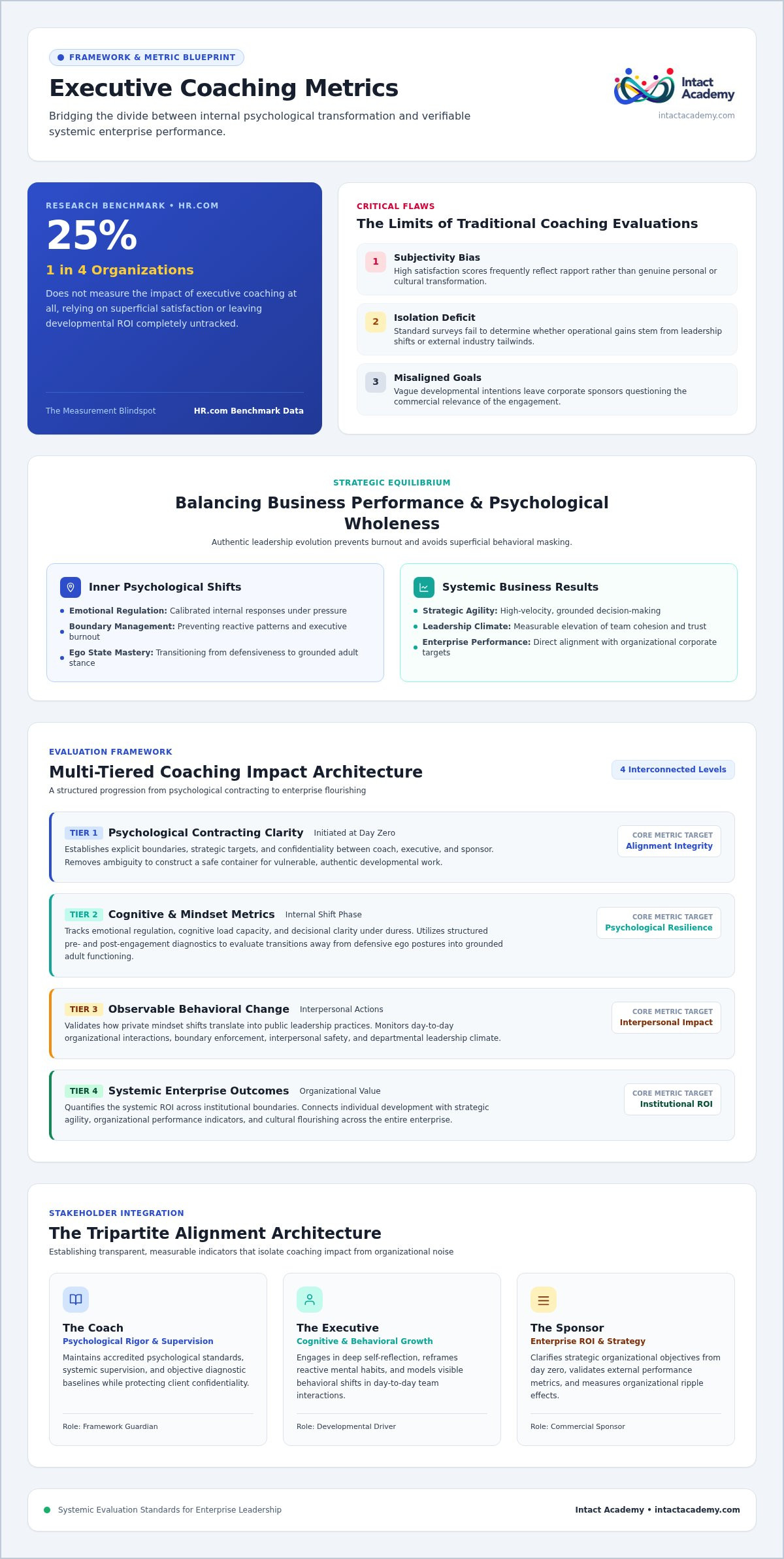
According to research from HR.com, one in four organizations does not measure the impact of coaching at all. When board members and executive sponsors demand tangible proof of value, leadership teams often find themselves caught between superficial satisfaction surveys and rigid spreadsheets that strip away genuine human growth. Establishing credible executive coaching metrics shouldn't mean reducing profound leadership evolution to an oversimplified transactional formula; it requires honoring both the inner psychological shift and the systemic business result.
You already recognize that lasting behavioral change ripples far beyond an individual leader, yet isolating that developmental momentum from organizational noise remains a complex challenge. In this guide, you'll discover how to track, quantify, and evaluate executive coaching metrics across behavioral, operational, and systemic levels without sacrificing human depth. We'll explore how to build a balanced scorecard rooted in clear psychological contracting from day zero, bridging the gap between nuanced executive growth and undeniable institutional ROI.
Key Takeaways
- Move beyond surface satisfaction scores by establishing robust executive coaching metrics that track behavioral growth, decision agility, and systemic organizational change.
- Discover a multi-tiered evaluation framework rooted in psychological contracting, ensuring strategic alignment between individual developmental goals and corporate objectives from day zero.
- Bridge the divide between subjective personal shifts and hard business outcomes by integrating qualitative behavioral observations with quantitative enterprise performance indicators.
- Implement a structured tripartite alignment process between coach, executive, and sponsor to establish transparent, measurable target indicators that isolate coaching impact.
- Elevate evaluation integrity through advanced psychological training and systemic supervision, protecting developmental boundaries while delivering credible proof of leadership ROI.
Why Defining Executive Coaching Metrics Is Vital for Modern Leadership
Executive coaching metrics are structured indicators tracking behavioral shifts, cognitive reframing, and systemic performance changes across an enterprise. Modern organizations demand rigorous accountability. The days of relying on subjective feedback sheets are fading quickly. True leadership development doesn't operate in a vacuum; it requires verifiable benchmarks that reflect both internal psychological maturity and tangible business impact. Executive coaching ROI is a blended measure of individual capability and organizational performance that reflects both behavioral growth and business outcomes.
When leadership development lacks clear indicators, ambiguity creeps in. Clear markers establish vital psychological safety by removing guesswork between the executive, coach, and sponsoring organization. As coaches and business advisors such as Jani Havunen emphasize, setting structured targets from the outset creates an objective framework where accountability and vulnerability coexist naturally.
The Limitations of Traditional Coaching Evaluations
Net Promoter Scores and end-of-program satisfaction surveys fall short when presenting to boardrooms. These tools measure immediate emotional gratification rather than sustained behavioral evolution. In corporate settings, business and executive coaching must withstand scrutiny against organizational complexity, shifting market conditions, and macroeconomic variables. Without defined baselines established early, separating real developmental progress from workplace noise becomes nearly impossible, creating friction between executive sponsors and coaching participants.
- Subjectivity bias: High satisfaction scores often reflect rapport rather than genuine personal or cultural transformation.
- Isolation deficit: Standard surveys fail to determine whether operational gains stem from leadership shifts or external industry tailwinds.
- Misaligned goals: Vague developmental intentions leave sponsors questioning the commercial relevance of the engagement.
Balancing Business Performance and Psychological Wholeness
A Multi-Tiered Framework for Measuring Executive Coaching Impact
Measuring leadership transformation requires moving past rigid, one-dimensional ROI calculations. An adapted four-tier architecture provides the scaffolding needed to capture internal growth alongside organizational value. This structure begins with psychological contracting clarity at Tier 1, maps internal mindset shifts in Tier 2, validates observable behaviors in Tier 3, and culminates in systemic enterprise outcomes in Tier 4. When organizations organize their executive coaching metrics across these interconnected levels, evaluation becomes a dynamic engine for systemic flourishing rather than an administrative post-mortem.
Tier 1 and 2: Cognitive and Mindset Metrics
Internal shifts precede outward transformation. In the earliest stages, tracking must assess the clarity of the psychological contract between the coach, leader, and organization. From there, Tier 2 gauges improvements in emotional regulation, cognitive load capacity, and decisional clarity under duress. Practitioners observe changes in internal ego states, monitoring how effectively a leader moves away from defensive posturing toward grounded, adult communication. Just as candidates benchmark analytical problem-solving through platforms like Reasoning Tests Online during high-stakes selection processes, organizations use structured pre- and post-engagement diagnostics to reveal how cognitive resilience strengthens over time, offering tangible proof of inner development.
Tier 3: Observable Behavioral Change and Leadership Climate
Private insights must translate into visible interpersonal actions. Tier 3 metrics capture how a leader's day-to-day interactions shift across the wider organization. Establishing goal-driven coaching metrics ensures that developmental growth maps directly to visible interpersonal shifts, such as improved delegation and proactive conflict resolution. Pulse surveys and 180-degree feedback tools gather input from direct reports and peers to gauge whether the leadership climate is truly shifting.
- Communication cadence: Evaluating the frequency of constructive feedback, transparent updates, and active listening.
- Conflict resolution: Tracking the reduction of unresolved team friction and passive-aggressive relational dynamics.
- Psychological safety: Measuring reporting lines for increased candor, innovation sharing, and healthy dissent.
Tier 4: Systemic Organizational and Strategic Outcomes
A transformed leader transforms the surrounding ecosystem. The final evaluation tier connects interpersonal growth directly to strategic execution and organizational health. Executive coaches look at critical organizational indicators: key milestone completion rates, cross-functional collaboration, and the dismantling of stubborn corporate silos. By reducing friction at the top, organizations protect their human capital, witnessing lower voluntary turnover among high-performing talent and stronger internal succession pipelines. For organizations seeking to build internal capacity around these multi-tiered frameworks, exploring advanced development through the TA EMCC Senior Practitioner academy offers systemic tools to design and track robust developmental interventions.
Quantitative vs. Qualitative Metrics: Selecting the Right Evaluation Tools
Pitting numerical data against narrative insight creates a false dichotomy that weakens leadership development. Numbers show patterns; stories provide context. To construct balanced executive coaching metrics, organizations need an integrated dashboard that bridges empirical rigor with relational nuance. When qualitative reflections explain the mechanisms behind shifting quantitative indicators, developmental progress becomes visible, credible, and actionable across the entire leadership team.
Quantitative Instrumentation: 360 Reviews and Pulse Diagnostics
Empirical measurement starts with validated 360-degree instruments deployed at baseline and repeated at the conclusion of an engagement. These assessments identify precise shifts in core leadership competencies rather than general popularity. Complementing longitudinal 360s with brief interim pulse surveys allows sponsors to monitor specific target behaviors between formal milestones. Given that senior leadership teams represent small sample sizes, these statistical baselines serve as directional indicators rather than absolute statistical truths, highlighting behavioral trends across quarters.
Qualitative Inquiry: The Power of Narrative and Relational Feedback
Integrating OKRs and Strategic Deliverables into Coaching Scorecards
Executive performance must translate into operational traction. Connecting coaching scorecards to existing Objectives and Key Results (OKRs) bridges personal growth with enterprise value. It's critical to separate meeting a quarterly operational milestone from cultivating the leadership capacity needed to repeat that success under pressure. Leaders who excel at leading organizational change track relational climate and systemic trust right alongside milestone velocity. This dual focus ensures teams deliver short-term results while building long-term organizational health.
- Strategic alignment: Map developmental target behaviors directly to designated corporate initiatives.
- Execution rhythm: Track cycle times and milestone delivery on cross-functional strategic programs.
- Relational sustainability: Monitor collaborative friction points to ensure operational wins do not come at the cost of team burnout.
How to Establish and Track Coaching Metrics: A 5-Step Implementation Guide
Implementing a credible measurement strategy requires intentional design before the coaching conversation begins. Without structured alignment, even sophisticated assessment tools produce conflicting interpretations. A reliable framework follows five disciplined steps: convening a tripartite alignment meeting, codifying 3-5 core behavioral target indicators, establishing baselines across qualitative and quantitative vectors, recalibrating at the mid-point, and delivering a summative review with a sustainability roadmap. By treating evaluation as an ongoing relational dialogue, organizations embed executive coaching metrics that inspire authentic commitment rather than compliance.
Step 1 and 2: Tripartite Contracting and Indicator Selection
The foundation of any successful developmental arc rests on a three-way agreement between the executive, their organizational sponsor, and the coach. This tripartite session establishes business expectations while preserving confidential developmental boundaries. Applying the principles of what is transactional analysis transforms this conversation from a top-down mandate into an adult-to-adult operational contract, ensuring enterprise priorities mirror the leader's internal drive for growth.
- Define clear boundaries: Agree on exactly what developmental data remains confidential and what behavioral evidence is shared with sponsors.
- Select target indicators: Establish three to five unambiguous, observable behaviors that signal progress in daily operations.
- Secure mutual ownership: Confirm that the leader, sponsor, and coach share identical criteria for ultimate success.
Step 3 and 4: Baselines and Mid-Engagement Recalibration
Establishing baseline metrics early requires care so the leader doesn't feel judged or scrutinized. Initial diagnostics and qualitative interviews provide an unvarnished snapshot of current operational realities. Halfway through the engagement, the tripartite group reconvenes to review emerging evidence. If market disruptions, corporate restructuring, or shifted strategic priorities alter initial assumptions, the group recalibrates targets collaboratively without derailing the developmental momentum.
Step 5: Final Evaluation and Sustaining Long-Term Gains
The closing evaluation presents both quantitative shifts and qualitative narratives to leadership sponsors. This session honors the milestones achieved while cataloging future frontiers of development. True leadership maturity involves embedding personal accountability mechanisms to prevent reversion to old defensive scripts during crises. To master these systemic contracting methodologies within your own leadership or coaching practice, explore the professional development pathways available through Intact Academy's accredited training programs.
Elevating Measurement Standards Through Accredited Coaching Mastery
Designing sophisticated executive coaching metrics is not an administrative afterthought; it is an advanced coaching competency requiring deep psychological insight and systemic rigor. Unaccredited practitioners frequently confuse personal affinity with leadership efficacy, producing evaluation reports that crumble under board scrutiny. When coaches undergo rigorous training in systemic organizational dynamics, they learn to isolate behavioral variables, navigate multi-stakeholder tensions, and align individual transformation directly with institutional governance. Review our comprehensive roadmap for executive coaching certification to master advanced systemic evaluation.
The Critical Role of Coaching Supervision in Metric Integrity
Systemic supervision serves as the primary safeguard for evaluation objectivity. Without regular supervision, even seasoned coaches risk colluding with an organization's dysfunctional patterns or uncritically accepting a leader's blind spots. Engaging in systemic supervision allows the practitioner to step outside the operational vortex and analyze parallel processes that distort evaluation metrics.
- Mitigating unconscious bias: Supervision dismantles the coach's subjective emotional attachments, ensuring progress reports reflect grounded behavioral evidence.
- Detecting systemic collusion: It prevents coaches from absorbing organizational defensiveness or shielding executives from rigorous accountability.
- Protecting ethical boundaries: Regular oversight ensures transparent sponsor reporting never breaches the inviolable psychological safety of the client container.
Professional Development Pathways for Systemic Impact
Organizations increasingly recognize that credible measurement demands credentialed expertise. With the coaching market largely unregulated by statute, dual accreditation from bodies like the EMCC and ICF provides essential quality assurance. Elevating your evaluative toolkit requires continuous professional development for coaches that integrates Transactional Analysis, structural boundary management, and advanced systemic inquiry. Through our accredited TA EMCC Senior Practitioner academy, practitioners cultivate the clinical depth and commercial pragmatism needed to architect scorecards that demonstrate genuine human wholeness alongside enterprise-level return on investment.
Transforming Leadership Evaluation Into Systemic Growth
True leadership evolution defies oversimplified formulas. When you anchor executive coaching metrics in multi-tiered frameworks, quantitative performance indicators align naturally with profound psychological maturity. Tripartite contracting and systemic supervision ensure that every developmental milestone serves both the individual's wholeness and the organization's strategic vision. By honoring behavioral nuance alongside empirical data, you move past vanity scores to demonstrate undeniable institutional value.
Mastering these advanced evaluation dynamics requires specialized developmental rigor. Designed by international organizational expert Sari van Poelje and trusted by leaders across 14+ countries, our dual-accredited curriculum bridges Transactional Analysis with organizational governance. Whether you're an executive sponsor seeking accountability or a practitioner refining your evaluative craft, the pathway to mastery begins with accredited standards recognized by both EMCC and ICF. Explore the TA EMCC Senior Practitioner Academy to elevate your systemic impact and lead sustainable organizational transformation today.
Frequently Asked Questions
How can you measure executive coaching without violating client confidentiality?
You measure outcomes by separating the private coaching dialogue from observable behavioral evidence. During tripartite contracting, the coach, leader, and sponsor agree on specific external competencies to track, such as delegation cadence or conflict resolution. The reflective conversations remain strictly confidential inside the room, while the leader's day-to-day interpersonal actions are evaluated transparently across the organization.
What is the typical formula used to calculate ROI on executive coaching?
The conventional formula calculates ROI as net financial benefits divided by total coaching costs, multiplied by 100. While straightforward on paper, modern organizations avoid relying solely on universal percentages. Instead, credible teams calculate returns by placing concrete financial values on specific operational improvements, such as reduced executive turnover, shortened project cycle times, and the accelerated onboarding of senior talent.
How do you isolate the impact of coaching from external market changes?
Isolating developmental impact requires combining baseline trend comparisons with stakeholder attribution weighting. Sponsoring teams interview key stakeholders and ask them to estimate what percentage of an observed performance improvement stemmed directly from the executive's behavioral evolution versus market shifts. Applying this isolation factor filters out macroeconomic noise, providing a realistic estimate of coaching contribution.
What are the most common executive coaching metrics tracked by HR leaders?
Industry research shows the most prevalent executive coaching metrics include participant feedback, goal attainment percentages, and leadership behavior change scores. Leading human resource teams expand beyond these baseline numbers by tracking 360-degree competency gains, key talent retention rates within the executive's business unit, and milestone completion velocity across complex strategic initiatives.
How often should executive coaching metrics be reviewed during an engagement?
Coaching metrics require structured evaluation at three distinct intervals across a standard six-month engagement. The tripartite team conducts an initial baseline review, convenes for a mid-point recalibration at the three-month mark, and completes a summative review at engagement close. Between these formal check-ins, the coach and executive monitor tactical behavioral shifts during every individual session.
Can qualitative behavioral shifts be converted into credible business cases?
Qualitative shifts become credible business cases when you map them directly to commercial risk reduction and operational execution. For instance, enhanced emotional regulation isn't just an internal comfort; it prevents destructive interpersonal conflicts, accelerates decision velocity, and curbs costly voluntary turnover among top-tier direct reports, delivering undeniable bottom-line value.
What is the difference between individual coaching metrics and team coaching metrics?
Why is psychological contracting essential when establishing coaching KPIs?
Psychological contracting surfaces the implicit assumptions, hidden anxieties, and unwritten expectations that often derail formal agreements. When coaches establish an authentic Adult-to-Adult psychological contract, the leader internalizes personal ownership of the process. This emotional commitment ensures that performance indicators reflect genuine developmental motivation rather than superficial organizational compliance.


