

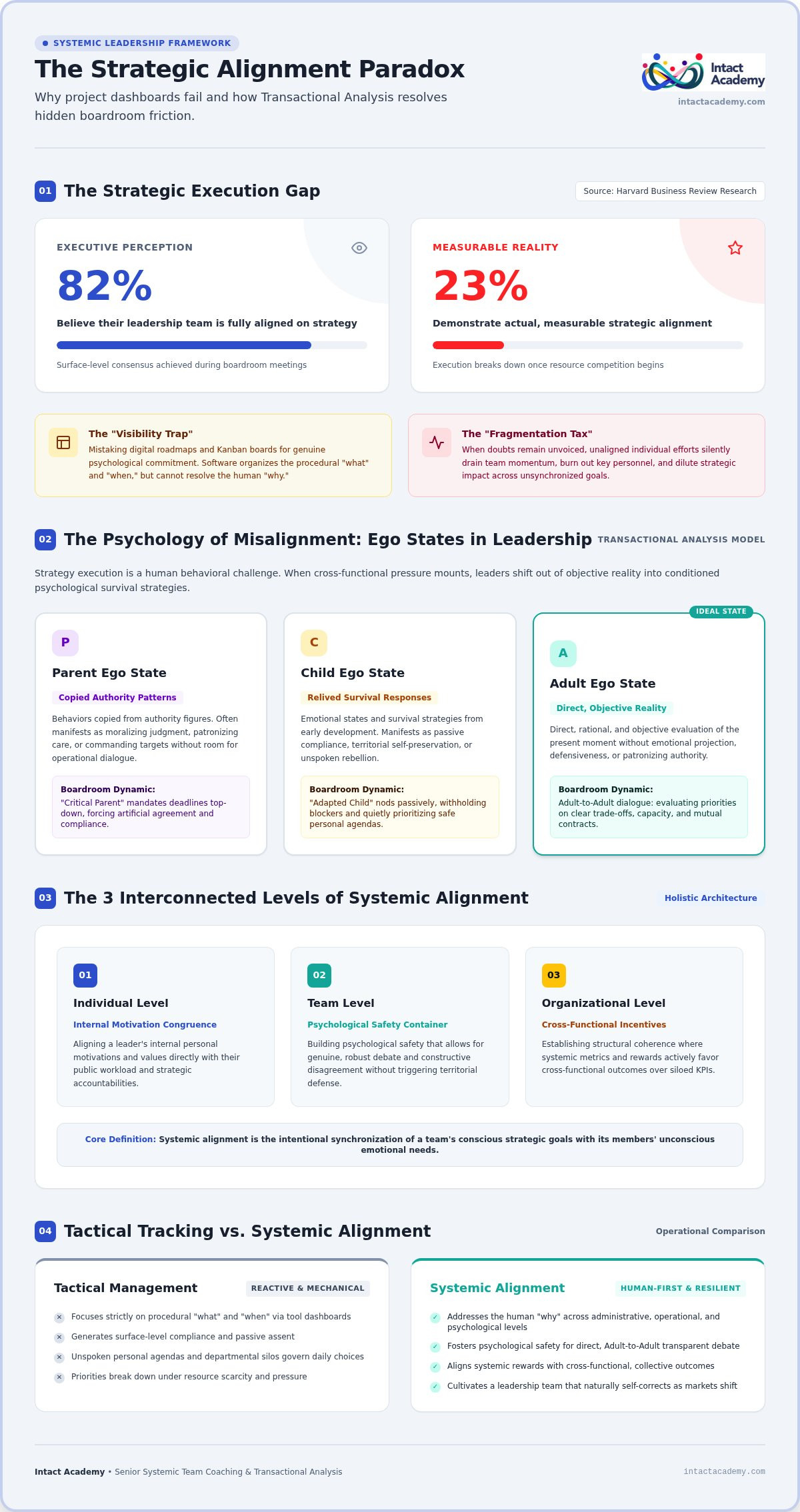
Research published in the Harvard Business Review shows that while 82% of executives believe their leadership team is aligned, measurable strategic alignment sits at just 23%. If you've ever walked out of a boardroom where everyone nodded in agreement, only to watch execution stall in silent cross-functional friction, you know this gap firsthand. Successfully aligning team priorities isn't a technical orchestration challenge. You can roll out fresh project management tools and build spotless roadmaps, yet still feel like you're herding cats the moment resources become scarce.
Surface-level agreement always dissolves when unspoken individual agendas take over. In this guide, you'll discover how to move beyond basic task tracking to achieve deep, systemic alignment through the practical lens of Transactional Analysis. We'll explore the hidden layers of organizational contracting, examine why executive scripts break down, and show you how to cultivate a leadership team that naturally self-corrects based on shared, high-impact goals.
Key Takeaways
- Why project dashboards fail to create genuine buy-in, and how the visibility trap obscures deeper systemic resistance.
- How Transactional Analysis surfaces the unspoken Child, Parent, and Adult ego state dynamics that derail boardroom execution.
- A structured four-step contracting framework for aligning team priorities across administrative, operational, and psychological levels.
- The critical operational differences between reactive task tracking and human-first systemic alignment that enables self-correcting teams.
- How senior systemic team coaching builds the psychological container required to turn cross-functional friction into sustainable collective impact.
Beyond the Dashboard: Why Aligning Team Priorities Fails with Tools Alone
Most modern organizations attempt to solve execution friction through software. Leaders invest in digital roadmaps, color-coded Kanban boards, and centralized goal trackers, assuming that visibility guarantees collaboration. Yet, seeing an objective pinned to a shared dashboard rarely translates into internal dedication. This is the visibility trap: mistaking the display of a task for the psychological resolution to achieve it.
Real organizational progress requires understanding that aligning team priorities is not a mechanical scheduling exercise; it is an ongoing systemic agreement. When leaders mistake tactical compliance for genuine commitment, teams simply play along. They attend the sprint ceremonies, log their hours, and nod during updates, while quietly prioritizing what feels safe, self-preserving, or politically advantageous. Behavior is almost never driven by the documented project plan. It is dictated by the "unspoken priority"—covert personal agendas, unspoken fears of obsolescence, and departmental territory wars that software cannot parse.
The Limits of Tactical Portfolio Management
Task management platforms like Jira or Trello organize the procedural "what" and "when," but they cannot address the human "why." When strategic shifts occur, high cognitive load triggers instinctive survival responses. If team members lack a safe forum to express doubts, priority drift sets in instantly. Organizations then pay a silent "fragmentation tax," where conflicting individual efforts drain momentum, burn out key personnel, and dilute strategic impact across competing, unsynchronized initiatives.
Defining Systemic Team Alignment
True alignment is not a permanent, static milestone you reach once on a Gantt chart. Instead, it is an ongoing, rhythmic process of returning to a state of completeness and operational wholeness as market environments shift. Grounded in the principles of Transactional Analysis, this dynamic operates across three interconnected levels:
- Individual: Congruence between a professional's internal motivations and their public workload.
- Team: Psychological safety that allows for genuine debate without triggering territorial defense.
- Organizational: Coherence where systemic incentives actively reward cross-functional success over siloed performance.
Ultimately, systemic alignment is the intentional synchronization of a team's conscious strategic goals with its members' unconscious emotional needs.
The Psychology of Misalignment: Ego States and Hidden Agendas
Every executive team operates on two parallel tracks: the visible strategic agenda and the invisible psychological script. When organizations fail at aligning team priorities, it is rarely due to intellectual shortcomings or poor roadmaps. Instead, misalignments stem from the unexamined behavioral patterns that leaders bring into the room. Research affirms that execution is a people problem, rooted in how individuals react under pressure, negotiate authority, and protect their domain.
Transactional Analysis (TA) offers a precise diagnostic lens for these moments. Developed by Eric Berne, the model explains how individuals shift between three primary Ego States:
- Parent: Behaviors, thoughts, and feelings copied from authority figures, often showing up as moralizing judgment or patronizing care.
- Adult: Direct, rational, and objective responses to the present reality, devoid of emotional projection.
- Child: Relived emotional states and behavioral survival strategies developed during early childhood.
When leadership decisions get stuck, cross-functional partners are seldom speaking Adult-to-Adult. Instead, childhood survival strategies take over the room.
Ego States in the Boardroom
A CEO operating from a "Critical Parent" ego state mandates targets without dialogue, generating compliance on the surface while prompting covert rebellion beneath it. In response, department heads often slip into the "Adapted Child" state. They nod affirmatively, adopt a stance of helpless submission, and withhold critical operational blockers. To achieve genuine strategic coherence, leaders must consciously anchor themselves in the Adult state, where team priorities become practical choices evaluated on clear trade-offs rather than power struggles.
Workplace Games and Priority Sabotage
When psychological safety collapses, teams resort to repetitive, unconscious behavioral loops designed to validate internal biases while dodging accountability. You have likely observed "Yes, But" during roadmap debates, where a stakeholder solicits input only to systematically shoot down every proposed solution. Another familiar dynamic is "If It Weren't For You," where functional leaders deflect their execution delays onto neighboring departments.
These maneuvers are not mere personality quirks. They are systemic defense mechanisms deployed to protect scarce resources and personal status. By learning to decode these psychological games in the workplace, coaches and executives can interrupt recurring drama loops before they undermine execution.
Transforming these ingrained patterns requires skilled facilitation that reaches beneath surface behavior. Engaging an executive trained through the TA EMCC Senior Team Coach Academy helps teams transition out of defensive posturing and into an Adult space where real strategic commitment thrives.
Systemic Alignment vs. Tactical Management
Tactical management asks, "Are we hitting our milestones?" Systemic alignment asks, "What invisible forces prevent us from pulling together?" Most enterprises default to software-first interventions because tracking tasks feels productive and measurable. However, optimizing delivery dates does nothing to heal fractured working relationships. Data from LSA Global indicates that organizations achieving deep strategic alignment grow revenue 58% faster and are 72% more profitable than their fragmented counterparts. High performance is rarely a question of software configuration. It is the natural return on investing in psychological depth.
Every organization runs on an unwritten systemic script. This script encompasses the shared myths, past organizational traumas, and survival strategies passed down through leadership generations. When leaders ignore this emotional substrate, aligning team priorities degenerates into an exhausting exercise in micromanagement. The leader's true task is to serve as a systemic anchor. By remaining grounded, self-aware, and emotionally stable, an executive holds a reliable container where collective focus can flourish instead of fracturing under market stress.
When to Use Tools vs. When to Use Coaching
Distinguishing between technical challenges and adaptive dilemmas determines your intervention strategy:
- Technical problems: Clear boundaries, established procedures, and predictable outcomes. Digital workflow boards excel here.
- Adaptive challenges: Competing values, political fiefdoms, and systemic shifts requiring new habits. Software cannot navigate these tensions.
Digital platforms provide the operational container, but human relationship constitutes the content. Leaders must master communicating strategic priorities effectively to translate overarching corporate vision into behavioral clarity. Navigating this delicate boundary between mechanics and mindset highlights the real value of advanced professional development for coaches, equipping practitioners to guide executive teams past superficial fixes.
The Cost of Misalignment
When covert departmental priorities clash, teams bleed energy into defensive documentation, backchannel diplomacy, and political maneuvering. Gallup estimates that disengagement and workplace friction drain close to nine trillion dollars from global output each year. Beyond balance sheets, unresolved friction breeds chronic cynicism, executive attrition, and mental exhaustion. True restoration occurs when leaders guide their groups back toward a state of completeness, releasing archaic organizational scripts and realigning personal purpose with collective impact.
A 4-Step Framework for Aligning Team Priorities through Contracting
In classical Transactional Analysis, alignment is never left to chance or unspoken assumptions. It is established through explicit contracting. Eric Berne recognized that human collaboration functions across distinct procedural and emotional tiers. When organizations struggle with aligning team priorities, it is nearly always because they confined their agreements to the operational surface, ignoring the psychological undercurrents that dictate real human investment.
To establish durable cohesion, leaders must engage four deliberate contracting phases:
- Administrative Contracting: Establishing procedural boundaries. This step defines decision-making forums, explicit team capacity, and meeting cadences, clarifying the formal "what" and "when."
- Professional Contracting: Defining explicit operational objectives. MIT Sloan research indicates that top-performing teams limit their core focus to no more than 3 to 5 strategic priorities over a multi-year horizon. Here, roles, mutual handoffs, and shared success metrics are settled transparently.
- Psychological Contracting: Unearthing the implicit level. Leaders surface unspoken fears of resource loss, territory erosion, and political vulnerability, moving dialogue into grounded Adult-to-Adult clarity.
- Systemic Review: Institutionalizing ongoing re-contracting. Teams periodically evaluate how evolving market conditions and wider organizational realities impact their existing agreements, adjusting systemic focus before friction hardens into stagnation.
The Art of the Psychological Contract
Unspoken fear is the primary catalyst for stalled execution. When strategic priorities shift, leaders wonder: Will my department lose headcount? Will my visibility diminish? Building a stable container allows team members to voice these anxieties without judgment. Coaches can introduce conditional scenarios: "If enterprise priority shifts entirely to Product A next quarter, what do you need to remain secure in your remit?" Testing commitment against realistic pressure points transforms fragile compliance into resilient, Adult-level buy-in.
Facilitating the High-Stakes Priority Session
Guiding a deadlocked executive team requires transitioning participants from an individual ego perspective into a systemic collective mindset. When discussions stall, the facilitator shifts attention away from competing departmental demands and redirects the room back to the overarching organizational whole. Studying Sari van Poelje's insights on agile systemic change illustrates how structural interventions help groups untangle rigid boardroom positions and return to collaborative flow.
If you are ready to help leadership teams resolve recurring behavioral friction and accelerate strategic execution, apply to join the TA EMCC Senior Team Coach Academy today.
Mastering Systemic Alignment with the Senior Team Coach Academy
Facilitating genuine strategic cohesion isn't an aptitude picked up in a weekend seminar. While tactical facilitators can manage meeting agendas and resolve immediate resource disputes, systemic transformation demands something deeper. It requires holding a steady psychological container while unspoken tensions, power dynamics, and institutional scripts surface. Truly mastering the craft of aligning team priorities marks the evolution from being a transactional facilitator who manages tasks to becoming a systemic practitioner who transforms human systems.
When you understand Transactional Analysis at an advanced level, you no longer merely track spoken discussions. You read the systemic currents beneath the boardroom dialogue in real time. You instantly identify shifts in ego states, interrupt covert psychological games designed to preserve territory, and intervene with grounded, calm authority.
Deep Impact and Sustainable Transformation
There is a profound difference between resolving a single priority dispute and expanding an executive team's long-term capacity to align itself. Surface-level interventions leave organizations perpetually dependent on external mediators. A systemic practitioner, by contrast, develops the presence of a wise global mentor, guiding leadership dynamics back toward completeness and psychological autonomy. Selecting an accredited team coaching course bridges deep psychological rigor with pragmatic business execution, turning interpersonal friction into collective impact.
Your Path to EMCC Senior Practitioner Status
True systemic mastery demands structured practice, rigorous developmental standards, and reflective supervision. Research validated by EMCC Global demonstrates that teams supported by coaches who receive formal systemic supervision achieve a 40% higher rate of sustained behavioral change. When aligning team priorities is approached through this depth of practice, organizational shifts endure far beyond the coaching engagement.
Led by global Transactional Analysis and systemic change expert Sari van Poelje, Intact Academy prepares professionals to meet the rigorous EMCC Global Individual Team Coaching Accreditation (ITCA) standards at the Senior Practitioner level. Joining an international cohort of seasoned consultants and executives representing 14+ countries gives you the experiential foundation needed to anchor high-stakes enterprise change. To take the next step in your professional journey, Discover the TA EMCC Senior Team Coach Academy.
From Tactical Compliance to Systemic Collective Impact
Strategic success doesn't depend on another software integration or stricter reporting cadences. Sustainable progress takes root when leaders move beneath the operational surface to address the unconscious scripts, ego state defenses, and emotional trade-offs that dictate daily execution. By applying structured contracting across administrative, operational, and psychological levels, aligning team priorities transforms from an exhausting battle of wills into an organic, self-correcting discipline.
Stepping into this level of leadership requires more than standard facilitation frameworks. It calls for the steady presence and diagnostic depth of a systemic practitioner. When you are ready to expand your mastery, Explore the TA EMCC Senior Team Coach Academy. Led by a global faculty of systemic experts, our EMCC Senior Practitioner level training integrates advanced Transactional Analysis to help you navigate high-stakes complexity. Step forward into your authority, cultivate genuine organizational wholeness, and guide your teams toward collective impact that endures.
Frequently Asked Questions
How do you handle a team member who refuses to align with the new priorities?
Resistance is rarely defiance; it is systemic data indicating an unaddressed psychological threat. Meet with the individual one-on-one from a calm Adult ego state rather than a punitive Parent stance. Inquire about their concerns regarding autonomy, status, or capacity. Once hidden anxieties surface, re-contract their contribution explicitly, connecting their drivers to the collective mission or evaluating whether their current role remains viable within the system.
What is the difference between team alignment and team agreement?
Agreement is an intellectual nod, whereas alignment is an embodied behavioral commitment. Teams frequently agree on paper to avoid tension, producing passive-aggressive drift later on. True alignment allows for rigorous intellectual disagreement during debate, followed by total systemic dedication to execution. In aligning team priorities, alignment means every member actively pulls in the same strategic direction, regardless of whether their personal proposal was chosen.
How often should a systemic team alignment session be conducted?
Executive teams should conduct comprehensive systemic alignment sessions semi-annually or whenever major strategic pivots occur. However, maintaining that coherence requires quarterly re-contracting reviews and brief monthly check-ins. Systems naturally drift toward entropy as external pressures mount. Scheduling regular developmental containers prevents silent priority fragmentation, ensuring that cross-functional interdependencies remain transparent and that emerging relational tensions are addressed before they solidify into operational bottlenecks.
Can Transactional Analysis be used for short-term project prioritization?
Yes. While Transactional Analysis enables deep cultural transformation, its diagnostic clarity works remarkably well in tactical sprints. Project leaders can quickly map whether debates are trapped in Parent-Child conflicts or stalled by psychological games like "Yes, But." By shifting the dialogue into clear, Adult-to-Adult transactions and using basic three-level contracting, teams can strip away political maneuvering and establish objective project priorities within a single working session.
What is a psychological contract in the context of team priorities?
A psychological contract represents the implicit, unspoken expectations, beliefs, and emotional boundaries that individuals hold regarding their workplace. Beyond formal KPI sheets, it covers unspoken assumptions about respect, safety, autonomy, and territory. When aligning team priorities, surfacing this implicit layer is vital. If leaders don't address what people secretly expect to give and receive emotionally, unwritten individual agendas will continually override the company's stated strategic objectives.
How does systemic team coaching differ from traditional team building?
Traditional team building relies on episodic events, recreational retreats, or isolated personality profiles that create temporary goodwill without altering workplace behavior. Systemic team coaching is an ongoing developmental journey lasting several months. It views the team as an interconnected living organism within a wider organizational ecosystem. A systemic practitioner observes live boardroom dynamics, surfaces repetitive behavioral scripts, and fosters durable capacity for long-term strategic execution and autonomous self-correction.
Is EMCC accreditation necessary for coaching teams on alignment?
While anyone can call themselves a coach, an EMCC Global accreditation sets an essential benchmark of professional rigor for enterprise work. Navigating complex organizational dynamics requires advanced developmental competencies and ongoing systemic supervision. Training through accredited pathways, such as the TA EMCC Senior Team Coach Academy at Intact Academy, ensures practitioners possess the psychological grounding, structured frameworks, and ethical discipline necessary to steer executive teams through high-stakes alignment challenges safely.
How do you measure the success of a team alignment intervention?
Success displays both behavioral and commercial markers. Quantitatively, aligned organizations see faster project velocity, reduced cross-functional cycle times, and stronger revenue outcomes. Qualitatively, indicators include fewer backchannel complaints, a marked decline in Karpman Drama Triangle behaviors, and shorter, more decisive meetings. The ultimate test is autonomous self-correction: when priorities shift unexpectedly, does the leadership team realign collaboratively without falling into territorial defense?


