

What if the mission statement hanging on your office wall is actually the primary barrier to your team's collective success? Most coaches have experienced the frustration of a team that nods in agreement during a strategy session, only to return to fragmented, individualistic behaviors the following Monday. You likely recognize that surface-level compliance often masks a deeper systemic resistance or a confusion between daily tasks and the true reason for existence. Defining team purpose in team coaching requires us to move beyond these superficial exercises to find a psychological and systemic anchor.
You'll learn how to move past the "what" to uncover a "why" that drives deep psychological alignment and sustainable performance. We will examine how to apply Transactional Analysis and systemic frameworks to facilitate a purpose that doesn't just sit on a wall, but lives within every interaction. This journey requires us to look beneath the surface of organizational scripts to find the genuine heart of collective work, ensuring that profound psychological concepts remain accessible and actionable for the modern leader. By grounding our approach in structured methodology, we create a space where complex systemic issues feel manageable and transformation becomes possible.
Key Takeaways
- Distinguish between the "what" of tasks and the "why" of purpose, creating a psychological container that holds both team anxiety and collective ambition.
- Apply Transactional Analysis frameworks, such as Collective Ego States and Organizational Scripts, to uncover the historical patterns influencing current team dynamics.
- Facilitate deeper alignment through multi-cornered contracting, ensuring the coach, leader, and team are united by a genuine psychological contract rather than mere compliance.
- Identify and move past the "Yes, But" games that often surface when defining team purpose in team coaching, transforming resistance into shared accountability.
- Recognize how systemic purpose facilitation serves as a hallmark of mastery for professionals within the TA EMCC Senior Team Coach Academy.
Beyond the Mission Statement: What Is Team Purpose in Coaching?
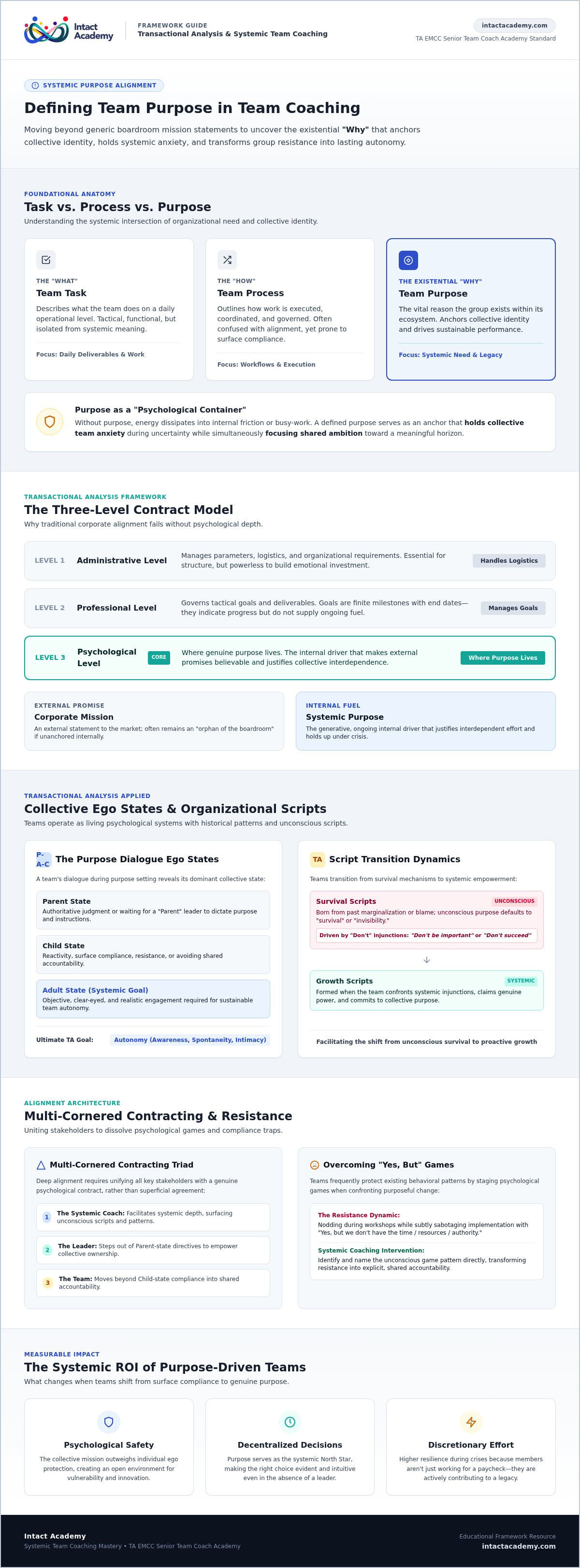
Most corporate mission statements are orphans of the boardroom; they are polished, professional, and ultimately powerless to change how people behave when the pressure mounts. In high-stakes environments, a generic statement fails because it lacks the psychological weight required to anchor a team during crisis. Defining team purpose in team coaching isn't about word-smithing a slogan. It's about identifying the vital reason a group exists within its larger ecosystem. While the task describes what the team does and the process outlines how they do it, the purpose answers the existential why. We define team purpose as the systemic intersection of organizational need and collective identity.
Psychologically, a clear purpose serves as a container. It holds the team's collective anxiety during periods of uncertainty and focuses their shared ambition toward a meaningful horizon. Without this container, energy often dissipates into internal friction or "busy-work" that masks a lack of true direction. When a team understands its systemic role, it moves from a collection of individuals to a unified entity capable of profound transformation.
Purpose vs. Goals vs. Mission: The Systemic Distinction
Goals are tactical milestones; they are finite and have an end date. Purpose is generative and ongoing, providing the fuel for those milestones. To understand this systemically, we look at the Three-Level Contract. The Administrative level handles the logistics, and the Professional level manages the goals. However, the Psychological level is where purpose lives. While a mission is an external promise to the market, purpose is the internal driver that makes that promise believable. It aligns with established models of team effectiveness by providing a compelling direction that justifies the team's interdependence and collective effort.
The ROI of Purpose-Driven Team Coaching
When a team shares a profound why, psychological safety increases because the collective mission outweighs individual ego protection. This clarity simplifies decision-making in complex systems. When the purpose is the North Star, the right choice becomes evident even in the absence of a leader. This deep work is a core competency taught within the TA EMCC Senior Team Coach Academy, where we move beyond simple facilitation into systemic mastery. Teams with a defined purpose show higher resilience and increased discretionary effort, as members aren't just working for a paycheck; they're contributing to a legacy. If you're looking for the right team coaching course to master these dynamics, focusing on this systemic depth is essential for sustainable organizational change.
A Systemic Framework for Defining Team Purpose
A team is not merely a collection of roles; it's a living system with its own psychological history and collective identity. When we approach defining team purpose in team coaching, we must look beyond the immediate task to the underlying script that governs the group's behavior. In Transactional Analysis (TA), we recognize that teams, like individuals, operate from a "Collective Ego State." This means a team might interact with its stakeholders from a place of compliance, rebellion, or authoritative judgment, rather than the clear-eyed, objective "Adult" state required for sustainable success.
The "Organizational Script" often dictates a team's sense of purpose before a single word is spoken in a workshop. If a team has a history of being marginalized or blamed, its unconscious purpose might be "survival" or "invisibility." These are what we call "Survival Scripts." As a systemic coach, your role is to facilitate the shift toward a "Growth Script." This transition happens when the team identifies the "Don't" injunctions, the unconscious rules like "Don't be important" or "Don't succeed," that prevent them from claiming their true systemic power.
The Role of Transactional Analysis in Purpose-Setting
Using the Parent-Adult-Child model allows us to analyze the quality of the purpose dialogue. Is the team waiting for a "Parent" leader to tell them why they exist? Or are they stuck in a "Child" state, resisting any form of accountability? The ultimate goal of a purpose-driven team is Autonomy. This TA concept describes a state of awareness, spontaneity, and intimacy where the team is free from the constraints of old scripts. In this state, defining team purpose in team coaching becomes an act of liberation rather than a chore of compliance.
Mapping the Systemic Stakeholders
A team's purpose cannot exist in a vacuum; it's defined by its relationship to its environment. We must identify the "Beneficiaries," those who rely on the team's output, to understand the team's "Primary Task." As explored in the classic study The Discipline of Teams, a real team must shape its own purpose in response to the demands of its ecosystem. This alignment ensures the team's work directly supports broader leading organizational change initiatives. Mastering these systemic nuances is a core component of the curriculum at the TA EMCC Senior Team Coach Academy, where practitioners learn to bridge the gap between human behavior and business results.
How to Facilitate the Purpose Dialogue: 5 Key Steps
Facilitation is often mistaken for managing an agenda, yet in the context of high-performance teams, it's actually the art of managing the psychological container. Defining team purpose in team coaching requires a deliberate movement through layers of organizational reality, moving from the visible "social" level to the hidden "psychological" level. To do this effectively, a coach must establish a holding space where vulnerability is safe and truth is expected. This process isn't a linear workshop; it's a systemic inquiry that demands both precision and empathy.
Step 1: Multi-Level Contracting
The foundation of any purpose-driven engagement is the contract. We distinguish between the Administrative contract, which covers the logistics and boundaries, and the Professional contract, which defines the goals. However, the most critical layer is the Psychological contract. This represents the unspoken expectations and hidden desires of the team members. Effective coaching contracting ensures that everyone is aligned on what the team really wants but isn't yet saying, preventing the "Yes, But" games that often derail transformation later on.
Step 2: Uncovering the Unspoken Needs
Once the boundaries are set, the coach acts as a systemic mirror to surface "under-the-table" agendas. By observing the difference between social level transactions (what is said) and psychological level transactions (what is felt), you can help the team identify their true needs. Surfacing these hidden scripts is essential for defining team purpose in team coaching because a purpose built on a lie cannot sustain a team through a crisis. You aren't just listening for words; you're listening for the energy behind them.
Step 3: Synthesizing the Collective "We"
Moving from individual desires to a unified purpose requires navigating the "Consensus Trap." This occurs when a team settles for a vague, middle-ground statement to avoid conflict. Instead, we use facilitation tools to maintain diversity of thought while forging a shared commitment. This alignment matches the ICF Team Coaching Competencies, which emphasize the coach's ability to facilitate a team's collective growth and identity. A true purpose gives the team the courage to say no to irrelevant tasks, acting as a filter for their collective energy.
Finally, the process concludes with a Purpose Audit, reviewing all current activities against the newly defined "Why," and drafting a Living Purpose statement. This isn't a static document; it's a dynamic agreement that evolves as the system changes, ensuring that the team remains in a state of continuous becoming and genuine alignment.
Overcoming Resistance and Psychological Games
Resistance is not an obstacle to the process; it is the process itself. When we engage in defining team purpose in team coaching, we are asking a system to move from the safety of ambiguity into the vulnerability of clarity. This shift often triggers unconscious defense mechanisms. Many teams subconsciously prefer a vague purpose because it provides a shield against accountability. If the reason for existence remains ill-defined, the team cannot truly fail. However, they also cannot truly succeed. This tension creates a fertile ground for psychological games that stall transformation.
In a team context, discounting is the internal mechanism of minimizing or ignoring information relevant to the solution of a collective challenge, which effectively renders the team's shared purpose invisible or irrelevant. When a team discounts their own agency or the significance of their mandate, they retreat into "Survival Scripts" rather than stepping into their potential. As a coach, you must identify when the team is operating from "Agitator" or "Resister" ego states, where they either rebel against the process or judge it as a waste of time.
Common "Games" Teams Play to Avoid Clarity
The "Yes, But" game is perhaps the most frequent intruder during purpose facilitation. A team member might agree with the necessity of a shared why, only to immediately provide a reason why it won't work in their specific department. Others may fall into "Ain't it Awful," where the group focuses entirely on external barriers, like a difficult board or a volatile market, to avoid looking at their internal lack of alignment. Some might play "Blemish," picking at minor word choices in a draft to derail the deeper conversation about meaning.
To break these cycles, the coach must "cross the transaction." If the team is inviting you into a "Parent-Child" dynamic by seeking permission or acting out, you must respond from a firm, empathetic "Adult" state. This invites the team back into a space of objective reality and shared responsibility.
The Anxiety of Alignment
Clarity brings a specific type of systemic anxiety. When a team defines a bold purpose, they often experience a collective form of Imposter Syndrome. They wonder if they are truly capable of delivering such value. This is particularly taxing for the leader, who may feel exposed by the high expectations a clear purpose creates. Supporting the leader through this vulnerability is essential. You can ground the team by returning them to the "here and now," reminding them that purpose is a North Star for movement, not a static state of perfection. To master these complex interventions and lead teams toward genuine wholeness, you can apply for the TA EMCC Senior Team Coach Academy and deepen your systemic expertise.
Integrating Purpose into Team Coaching Mastery
Mastering the art of defining team purpose in team coaching represents the threshold between basic facilitation and true systemic mastery. A facilitator might help a team reach consensus on a mission statement; a systemic team coach helps a team reclaim its collective soul. This distinction is central to any high-caliber team coaching course at the Senior Practitioner level. It requires the coach to hold a steady "Adult" ego state even when the team system is in turmoil. By maintaining this professional stance, you provide the stable container necessary for the team to move through their psychological games and into a state of genuine autonomy.
To reach this level of practice, the coach must also commit to their own continuous evolution. Supervision and reflective practice are not optional; they are the guardrails that prevent us from being pulled into the team's script. We must be able to mirror the system without becoming part of its dysfunction. This deep internal work is what allows a coach to facilitate profound human transformation rather than mere operational adjustments. When the coach models wholeness and genuineness, the team feels safe enough to do the same.
The Path to EMCC Senior Team Coach Accreditation
Achieving accreditation as an EMCC Senior Team Coach involves demonstrating a high degree of competence in managing multi-stakeholder contracts and navigating complex systemic dynamics. In the current landscape of professional development for coaches, the focus has shifted toward these deeper, psychologically-informed methodologies. Intact Academy’s TA-based approach prepares practitioners for these global standards by providing a rigorous framework rooted in Transactional Analysis. You learn to see the invisible threads that bind a team to its past and help them weave a new narrative for the future, ensuring that every intervention is both intellectually rigorous and deeply human.
Conclusion: Purpose as a Living System
We must remember that purpose is a living system, not a static destination. It is a continuous journey of becoming. As a coach, your role is to hold the purpose for the team until they are strong enough to hold it for themselves. This requires patience, depth, and the courage to stay with the team in their moments of uncertainty. By defining team purpose in team coaching through a systemic lens, you aren't just improving performance; you're fostering wholeness. We invite you to deepen your impact and join us in the TA EMCC Senior Team Coach Academy to begin transforming organizations one team at a time.
Mastering the Systemic Heart of Team Performance
Moving from surface compliance to deep psychological alignment requires more than a simple strategy session; it demands a profound shift in the team's collective script. By defining team purpose in team coaching as a systemic anchor, you provide the vital container necessary for teams to navigate their own anxieties and shared ambitions. You've seen how identifying "Yes, But" games and crossing transactions can break cycles of resistance, allowing a team to step into its true autonomy. This process isn't a one-time event but a continuous journey of growth and genuine connection.
If you're ready to bridge the gap between human behavior and organizational success, we invite you to Apply for the TA EMCC Senior Team Coach Academy. Led by global expert Sari van Poelje, our academy is an EMCC Global Quality Award (EQA) provider with a curriculum deeply rooted in Transactional Analysis and systemic theory. It's time to move beyond the role of a facilitator and emerge as a systemic coach capable of fostering profound transformation. Your commitment to this depth is the catalyst for creating organizations where teams don't just perform, but truly flourish.
Frequently Asked Questions
What is the difference between team mission and team purpose?
A team mission is an external promise that describes what the group does and for whom. In contrast, team purpose is an internal systemic driver that explains why the group exists at a psychological level. While a mission statement might sit on a website, a true purpose acts as a container for collective energy and ambition. It provides the meaning that fuels daily tasks and helps the team navigate complex organizational scripts.
How do you facilitate team purpose when the leader is resistant?
Resistance from a leader often signals a fear of losing control or a "Parent" ego state response to perceived vulnerability. You facilitate this by returning to the multi-cornered contract and mirroring the systemic impact of the resistance. By creating a safe holding space, you help the leader see that a shared purpose actually distributes accountability. This shift allows the leader to move from a "Survival Script" into a more autonomous and generative "Growth Script."
Can a team have a purpose that conflicts with the company's mission?
A team's purpose should never exist in a vacuum; it must align with the organization's "Primary Task." If a conflict exists, it often points to a systemic fracture or a "rebellious child" ego state within the team script. Defining team purpose in team coaching involves uncovering these misalignments to ensure the team supports the broader ecosystem. Without this harmony, the team risks becoming a silo that drains organizational energy rather than contributing to its flourishing.
How long does it typically take to define a meaningful team purpose?
Meaningful purpose isn't captured in a single afternoon. While an initial intensive session of two or three days can draft a "Living Purpose," the true integration into the team's operations takes several months of consistent coaching. This period allows the team to test their purpose against real-world challenges and psychological games. It's a continuous process of evolution where the purpose is refined as the team’s collective maturity and systemic awareness grow.
What are the best Transactional Analysis tools for team coaching?
The most effective tools include the Parent-Adult-Child ego state model to analyze communication and the Three-Level Contract to manage expectations. We also use Script Analysis to uncover the team's historical patterns and "Games" analysis to identify unproductive cycles like "Yes, But." These frameworks allow a coach to see beneath surface-level behaviors. They provide a structured methodology for facilitating deep human transformation and ensuring that professional concepts remain actionable in high-stakes business environments.
How do you measure if a team is actually living its purpose?
You measure it through the team's decision-making speed and their ability to say "no" to irrelevant tasks. When a purpose is lived, you'll see an increase in discretionary effort and a reduction in "Blemish" or "Ain't it Awful" games. Psychological safety also serves as a key indicator. If members feel safe enough to challenge the status quo in service of the shared "Why," the team has successfully moved beyond surface-level compliance.
Is defining team purpose part of the EMCC Senior Team Coach curriculum?
Yes, it's a foundational competency within the TA EMCC Senior Team Coach Academy at Intact Academy. At the Senior Practitioner level, coaches must demonstrate they can move beyond simple facilitation to handle complex systemic dynamics and psychological contracts. Our curriculum ensures you have the intellectual rigor and empathetic depth to lead teams toward wholeness. Defining team purpose in team coaching through our program helps you anchor a team's identity in a way that drives sustainable performance.
What happens if a team cannot agree on a shared purpose?
If a team cannot agree, it's usually because of a "discount" of their collective agency or an underlying "Don't succeed" injunction. As a coach, you don't force a consensus. Instead, you surface the hidden agendas and psychological level transactions that are blocking the alignment. By identifying these systemic barriers, you help the team return to an "Adult" state where they can honestly confront their resistance and reclaim their genuine reason for existence.


