

Most coaching supervision remains a transactional exercise in box-ticking, leaving the coach's most profound psychological blocks untouched. With the ICF’s 2027 policy shift requiring accredited supervision for credential renewal, the search for a mentor is no longer just about compliance; it's about professional survival and systemic growth. When considering what to look for in a coaching supervisor, you must look beyond the certificate to find a partner who can hold the weight of organizational complexity. You likely recognize the quiet exhaustion of client patterns that refuse to shift or the lingering anxiety of navigating ethical gray areas without a stable, reflective container.
We believe your evolution deserves more than a cursory review of your coaching hours. This guide explores how to identify a supervisor who moves beyond administrative oversight to foster deep psychological insight and systemic transformation. You'll learn to map unconscious organizational patterns using Transactional Analysis and the Seven-Eyed Model. We will outline the path to achieving EMCC or ICF senior credentials while ensuring your practice remains a space for profound human flourishing. By the end, you'll have a clear methodology for choosing a wise mentor who honors your maturity and challenges your blind spots.
Key Takeaways
- Realize why professional accreditation is merely the entry point for a relationship that should challenge your boundaries and expand your awareness.
- Identify what to look for in a coaching supervisor by assessing their skill in spotting the psychological games and unconscious patterns that often stall organizational change.
- Master the application of the Seven-Eyed Model to move your focus from the individual client to the wider organizational system.
- Use our structured vetting checklist to navigate chemistry sessions with clarity, ensuring your chosen mentor can facilitate both emotional holding and professional rigor.
- Learn how a supervisor trained in Transactional Analysis can help you achieve senior credentials while returning to a state of professional genuineness.
The Essential Criteria: Beyond the Accreditation Checkbox
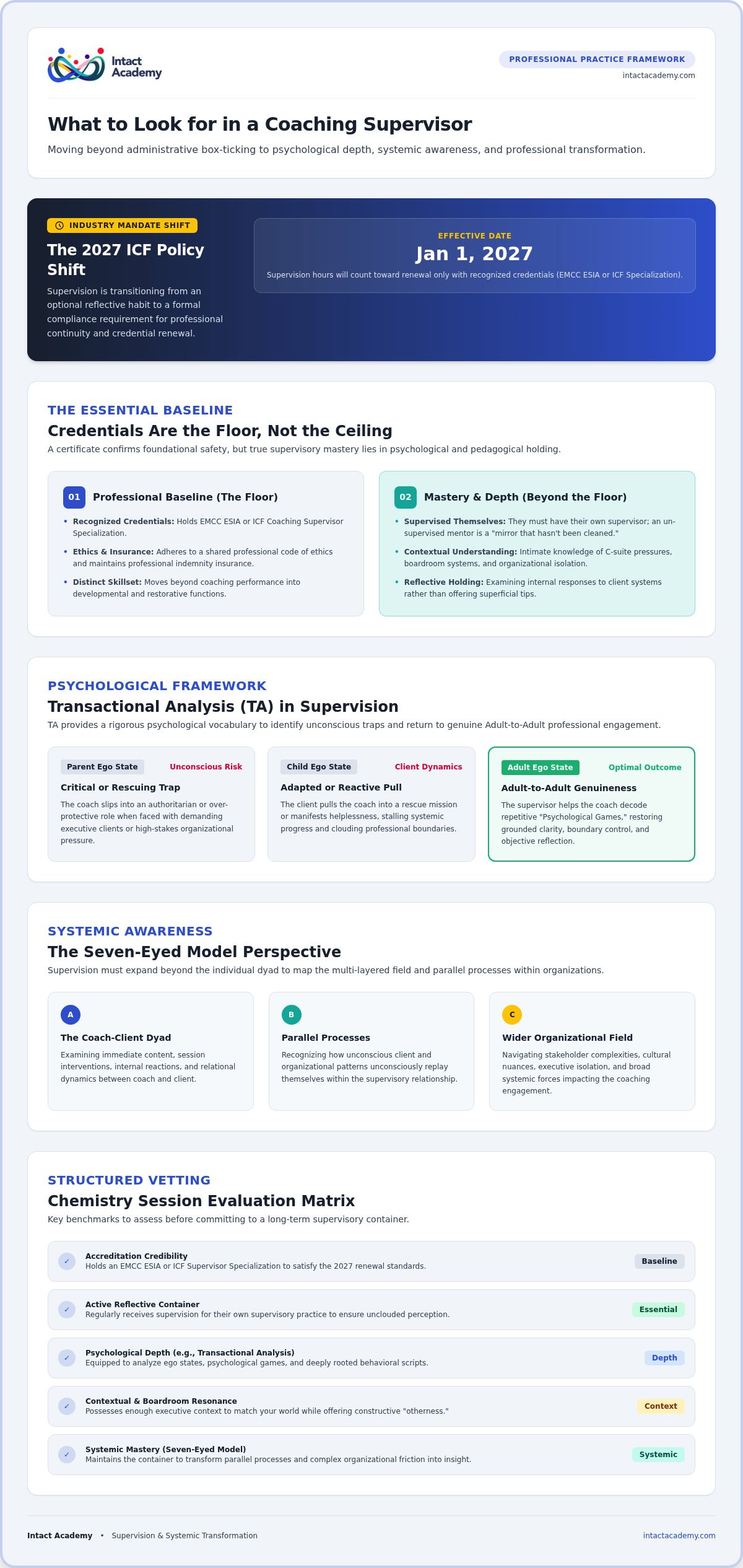
Accreditation serves as the foundation of professional safety, yet it's often mistaken for the peak of mastery. In reality, a certificate is the floor of a supervisor's practice, not the ceiling. As you evaluate what to look for in a coaching supervisor, you're seeking a partner whose credentials are backed by a living commitment to their own growth. A supervisor who lacks a dedicated supervisory qualification may be a gifted coach, but they likely lack the specific pedagogical and psychological tools required to hold your professional development safely. This distinction becomes critical as the industry tightens its standards. For instance, the ICF has confirmed that starting January 1, 2027, supervision hours will only count toward credential renewal if the supervisor holds a recognized accreditation like the EMCC ESIA or the ICF Coaching Supervisor Specialization.
Professional Accreditations and Standards
The difference between an EMCC Senior Practitioner and an ESIA Supervisor is more than a title; it represents a shift in focus from coaching performance to the developmental and restorative functions of supervision. A qualified supervisor understands that their role isn't to coach you on how to coach, but to provide a reflective space where you can examine your internal responses to client systems. Membership in a professional body ensures they adhere to a shared code of ethics and maintain professional indemnity insurance. Perhaps most importantly, you should ask if they have a supervisor of their own. A supervisor without their own reflective container is a red flag. They're essentially asking you to trust a mirror that hasn't been cleaned; they can't help you see what they've stopped looking for in themselves.
Niche Experience and Contextual Understanding
Context is the silent partner in every coaching conversation. If you work primarily with C-suite executives, your supervisor must understand the specific systemic pressures of the boardroom, from stakeholder management to the isolation of leadership. Without this contextual resonance, supervision can become too abstract. A supervisor with a deep understanding of corporate systems can help you navigate the Seven-Eyed Model of supervision, which looks beyond the coach-client dyad to include the wider organizational field and parallel processes. This global perspective is indispensable in an international market where cultural nuances and systemic dynamics often collide. Your supervisor should be able to match your background while offering enough "otherness" to challenge your habitual ways of thinking. They provide the stable container needed to transform turbulent organizational challenges into moments of profound professional insight.
Psychological Depth: Evaluating the Supervisor's Theoretical Lens
A supervisor's credentials provide the professional container, but their theoretical lens determines the depth of the transformation that occurs within it. If you're wondering what to look for in a coaching supervisor, prioritize those who possess a robust psychological framework. Without a coherent lens, supervision risks becoming a series of superficial tips rather than a site of profound human growth. You need a mentor who can see the invisible threads connecting a client's struggle to the broader organizational field.
The Power of Transactional Analysis in Supervision
Transactional Analysis (TA) offers an exceptionally clear window into the unconscious dynamics of professional relationships. By understanding ego states, a supervisor helps you recognize when you've stepped into a "Parent" role with a demanding CEO or when a client’s "Child" state is pulling you into a rescue mission. Understanding what is transactional analysis allows you to move beyond the content of the session to the process itself. This methodology provides a shared vocabulary for identifying "Psychological Games." These are the repetitive, unconscious patterns that lead to predictable, often negative, outcomes for the coach, the client, and the organization. A supervisor trained in TA doesn't just offer advice; they help you decode the game so you can return to a state of Adult-to-Adult genuineness.
Moving from Surface Issues to Core Patterns
Deep supervision addresses the "Life Scripts" we all carry. These are the unconscious life plans formed early in life that continue to influence how we lead and coach today. A skilled supervisor identifies when your own script is hindering your work. Perhaps you have a compulsion to be "perfect" or a fear of healthy confrontation that prevents you from challenging a senior leader. They help you "contract for change" effectively, ensuring you aren't just solving a client's immediate problem but addressing the underlying systemic pattern. This shift from transactional advice to transformational inquiry is what distinguishes a master supervisor from a mere auditor. At Intact Academy, we believe this level of depth is essential for those seeking Systemic Supervision that honors the complexity of the human experience.
The supervisor's role is to help you move from "what happened" to "what is happening" in the room right now. This involves uncovering unconscious biases and parallel processes where the dynamics between you and your client are mirrored in the supervision itself. By making these patterns visible, the supervisor provides you with the tools to map the unconscious organizational field. You'll find that as your internal psychological map becomes clearer, your ability to facilitate change in others expands proportionally. This is the essence of moving from a practitioner who follows a script to a mentor who understands the soul of the system.
Systemic Awareness and the Seven-Eyed Model
A coach never enters a room alone. Every session is populated by the ghosts of the client's organization, the pressure of their stakeholders, and the unspoken rules of their corporate culture. To navigate this complexity, you need more than a sounding board; you need a supervisor who can look through multiple lenses simultaneously. When considering what to look for in a coaching supervisor, their ability to hold a systemic view is the differentiator between a mentor who helps you solve a problem and one who helps you transform a practice. This systemic awareness ensures that the work doesn't just benefit the individual client, but also serves the health of the wider organizational field.
The Seven-Eyed Model Explained
The Seven-Eyed Model, developed by Peter Hawkins and Robin Shohet, remains the gold standard for holistic supervision. It moves the focus beyond the coach-client dyad into seven distinct modes of inquiry. These include the client's narrative, the coach's interventions, and the relational dynamics at play. It also delves deeper, examining the coach's internal reactions and the supervisor's own somatic responses. Finally, it looks at the "Seventh Eye," the wider context of the organization and the global environment. A master supervisor fluidly moves between these perspectives, ensuring that no blind spot remains unexamined. This multi-layered approach protects everyone involved, providing a stable container for high-stakes executive work where the ripples of a single coaching session can affect hundreds of employees.
Spotting the Parallel Process
One of the most potent tools in a supervisor's arsenal is the ability to identify a parallel process. This occurs when the dynamics, tensions, or "stuckness" present in the coach-client relationship are unconsciously mirrored within the supervisor-coach relationship. If you feel uncharacteristically defensive or dismissive during supervision, it may not be about the supervisor at all. Instead, you might be playing out the exact dynamic your client feels toward their board of directors. Parallel process is a systemic diagnostic tool that reveals how the dynamics of the client system are unconsciously mirrored within the supervisory relationship.
Identifying these hidden mirrors requires a supervisor with immense self-awareness and the courage to name what is happening in the room. By bringing these unconscious patterns into the light, you gain an immediate, lived understanding of your client's world. This breakthrough doesn't come from intellectual analysis but from a deep, systemic resonance. When you look for a supervisor, prioritize someone who views their own internal state as a data point for your client's system. This level of insight allows you to return to your coaching practice with a renewed sense of clarity and a map for the unconscious forces at play.
The Practical Vetting Process: Questions to Ask Potential Supervisors
Choosing a supervisor is an act of professional intimacy. It requires a level of trust that goes beyond simple social rapport; it demands a shared commitment to the truth of your practice. When you begin the search for a mentor, the initial chemistry session is your most valuable diagnostic tool. This is not merely a time to see if you "like" someone, but an opportunity to test the strength of the container they provide. You need a space where your vulnerability is held with both empathy and clinical rigor, allowing you to explore the "stuck" places in your work without fear of professional judgment. Understanding what to look for in a coaching supervisor involves assessing their ability to remain grounded while you navigate the turbulence of complex client systems.
The Chemistry Session Checklist
To evaluate the depth of a potential partnership, come prepared with questions that probe their theoretical and practical boundaries. Start by asking about their view on human change. Does their approach align with your own, or do they offer a complementary lens that will challenge your habitual patterns? Inquire specifically about their experience with leading organizational change. A supervisor who has navigated the psychological undercurrents of large scale transformations will be better equipped to help you untangle systemic knots. Use this session to observe their feedback style in real time. Are they able to offer a perspective that is both supportive and sharply provocative? You're looking for someone who can hold the mirror steady, even when the reflection is uncomfortable.
Logistics and Contracting
Once the psychological alignment is clear, you must address the practical architecture of your relationship. Discuss the frequency and format of your sessions, ensuring they provide enough consistency to foster deep learning. If you're working toward an executive coaching certification, verify that your supervisor understands the specific reporting requirements of bodies like the EMCC or ICF. Clarity on the balance between administrative oversight and developmental inquiry is essential. A master supervisor ensures that the "box-ticking" never starves the soul of the reflective process. They provide the structure that allows your practice to flourish, ensuring that every hour spent in supervision translates into greater impact for your clients.
Ready to deepen your systemic mastery? Explore our Systemic Supervision programs to find a mentor who matches your professional ambition with psychological depth.
Committing to Professional Wholeness with Intact Academy
The journey toward professional mastery is rarely a linear path. It is a process of returning to a state of completeness, where your technical skills and your human presence become one. By now, your understanding of what to look for in a coaching supervisor has likely moved from a simple checklist of requirements to a vision of professional evolution. At Intact Academy, we believe that supervision should be more than a safety net; it should be a North Star. We provide the stable container required for coaches to explore the depths of their practice, ensuring that every systemic knot becomes an opportunity for profound insight and renewed clarity.
Systemic Supervision at Intact Academy
Our approach integrates Transactional Analysis (TA) and systemic theory to create a methodology that is both psychologically deep and professionally pragmatic. When you work with a supervisor trained in the Sari van Poelje methodology, you aren't just reviewing client cases. You are learning to observe the invisible forces that shape organizational behavior. Our international team of experts brings a global perspective to every session, reflecting the diverse and complex environments in which our coaches operate. We focus on sustainable transformation, helping you move beyond transactional coaching to facilitate professional development for coaches that resonates at a systemic level. This ensures your practice remains vibrant, ethical, and deeply impactful in an increasingly volatile corporate world.
Next Steps Toward Mastery
If you feel called to move beyond the role of practitioner and into the realm of master mentor, our TA EMCC Senior Supervisor academy offers a rigorous pathway to accreditation. This program is designed for those who wish to hold the space for others, combining advanced theoretical study with practical, supervised experience. We invite you to explore our upcoming 2026 cohorts, where you will join a community of global citizens committed to the art of human flourishing. Whether you are looking for individual Systemic Supervision or a group cohort, the first step is a reflective inquiry into your own needs.
- Reflect: What is the current "growth edge" in your coaching practice?
- Inquire: Does your current supervision challenge your blind spots or merely confirm your successes?
- Act: Book a consultation to discuss how our systemic approach can support your path to senior credentials.
True mastery requires the courage to change and the integrity to remain curious. By choosing a supervisor who understands the soul of the system, you commit to a practice of professional wholeness. We are here to provide the methodology and the mentorship you need to return to your most genuine and effective self. Your clients deserve a coach who has done the deep work; your practice deserves a supervisor who can see the whole picture.
Elevating Your Practice Through Systemic Partnership
Mastering the art of coaching requires more than accumulating hours; it demands a relentless commitment to your own psychological and systemic evolution. You've seen that the baseline of accreditation is merely the beginning. True growth happens when you prioritize psychological depth, utilizing frameworks like Transactional Analysis and the Seven-Eyed Model to map the invisible dynamics of the organizational field. Understanding what to look for in a coaching supervisor ensures that your reflective space remains a site of genuine transformation rather than a transactional requirement.
With professional standards shifting toward 2027, the choice of a mentor becomes a strategic pillar for your long-term success. We invite you to Explore our TA EMCC Senior Supervisor Academy at Intact Academy. Led by systemic expert Sari van Poelje, our programs are accredited by the EMCC and ICF, connecting you with a vibrant global community from 14+ countries. By choosing a partnership rooted in clinical rigor and professional pragmatism, you honor both your own maturity and the complexity of the systems you serve. Step into your next level of mastery with a mentor who sees your potential for wholeness.
Frequently Asked Questions
What is the difference between a coach mentor and a coaching supervisor?
Mentor coaching evaluates your performance against specific competency rubrics, focusing primarily on the "what" of your coaching technique. Supervision acts as a reflective, systemic space focusing on the "who"-your professional identity, unconscious biases, and the field dynamics between you and the client. While a mentor helps you pass an exam or achieve a credential, a supervisor ensures you remain ethically sound and psychologically present within complex systems.
Is coaching supervision mandatory for ICF or EMCC accreditation in 2026?
For EMCC accredited coaches, ongoing supervision is a mandatory requirement with a minimum ratio of one hour for every 35 hours of coaching. For the ICF, supervision is currently optional for credential renewal, though you can apply up to 10 hours toward Core Competency CCE units. However, for those seeking the ICF Advanced Certification in Team Coaching, at least five hours of dedicated team coaching supervision are strictly required.
How often should I meet with my coaching supervisor?
Your meeting frequency depends on your client caseload and professional body requirements. The EMCC mandates a 1:35 ratio, while the Association for Coaching recommends 1:15. Most practitioners find a monthly rhythm provides the necessary stability to process ongoing client patterns. If you are handling high-intensity executive transformations, you might require more frequent sessions to maintain your own psychological health and ensure professional boundaries remain intact.
Can I have a supervisor from a different coaching niche than my own?
You can certainly work with a supervisor from a different niche; this often provides a valuable "outsider" perspective that challenges your blind spots. However, when considering what to look for in a coaching supervisor, ensure they possess a deep understanding of systemic dynamics. An executive coach benefits most from a supervisor who understands corporate pressures and organizational field dynamics, even if their specific background differs from your own.
What should I do if I feel my current supervisor isn't challenging me enough?
If you feel your growth has plateaued, initiate a re-contracting conversation to discuss your need for greater provocation. A master supervisor should be able to adjust their style to meet your developmental stage. If the relationship remains too comfortable or transactional after this dialogue, it may be time to seek a mentor who uses more robust psychological frameworks, such as Transactional Analysis, to push your professional boundaries.
What happens if an ethical dilemma arises between sessions?
Most professional supervision contracts include provisions for ad-hoc or emergency sessions when an urgent ethical knot arises. You shouldn't wait for your scheduled monthly meeting to address a situation that risks professional integrity or client safety. A reliable supervisor provides a stable container that is accessible during these turbulent moments, offering immediate systemic insight to help you navigate the gray areas of executive and organizational practice.
Is group supervision as effective as individual supervision?
Both formats offer unique developmental benefits. Individual supervision allows for a deep, private exploration of your internal world and specific client scripts. Group supervision, often limited to four to six participants at Intact Academy, leverages the power of the parallel process and peer perspective. Seeing your own struggles mirrored in others often accelerates systemic learning and reduces the isolation frequently felt by senior executive and team coaches.
How much does professional coaching supervision typically cost?
Fees for professional supervision vary significantly based on the supervisor’s level of accreditation, such as holding an ESIA or MCC designation, and their specialized expertise. Individual sessions with master supervisors working in executive or organizational contexts generally command higher rates than group cohorts. Rather than focusing solely on the price, evaluate the return on investment in terms of your long-term professional wholeness and the safety of your practice.


