

What if the polished harmony in your boardroom is actually a symptom of systemic stagnation? Many executive teams mistake polite compliance for cohesion, yet they still struggle with persistent political maneuvering and a lack of genuine vulnerability. You likely feel the weight of this "performance" every day. It's the exhaustion of navigating unspoken resistance while trying to drive meaningful change. You know that surface-level rapport isn't enough to sustain a high-stakes organization, but the path to something deeper often feels obscured by the very egos you're trying to align.
Discovering how to build trust in a leadership team requires moving beyond traditional business coaching into the realm of psychological depth. We're going to explore how to use Transactional Analysis to dismantle unproductive workplace games and return your team to a state of completeness and genuineness. This guide provides a clear framework for diagnosing hidden trust gaps and offers the systemic tools needed for a transformation that impacts your bottom line. We will examine the transition from individual ego to systemic wholeness, ensuring your team stops performing and starts truly collaborating through Adult-to-Adult dialogue.
Key Takeaways
- Understand trust not as a collection of individual traits, but as a systemic property that emerges when a team moves toward collective wholeness.
- Discover how to build trust in a leadership team by moving beyond predictive reliability toward vulnerability-based trust, allowing for genuine transparency in the C-suite.
- Apply the principles of Transactional Analysis to map Ego States, enabling you to identify and neutralize the unconscious games that disrupt executive alignment.
- Establish a psychological "contract" for interaction that surfaces unspoken loyalties and creates a stable container for professional transformation.
- Transition the leadership dynamic from individual ego to systemic synergy, ensuring that every interaction contributes to the team’s long-term evolution and the bottom line.
Redefining Trust in Leadership: A Systemic Perspective
Trust isn't a static attribute held by individuals. It's a dynamic, systemic property that lives in the spaces between people. When we ask how to build trust in a leadership team, we must look beyond the integrity of the person and examine the health of the system they inhabit. In high-pressure executive environments, trust often fractures because the system itself prioritizes self-protection over collective transparency. This erosion isn't usually the result of bad intentions; it's a natural byproduct of high-stakes decision-making where the cost of being "wrong" feels existentially high.
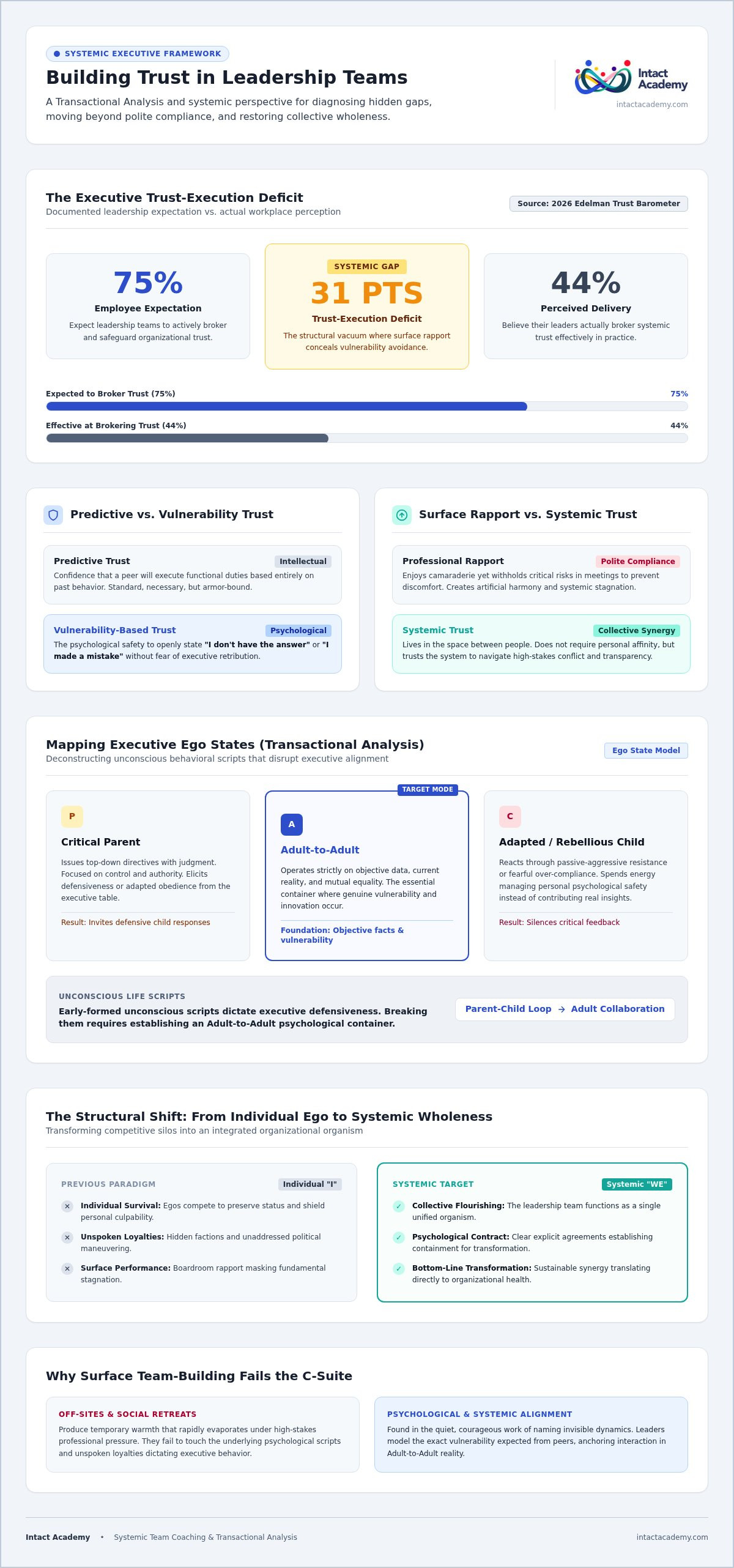
We must distinguish between predictive trust and vulnerability-based trust. Predictive trust is intellectual; it's the confidence that a colleague will fulfill their functional duties based on past behavior. Vulnerability-based trust is psychological. It's the courage to say, "I don't have the answer" or "I made a mistake," without fear of retribution. The 2026 Edelman Trust Barometer highlights a 31-point trust-execution gap in organizations, where 75% of employees expect leaders to broker trust, yet only 44% believe they do so effectively. This gap exists because many leadership teams master the predictive side while remaining armored against the vulnerability required for true innovation.
The path to sustainable alignment leads toward Systemic Wholeness. This state represents a return to genuineness where the team functions as a single, integrated organism rather than a collection of competing egos. It's a move from the "I" to the "We," where the focus shifts from individual survival to the flourishing of the entire organizational system.
The Difference Between Rapport and Systemic Trust
Professional rapport is often mistaken for trust. You can enjoy a colleague's company and still withhold critical information during a board meeting. This artificial harmony creates a dangerous silence where risks go unmentioned to avoid discomfort. Systemic trust is different. It doesn't require you to like your peers, but it demands that you trust the system to handle high-stakes conflict. It provides the interpersonal infrastructure needed for Adult-to-Adult dialogue, a core concept in Transactional Analysis, where objective data and reality take precedence over defensive posturing.
Why Traditional Team Building Fails Leadership Teams
Surface-level bonding exercises like off-site retreats or social dinners rarely touch the root of trust erosion. These events often create temporary warmth that evaporates under the first sign of professional pressure. Deep psychological insight is required to shift the underlying scripts that dictate team behavior. Leaders must set the systemic tone by modeling the very vulnerability they expect from others. Sustainable change isn't found in a ropes course; it's found in the quiet, courageous work of naming the invisible dynamics that pull a team apart. This is the foundation of how to build trust in a leadership team at a level that actually transforms the bottom line.
Mapping the Unconscious: Using Transactional Analysis to Diagnose Trust
To understand how to build trust in a leadership team, we must look beneath the surface of professional behavior into the unconscious architecture of human interaction. Transactional Analysis (TA) offers a sophisticated map for this journey. It allows us to move beyond observing what leaders do and start understanding why they do it. By categorizing our internal states into three distinct Ego States, Parent, Adult, and Child, TA reveals the hidden scripts that either fortify or fracture executive alignment. In a high-functioning system, trust is an Adult-to-Adult phenomenon, yet many boardrooms are unconsciously dominated by Parent-Child dynamics that stifle genuine collaboration.
When a CEO operates from a Critical Parent state, issuing directives with an edge of judgment, they often invite a Child state reaction from their team. This might manifest as passive-aggressive rebellion or a fearful, over-adapted compliance. In both scenarios, Adult-to-Adult trust erodes. The "Child" is too busy managing their own safety to offer honest feedback, while the "Parent" is too focused on control to receive it. Life Scripts are the unconscious life plans, formed in early childhood, that dictate our fundamental beliefs about our own worth and the reliability of others. These scripts act as a silent filter, often pre-determining our capacity for trust before we even step into a meeting.
Identifying Psychological Games in the Boardroom
In environments where vulnerability feels dangerous, teams often resort to psychological games. These are repetitive, dishonest patterns of interaction that provide a familiar, albeit destructive, sense of predictability. You might recognize the "Yes, But" game, where a leader asks for input only to systematically reject every suggestion offered. Another common game is "Now I've Got You," where a peer waits for a minor slip-up to launch a disproportionate critique. These interactions are fueled by the Drama Triangle, where individuals rotate between the roles of Victim, Rescuer, and Persecutor. These games are not just interpersonal annoyances; they are significant drains on organizational efficiency that prevent the team from reaching a state of systemic wholeness.
Moving to an Adult-to-Adult Leadership Culture
Transitioning toward a high-trust culture requires a deliberate return to the Adult ego state. This state is objective, present-centered, and data-driven. It's the only state capable of building psychological safety in the workplace by stripping away the weight of historical scripts and focusing on current reality. Leaders can cultivate this by practicing proactive inquiry and staying anchored in their Adult state, even when others around them "hook" their Parent or Child reactions. Understanding what is transactional analysis provides the necessary vocabulary for this shift, turning complex interpersonal friction into manageable systemic insights. For those seeking to master these profound human interventions, the TA EMCC Senior Team Coach Academy offers a rigorous path toward becoming a wise mentor in the executive space.
The 5-Step Framework for Cultivating Psychological Safety
Establishing psychological safety is not about creating a comfortable environment. It's about building an interpersonal infrastructure that can withstand the friction of high-stakes truth-telling. When we look at how to build trust in a leadership team, we must treat the team as a living organism rather than a collection of individuals. This framework provides the methodology to move from guarded performance to systemic wholeness. Research from the Center for Creative Leadership emphasizes that how to build trust in a leadership team is a reciprocal, systemic foundation required to navigate ambiguity and align executive priorities.
Step 1: The Power of Clear Contracting
A contract is more than a signed document; it's a shared understanding of reality. In Transactional Analysis, we identify three essential layers: administrative, professional, and psychological. The administrative contract covers the logistics of interaction. The professional contract defines the shared goals and purpose. The psychological contract addresses the unspoken needs and fears that often derail collaboration. By explicitly naming these layers, you reduce the ambiguity that fuels political maneuvering. This structural clarity is essential when leading organizational change, as it provides a stable anchor during times of systemic transition.
Step 2 involves identifying and naming the "invisible" dynamics. These are the systemic loyalties to former leaders or functional silos that pull the team apart. Step 3 focuses on implementing Adult-to-Adult communication protocols. This means establishing meeting rules that discourage Parent-state criticism or Child-state evasion. It ensures that objective data and present-centered reality remain the primary drivers of executive decision-making.
Step 4: Permission, Protection, and Potency
In the executive space, vulnerability is often viewed as a liability. To shift this, we use the "3 Ps" of Transactional Analysis. First, leaders need Permission to be human, to admit uncertainty, and to drop the mask of perfection. Second, the system must provide Protection. This means ensuring that transparency is rewarded rather than penalized by the board or peers. When permission and protection are present, the team develops Potency. This is the collective power to drive profound transformation and achieve results that were previously hindered by internal friction.
Finally, Step 5 requires regular systemic supervision. Just as individuals benefit from coaching, the team organism needs a reflective space to process its evolution. This ongoing commitment ensures that the trust built is not a temporary peak but a sustainable, systemic property of the leadership team. It allows the team to remain in a state of completeness, even as the external business environment changes.
From Individual Ego to Systemic Wholeness: The Role of Team Coaching
High-performance leadership requires a fundamental shift in perspective. It's the move from the "I" to the "We." Most executive development programs focus on the individual leader, yet the most critical challenges occur in the interactions between them. To truly grasp how to build trust in a leadership team, we must address the "unspoken loyalties" that operate beneath the surface. These are the hidden attachments to functional silos, former mentors, or personal career scripts that quietly pull the team in different directions. Systemic coaching treats the team as a single entity with its own history, patterns, and potential. By viewing the team as an integrated organism, we can begin to heal the fractures caused by competing egos and return the group to a state of systemic wholeness.
Overcoming Resistance to Systemic Change
Transformation is rarely linear. Teams often feel a sense of loss as they abandon old, familiar patterns of distrust, even when those patterns were unproductive. When pressure mounts, it's natural to regress into defensive silos where the ego feels protected. This period of transition is what we call the "liminal space." It's a time of uncertainty where the new culture of trust hasn't yet fully formed. The role of the external coach is to hold the "systemic container," providing a safe and stable environment where the team can process this discomfort without collapsing back into political maneuvering. This steady presence allows the team to stay with the work of how to build trust in a leadership team even when the process feels turbulent.
Measuring the Impact of Improved Trust
The results of this psychological work are tangible and measurable. Trust is the primary lubricant of organizational efficiency. When a leadership team functions with genuine vulnerability and alignment, decision-making speed accelerates. We see a significant reduction in "organizational drag," which is the hidden cost of second-guessing, gossip, and shadow meetings. The ripple effect is undeniable; a high-trust C-suite creates a template for the entire organization to follow. We track this evolution through systemic metrics, observing how the quality of conflict shifts from personal attacks to generative debates that serve the collective purpose.
Mastering these deep systemic interventions is the hallmark of a world-class practitioner. To gain the tools needed for this level of transformation, consider enrolling in the TA EMCC Senior Team Coach Academy.
Mastering Trust-Building: Professional Training for Senior Coaches
Transitioning from understanding the theory of systemic health to facilitating it within a boardroom requires a specialized set of psychological and methodological tools. While many practitioners grasp the surface-level mechanics of how to build trust in a leadership team, few possess the depth required to navigate the unconscious currents that dictate executive behavior. The TA EMCC Senior Team Coach Academy is designed for those ready to bridge this gap. It offers a rigorous path toward mastering the interventions that move a team from defensive posturing to a state of systemic wholeness. Earning an EMCC-accredited certification isn't just about professional recognition; it's about ensuring your practice is grounded in a framework that is both ethically sound and psychologically profound.
Why TA-Based Coaching is the Future of Leadership Development
The global market is increasingly demanding coaches who can manage high levels of systemic complexity. Transactional Analysis (TA) provides a precise map for this often-confusing landscape of human behavior in business. It allows you to see the "invisible" scripts and ego states that drive conflict, turning what feels like chaotic friction into a series of manageable systemic insights. Under the guidance of international expert Sari van Poelje, participants learn to bridge the world of organizational results with the world of deep human transformation. This unique focus sets Intact Academy graduates apart, equipping them to handle the high-stakes dynamics that standard business coaching often avoids.
Joining a Global Community of Systemic Practitioners
Learning doesn't happen in isolation. Our academy brings together a diverse cohort of professionals from over 14 different countries, creating a rich environment for cross-cultural learning and global citizenship. This community serves as a stable container for your own professional evolution, offering ongoing systemic supervision and development long after the initial program ends. It's a space where you can refine your potency and learn to provide the protection necessary for leadership teams to take real risks. If you're ready to move from reading about trust to actively facilitating it at the highest levels of global business, we invite you to explore our TA EMCC Senior Team Coach Academy. Your journey toward becoming a wise mentor in the executive space begins with a commitment to your own depth and professional mastery.
Beyond Performance: The Path to Systemic Wholeness
Authentic trust in the C-suite is not a soft sentiment; it's a systemic achievement. It requires moving beyond the "performance" of harmony and embracing the vulnerability of Adult-to-Adult dialogue. By using the architecture of Transactional Analysis, we can dismantle the psychological games that stifle innovation and return our teams to a state of completeness. This transformation doesn't happen by chance. It is the result of clear contracting, systemic insight, and the courage to look inward before taking outward action.
Mastering how to build trust in a leadership team is the hallmark of a truly sophisticated practitioner. To transition from understanding these concepts to facilitating profound human transformation, you need mastery-level training grounded in proven methodology. Our EMCC and ICF accredited programs provide the tools and the global community necessary for this evolution. We invite you to Join the TA EMCC Senior Team Coach Academy and become part of a global network of systemic practitioners. The journey toward organizational wholeness begins with your own commitment to depth and professional excellence.
Frequently Asked Questions
How can you rebuild trust in a leadership team after a major betrayal?
Rebuilding trust requires a deliberate process of re-contracting and surfacing the underlying systemic loyalties that were fractured. It isn't about simple apologies; it's about a collective return to genuineness. The team must process the betrayal from an Adult ego state, examining the administrative and psychological contracts that failed. This structured approach ensures that the repair is systemic rather than just emotional, preventing the same patterns from recurring under future pressure.
What is the most common reason leadership teams fail to trust each other?
The most common reason trust erodes is the prevalence of "artificial harmony" masking deep-seated Ego State conflicts. Instead of engaging in productive Adult-to-Adult dialogue, leaders often slip into Critical Parent or Rebellious Child roles. These unconscious interactions create a culture of defensive posturing and psychological games. When teams prioritize individual safety over systemic wholeness, they lose the ability to navigate complex challenges with the transparency required for high-level organizational success.
How do you measure trust in a leadership team quantitatively?
You can measure how to build trust in a leadership team by tracking decision-making velocity and the reduction of "organizational drag." Quantifiable metrics include the time spent in "shadow meetings" versus formal boardroom discussions. Additionally, validated instruments like psychological safety surveys provide a numerical baseline for interpersonal vulnerability. These data points, combined with systemic supervision metrics, allow a team to visualize their evolution from fragmented silos toward a state of completeness.
Can a leadership team build trust without a professional coach?
While teams can make progress through self-reflection, they often hit a ceiling caused by their own unconscious blind spots. An external practitioner provides the "systemic container" and the protection necessary for members to drop their masks. Professional training, such as that offered in our TA EMCC Senior Team Coach Academy, equips leaders with the psychological depth to see patterns they are too close to identify themselves. Without this external mirror, teams often regress under pressure.
How long does it typically take to see a shift in a team’s trust levels?
A shift in awareness can happen in a single, well-facilitated session, but sustainable transformation usually requires six to twelve months. This duration allows the team to move through the "liminal space" where old scripts are abandoned and new Adult communication protocols are integrated. The goal isn't a quick fix but a permanent evolution of the team organism. Consistent systemic supervision ensures these trust levels remain stable even as the external business environment fluctuates.
What is the role of the CEO in building team trust?
The CEO acts as the primary architect of the team's systemic tone. Their role is to model the vulnerability they expect from others, providing the "Permission" required for the team to be genuine. By staying in an Adult ego state during high-pressure negotiations, the CEO creates the "Protection" necessary for others to take risks. Their commitment to the psychological contract is the single most influential factor in determining how to build trust in a leadership team.
How does Transactional Analysis differ from other team-building frameworks?
Transactional Analysis (TA) differs from traditional frameworks by focusing on the unconscious architecture of human interaction rather than just observable behavior. While other models might suggest "better communication," TA provides a precise map of Ego States and Life Scripts. It allows teams to diagnose the specific psychological games, such as the Drama Triangle, that erode their potency. This depth ensures that interventions address the root causes of distrust rather than just the surface-level symptoms.
What happens if one member of the leadership team refuses to participate in trust-building?
When a member refuses to participate, it is often a systemic symptom rather than just an individual problem. The refusal may signal a lack of "Protection" within the current system or a fracture in the psychological contract. In these cases, the team must examine the systemic loyalties or fears that make participation feel dangerous for that individual. If the impasse remains, it becomes a boundary issue that the rest of the team must address from an Adult perspective.


