

Have you ever finished a coaching session feeling more exhausted than the person you're supposed to be helping? It's a sobering realization for many senior practitioners when they discover they've inadvertently stepped into a Rescuer role, while their client remains comfortably anchored in a state of helplessness. Using the drama triangle in coaching isn't merely about identifying difficult behaviors; it's about uncovering the deep, unconscious scripts that keep individuals and teams locked in repetitive, unproductive cycles. When you recognize these systemic games, you stop being an unwitting participant and start becoming a catalyst for genuine, lasting change.
You likely entered this field to facilitate profound growth, yet you often encounter teams that cycle through blame or individuals who seem to resist the very progress they claim to seek. We understand the frustration of working harder than the person sitting across from you. This guide offers a sophisticated diagnostic framework to help you move beyond surface level symptoms. You'll master the art of neutralizing these psychological patterns to facilitate systemic transformation in your practice. We'll explore the mechanics of the Victim, Rescuer, and Persecutor roles, providing practical techniques to shift your clients from reactivity toward a state of empowerment and wholeness.
Key Takeaways
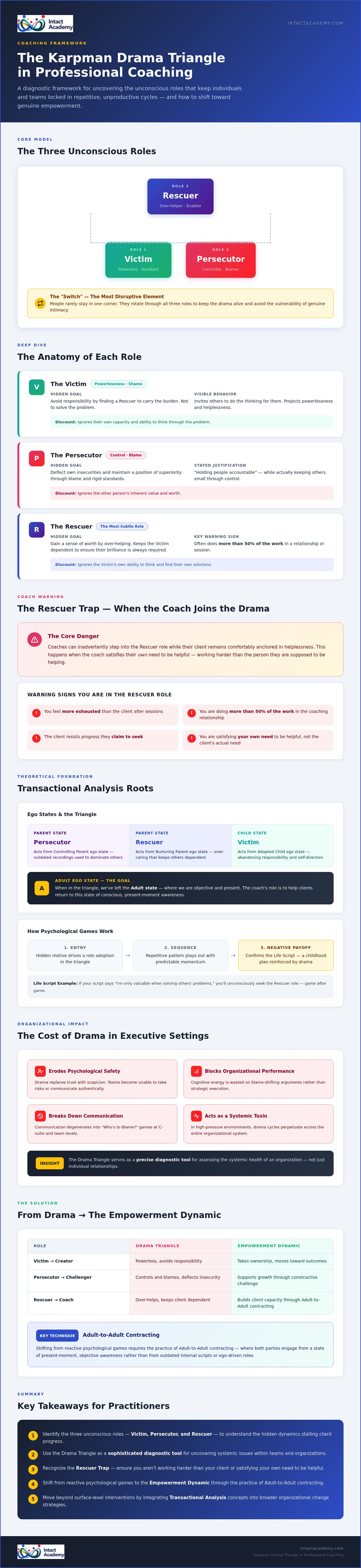
- Identify the three unconscious roles of Victim, Persecutor, and Rescuer to understand the hidden dynamics stalling client progress.
- Master using the drama triangle in coaching as a sophisticated diagnostic tool for uncovering systemic issues within teams and organizations.
- Recognize the signs of the Rescuer Trap to ensure you aren't working harder than your client or satisfying your own need to be helpful.
- Learn how to shift from reactive psychological games to the Empowerment Dynamic through the practice of Adult-to-Adult contracting.
- Move beyond surface-level interventions by integrating Transactional Analysis concepts into your broader organizational change strategies.
Understanding the Karpman Drama Triangle in Professional Coaching
The Karpman Drama Triangle offers a profound psychological map of dysfunctional social interactions. Developed by Stephen Karpman as an extension of Transactional Analysis, this model illustrates how individuals enter into unconscious "games" to satisfy deep seated emotional needs. Within this framework, participants adopt one of three primary roles: the Victim, the Persecutor, or the Rescuer. While these roles feel real to the people inhabiting them, they're actually defensive postures that prevent authentic growth and systemic wholeness.
The most disruptive element of this dynamic is the "Switch." People rarely stay in one corner of the triangle; they rotate through the roles to keep the drama alive. A manager might start as a Rescuer, feel unappreciated, and then switch to Persecutor to punish the team for their perceived lack of gratitude. This movement avoids the vulnerability of genuine intimacy and replaces it with a familiar, negative payoff. Using the drama triangle in coaching allows practitioners to hold a mirror to these shifts, creating the necessary friction for a client to choose a different, more conscious path.
The Anatomy of the Three Roles
Each role within the triangle carries its own hidden agenda and psychological cost. Understanding these nuances is essential for any coach aiming for systemic impact.
- The Victim: This individual projects a sense of powerlessness and shame. Their hidden goal isn't to solve the problem but to avoid responsibility by finding a Rescuer to carry the burden. They often invite others to do the thinking for them.
- The Persecutor: Driven by a need for control, the Persecutor uses rigid standards and blame to keep others small. They justify their behavior as "holding people accountable," though their true aim is to deflect their own insecurities and maintain a position of superiority.
- The Rescuer: Perhaps the most subtle role, the Rescuer gains a sense of worth by over-helping. They keep the Victim dependent, ensuring their own brilliance or kindness is always required. They often do more than 50% of the work in a relationship.
The Cost of Drama in Executive Settings
In high pressure environments, drama acts as a systemic toxin. It erodes psychological safety and blocks organizational performance by replacing trust with suspicion. When C-suite teams cycle through these roles, they waste immense cognitive energy on blame-shifting arguments rather than strategic execution. Using the drama triangle in coaching provides a clear lens to see where communication has broken down into a game of "Who's to Blame?" This insight is vital for returning a team to a state of effectiveness and genuine collaboration. The Drama Triangle serves as a precise diagnostic tool for assessing the systemic health of an organization.
The Transactional Analysis Roots: Ego States and Psychological Games
To achieve professional mastery when using the drama triangle in coaching, one must look beneath the surface of the model. It isn't a standalone tool; it's a vital branch of what is transactional analysis. At its core, this framework helps us understand the "Ego States" we inhabit: Parent, Adult, and Child. When we enter the triangle, we've effectively left our Adult state, where we're objective and present. Instead, we're operating from outdated internal recordings that no longer serve the current reality.
Every entry into the triangle is part of what we call a "Psychological Game." These games aren't playful; they're repetitive sequences with a hidden motive and a predictable, negative "payoff." This payoff serves to confirm our "Life Script," a childhood plan for how our life should go. If your script suggests that you're only valuable when solving others' problems, you'll unconsciously seek the Rescuer role. Each role involves a "discount," where we ignore some aspect of reality. A Rescuer discounts the Victim's ability to think, while a Persecutor discounts the other person's inherent value.
Ego States in the Triangle
The roles within the triangle are external manifestations of internal Ego States. The Persecutor often acts from a Controlling Parent state, using criticism to manage their own anxiety or need for order. Conversely, the Rescuer operates from a Nurturing Parent state, but in a distorted way that creates dependency rather than growth. The Victim resides in the Adapted Child state, re-enacting a time when they truly were powerless. The only exit from this pull is a return to the Adult state, which is the seat of consciousness, agency, and systemic wholeness.
Identifying the 'Game' Payoff
Why do we return to these painful patterns? It's because the payoff provides a familiar, albeit toxic, sense of security. In corporate settings, games like "Yes, But" or "I'm Only Trying to Help You" allow teams to avoid the risk of true change. By studying Sari van Poelje's systemic approach, coaches learn to spot the subtle "con" and "gimmick" that start these games before they escalate. This level of diagnostic precision is a core competency within the TA EMCC Senior Practitioner academy, where we move from observing behavior to mastering the science of human transformation.
Recognizing the Rescuer Trap: When the Coach Becomes Part of the Drama
Every practitioner enters the coaching room with a degree of "Stroke Hunger," which is the unconscious need to be seen as helpful, brilliant, or indispensable. While this drive often brings us to the profession, it also makes us vulnerable to the Rescuer trap. When using the drama triangle in coaching, the most difficult role to spot is often our own. We might believe we're simply being supportive, but if we're doing more than 50% of the work, we've effectively stepped into the triangle and invited the client to remain in a state of helplessness.
The signs of Rescuing are subtle but consistent. You might find yourself feeling strangely exhausted after a session while the client seems energized, or you may notice you're giving unsolicited advice to "save" them from a difficult decision. This dynamic is a systemic mirror of the client's wider world. When a coach rescues a leader, they're often re-enacting the over-functioning culture of that leader's organization. This prevents the client from reclaiming their agency and reinforces the very dysfunction they hired you to resolve.
The Coach as Persecutor or Victim
Coaches aren't immune to the "Switch" that keeps the drama alive. If a client fails to implement your suggestions, you might find yourself moving into a Persecutor role, judging their "lack of progress" or pushing them with a rigid intensity that mirrors their own internal critics. Alternatively, you might feel like a Victim when a demanding stakeholder or a resistant client makes you feel "done to." In these moments, a reflective inquiry is vital. Ask yourself: "Whose work am I doing right now?" This question helps you detach from the drama and return to a position of professional neutrality.
The Role of Systemic Supervision
True mastery requires a commitment to ongoing professional development for coaches that moves beyond simple skill acquisition. Systemic supervision is the essential container for this work, as it helps uncover "parallel processes" where the coach unconsciously acts out the client's internal drama. Within our Systemic Supervision offerings, we emphasize the "Contract" as your primary defensive wall. A clear, Adult-to-Adult agreement on goals and responsibilities ensures that the coaching space remains a place of transformation rather than a playground for psychological games.
Escaping the DDT: Moving from Drama to the Empowerment Dynamic
Breaking the cycle of the "Dreaded Drama Triangle" (DDT) requires more than a simple change in perspective. It demands a rigorous return to the Adult ego state. Using the drama triangle in coaching effectively begins with Awareness; you must name the role you're currently occupying without judgment. This naming interrupts the unconscious pull of the Life Script and allows for a moment of choice. Once aware, the practitioner must move immediately into Adult-to-Adult Contracting. By re-establishing the boundaries of the relationship, you dismantle the psychological "con" that fuels the drama and return the responsibility for growth to the client.
To facilitate a sustainable exit, we utilize the "3 Ps" of Transactional Analysis: Potency, Protection, and Permission. Potency is your ability as a coach to stay grounded and authoritative in the face of drama. Protection involves creating a safe, contracted container where the client feels secure enough to drop their defensive roles. Finally, Permission is the invitation for the client to behave differently than their childhood scripts dictate. These three elements provide the psychological stability needed to move toward the Empowerment Dynamic or the Winner's Triangle.
The Winner's Triangle: Healthy Alternatives
In the Winner's Triangle, each dysfunctional role is transformed into a state of agency and wholeness. The Victim becomes Vulnerable, learning to own their feelings and ask for what they need directly rather than signaling helplessness. The Persecutor shifts to Assertive, where they set firm boundaries and hold others accountable without attacking their inherent value. The Rescuer evolves into a Caring or Coaching presence, offering support and active listening while strictly refusing to take over the client's work. This shift ensures that the relationship remains systemic and developmental rather than transactional and draining.
Techniques for Facilitating the Shift
Practical techniques can help clients visualize and embody these new roles. The "Empty Chair" technique is particularly effective, allowing a client to hold a dialogue between their "Victim" part and their "Adult" part to uncover the discount at play. Using "I" statements also helps clients move from the blaming energy of Persecution to the clarity of Assertiveness. Contracting for the Adult is the primary antidote to drama. When you master these shifts, you move from being a "tool user" to a systemic practitioner. If you're ready to deepen your psychological rigor, explore our TA EMCC Senior Practitioner academy to master the science of human transformation.
Cultivating Mastery: Beyond the Triangle with Intact Academy
Mastering the nuances of the Karpman model is a bridge to a much larger landscape of systemic transformation. Using the drama triangle in coaching moves from a tactical intervention to a strategic pillar when you integrate it into a leading organizational change strategy. This shift requires you to move beyond being a mere "tool user" who identifies roles, becoming instead a systemic practitioner who understands the deep psychological undercurrents of an entire culture. When you view drama as a symptom of organizational health rather than just individual friction, you unlock the ability to facilitate profound, lasting evolution.
The TA EMCC Senior Practitioner academy provides the rigorous, stable container necessary for this level of study. It's a space where theory meets 30 years of expert insight, allowing you to refine your self-awareness and professional potency. By mastering the science of human behavior through the lens of Transactional Analysis, you ensure that your interventions are not just reactive fixes but invitations to systemic wholeness.
Systemic Team Coaching and Drama
In the context of team dynamics, the triangle often manifests as collective patterns rather than individual choices. You might observe a group unconsciously nominating a "Scapegoat" to occupy the Victim role, carrying the weight of the team's perceived failures. Conversely, a "Hero" might emerge as a perpetual Rescuer, preventing the group from developing the resilience needed to face strategic challenges. These patterns are rarely about the individuals involved; they're about the system's current inability to inhabit an Adult ego state. Our team coaching course provides the methodology to identify these group-level scripts. You'll learn to hold the Adult space for an entire system, breaking the cycle of organizational blame and moving the collective toward shared accountability and performance.
Your Path to Professional Wholeness
True professional mastery is a journey toward completeness and genuineness. Achieving an executive coaching certification that honors these psychological complexities distinguishes you in a crowded market. It signals that you're capable of more than transactional coaching; you're a facilitator of human transformation. We invite you to join a global community of mentors and experts dedicated to this depth of work. The difference between surface-level coaching and transformational TA mastery lies in the courage to look inward before taking outward action. We encourage you to explore our upcoming academy cohorts and masterclasses to begin your next stage of evolution. In this space, complex systemic issues become manageable through insight, structured methodology, and the quiet power of professional integrity.
Embodying Professional Mastery and Systemic Wholeness
Moving beyond the surface level of conflict requires a commitment to deep psychological study and a return to your own Adult ego state. By identifying the subtle shifts between Victim, Persecutor, and Rescuer, you reclaim the power to facilitate genuine transformation. Mastering the art of using the drama triangle in coaching isn't just about solving problems; it's about shifting the entire system from a place of reactivity to one of empowerment and clarity. This journey from a "tool user" to a systemic practitioner is the hallmark of professional integrity.
If you're ready to move beyond transactional interventions, we invite you to explore our EMCC and ICF accredited programs. Led by Sari van Poelje, our curriculum is built on 30 years of expert insight into human behavior and organizational systems. You can deepen your impact and master systemic change in our TA EMCC Senior Practitioner academy, where we provide the stable container for your professional evolution. It's time to step into your most potent self and lead your clients toward a state of completeness and genuineness. Your path to mastery begins with the courage to see the system as it truly is.
Frequently Asked Questions
How do I know if I'm Rescuing or actually Coaching?
You're Rescuing if you feel more exhausted than your client or if you're doing more than 50% of the work. Coaching focuses on the Adult-to-Adult contract, where the client remains responsible for their own growth. If you find yourself giving unsolicited advice or trying to "save" the client from discomfort, you've likely stepped into the triangle. True coaching empowers the client to find their own solutions rather than relying on your brilliance.
Can a team be stuck in a Drama Triangle collectively?
Yes, teams often adopt collective roles to manage systemic anxiety. A group might nominate a "Scapegoat" to occupy the Victim role, while a leader acts as a perpetual Rescuer. This dynamic prevents the team from taking collective responsibility and blocks organizational performance. Recognizing these patterns is a core part of using the drama triangle in coaching at a systemic level, allowing the team to move toward shared accountability and wholeness.
What is the difference between the Drama Triangle and the Winner's Triangle?
The Drama Triangle is a map of dysfunctional, unconscious interactions based on blame and powerlessness. In contrast, the Winner's Triangle offers healthy alternatives for each role. The Victim becomes Vulnerable, the Persecutor becomes Assertive, and the Rescuer becomes Caring. While the Drama Triangle relies on "discounts" of reality, the Winner's Triangle operates from an Adult ego state, where individuals take full responsibility for their feelings, boundaries, and support.
How do I bring up the Drama Triangle to a client without being a Persecutor?
Introduce the model as a neutral diagnostic tool rather than a critique of the client's character. You might say, "I'm noticing a pattern that reminds me of a framework called the Drama Triangle. Would you be open to exploring how it might be playing out here?" By asking for permission and maintaining a calm, Adult presence, you avoid the blaming energy of the Persecutor. This approach keeps the focus on systemic insight rather than personal judgment.
What happens if the client refuses to leave the Victim role?
If a client remains anchored in the Victim role, it often indicates a deep seated Life Script that provides a familiar psychological payoff. In these cases, you must return to the initial contract. Ask the client what they want from the session and clarify that you don't do the work for them. If the game persists, it may be necessary to address the discount directly or seek systemic supervision to ensure you aren't being pulled into the Rescuer trap.
Is the Drama Triangle the same as a Psychological Game?
The Drama Triangle is the visual map that illustrates the roles played within a Psychological Game. A game is a repetitive sequence of transactions with a hidden motive and a predictable, negative payoff. The triangle shows how people switch roles during the game to maintain the drama. Understanding this connection is vital when using the drama triangle in coaching, as it helps you spot the "con" and "gimmick" before the game reaches its conclusion.
How does Transactional Analysis improve my use of this model?
Transactional Analysis (TA) provides the theoretical foundation that most surface level coaching models lack. It connects the triangle to Ego States and Life Scripts, allowing you to understand why a client defaults to certain roles under stress. This depth transforms the triangle from a simple conflict tool into a sophisticated diagnostic window. TA mastery enables you to facilitate profound human transformation by addressing the root causes of repetitive behavioral patterns.
What training do I need to master systemic drama interventions?
Mastery requires moving beyond basic workshops into accredited, long term professional development. The TA EMCC Senior Practitioner academy at Intact Academy is specifically designed for this purpose. Led by Sari van Poelje, this program offers the systemic and psychological depth needed to handle complex organizational dynamics. Participants from over 14 countries join our cohorts to transition from "tool users" to expert practitioners capable of facilitating sustainable transformation in high pressure executive environments.


