

What if the most significant barrier to your growth as a coach isn't a lack of skill, but the very habit of focusing on the individual? When you begin transitioning from individual to team coaching, it's natural to feel like an imposter. You're observing a complex web of interactions, yet you might find yourself instinctively coaching one person at a time while the rest of the group fades into the background. It's a common struggle to maintain the narrative thread when the psychological games of a high-stakes team begin to surface.
You're right to feel that the stakes have changed. A team isn't just a collection of people; it's a living system with its own unconscious patterns and rhythmic needs. This guide helps you shift your lens from the individual ego to the systemic field using the psychological depth of Transactional Analysis. You'll discover a clear framework for systemic intervention and gain the confidence to manage group dynamics with quiet authority. We'll explore how to move beyond surface-level facilitation toward the senior-level mastery that honors both human transformation and organizational success.
Key Takeaways
- Learn how to shift your focus from individual egos to the systemic field; it's the foundation of treating the group as a single, living organism.
- Use Transactional Analysis to decode the collective "scripts" and ego states that drive a team's recurring patterns of behavior.
- Master the essential steps for transitioning from individual to team coaching by re-contracting your identity and adopting a systemic helicopter view.
- Develop the psychological resilience to manage imposter syndrome, ensuring you don't lose your way during high-stakes group games.
- Understand how senior-level accreditation and systemic supervision can anchor your practice; you'll gain the global credibility required for complex transformation.
Shifting the Lens: From Individual Ego to the Systemic Field
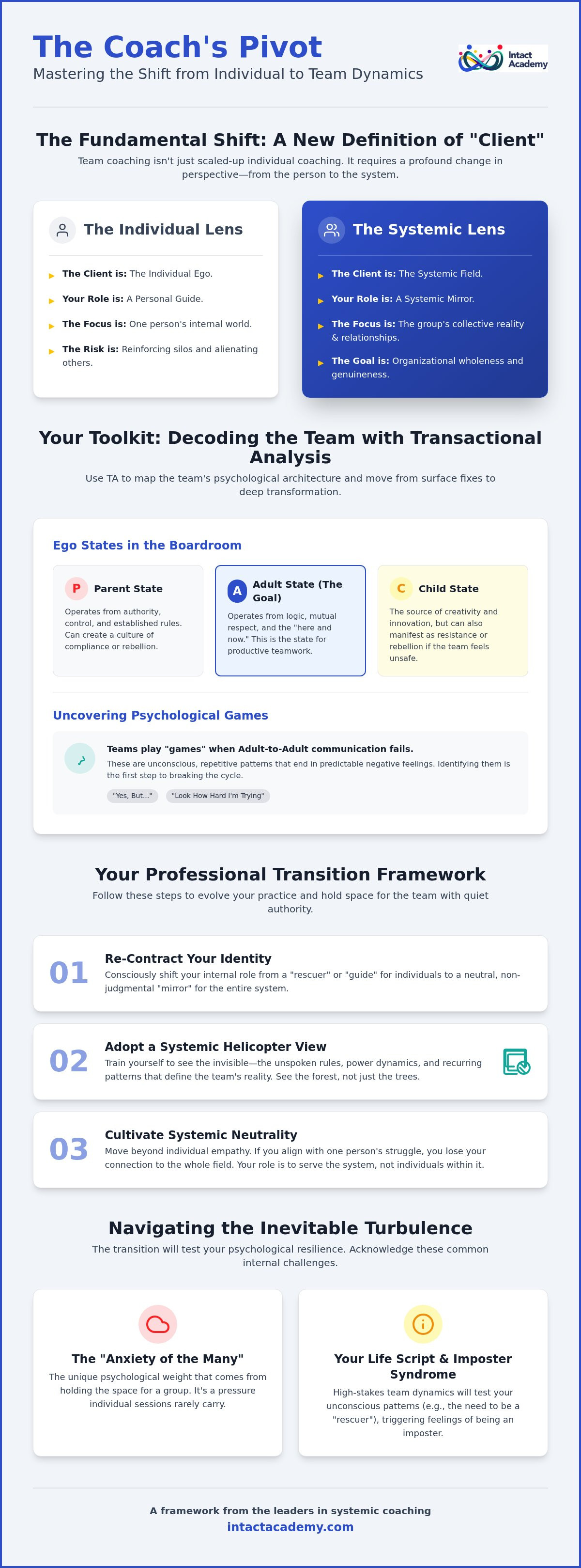
Many practitioners assume that team coaching is merely individual coaching performed in a larger room. This is a fundamental misunderstanding. When you are transitioning from individual to team coaching, you aren't just scaling your skills; you're changing the very definition of who your client is. In this systemic work, the "client" isn't the CEO or the manager; it's the systemic field. This field is the invisible web of relationships, history, and unexpressed needs that exists between the members. Understanding this shift is the first step in transitioning from individual to team coaching with integrity.
To succeed, you must evolve from a personal guide into a systemic mirror. While a guide helps an individual navigate their own ego, a systemic mirror reflects the group's collective reality back to them without judgment. Individual techniques often fail in this environment because they focus on the ego of one person. This can inadvertently alienate others or reinforce existing silos. Our goal is to foster organizational wholeness, allowing the system to return to a state of completeness and genuineness. This perspective honors the intelligence of the group rather than the expertise of the coach.
The Internal Landscape of the Team Coach
Entering a team session often triggers a specific "anxiety of the many." It's a psychological weight that individual sessions rarely carry. To hold this space effectively, you must move from individual empathy to systemic neutrality. If you empathize too deeply with one person's struggle, you lose your connection to the field. Your own Life Script, the unconscious plan formed in your early years, will inevitably be tested. If your script demands you be a "rescuer," you'll find yourself trying to save individuals rather than allowing the team to experience the productive tension necessary for growth.
Seeing the Unseen: The Team as a Single Organism
We must learn to listen for the "team voice." This isn't simply the loudest person speaking; it's the recurring theme that emerges from the collective silence, the shared jokes, and the recurring frustrations. In executive settings, every intervention has a systemic impact. A shift in one corner of the leadership team ripples through the entire organization, affecting its health and vibrancy. You're looking for invisible boundaries: the unspoken rules about who is allowed to speak, what can be challenged, and where the power truly resides within the professional team.
The Psychological Architecture: Using Transactional Analysis for Teams
When you are transitioning from individual to team coaching, you need a psychological map that accounts for more than just one person's internal world. Transactional Analysis (TA) provides this architecture. It allows us to see how a team functions as a single entity by analyzing the transactions between its members. Rather than just measuring productivity, we look at the health of the underlying psychological structure. This approach moves the work from surface-level transactional fixes to deep, transformational change.
Ego States in the Boardroom
In many hierarchical organizations, a "Parent" culture dominates. Decisions are made from a place of authority and control, often forcing other team members into a "Child" state of compliance or rebellion. For a coach, the goal is to foster "Adult-to-Adult" transactions. This is where the team operates from the here and now, using logic and mutual respect rather than outdated emotional patterns. While the "Child" state is often where innovation and creativity live, it can also manifest as resistance if the team feels unsafe. Recognizing these shifts in real-time is a hallmark of senior-level mastery.
Departmental "Psychological Games" often emerge when Adult communication fails. You might see "Yes, But" played out between marketing and sales, or "Look How Hard I'm Trying" during a difficult restructuring. These games are repetitive, unconscious patterns that end in a predictable "payoff" of negative feelings. By identifying these games, you help the team step out of the cycle and return to a state of genuineness. If you're looking to deepen your understanding of these dynamics, the TA EMCC Senior Team Coach Academy offers the structured methodology needed to navigate such complex group interactions.
Decoding the Team Script
Every team has a script. This collective narrative is built from past organizational failures, historical leadership styles, and shared successes. Just as an individual's script dictates their life choices, a team script dictates future performance. If a team's history is rooted in a "Don't Succeed" injunction from a previous merger, they will unconsciously sabotage new opportunities. Transitioning from individual to team coaching requires the ability to rewrite this narrative. You aren't just coaching the people in the room; you're helping the entire system shed its present-day limitations by honoring its history and choosing a new path forward.
A Step-by-Step Framework for the Professional Transition
Moving from the intimacy of a one-on-one session to the dynamic complexity of a group requires a disciplined methodology. When you're transitioning from individual to team coaching, you must first re-contract your professional identity. You aren't there to be the "hero" who fixes people; you're there to facilitate the system's own capacity for healing and growth. This shift demands a clear framework that anchors your practice as you move through the layers of organizational reality.
- Step 1: Identity Re-contracting. Explicitly move away from being a personal guide to becoming a systemic mirror.
- Step 2: The Helicopter View. Develop the capacity to observe patterns of interaction rather than just the content of the conversation.
- Step 3: Multi-party Contracting. Align the expectations of the team, the leader, and the broader organization.
- Step 4: Systemic Supervision. Use a supervisor to process the parallel processes that inevitably emerge in group work.
- Step 5: Senior Accreditation. Formalize your expertise through programs like the TA EMCC Senior Team Coach Academy to ensure global credibility.
The Art of Systemic Contracting
In individual work, the contract is often a simple agreement between two people. With teams, contracting for change involves managing a web of hidden stakeholders and conflicting agendas. You're contracting with the "systemic field" itself. This means establishing clear boundaries between coaching and consultancy. If the team expects you to provide the answers, you've slipped into a consultancy role. A systemic coach remains neutral, ensuring the contract focuses on the team's collective accountability rather than individual performance metrics.
Developing the Systemic Ear
To succeed in transitioning from individual to team coaching, you must train what we call the "systemic ear." This involves moving from content awareness to process awareness. Instead of listening to what is being said, you listen to how it's being said and who is being ignored. You can practice this by observing group silences. Is the silence a sign of reflection, or is it a "Child" state of withholding? Using silence as a systemic intervention tool allows the team to feel the weight of their own dynamics. It creates the space for them to step into their "Adult" state and take responsibility for the narrative they're co-creating.
Navigating the Turbulence: Overcoming Common Transition Challenges
Transitioning from individual to team coaching often feels like stepping into a storm without a compass. You might find yourself gripped by imposter syndrome during those first sessions. This isn't necessarily a lack of competence. It's often your body's response to the intense psychological pressure of the group field. Established teams have a natural "Outsider" dynamic; they may unconsciously test you to see if you can be pulled into their existing games or alliances.
In dysfunctional systems, the "Scapegoat" mechanism is a frequent trap. The team might present one member as the "problem" to avoid looking at their own collective shadow. As a coach, you must remain grounded. If you allow yourself to be pulled into a game, you lose your systemic neutrality. You become part of the dynamic you were hired to observe. Staying centered requires a deep commitment to your own psychological hygiene and a clear understanding of the systemic forces at play. It's about holding the space while the team tests its own boundaries.
Resistance as Information
When leading organizational change, resistance shouldn't be viewed as a barrier. It's vital systemic information. It's a defense mechanism designed to protect the status quo, however uncomfortable that status quo might be. Using Transactional Analysis, we can decode this refusal to grow. Is the team operating from a place of historical fear? Are they stuck in a script that says change is dangerous? By bringing this unconscious resistance into the light, you allow the team to choose a different, more Adult path forward. You transform a "refusal" into a shared inquiry.
The Safety Net: Systemic Supervision
Individual supervision focuses on the coach and a single client. Systemic supervision is different. It accounts for "parallel processes" where the dynamics of the team are mirrored in the coaching relationship itself. Finding a mentor like Sari van Poelje provides the senior-level guidance necessary to navigate these turbulent waters. You need a reflective space where you can process your own reactions and refine your systemic lens. Without this anchor, it's easy to lose the thread of the narrative in high-stakes environments.
To truly master these complexities and move beyond the surface, explore our Systemic Supervision offerings designed for senior practitioners who are committed to profound human transformation.
The Path to Mastery: Integrating Skills into a Senior Practice
The journey of transitioning from individual to team coaching reaches its zenith when you no longer see individual performance and systemic health as separate entities. Mastery involves synthesizing the depth of your one-on-one experience with a broader, more rhythmic understanding of organizational life. You aren't abandoning your roots; you're allowing them to support a more expansive canopy of influence. This integration distinguishes a senior practitioner from a facilitator. It's the ability to hold the individual's growth while simultaneously mirroring the system's evolution.
As you move forward, your professional identity must evolve to reflect this dual focus. You're no longer just a coach for people; you're a coach for the relationships and the culture they co-create. This shift requires a commitment to psychological depth and a willingness to step into the role of a wise global mentor. By anchoring your practice in Transactional Analysis, you ensure that your interventions remain grounded in evidence-based theory while reaching for profound human transformation.
Building a Systemic Portfolio
As you solidify your new identity, focus on selecting the right pilot teams. These aren't necessarily the easiest groups, but those where the systemic dynamics are visible and the leadership is open to Adult-to-Adult transactions. Documenting your impact is a critical part of professional development for coaches. You must learn to articulate how a systemic intervention led to a shift in organizational flourishing rather than just a change in an individual's behavior. Your marketing must reflect this shift. Move away from promising individual breakthroughs and toward offering systemic resilience and wholeness.
Joining the Global Community of Masters
True mastery is rarely achieved in isolation. It's forged within a cohort of international peers who challenge your perspectives and hold your growth. The TA EMCC Senior Team Coach Academy is designed to bridge the gap between deep psychological theory and professional pragmatism. It provides a stable container where you can experiment with systemic interventions and receive feedback from global experts who have seen the inner workings of countless organizations across 14+ countries.
This path is more than a professional upgrade. It's a return to a state of completeness and genuineness in your work. By embracing the complexity of transitioning from individual to team coaching, you position yourself at the intersection of human behavior and business success. EMCC Senior Team Coach accreditation serves as a global marker of this maturity. It signals to the market that you possess the courage to work with the system's shadow and the skill to guide it toward light. Your practice becomes a mirror for the organization's potential, reflecting back a vision of what it means to be truly human in a professional world.
Stepping Into Systemic Mastery
The journey toward becoming a senior team coach is a profound evolution of the self. You've seen how shifting your focus from individual egos to the systemic field allows for a deeper level of organizational transformation. By applying the psychological architecture of Transactional Analysis, you can decode the unconscious scripts and games that keep teams stuck in repetitive patterns. When transitioning from individual to team coaching, you're not just expanding your toolkit; you're refining your ability to act as a systemic mirror for the group's collective intelligence.
This path requires more than just facilitation skills. It demands a rigorous methodology and a community of peers who value depth. Our programs are taught by international experts and utilize a unique Systemic TA methodology to help you return to a state of completeness in your work. To formalize your expertise and gain global credibility through EMCC and ICF accredited training, we invite you to apply for the TA EMCC Senior Team Coach Academy. The complexity of the system doesn't have to be overwhelming when you have the right psychological map. Your next chapter of mastery begins with the courage to see the whole.
Frequently Asked Questions
What is the main difference between individual and team coaching?
The primary difference lies in the client definition; in individual work, you focus on a single person's ego and goals, while team coaching treats the entire group as a single organism. You're observing the systemic field rather than just personal narratives. This shift requires you to mirror the interactions and unconscious patterns that emerge between members, ensuring the collective system, not just the individual, moves toward a state of completeness.
Do I need a new certification to start coaching teams?
While no law mandates a specific license, obtaining a senior-level accreditation is vital for practitioners transitioning from individual to team coaching at an executive level. Global bodies like the EMCC and ICF provide frameworks that ensure your practice meets international standards for systemic work. Enrolling in a specialized academy provides the psychological depth and professional pragmatism required to manage the high-stakes dynamics found in global organizations.
How does Transactional Analysis help in team coaching?
Transactional Analysis offers a structured map to decode the unconscious architecture of a group. By identifying the Parent, Adult, and Child ego states within a boardroom, you can facilitate more genuine transactions. TA helps you recognize "Team Scripts" and repetitive psychological games that hinder performance. This methodology allows you to address the root causes of dysfunction rather than just managing surface-level symptoms of organizational conflict or resistance.
What are the common pitfalls when transitioning from 1-on-1 coaching?
A frequent mistake is attempting to coach individuals sequentially within the group setting rather than coaching the team as a whole. This often leads to the coach being pulled into the team's psychological games or alliances. Other pitfalls include losing the narrative thread during high-stakes facilitation and failing to establish clear systemic boundaries. These challenges can trigger imposter syndrome unless you have a clear framework for systemic intervention and grounded authority.
How long does it take to become a proficient team coach?
Proficiency is a process of becoming rather than a destination reached through a single workshop. For an experienced executive coach, the transition to senior-level team mastery typically involves a year of dedicated study and supervised practice. This timeframe allows you to integrate complex theoretical frameworks with real-world application. It's about developing the systemic ear and the internal stability to hold the anxiety of the many without losing your presence.
Is team coaching more profitable than individual executive coaching?
Team engagements often command higher fees because they address organizational-level challenges and involve multiple stakeholders. The scale of impact is greater; a single systemic shift in a leadership team can ripple through an entire company. While individual executive coaching remains valuable, team coaching allows you to leverage your expertise across a broader field. This reflects your status as a senior practitioner capable of facilitating profound human and organizational transformation.
What role does systemic supervision play in the transition?
Systemic supervision acts as an essential safety net and a reflective mirror for your practice. It helps you process parallel processes, where the team's dynamics are unconsciously mirrored in your relationship with them. A supervisor provides the grounding needed to stay neutral when a system tries to pull you into its dysfunction. This support ensures you maintain the integrity and depth required for senior-level work in complex, often turbulent executive environments.
Can I use the same tools I use in individual coaching for teams?
While some foundational skills overlap, most individual tools require a systemic reframe to be effective with groups. Techniques like active listening must evolve into systemic listening, where you hear the collective voice rather than just individual complaints. You'll need new methodologies, such as multi-party contracting and group script analysis, to address the unique psychological architecture of a team. Relying solely on 1-on-1 tools often fails to capture the group's complexity.


