

Conflict resolution skills can be learned; they aren’t simply innate. Facilitating difficult conversations in teams relies on skills people can practise, including listening without preparing a rebuttal, asking questions with genuine curiosity, and making room for perspectives that differ. Preparation matters, too: understand the issue, notice the emotions and identity concerns involved, and give the conversation a clear purpose.
If you’ve ever hesitated before raising a concern, you know good intentions alone don’t make a difficult discussion easier. With structure and practice, people can learn to stay present as tension rises, respond rather than react, and help a team move toward shared understanding.
This guide covers the communication skills that support difficult team conversations, ways to prepare for emotional and identity dynamics, and practical methods for rehearsing how to lead a discussion. It also explains how team coaching and related development can help leaders and teams build these capabilities over time.
Key Takeaways
- Listen to understand before responding, then use open questions and clear, respectful language to express your perspective.
- Prepare specific observations and consider how emotions, identity, culture, and power may shape the conversation.
- Set a shared purpose, make room for different voices, and close with clear commitments or a next step.
- Practise with role-play and feedback to build steadier communication and facilitation skills over time.
What core communication skills does facilitate difficult team conversations training build?
Facilitating difficult conversations in teams draws on four connected skills: listening, exploring perspectives, communicating clearly, and adapting to the setting. Practise each deliberately to keep tension focused on understanding rather than escalation.
-
Listen with curiosity and an open mind
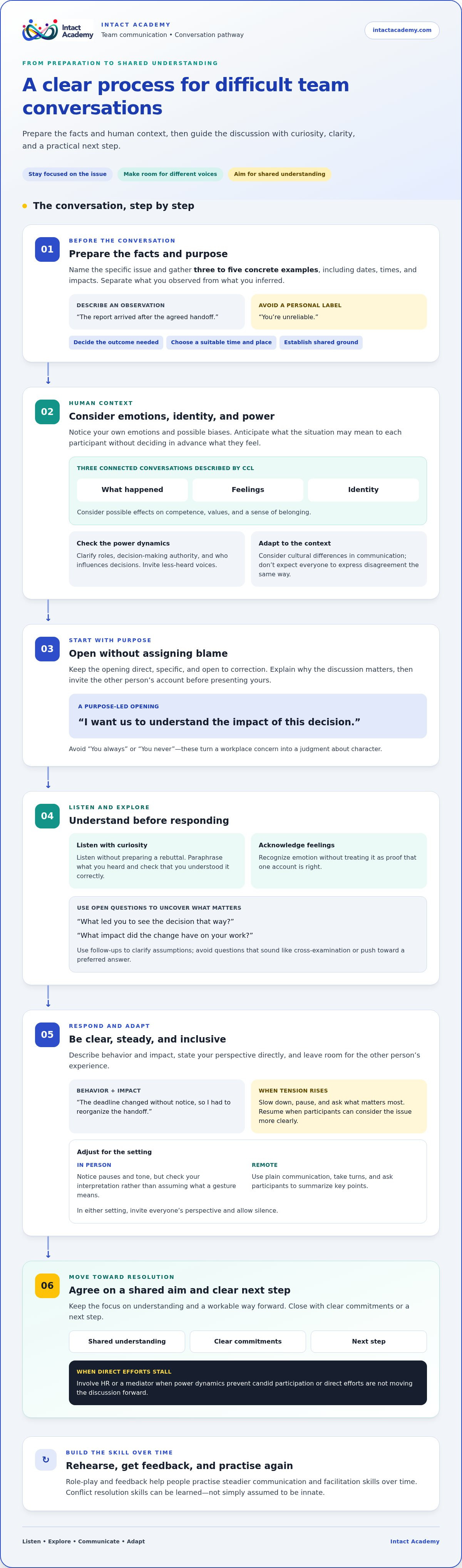
Ask each person how they experienced the situation, then listen without preparing a rebuttal. Separate observations from conclusions: paraphrase what you heard and check that you understood it correctly. Acknowledge feelings without treating them as proof that one account is right. To address power dynamics, clarify who makes decisions and who influences them, then invite less-heard voices into the discussion.
-
Explore perspectives with open questions
Ask questions that help the team explain what matters beneath each position. Try, “What led you to see the decision that way?” or “What impact did the change have on your work?” Open questions invite fuller answers than yes-or-no questions. Use follow-ups to clarify assumptions, and avoid questions that sound like cross-examination or push people toward your preferred answer.
-
Communicate assertively
State your perspective directly while leaving room for another person’s experience. Describe the behavior and its impact: “The deadline changed without notice, so I had to reorganize the handoff,” rather than labeling someone careless. If you receive criticism, pause, acknowledge the concern, and explain your view without dismissing theirs. This makes needs clear without turning disagreement into a contest over whose perspective counts.
-
Adapt to remote and in-person conversations
In person, notice pauses and tone, but check your interpretation instead of assuming what a gesture means. Remote conversations can lack nonverbal cues, increasing the chance of misunderstanding. Communicate plainly, take turns, and ask participants to summarize key points. In either setting, invite everyone’s perspective and allow silence. These adjustments help keep the process of facilitating difficult conversations in teams clear and inclusive.
Preparing facts, emotions, and identity considerations
Prepare the evidence and human context before inviting participants into a sensitive discussion. A clear purpose helps keep conflict focused on the issue rather than personal blame.
-
Prepare the facts
Identify the specific issue and gather three to five concrete examples, including dates, times, and impacts. Separate what you observed from what you inferred: “The report arrived after the agreed handoff” is more useful than “You’re unreliable.” Decide what outcome the discussion needs, and consider the consequences of raising the issue as well as leaving it unaddressed. Choose a suitable time and place, and establish shared ground before exploring disagreement.
-
Consider emotions and identity
Before the conversation, name your own emotions and possible biases. CCL describes difficult conversations as involving three connected conversations: what happened, feelings, and identity. Ask yourself what the situation may mean to each participant’s competence, values, or sense of belonging. Anticipate reactions without deciding in advance what someone else feels. Curiosity leaves room for their account and reduces the risk of treating an assumption as fact.
- Plan how to acknowledge emotion without losing sight of the issue. For example, say, “I can see this decision has been frustrating; I’d also like us to understand its effect on the handoff.” Explain why the discussion matters, recognize the other person’s concerns, and identify a shared aim. If hierarchy affects who feels able to speak, clarify roles and decision-making authority before inviting views.
- Adapt your preparation to the participants and context. In cross-cultural discussions, consider how differences may shape communication, and adjust your approach rather than expecting everyone to express disagreement in the same way. For a planned meeting, prepare a concise opening, supporting examples, and questions that invite the other person’s account. Keep sensitive details relevant to the issue, and avoid building a case from speculation or personal labels.
Strategies for managing tough conversations
Open with, “I’d like to understand what happened and find a workable next step.” Listen, paraphrase, and pause to de-escalate. Involve HR or a mediator when direct efforts stall or power dynamics prevent candid participation.
-
Choose an effective opening phrase
State the purpose without assigning blame: “I want us to understand the impact of this decision.” Then invite the other person’s account before presenting yours. Keep the opening direct, specific, and open to correction. Avoid “You always” or “You never,” which turn a workplace concern into a judgment about someone’s character and invite defensiveness.
-
Manage emotional triggers and resistance
When anger or defensiveness surfaces, slow the exchange rather than pushing for agreement. Describe what you observe without judging: “We’ve moved quickly from the missed handoff to its impact on the project.” Ask what matters most to the person, then reflect their answer. If the discussion becomes unproductive, pause and resume when participants can consider the issue more clearly.
-
Manage stress, reactions, and biases
Notice your own stress before responding to a sharp comment. Take a breath, distinguish the person’s words from your interpretation, and ask a clarifying question instead of immediately defending yourself. Leaders can consider whether feedback refers to a specific behavior or rests on an assumption about an individual. Staying curious helps prevent a reaction from narrowing the options the team can explore.
-
Handle heckling and joking
Respond to heckling without trading remarks. Acknowledge the comment briefly, then redirect attention to a group question or activity. If joking seems to release tension, name the tension directly and invite participants to discuss what feels difficult. Ask what is behind a side conversation rather than assuming bad intent. Involve HR or a mediator when repeated attempts cannot restore constructive dialogue.
Practice and training for difficult conversations
These skills develop through structured practice, not instinct alone. Use realistic scenarios, feedback, and reflection to make new techniques easier to draw on when a challenging conversation arises.
- Choose a realistic scenario and define its purpose before practising. For example, use a recurring disagreement about project priorities, but change identifying details. Assign roles for the facilitator and participants, then agree what the facilitator should practise: opening clearly, staying present, or handling resistance. A focused aim makes feedback more useful than a general instruction to “communicate better.”
- Role-play the conversation, then replay the moment that felt most difficult. A participant can practise responding to interruption, defensiveness, or silence without needing to resolve a real workplace conflict. Pause the exercise if the facilitator loses curiosity or rushes to fix the issue. Rewind, try another response, and notice how different wording changes the discussion.
- Give feedback on observable behavior, not personality. A useful comment might be, “You summarized their concern before sharing your view,” followed by a question about impact: “Did that help keep the exchange open?” Invite the facilitator to reflect on their thinking and emotional reactions. This makes feedback specific, respectful, and connected to the skill being practised.
- Build practice into ongoing development rather than treating one workshop as mastery. HR and learning teams can provide frameworks and support; managers can reinforce techniques during coaching and team reflection. Rehearse both in-person and virtual scenarios, then identify one behavior to apply in the next real discussion. Behavioral change from communication training typically becomes visible within weeks of consistent practice.
Develop your capacity to hold challenging conversations through structured coaching development.
Intact Academy: TA EMCC Senior Practitioner academy
Intact Academy’s TA EMCC Senior Practitioner academy supports professionals who want to deepen their coaching practice and work thoughtfully with complex interpersonal dynamics. If you’re applying listening, inquiry, and reflection in team settings, further development can help you examine how your presence shapes the conversation and how group patterns influence what becomes possible.
For work focused specifically on team coaching, Intact Academy’s TA EMCC Senior Team Coach Academy offers a relevant learning path. Executive Coaching may suit leaders seeking to develop their approach to challenging workplace discussions. The right next step depends on the work you want to do and the professional practice you’re building.
You’re welcome to contact Intact Academy to explore which learning path fits your goals.
Make the next conversation a place to grow
The next difficult discussion can become more than a moment to resolve tension. It can help a team build the capacity to speak honestly, learn from difference, and work with greater trust. That shift comes through repeated practice, thoughtful reflection, and a willingness to stay engaged when the conversation feels challenging.
For professionals ready to deepen this work, Intact Academy offers the TA EMCC Senior Practitioner academy and TA EMCC Senior Team Coach Academy. The TA EMCC Senior Supervisor academy offers a further development path for those working with supervision. Each supports a different professional focus while connecting to the broader practice of facilitating difficult conversations in teams.
Contact Intact Academy to build your team’s skills and explore a next step that fits your development. With care and practice, difficult conversations can become moments of greater understanding and possibility.
Frequently Asked Questions
Can conflict resolution skills be learned, or are they innate?
Conflict resolution skills can be learned and strengthened through deliberate practice. Differences in temperament may affect how readily someone speaks up or stays calm, but they don’t determine whether that person can improve. Practise one behavior at a time, such as acknowledging disagreement without interrupting. Then seek specific feedback on what helped keep the exchange productive and what made it harder.
How does psychological safety affect difficult conversations?
Psychological safety makes it more possible for people to raise concerns without fearing humiliation or punishment. It doesn’t mean everyone feels comfortable or agrees. For example, a team member should be able to question a proposed deadline without being treated as disloyal. Leaders shape this climate through their response to dissent: curiosity invites more candor, while ridicule can silence it.
What common challenges arise, and how does training help managers overcome them?
Managers may face defensiveness, silence, competing accounts, or one person dominating the discussion. Training lets them practise responding to these moments before they arise in a consequential meeting. An observer can note whether the manager interrupted, made space for quieter voices, or moved too quickly to a solution. Reviewing these behaviors gives the manager a clear focus for the next practice round.
Which tools and prerequisites prepare managers for challenging team talks?
Managers need a clear purpose, relevant examples, enough time, and an understanding of who can decide or influence the outcome. A short agenda can identify the issue, the perspectives to hear, and the decision that remains open. For a virtual meeting, send the purpose in advance and agree how participants will take turns. These simple tools reduce confusion before the discussion begins.
What makes conversations difficult in teams, and why do they matter?
Team conversations become difficult when people interpret the same event differently, or when roles, status, values, or limited resources are at stake. A disagreement about priorities, for example, may also reflect concerns about workload or recognition. Avoiding the underlying issue can leave people acting on different assumptions. Addressing it helps clarify shared expectations and reveal what the team needs to resolve.
How should a manager prepare for a difficult team conversation?
Start by deciding why the discussion needs to happen and what a useful next step would look like. Consider the cost of raising the issue and the cost of continued silence. Then plan a neutral opening, identify who should participate, and clarify what you can decide yourself. If the conversation ends without agreement, define what remains open and how the team will return to it.


