

Credibility comes from showing how your work helps leaders change, not simply claiming expertise. To market yourself as an executive coach, define the challenges you are equipped to address and support that focus with thoughtful insights and client testimonials. Evidence of real progress gives prospective clients a more grounded reason to trust you than broad promises do.
Visibility matters, but it does not answer the question an executive is weighing: “Can this coach understand the complexity of my role and help me move forward?” Your positioning, professional voice, and evidence of impact can begin to answer that question before a first conversation.
This article explores how to build credibility through a clear area of expertise, responsible use of testimonials and case studies, and useful content that reflects the realities of leadership. The aim is not to make your work sound larger than it is. It is to communicate its value with clarity and integrity, and with enough specificity for the right people to recognize themselves in it.
Key Takeaways
- Choose a clear leadership challenge to be known for, and make your public message reflect the change you help clients pursue.
- Use email to continue a useful conversation after someone engages with your work; make each message relevant and give readers a clear next step.
- Shape your LinkedIn profile and content around executive concerns, sharing practical insight that demonstrates how you think and work.
- Request specific, permission-based testimonials that describe the client’s experience and progress, so prospective clients can assess your approach with greater clarity.
1. Personal branding, credibility, and client testimonials
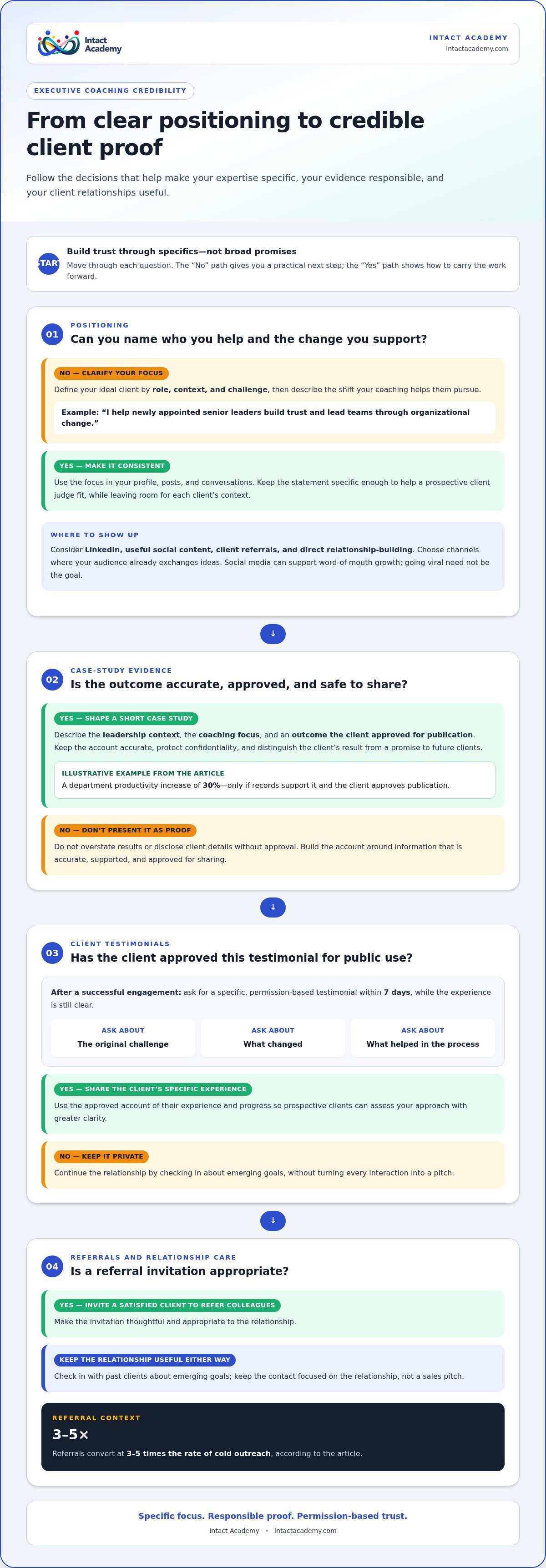
An effective executive coaching brand makes a clear promise to a specific audience. Define your ideal client by role, context, and challenge, then identify the change your coaching supports. For example: “I help newly appointed senior leaders build trust and lead teams through organizational change.” This is more credible than claiming expertise in every leadership issue.
Which marketing channels work best for executive coaches in the United States? LinkedIn, useful social content, client referrals, and direct relationship-building can help you reach potential clients. Choose channels where your audience already exchanges ideas, then keep your message consistent across your profile, posts, and conversations. Social media can support word-of-mouth growth, but going viral need not be the goal.
What makes an effective positioning statement for an executive coach? Name the leaders you serve, the situation they face, and the meaningful shift your work helps them make. Keep it specific enough to guide your marketing while leaving room for each client’s context. A defined focus helps prospective clients judge whether your approach fits their needs.
Credibility grows when you make your process visible. Share a short case study describing the leadership context, the coaching focus, and an outcome the client has approved for publication. If records support it, an example might describe a department productivity increase of 30%. Keep the account accurate, protect confidentiality, and distinguish the client’s result from a promise to future clients.
Ask for a testimonial within 7 days of a successful engagement, while the experience is still clear. Invite the client to describe the original challenge, what changed, and which part of the process helped. Maintain continuity by checking in with past clients about emerging goals, without turning every interaction into a pitch. When appropriate, invite satisfied clients to refer colleagues; referrals convert at 3-5 times the rate of cold outreach. This makes relationship care a practical, thoughtful part of building a coaching business.
2. Email list building and nurture sequences
A focused email list gives potential clients a quieter way to understand your work. Create a landing page around one useful resource, such as a leadership reflection guide or a short decision-making exercise. Explain who it helps, what readers will receive, and how to subscribe. Share the page in LinkedIn posts, workshop follow-ups, and your email signature. This attracts people interested in your practice rather than building an untargeted list.
Build campaigns around a real leadership question. For example, a sequence about leading through organizational change could offer one insight in each email. Start with the promised resource, then share a practical reflection, a coaching example, and an invitation to take action. Keep messages focused. Concise emails respect busy readers and give each idea room to land.
Timing matters after a live interaction. Follow up with workshop or speaking attendees within 24 hours, as recommended in the market research. Mention the session’s topic, offer one relevant takeaway, and invite a reply or next step. If someone attended a session on leadership transitions, send a prompt they can apply to an upcoming conversation. This turns a single event into a thoughtful continuation, not an abrupt sales approach.
Email is not the only format. A short video can explain one coaching concept, while SMS can support brief, timely communication with people who have chosen that channel. Keep your message consistent across formats, but adapt its shape: an email can explore context, a video can demonstrate a reflective question, and a text can point to a useful next action. Track which messages prompt replies, resource downloads, or booked conversations, then refine your campaigns.
Design each sequence to help readers move from interest to informed action. If you’re developing a more grounded coaching practice, explore professional coaching development as a way to deepen the thinking behind your public communication.
3. LinkedIn profile optimization and executive-focused content
Treat your LinkedIn profile as a working introduction, not a résumé archive. Use your headline to name your audience and its leadership challenge. Explain your approach, relevant experience, and coaching services in the About section. Keep your photo, language, and featured resources consistent with your personal brand. Executives should quickly understand whom you help and how to start a conversation.
Identify ideal clients by examining the roles, organizational contexts, and recurring challenges you understand well. Then focus on people whose responsibilities and needs align with that experience. For example, if your work centers on leadership transitions, create content for executives stepping into broader roles. This helps potential clients see the relevance of your work before they engage.
Use LinkedIn as a place to demonstrate thought and invite meaningful exchange. The recommended baseline is 2-3 posts per week at minimum. A useful content balance is four expertise-demonstrating posts for each post inviting engagement. Share a decision-making prompt, an anonymized coaching insight, or a reflection on team dynamics. Answer comments with substance; a considered response can extend the original idea and deepen professional dialogue.
Build a free resource around one practical executive need, such as a meeting-reflection worksheet or a leadership-transition guide. Make the next action clear, whether readers download the resource or respond with a question. The resource should be useful on its own, not a disguised pitch. A focused lead magnet can also provide material for future posts and conversations.
Longer content can give complex ideas room to develop. LinkedIn articles of 1,500-2,500 words monthly are recommended as anchor content. Choose one issue, such as authority during change, and connect its organizational context with an actionable reflection. Adapt the central thought for other platforms, but preserve its meaning. Track which topics prompt relevant replies and profile visits, then use those signals to refine your content and strengthen your coaching practice over time.
4. Executive coaching testimonials
A useful testimonial helps prospective leaders understand what working with you feels like. Get permission to share the client’s words, and preserve their meaning and context. A strong account might describe the leadership situation, the client’s insight, and how that insight influenced their next action. Include the client’s role or industry only with explicit approval. Specificity makes testimonials informative rather than merely flattering.
Ethical marketing means protecting confidentiality, getting clear consent, and representing results accurately. Use only credentials and designations you hold, and distinguish completed qualifications from training in progress. Do not imply that one client’s experience is typical or guaranteed for everyone. If a testimonial identifies a person or organization, secure approval for that exact use and platform.
How much should executive coaches spend on marketing and advertising? A market recommendation is to allocate 5-10% of revenue to marketing. Treat that as a planning guide, then decide how to distribute the budget across channels, content, and events. Review whether each expense supports a clear objective, such as reaching decision-makers or building referral opportunities.
Measure performance by recording where inquiries come from, how many turn into conversations, and how many engage your program. Track marketing expenses alongside new clients to estimate acquisition cost: divide total marketing spend by the clients acquired in the same period. Compare channels using the same tracking window. For example, record a LinkedIn inquiry separately from a referral.
Common mistakes include publishing testimonials without adequate consent, overstating outcomes, and using vague claims that obscure your position. Avoid treating likes as proof of business impact; track qualified inquiries and client conversations instead. Use each review to improve your message, not to promise identical results. To strengthen the coaching work behind credible client stories, explore executive coaching support.
Intact Academy: TA EMCC Senior Practitioner academy
Intact Academy’s TA EMCC Senior Practitioner academy can support coaches who want to deepen their practice and communicate their work with greater clarity. When marketing prompts questions about your approach, professional development can help you examine the thinking and methods behind your coaching.
If your work centers on teams, the TA EMCC Senior Team Coach Academy may align with your development goals. The TA EMCC Senior Supervisor academy is for those focused on supervision. Intact Academy also offers Executive Coaching. Consider which direction aligns with the clients and leadership challenges you serve, then let that focus shape your professional message.
Credibility grows through congruence: your professional development, your work, and your claims should reflect one another. To explore a learning path that fits your coaching direction, contact Intact Academy.
Let your visibility grow from the work itself
Learning how to market yourself as an executive coach is not separate from coaching. It is an opportunity to bring the same curiosity, integrity, and attention to your public presence that you bring to a leadership conversation. Choose one message you want the right people to remember, then check whether your profile, writing, and conversations express it clearly.
Make your next step deliberate rather than simply louder. You might refine how you describe your approach, deepen your professional development, or make space to reflect on the kind of change you want to support. Over time, alignment between your practice and your communication can make your work easier to understand and trust.
If you’re ready to explore how your development can support your coaching practice, contact Intact Academy to discuss your coaching. Keep building with care, and let your credibility emerge through the quality and consistency of your work.
Frequently Asked Questions
How can executive coaches build credibility without extensive client testimonials?
Show how you think through practical examples, relevant experience, and clear boundaries. If you are considering how to market yourself as an executive coach, publish a leadership scenario and explain how you might explore competing priorities without presenting it as a client result. Describe your training accurately, clarify whom your approach suits, and offer a focused resource. These signals help prospective clients assess your judgment before you have many testimonials.
How can executive coaches use LinkedIn to attract corporate clients?
Use LinkedIn to make your relevance to organizational decision-makers visible. Follow target companies and notice the leadership themes their executives discuss. Respond with thoughtful observations, then publish posts connecting those themes to coaching practice, such as navigating a role transition or improving team communication. Keep your profile aligned with the work you want to attract, and use genuine conversations to learn whether an organizational need exists.
How do executive coaches generate referrals and strategic partnerships?
Make referrals easier by describing the situations where your work is most useful. In a follow-up conversation, you might say, “I’m especially helpful when a leadership team is adapting to a new structure.” Build partnerships with complementary professionals, such as organizational consultants or leadership-development specialists, by sharing insights and clarifying where your work connects. Respect client confidentiality, and never imply a referral relationship without agreement.
What should an executive coach include on a website and landing page?
A focused website can help you market yourself as an executive coach by showing visitors whom you serve and how to take the next step. Include the leadership challenges you address, your coaching approach, a concise biography, and useful content such as a reflection exercise. Keep navigation simple, use language executives understand, and give each page one clear purpose, such as inviting a conversation or offering a relevant resource.
What are typical executive coaching fees and pricing models in the United States?

Article by
Drs. Sari van Poelje
Sari van Poelje is an international master executive and team coach, supervisor and expert in agile business innovation. She has 40 years of experience. She is Managing Director of Intact Academy. The academy offers EMCC level 7 accredited training to coaches and consultants in 10 countries. She was also a director in multinationals such as Shell, EMI Music, KLM and ASML for 23 years.
Sari works with multinationals, family businesses and start-ups in a wide range of industries. She coaches leadership teams to create inspiring leadership, cooperative cultures and agile innovation processes.
She is an accredited EMCC Master Coach, Master Team Coach and Master Supervisor. She holds an MSc in systemic team coaching and an MSc in supervision. She is a Teaching and Supervising Transactional Analyst (TSTA-O) and a PCM coach trainer. She has published 34 articles and 5 books on leadership, coaching and organisational change.


