

The sponsor isn’t the only person who needs to understand coaching. Stakeholders can be invited to experience it, while the coaching relationship stays centred on the person being coached. Managing stakeholders in a coaching engagement means identifying who can support, influence or be affected by the work, then agreeing openly on everyone’s role and the boundaries around confidentiality.
Involving relevant people can clarify the context, connect development goals to organisational priorities and help sustain change. But involvement should be purposeful, not automatic. The coachee’s agreement, the engagement’s purpose and clear expectations all matter.
This article explains how to map stakeholders, decide whom to involve and help them understand coaching without turning it into a reporting exercise. You’ll also learn how to connect individual development with business needs and use feedback to review progress. The aim is a clear, human framework: enough shared understanding to support change, with enough trust to keep the coaching meaningful.
Key Takeaways
- Map who can influence, support, or be affected by coaching, then tailor each person’s involvement to their role.
- Offer stakeholders a chance to experience coaching so they can better understand its purpose and value.
- Agree on meaningful progress measures and gather feedback in ways that protect the coaching relationship.
- Connect development goals to organizational priorities while keeping expectations, responsibilities, and confidentiality clear.
1. Stakeholder mapping for organisational coaching programmes
Start by mapping the people who shape, support or experience the coaching: the coachee, executive sponsor, Human Resources, direct manager and relevant project partners. Note each person’s influence, interest and expected involvement. Some may provide context at the outset; others may need only periodic updates. Use the map to decide who to consult, inform or involve in reviewing agreed goals.
For a kickoff, bring the coachee, coach and sponsor together to clarify the purpose, desired outcomes, roles and confidentiality boundaries. A three-way meeting works best when the coachee has agreed to the participants and everyone understands what information may be shared. Keep coaching distinct from performance management, and agree how to discuss progress without disclosing private session content.
Consider organisational politics and reporting lines before setting goals. In a matrix organisation, a coachee may have two line managers with different priorities. Map both perspectives and identify where expectations overlap or conflict. A project manager may also be relevant if the leadership challenge arises within a project. Ask the coachee which relationships affect their work, then gather relevant context transparently.
Prepare for the first meeting with focused materials, not an information dump. Before intake, send a short overview of the coaching purpose, process, commitment and confidentiality boundaries. Use the session to explore the coachee’s roles, organisational structure, current challenges, perceived leadership style and previous feedback or assessments. Agree which goals connect to organisational objectives and which details remain confidential.
Sponsor influence becomes risky when coaching is treated as surveillance, goals serve only the sponsor or pressure silences the coachee. The coach should contract clearly with all parties and preserve the coachee’s say over information sharing. To support continuous learning and organisational agility, revisit the stakeholder map when priorities or reporting relationships change. Adjust participation while keeping the coaching purpose clear.
Progress measurement through feedback and mini-surveys
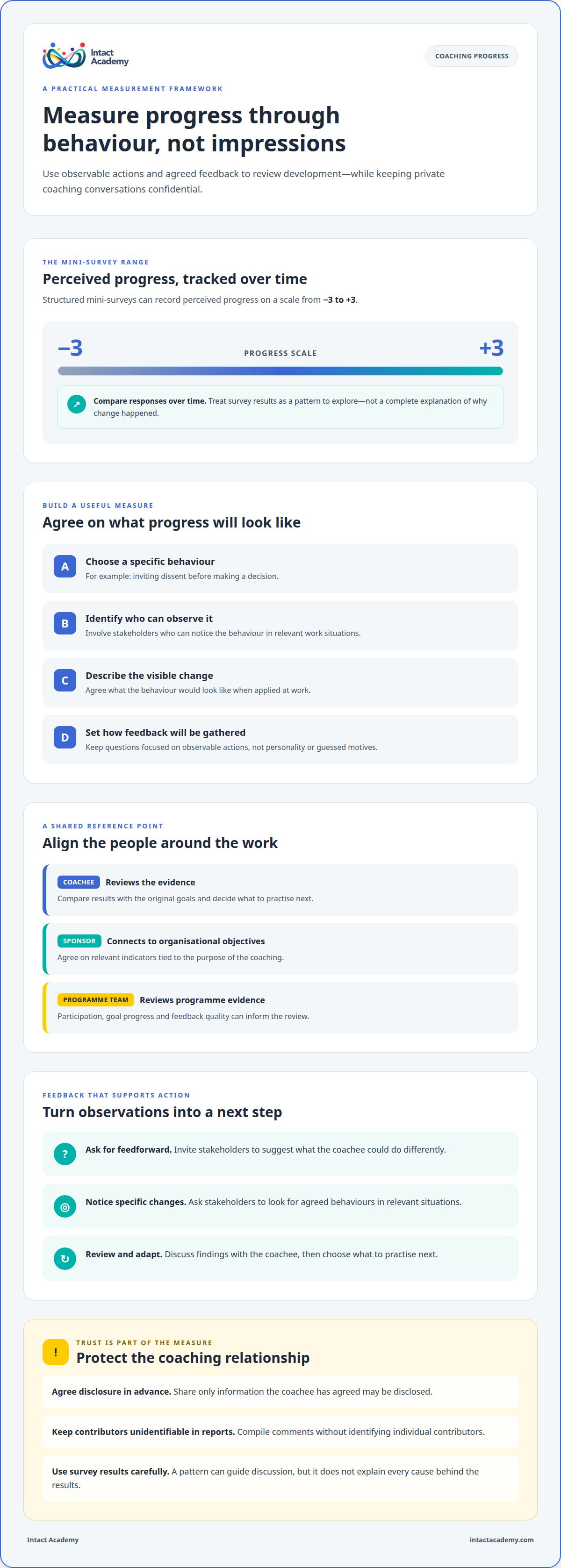
Define progress through observable behaviour, not broad impressions. At the outset, agree on a specific leadership behaviour to practise, such as inviting dissent before deciding. Identify who can observe it, what change would look like and how feedback will be gathered. This gives the coachee, executive sponsor and programme team a shared reference point without making confidential coaching conversations part of the assessment.
How often should a coach communicate with organisational sponsors? Agree on a communication rhythm during contracting, based on programme milestones and the sponsor’s role. Schedule updates around those checkpoints, and share only information the coachee has agreed may be disclosed.
Feedforward turns measurement into a practical next step. Ask stakeholders for suggestions about what the coachee could do differently, then invite them to notice specific changes. In structured approaches, mini-surveys can track perceived progress on a scale from -3 to +3. Compare responses over time, and compile comments in a report that doesn’t identify individual contributors. Keep questions focused on observable actions, not personality or speculation about motives.
Budget holders and programme managers may define value differently. A budget holder may want to know whether coaching supports organisational objectives, while programme managers may focus on participation, goal progress and feedback quality. Set measurable objectives at the programme’s outset, then choose indicators that connect these perspectives. For example, track whether agreed leadership behaviours are applied in relevant work situations, alongside stakeholder observations.
Use evidence with care. A mini-survey can reveal a pattern, but it doesn’t explain every cause behind it. Review results with the coachee, compare them with the original goals, and decide what to practise next. If you’re developing a stronger approach to individual leadership growth, executive coaching can help build the practice that supports this work.
3. Connecting coaching to business needs and priorities
Start with the organisational need, then translate it into a developmental goal the coaching client can own. For example, if departments struggle to coordinate decisions, the goal might focus on listening across functions and clarifying shared priorities. The sponsor can describe the business context, while the client identifies behaviours they’re willing to practise. The coach connects both perspectives without turning coaching into a performance mandate.
How do you align a coaching client, sponsor and coach on goals? Hold a contracting conversation where each person explains their hopes, concerns and measures of progress. Agree on a shared purpose, specific goals, roles and confidentiality boundaries, then document them for reference.
Bring Human Resources into the dialogue when it helps connect the assignment to wider organisational priorities. A coaching agreement can clarify intended outcomes, who participates in reviews and what information may be shared. Keep the client’s goals distinct from the sponsor’s expectations, then identify where they genuinely overlap. If they conflict, address that tension before setting measures.
Make the business connection observable. Choose indicators tied to the coaching purpose, such as whether cross-department meetings surface shared outcomes or whether a leader invites perspectives before making decisions. Ask what success would look like to the sponsor, the client and the people affected by the work. Their answers can shape relevant measures without reducing development to a single metric.
To build a broader coaching culture, identify stakeholders affected by, interested in or able to influence its development. A pilot can give participants and decision-makers a focused experience of coaching; collect their feedback and examples to inform the next stage. Present those insights alongside relevant performance indicators, and explain how coaching may support productivity, retention or performance. Avoid claiming a causal result unless the evidence supports it. This keeps the case credible, connects investment to organisational priorities and leaves room to learn as needs evolve.
4. Identifying stakeholders in an individual coaching engagement
Start with the person being coached, then trace the relationships around their work. Identify the sponsor or manager authorising the assignment, Human Resources, relevant line managers and people affected by the development goal. A project manager may be relevant when coaching relates to a specific project. Include someone only when their perspective, support or influence connects to the purpose.
Global Coaching Alliance describes an individual engagement as a four-way partnership among the client, sponsor or manager, Human Resources and coach. The sponsor commonly supports and authorises the assignment; the manager can provide context and reinforce sustained growth. Clarify each role, especially when one person is both sponsor and line manager.
What is the difference between stakeholder management in internal and external coaching? An internal coach works within the organisation, so organisational relationships and role boundaries need careful attention. An external coach contracts across the client, sponsor, Human Resources and coach, clarifying who receives updates and what remains confidential.
Ask the coachee to name people who see the relevant behaviour in practice. For a leader improving cross-team collaboration, that might include a peer team lead, a direct report and a project partner. Discuss each proposed stakeholder with the coachee, agree whether they’ll be involved and define what they may contribute. Their input should inform development, not become a route for undisclosed evaluation.
Clarify the assignment’s real purpose, too. If a manager recommends coaching instead of addressing a performance concern directly, distinguish developmental goals from unresolved performance management. The coachee needs to understand the process, commitment, implications and duration before agreeing. If they hesitate about sharing information, explore their concerns rather than treating consent as a formality.
For coaches building skill in complex organizational relationships, develop your stakeholder-aware coaching practice through focused professional learning.
Intact Academy: TA EMCC Senior Practitioner academy
Intact Academy’s TA EMCC Senior Practitioner academy supports coaches seeking to deepen their professional practice. The stakeholder work discussed here calls for more than mapping roles. It asks coaches to hold the client’s development alongside organisational expectations, contract transparently and keep confidentiality and trust in view.
If you’re reflecting on how to work with these dynamics in your own coaching, the academy offers a path for continued development. For work centred on teams and their wider organisational relationships, Intact Academy also offers the TA EMCC Senior Team Coach Academy and Team Coaching.
You’re welcome to contact Intact Academy to explore the next step that fits your practice.
Carry the work into your next engagement
Managing stakeholders in a coaching engagement is an ongoing practice of attending to both human development and organisational context. In your next engagement, consider whose perspective could help the client move forward and what boundaries will protect trust. A thoughtful conversation can make the work clearer without making it less personal.
For coaches looking to deepen their professional development, Intact Academy offers the TA EMCC Senior Practitioner academy, TA EMCC Senior Team Coach Academy and TA EMCC Senior Supervisor academy. Each provides a distinct learning pathway for practitioners reflecting on their coaching work and its wider impact.
Contact Intact Academy to explore a suitable next step. Continue with curiosity, clarity, and respect for the people involved.
Frequently Asked Questions
Can you offer stakeholders the opportunity to experience coaching?
Yes. Invite a sponsor or manager to experience a brief coaching conversation using a neutral workplace challenge, rather than the coachee’s personal material. This can help them understand coaching as reflective dialogue, not advice-giving or performance reporting. Explain the purpose beforehand, and keep the demonstration separate from the coachee’s confidential work. This is especially useful when a stakeholder is unfamiliar with coaching.
How is progress measured?
Measure progress by comparing agreed behaviours with real examples from work. A coachee might reflect on whether they now invite differing views before making a decision, while a colleague describes what they observed in a meeting. Use self-reflection and stakeholder feedback together, then review the evidence against the original development aim. A single score rarely captures the full context of change.
What is stakeholder management in a coaching engagement?
Managing stakeholders in a coaching engagement means coordinating the people connected to the work without letting their interests displace the coachee’s development. It involves identifying who can influence the assignment, understanding what each person needs from it and agreeing how they can contribute. For example, a sponsor may clarify organisational context, while a peer can offer insight into everyday collaboration.
What should a coaching agreement say about confidentiality and information sharing?
The agreement should specify who may receive updates, what they can contain and how the coachee approves information sharing. It can distinguish attendance or goal-review updates from private session content. For example, the sponsor might receive a progress summary reviewed by the coachee, but not personal reflections shared in coaching. Revisit the agreement if participants or expectations change.
How should coaches handle conflicting stakeholder expectations?
Make any disagreement explicit before it shapes the coaching goals. For example, a sponsor may want faster decisions, while the coachee wants to build broader team participation. Clarify the business concern behind each expectation, then identify a development goal that addresses the underlying tension. If the parties cannot agree on the assignment’s purpose, pause goal-setting and renegotiate the coaching contract together.
How can a coach manage stakeholder feedback without compromising client trust?
Agree on the feedback process with the coachee before inviting input. Ask stakeholders for observations about specific work behaviours, not character judgments, and explain how their comments will be used. Share themes rather than attributed remarks, unless the coachee has agreed otherwise. For instance, summarise that colleagues notice more questions in team discussions without naming individual respondents or revealing session content.

Article by
Drs. Sari van Poelje
Sari van Poelje is an international master executive and team coach, supervisor and expert in agile business innovation. She has 40 years of experience. She is Managing Director of Intact Academy. The academy offers EMCC level 7 accredited training to coaches and consultants in 10 countries. She was also a director in multinationals such as Shell, EMI Music, KLM and ASML for 23 years.
Sari works with multinationals, family businesses and start-ups in a wide range of industries. She coaches leadership teams to create inspiring leadership, cooperative cultures and agile innovation processes.
She is an accredited EMCC Master Coach, Master Team Coach and Master Supervisor. She holds an MSc in systemic team coaching and an MSc in supervision. She is a Teaching and Supervising Transactional Analyst (TSTA-O) and a PCM coach trainer. She has published 34 articles and 5 books on leadership, coaching and organisational change.


