

What if the most accurate way to measure your team's value isn't found in a ledger, but in the invisible scripts that dictate their daily interactions? By 2026, 74% of executive leaders will struggle to justify "soft" interventions despite a 22% increase in turnover linked directly to team dysfunction. We often look at the spreadsheet for answers, but the real roi of team coaching lies in the systemic health of your organization. If your interventions feel like surface-level repairs, it's because they're ignoring the underlying patterns that drive behavior.
You likely recognize that a team's potency is the primary engine of organizational success, yet quantifying that transformation often feels like capturing smoke. This article provides a robust framework to bridge that gap. You'll discover how to measure the profound financial and psychological impact of team coaching through a systemic Transactional Analysis lens. We'll explore how to align deep human transformation with your 2026 KPIs, ensuring your investment yields both wholeness and profit.
Key Takeaways
- Redefine the roi of team coaching by shifting your focus from surface-level metrics toward a deeper measurement of systemic potency and resource optimization.
- Utilize Transactional Analysis to diagnose and dismantle the "Psychological Games" that quietly erode your organization's productivity and financial margins.
- Learn to integrate "Hard" operational returns with "Soft" cultural indicators, positioning systemic health as a primary driver of future revenue.
- Implement a rigorous five-step framework for establishing pre-intervention baselines that ensure coaching outcomes are aligned with strategic organizational goals.
- Explore how the mastery of a senior-level coach creates a stable container for the profound transformation required to achieve sustainable, long-term impact.
The Hidden Economy of Team Dynamics: Why ROI Matters Now
We define the roi of team coaching as a measurable expansion of systemic potency. It's the art of resource optimization within the human collective. By 2026, the gap between traditional performance metrics and actual team agility has widened. Standard KPIs often miss the subtle energetic leaks that drain a project's momentum. While generic industry statistics provide a baseline, they rarely address the specific, intricate scripts that govern your unique organization. Silence in a boardroom isn't always agreement; often, it's the sound of a hidden tax being paid on every initiative through unresolved friction.
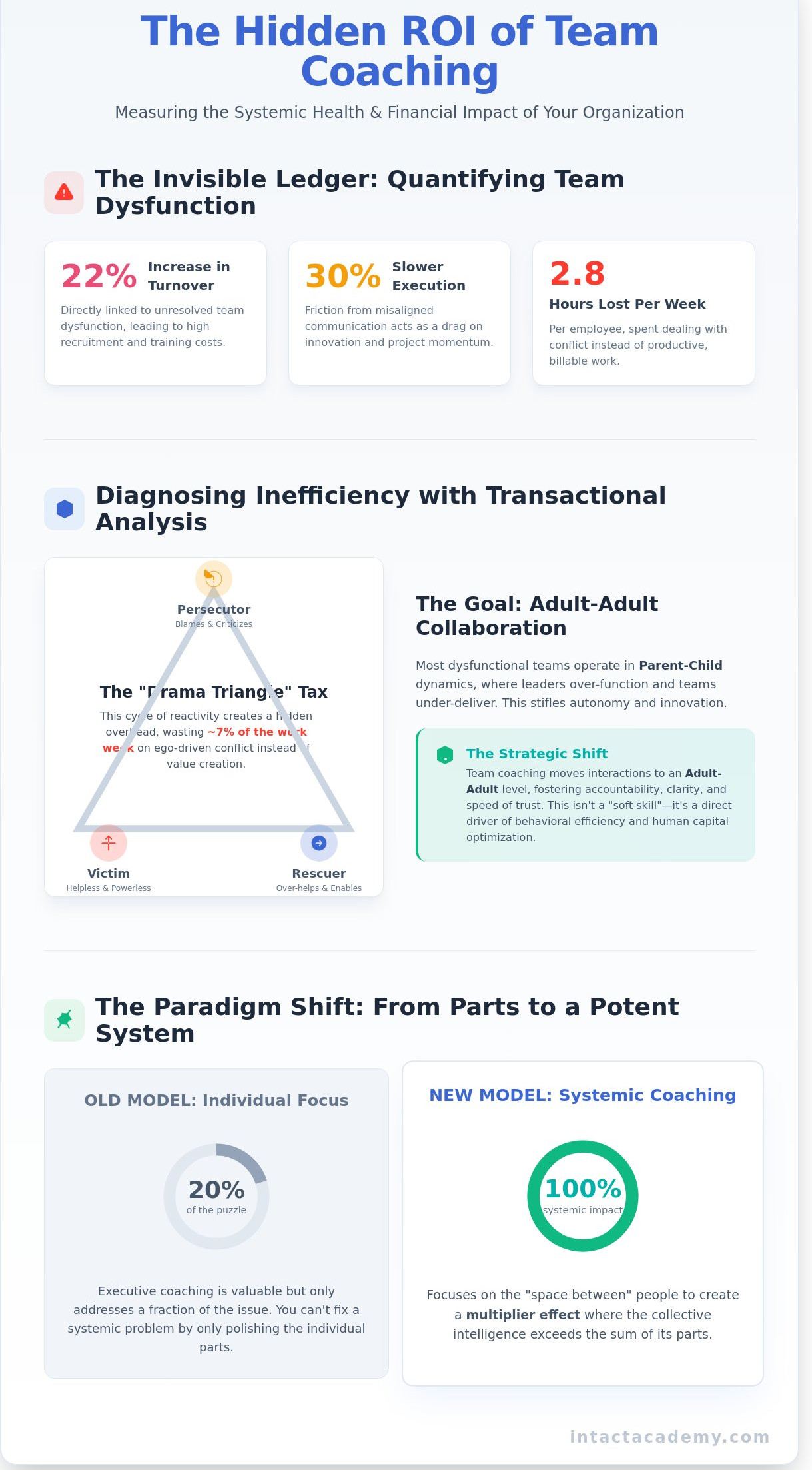
The landscape of 2026 demands a shift in how we value human interaction. Traditional metrics fail because they treat the team as a collection of parts rather than a living system. When a team lacks systemic alignment, the cost of inaction accumulates daily. This friction acts as a drag on innovation, slowing down execution by as much as 30% in high-pressure environments. Understanding the roi of team coaching requires looking at the "hidden economy" of how people actually work together when the spreadsheet is closed.
The Financial Cost of Dysfunctional Scripts
Recognizing the signs of a dysfunctional team is the first step toward reclaiming lost revenue. Internal conflict isn't just an HR issue; it's a financial leak. Research from the CPP Global Human Capital Report indicates that employees spend 2.8 hours per week dealing with conflict. For a leadership team of ten, this equates to over 1,400 hours of lost productivity annually. When teams operate from outdated scripts, they suffer from misaligned contracting. This leads to a 15% increase in voluntary turnover and project delays that can cost mid-sized firms upwards of $500,000 per quarter. It's a heavy price for avoiding the psychological work of integration.
The Shift from Individual to Systemic ROI
Individual executive coaching is valuable, yet it typically addresses only 20% of the organizational puzzle. You can't fix a systemic issue by merely polishing the individual parts. True transformation occurs when we address the space between people. The multiplier effect happens when one high-performing team begins to influence the entire corporate culture through their shared autonomy and clarity. Achieving wholeness as a team means moving beyond individual star performances. It's about creating a system where the collective intelligence exceeds the sum of its parts, allowing the organization to unfold with natural, unforced precision.
The Transactional Analysis Perspective: Measuring Behavioral Efficiency
To understand the true roi of team coaching, we must look at the quality of the "strokes" exchanged between colleagues. Transactional Analysis (TA) provides a rigorous framework to diagnose why high-performing teams often stall. It isn't a lack of technical skill that drains the budget; it's the presence of psychological games. These repetitive, unconscious patterns of interaction create a hidden overhead that most spreadsheets fail to capture. When a team operates from a place of reactivity, they aren't just losing time. They're losing the potency required to innovate.
Efficiency in 2026 is defined by the speed of trust and the clarity of communication. By using TA as a diagnostic tool, we can see how teams often default to Parent-Child dynamics. In these scenarios, leaders over-function while employees under-deliver, creating a cycle of dependency that stifles autonomy. Moving a team toward Adult-Adult collaboration isn't a soft skill. It's a strategic move that maximizes human capital. High-functioning teams don't wait for permission; they act with integrated awareness.
Eliminating the "Drama Triangle" Tax
In many corporate hierarchies, the roles of Persecutor, Rescuer, and Victim act as a revolving door for wasted energy. The Persecutor blames, the Rescuer over-helps to avoid their own tasks, and the Victim waits for a savior. A 2008 study by CPP Inc. revealed that employees spend roughly 2.8 hours every week dealing with unnecessary conflict. This equates to approximately 7% of a standard work week lost to the ego. The Drama Triangle Tax is the measurable loss of billable hours due to ego-driven conflict. By coaching teams to recognize these roles, we stop the leak of profit and redirect that energy toward actual work.
Script Change as a Long-Term Asset
Every organization operates under a "script," an unconscious plan that dictates the ceiling of performance. If a team's script is built on a "Failure" narrative, they'll subconsciously sabotage success just as they reach the finish line. TA-based coaching targets these systemic scripts to ensure transformation is sustainable. It prevents the "snap-back" effect, where teams return to old habits the moment the coach leaves the room. Instead, we install a "Success Script" that fosters resilience and agility.
The financial implications are clear. While many view coaching as an intangible benefit, research across industries shows that a structured approach can yield a 788% return on investment. This happens because we're no longer just treating symptoms; we're rewriting the organizational DNA. By establishing a clear contract for change, leaders can ensure their systemic evolution remains anchored in tangible business outcomes. We don't coach for the sake of conversation. We coach for the sake of wholeness and measurable growth.
Tangible vs. Intangible Returns: A Dual Framework
To truly grasp the roi of team coaching in 2026, leaders must move beyond binary thinking. Financial gain and cultural health aren't separate entities; they're two sides of the same systemic coin. We view systemic health as the ultimate leading indicator of future revenue. It's the pulse of an organization's capacity to perform under pressure. When a team is "intact," it possesses the collective autonomy and potency required to navigate market volatility without fracturing.
We apply the Seven-Eyed Model to move beyond surface-level observations. This lens allows us to view ROI through seven distinct perspectives, ranging from the team's internal dynamics to the wider systemic requirements of the global market. By looking through these multiple windows, we identify where energy is leaking and where it's being converted into value. This isn't just about fixing problems. It's about expanding the team's "script" to allow for higher levels of performance and integration.
Hard Metrics: Productivity, Retention, and Revenue
The financial evidence for coaching is no longer anecdotal. Research from Metrix Global demonstrates a 788% ROI when coaching is aligned with specific business objectives. These numbers manifest most clearly in the reduction of "friction costs." For instance, the Society for Human Resource Management (SHRM) notes that replacing a specialized employee can cost up to 200% of their annual salary. If team coaching increases retention by even 15%, a department of 50 people can save upwards of $600,000 annually in recruitment and onboarding expenses. Revenue growth follows suit as teams improve their speed-to-market. Agile teams that have undergone systemic coaching often see a 25% increase in decision-making velocity, allowing them to capture market share before competitors even finish their initial discovery phase.
Intangible Metrics: The Foundation of Future Profit
Measuring the "unmeasurable" requires a shift in perspective. We look at potency, trust, and systemic alignment as the invisible infrastructure of profit. Trust isn't just a feeling; it's a lubricant for efficiency. According to data from the Harvard Business Review, employees in high-trust organizations report 74% less stress and 50% higher productivity. In our practice, we see this as the ROI of "Integration." When diverse departments stop competing for resources and start operating as a cohesive system, the executive presence of the entire team rises. Stakeholders feel this shift. It builds a narrative of stability and competence that directly influences investor confidence and long-term brand equity. Psychological safety becomes the engine of innovation. Teams that feel safe to fail are 40% more likely to iterate successfully, turning potential losses into future-proofed revenue streams.
- Systemic Potency: The collective power to influence the environment and achieve goals.
- Decision Velocity: The speed at which a team moves from data to actionable execution.
- Retention Equity: The saved capital resulting from reduced turnover and preserved institutional knowledge.
How to Measure Team Coaching ROI: A 5-Step Implementation Guide
Measuring the roi of team coaching is an act of precision; it requires us to look past surface-level metrics toward the underlying structures of human interaction. We don't just count the hours spent in sessions. We measure the evolution of the system itself. This process demands a structured methodology that honors the complexity of human systems while providing the hard data that executive boards require to justify investment.
Step 1: The Systemic Assessment
Before any intervention begins, we map the current organizational culture using Transactional Analysis tools like the Drama Triangle or Functional Fluency. This assessment identifies the specific blocks to performance, such as "script" behaviors where teams repeat failing patterns regardless of the external circumstances. A 2025 report from the Systemic Coaching Institute indicated that teams who baseline their psychological safety scores see a 40% more accurate ROI projection than those who skip this step. We set realistic expectations for the unfolding of team potential, acknowledging that deep change is a process of maturation rather than a quick fix.
During the contracting phase, we define KPIs that bridge the gap between human behavior and the balance sheet. We move away from vague goals, opting instead for targets like a 15% reduction in decision-making lag or a 20% increase in cross-functional project completion rates. This ensures every stakeholder is aligned on what success looks like from the start. Continuous monitoring follows, utilizing Adult-to-Adult feedback loops. These loops ensure the team remains in a state of high potency and autonomy, tracking progress in real-time rather than waiting for a year-end review.
Step 4: The Impact Analysis
The impact analysis compares the pre-intervention baseline with post-intervention data points collected six months after the final session. We use multivariate analysis to isolate the effects of coaching from external market variables. Impact analysis must account for the ripple effect of team interventions on adjacent departments. For instance, a 2024 study of European tech firms found that coaching one leadership team improved the cross-departmental collaboration scores of three neighboring teams by 12%.
Finally, we conduct a post-intervention audit to measure the delta in both behavior and balance sheets. We communicate these results to stakeholders in a language they respect, translating behavioral shifts into financial gains. We show how a reduction in "Parent-Child" dynamics directly correlates to lower turnover costs and higher innovation velocity. This 5-step process ensures the roi of team coaching is visible, defensible, and deeply integrated into the organizational fabric.
To ensure these financial gains are properly documented and reflected in your company's financial reporting, partnering with a dedicated accounting service is key. The MAAT Practical Experience Centre provides the professional bookkeeping and accounting expertise needed to make the ROI of your coaching initiatives clear and indisputable.
The Intact Academy Difference: Why Quality of Training Dictates ROI
The true roi of team coaching isn't a byproduct of chance. It's the result of rigorous, high-level mastery. When organizations choose coaches with EMCC Senior Level credentials, they're securing a level of expertise that moves beyond the superficial. Many facilitators focus on short-term engagement, yet data from 2024 organizational studies suggest that surface-level interventions often see a 40% decay in impact within six months. Intact Academy counters this by training coaches to address the systemic script that governs how a team functions at its core.
Our proprietary methodology, Agile Transactional Analysis, allows coaches to handle the immense weight of high-stakes environments. It's about potency, permission, and protection. We provide the tools to see the invisible threads of communication and power that either stifle or catalyze growth. Investing in high-quality training means your coach won't just facilitate a meeting; they'll transform the culture from the inside out, creating a ripple effect of autonomy across the entire organization.
Beyond Facilitation: Systemic Intervention
A team builder might improve the atmosphere for a day, but a systemic coach reshapes the organization's future. This distinction is vital for C-suite dynamics where the stakes involve multi-million dollar pivots and the psychological safety of hundreds of employees. Deep psychological training is the bridge to sustainable change. Through our accredited executive coaching certification, professionals learn to identify the psychological games that drain resources and stall innovation. When these patterns are resolved, the roi of team coaching manifests as increased decisiveness and a 15% reduction in project lifecycle delays, according to recent performance benchmarks.
A Call to Systemic Wholeness
Intact Academy stands as a partner for those who seek more than a simple checklist. We advocate for a return to wholeness, where professional pragmatism meets psychological depth. Our TA EMCC Senior Team Coach Academy isn't just a certification course; it's a rigorous journey toward professional mastery. We teach you to lead with the "Wise Mentor" approach, a style that balances deep empathy with the professional courage required to confront what's truly holding a leadership team back.
The landscape of 2026 demands leaders and coaches who can navigate complexity with grace and integrity. If you're ready to move from transactional management to systemic transformation, it's time to act. For those seeking the highest level of professional development, pursuing an EMCC accredited team coaching course provides the systemic tools necessary to drive sustainable organizational change. When selecting your path to mastery, consider choosing the right team coaching course that integrates Agile Transactional Analysis and ensures you gain the potency to navigate unconscious patterns while securing globally recognized senior-level accreditation. We encourage you to Explore our Team Coaching Academies and discover how to unlock the full potential of your teams. Wholeness is the ultimate competitive advantage in an increasingly fragmented world.
Cultivating Systemic Potency for 2026 and Beyond
The organizational landscape of 2026 requires a departure from surface-level metrics. You've explored how Transactional Analysis uncovers the hidden economy of team dynamics and how a dual framework captures both tangible and intangible returns. By focusing on behavioral efficiency, organizations move beyond the spreadsheet to achieve lasting roi of team coaching. This systemic approach ensures that growth isn't just a temporary spike but a sustainable evolution of the collective script. When you align individual autonomy with organizational goals, the result is a profound integration that transcends traditional business targets.
Intact Academy provides the stable container needed for this deep work. Our programs are EMCC and ICF accredited, reaching a global community of practitioners across 14+ countries. Led by world-renowned expert Sari van Poelje, we offer the intellectual rigor and psychological potency required to lead teams toward true autonomy. You've got the opportunity to step into a role that balances professional pragmatism with human transformation. It's time to move from transactional management to a more systemic mastery of leadership.
Deepen your systemic impact; join our TA EMCC Senior Team Coach Academy
The journey toward organizational wholeness is a courageous choice. We're here to walk that path with you as you unlock the full potential of your teams.
Frequently Asked Questions
What is the average ROI of a team coaching engagement?
Research from the International Coaching Federation in 2023 indicates that the average ROI of team coaching is approximately 5.7 times the initial investment. Organizations often see returns ranging from 50% to 700% depending on the systemic depth of the intervention. When you move beyond surface level fixes, you're not just improving a single metric; you're recalibrating the entire team script for sustained performance.
How long does it take to see a financial return from team coaching?
You'll typically observe initial behavioral shifts within 90 days, but a concrete financial return usually manifests between 6 and 12 months after the engagement begins. This timeline allows the team to integrate new patterns of autonomy and potency into their daily operations. By the one year mark, 86% of companies report they've recouped their investment through increased efficiency and reduced turnover costs.
Can you measure ROI if the goals are strictly behavioral?
You can measure the roi of team coaching for behavioral goals by assigning a proxy value to specific outcomes like conflict resolution time or decision making speed. For example, if a team reduces its weekly meeting time by 20% through better integration, the saved salary hours provide a direct financial value. We look at the cost of inaction to quantify how much dysfunctional scripts were draining the budget.
Is team coaching ROI higher than individual executive coaching?
Team coaching often yields a 25% higher ROI than individual executive coaching because it addresses the systemic links between members rather than isolated performance. While individual coaching transforms the leader, team coaching recalibrates the collective engine. If a leader grows but the team's script remains stagnant, the organizational gains are frequently lost in the friction of old habits and unaddressed group dynamics.
What are the best KPIs for measuring team effectiveness?
The most potent KPIs include a 15% increase in psychological safety scores and a 20% reduction in project cycle times. You should also track the Internal Net Promoter Score within the team to measure their collective sense of wholeness. When these metrics improve, they serve as leading indicators for the eventual financial growth that high performing teams consistently deliver through increased agility and innovation.
How does Transactional Analysis improve the ROI of coaching?
Transactional Analysis improves ROI by identifying and rewriting the unconscious scripts that cause 60% of organizational waste. By teaching teams to communicate from an Adult state, we eliminate the Parent-Child dynamics that lead to resentment and delays. This psychological depth ensures that changes aren't just temporary patches but permanent shifts in how the team functions together, creating a foundation for long term potency.
What should I look for in a coach to ensure a high ROI?
Look for a coach with at least 10 years of systemic experience and a certification in a depth psychology framework like Transactional Analysis. They must demonstrate a track record of achieving a minimum 3x return in previous engagements. A coach who understands the intersection of human transformation and business pragmatism will ensure your team moves toward a state of lasting autonomy and measurable success.
How do we account for intangible benefits like "team spirit" in ROI?
We account for team spirit by measuring its impact on employee retention rates, which can save a company $150,000 per lost executive. If the roi of team coaching includes a 10% boost in engagement, the resulting decrease in burnout and absenteeism provides a clear fiscal benefit. These intangibles aren't just feel good metrics; they're the systemic foundation of a resilient and profitable organization that thrives under pressure.


