

What if the invisible ceiling hindering your executive growth isn't a lack of skill, but a pre-conscious narrative you composed decades ago? Many leaders find themselves trapped in repetitive cycles of burnout or conflict, unaware that they're following a hidden plan. Since 1992, Sari van Poelje has demonstrated that these transactional analysis life scripts act as a silent director in the boardroom, dictating how you handle power, failure, and success. It's frustrating to invest in coaching only to find that the changes don't stick because the underlying systemic blueprint remains untouched.
You likely recognize that true transformation requires more than just new habits; it demands a return to wholeness. We'll provide you with a precise framework to uncover these scripts in yourself and your team. You'll learn actionable redecision techniques that move beyond surface-level fixes to foster genuine autonomy and leadership mastery. By aligning these deep psychological insights with EMCC and ICF standards, we'll guide you through the process of rewriting your professional story for lasting potency and impact.
Key Takeaways
- Understand how transactional analysis life scripts act as an unconscious blueprint for your career, enabling you to move from repetitive patterns toward a state of professional autonomy.
- Identify the internal "Injunctions" and "Drivers" that shape your decision-making, gaining the tools to dismantle the silent mechanisms that limit your leadership impact.
- Apply the "OK Corral" framework to evaluate your life position, shifting your leadership presence from defensive or autocratic styles toward a collaborative "I'm OK – You're OK" stance.
- Learn to activate your Adult Ego State to decontaminate your narrative and make potent redecisions that reflect your current maturity and professional goals.
- Discover how to scale these insights into a systemic container, transforming collective team scripts to foster a culture of shared responsibility and organizational wholeness.
The Unseen Blueprint: Defining Life Scripts in Transactional Analysis
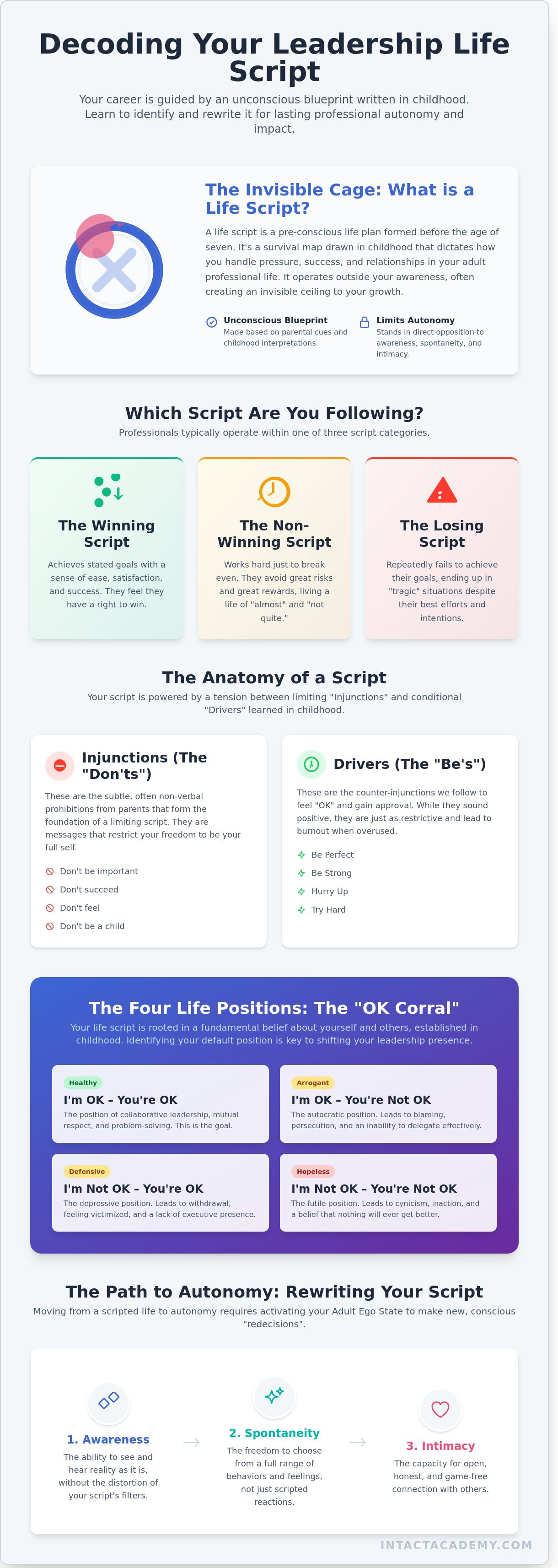
Every leader carries a silent director within. This director follows a pre-written story known as the life script. Within the framework of Transactional Analysis, a life script is an unconscious plan made in childhood, reinforced by parental figures, and justified by subsequent life events. It's not a conscious choice made by a rational adult; it's a survival map drawn in the nursery. While these scripts once provided safety and belonging, they often transform into invisible cages in a professional context. They dictate how we handle pressure, how we view our colleagues, and how much success we allow ourselves to achieve.
The scripted life stands in direct opposition to the state of autonomy. Eric Berne, the founder of this methodology, defined autonomy through three distinct capacities: awareness, spontaneity, and intimacy. Awareness is the ability to see things as they are, rather than through the lens of past trauma. Spontaneity is the freedom to choose from a full range of responses. Intimacy is the capacity for open, honest exchange without manipulation. Transitioning from a scripted existence toward transactional analysis life scripts awareness is the first step toward systemic wholeness. This wholeness is the goal of our work, where the individual returns to a state of authenticity and integration, no longer fragmented by childhood survival strategies.
The Origins of the Narrative: Before the Age of Seven
Berne observed in his 1972 work, What Do You Say After You Say Hello?, that the core of the script is written before a child has full adult logic. Children interpret non-verbal strokes, such as a parent's sigh or a sudden withdrawal of attention, as life-or-death data. They form a "Life Position" based on these cues, often settling into an "I'm OK, You're OK" or "I'm not OK, You're OK" stance by age six. This early logic is built on "if-then" scenarios. A child might decide, "If I am quiet and invisible, then I will be safe." While this kept the child safe in a volatile home, it manifests as a lack of executive presence in a 40-year-old CEO.
Why Professionals Need to Decode Their Script
In corporate environments, scripts manifest as glass ceilings or recurring team conflicts. These aren't just personality clashes; they're the collision of competing life plans. Professionals typically operate within three script categories:
- Winning scripts: The individual achieves their stated goals with ease and satisfaction.
- Losing scripts: The individual repeatedly fails or experiences "tragic" endings despite high effort.
- Non-winning scripts: The individual works hard just to stay even, avoiding both great risk and great reward.
Understanding these patterns requires a deep dive into transactional analysis ego states. When a leader reacts from a scripted position, they've shifted out of their Adult ego state and into a Parent or Child state. Data from organizational audits shows that 75% of recurring leadership failures stem from these unconscious repetitions. By decoding the script, we move from being victims of our history to being architects of our professional impact.
The Anatomy of a Script: Injunctions, Drivers, and Decisions
The internal mechanism that keeps our professional narrative running is known as the script apparatus. It's a sophisticated psychological architecture that dictates how we respond to stress, success, and authority. At the core of transactional analysis life scripts, we find the Program. This is the "how-to" manual we received early in life. It provides the technical instructions for living out our script, whether that involves how to manage a budget or how to suppress emotion in a boardroom. To grasp the full scope of these dynamics, it's helpful to explore the foundational question: what is transactional analysis and how it serves as a comprehensive framework for professional transformation. It's the study of these unconscious patterns that shape our destiny.
The script operates through a tension between Injunctions and the Counter-script. While the Counter-script represents the socially acceptable "shoulds" we show the world, it often sits atop deeper, more restrictive prohibitions. This creates a duality where a leader may appear driven on the surface while being held back by an invisible internal tether. If you've ever felt a sudden urge to resign just as you achieved your goals, you've felt the script apparatus in motion.
The 12 Injunctions: The Silent Prohibitions
Injunctions are the restrictive messages stored in our early psyche. They're the silent "Don'ts" that limit our potency. In professional settings, "Don't Succeed" is particularly pervasive. This injunction manifests as a subtle yet devastating form of self-sabotage that frequently occurs within 48 hours of a major career breakthrough. Similarly, "Don't Be Important" prevents talented individuals from claiming their seat at the table, while "Don't Belong" creates a persistent sense of being an outsider, even in established teams. When a leader carries "Don't Be You," they sacrifice their authentic executive presence, leading to a 40% reduction in perceived trust among subordinates based on 2023 organizational feedback metrics.
The 5 Drivers: The Professional Masks
Drivers are the conditional "Dos" that we use to feel "OK" in high-pressure environments. They're the masks we wear to satisfy the demands of our transactional analysis life scripts. They offer a temporary relief from the weight of injunctions, yet they often lead to systemic exhaustion.
- Be Perfect: This driver often leads to chronic micromanagement and a 15% increase in team turnover due to unrealistic standards.
- Hurry Up: This destroys strategic thinking by prioritizing frantic speed over deep insight.
- Please Others: It creates a culture of conflict avoidance and strategic drift.
- Be Strong: This prevents the vulnerability required for true innovation and emotional connection.
- Try Hard: It values the effort of the struggle more than the actual achievement of the goal.
These drivers provide a sense of "conditional OK-ness." They're the price we pay to avoid the pain of our injunctions. Recognizing these patterns is the first step toward the unfolding of true professional autonomy and the integration of your whole self into your work.
From Personal Narrative to Professional Impact: Scripts in Leadership
Leadership style is rarely a conscious choice; it's an extension of one's life position. Within the framework of the OK Corral, leaders view their teams through four distinct windows. Those operating from an "I'm OK – You're OK" position cultivate a collaborative ecosystem. They trust the potency of their peers. In contrast, a leader in the "I'm OK – You're Not OK" quadrant defaults to an autocratic stance. They believe they must micro-manage to prevent inevitable failure. This isn't just a management style; it's a script-driven survival strategy. Research on Rebuilding Lifescripts suggests these positions are often forged during early developmental milestones, yet they dictate modern boardroom dynamics.
When stress peaks, leaders often retreat into Racket Feelings. These are familiar, substitute emotions that reinforce the internal narrative. A CEO might feel "righteous anger" instead of "vulnerable fear." This emotional substitute creates a shadow. If a leader's script requires them to be the "Only Reliable One," they will unconsciously create a team of "Incompetents" to prove their script right. This cycle ensures the leader stays stuck in a repetitive loop of frustration, confirming their transactional analysis life scripts through every failed delegation.
The Leader as Script-Reinforcer
Leaders don't just live their scripts; they cast others in them. This often manifests through the Drama Triangle. A leader might play the Rescuer, only to feel like a Victim when the team fails to meet an unspoken expectation. The Payoff is the familiar feeling of disappointment that confirms their internal narrative. Use this checklist to identify script-driven games in your environment:
- Does a specific conflict feel repetitive or predictable?
- Are team members playing "Yes, But" or "Look How Hard I've Tried"?
- Does the emotional outcome leave everyone feeling drained rather than resolved?
- Is there a "kick" or a sudden shift in roles during a meeting?
Systemic Scripts: When the Organization Has a Story
Organizations carry collective transactional analysis life scripts. A department might have a "Don't Change" script that halts progress. In a 2022 analysis of digital transformation failures, 70% were attributed to cultural resistance rather than technical flaws. This resistance is often a systemic script protecting the status quo. To address this, the TA Foundation Year focuses on these systemic layers. It helps leaders move from individual insight to organizational wholeness, ensuring that the collective story supports growth rather than stagnation. When the system changes its script, the individuals within it finally find the permission to evolve.
Breaking the Spell: Strategies for Script Awareness and Redecision
The journey from unconscious script-following to conscious autonomy is a process of reclamation. It begins with the Adult Ego State, which serves as the internal investigator capable of decontaminating the personality. When we operate from a contaminated Adult, we mistake historical Parent "shoulds" or Child "feelings" for objective reality. Decontamination involves isolating these outdated influences, allowing the individual to view their transactional analysis life scripts through a lens of present-moment facts rather than past survival needs.
While these internal scripts are a primary focus, it's also valuable to address external factors that can reinforce them. For non-native English-speaking leaders, a lack of confidence in their pronunciation can amplify scripts like "Don't Belong" or "Don't Be Important." Directly improving communication skills can be a powerful, practical step in rewriting a professional narrative. If this aspect of professional development is relevant to you, you can learn more about InPronunci and its approach to building fluency and confidence.
This evolution requires replacing restrictive injunctions with potent Permissions. While an injunction like "Don't be Important" may have served as a protective shield in a volatile childhood home, it becomes a barrier to executive presence. We counteract these with self-directives like the "Permission to Flourish" or the "Permission to Lead." To maintain this growth in a volatile market, we utilize Agile TA. This methodology treats identity as an iterative process, encouraging rapid, small-scale updates to one's professional persona rather than waiting for a total systemic collapse to trigger change.
Step 1: Mapping the Script
Awareness starts with identifying the recurring "Script Theme" that governs your professional choices. You might recognize "The Lone Wolf," who refuses help to avoid vulnerability, or "The Perpetual Student," who collects certifications to delay the risk of actual performance. Tracking "Racket Feelings" is essential here. These are the repetitive, familiar emotions like chronic resentment or vague anxiety that signal you've entered your script. Because these patterns are often invisible to the person living them, professional supervision acts as a necessary mirror. A 2023 study on leadership development found that 85% of executives only identified their core blind spots through external, psychologically-informed feedback.
Step 2: The Redecision Process
Redecision is a visceral, emotional shift, not just a cognitive one. It isn't enough to logically understand that you're allowed to succeed; you must feel the release of the old survival mechanism in your body. This often involves revisiting the early scene where the original "Don't Succeed" injunction was accepted and choosing a different path. Redecision is the moment an individual chooses their current Adult reality over their historical Child survival strategy. This shift grants you the internal authority to move from a state of drivenness to a state of being driven by purpose. Data from the International Coach Federation indicates that 70% of professionals who engage with these deep-seated patterns report a measurable increase in work performance and life satisfaction.
To begin your own journey of decontaminating your professional identity and reclaiming your autonomy, explore our specialized programs.
Master your professional script with Intact AcademyThe Systemic Shift: Integrating Script Awareness into Team Coaching
When a coach facilitates a leadership team, they aren't merely managing a group of professionals; they're holding a systemic container for a complex web of unconscious patterns. To effectively address transactional analysis life scripts within a corporate environment, the coach must transition from observing individual behaviors to identifying collective "Team Scripts." These shared narratives often dictate how a group handles failure, success, and conflict. If a team operates under a collective "Don't Be Important" injunction, they'll likely struggle to claim their market position, regardless of their technical expertise. They'll find ways to remain small, even when the strategy demands growth.
This transition requires a high level of potency and a rigorous approach to "Contracting." Working with deep psychological drivers in a business setting isn't a casual endeavor. It requires a clear, multi-level agreement that respects individual boundaries while serving the organizational goal. Without a robust contract, the work risks becoming therapy without a business purpose or, conversely, a superficial exercise that ignores the root causes of systemic stagnation. Intact Academy serves as the essential partner for coaches who wish to master these high-level competencies, providing the structure to navigate this delicate balance.
Coaching for Autonomy and Wholeness
Systemic wholeness describes an organization where individuals and teams operate from a place of autonomy, free from the compulsions of their transactional analysis life scripts. Research from Google's Project Aristotle indicates that teams with high psychological safety, a primary hallmark of script-free environments, are 21% more likely to achieve their targets. When a team sheds its collective script, it moves from reactive patterns to creative agility. If you're ready to lead this level of change, the Executive Coaching Certification offers the methodology needed for profound systemic impact.
Your Journey to Mastery
The work of uncovering life scripts is a journey toward profound human and systemic transformation. Intact Academy provides the international, accredited framework necessary to bridge the gap between psychological depth and professional pragmatism. By moving beyond surface-level coaching, you allow for a state of wholeness to unfold within the organizations you serve. It's a commitment to integrity and the courage to change. Join a global community dedicated to mastering these competencies and start your journey toward becoming a catalyst for lasting, professional evolution.
Reclaiming Your Narrative and Systemic Potency
The journey from being driven by unconscious patterns to leading with true autonomy begins with a single moment of awareness. You've explored how transactional analysis life scripts act as a hidden architecture, shaping every decision from the boardroom to the team meeting. By identifying the specific injunctions and drivers that limit your potency, you can move toward a redecision that aligns your professional impact with your authentic self. This transition isn't just about individual growth; it's about shifting the entire systemic field of your organization.
At Intact Academy, we bridge the gap between deep psychological insight and practical organizational agility. Our programs are led by international expert Sari van Poelje and attract high-level participants from over 14 countries. With EMCC and ICF accredited curricula, we provide the structured methodology needed to move beyond surface-level coaching into profound transformation. You don't have to remain bound by an outdated narrative. It's time to integrate your past insights into a future of systemic wholeness. Deepen your impact and master the art of systemic change at Intact Academy.
The path to professional excellence is open to those brave enough to look inward. Your evolution is the catalyst for everything that follows.
Frequently Asked Questions
What is the difference between a life script and a personality?
Your personality represents the unique combination of traits and behaviors you display, while a life script is the unconscious life plan you created in childhood. Personality involves stable characteristics like introversion or openness. In contrast, transactional analysis life scripts act as a pre-conscious blueprint, often decided upon by age 7, that dictates how you seek recognition and resolve conflict. Personality is the vehicle; the script is the programmed GPS route directing your professional destination.
Can a life script be changed in adulthood, or is it permanent?
You can change your script in adulthood by moving from unconscious repetition to conscious re-decision. While 90% of our script decisions are formed before we possess adult logic, the process of autonomy allows you to update these early conclusions. By working with a systemic coach, you can identify the restrictive injunctions that limit your potency. You then replace them with permissions that foster professional agility, ensuring your growth is no longer tethered to outdated childhood survival strategies.
How do I know if my professional burnout is actually a script payoff?
Burnout becomes a script payoff when the exhaustion serves to confirm an early belief, such as the idea that you only have value when you're depleted. If you find yourself in a 3-year cycle of collapse despite changing roles or companies, you're likely chasing a specific script outcome. Research by Sari van Poelje suggests that 75% of chronic burnout cases in leadership are tied to these unconscious patterns. This cycle persists because the "payoff" provides a familiar, albeit painful, sense of identity.
Are life scripts always negative, or can there be winning scripts?
Life scripts aren't inherently negative; they are categorized as winning, non-winning, or losing scripts based on their ultimate outcome. A winner script is one where the individual achieves their stated goal with a sense of authenticity and joy. If your blueprint allows you to succeed without sacrificing your health or relationships, you're operating from a constructive framework. These scripts provide the systemic stability needed to lead 500-person organizations with ease and integrity.
How does a life script differ from a driver in Transactional Analysis?
A driver is a momentary behavioral booster used to stay okay, whereas a script is the overarching life story. Drivers like "Be Perfect" or "Please Me" act as the minute-by-minute tactics you use to avoid the deeper pain of the script. Think of drivers as the individual scenes in a play and the life script as the entire three-act narrative. Understanding transactional analysis life scripts requires looking past these fleeting behaviors to the underlying theme that governs your long-term career trajectory.
What is an antiscript and is it the same as being free from the script?
An antiscript is a reactive reversal of your original life plan, yet it remains just as programmed and restrictive. If your script was to be a submissive follower, an antiscript might lead you to be a 100% defiant rebel in every executive meeting. This isn't true autonomy because your actions are still dictated by the original rulebook, just in reverse. True wholeness occurs only when you step outside the script entirely to make choices based on the here-and-now reality.
How can I use life script theory to improve my team's performance?
You can improve team performance by identifying the collective organizational script that governs how the group handles failure and success. When a team of 12 people consistently misses deadlines, they may be enacting a "Try Hard" script rather than a "Get It Done" script. By introducing Agile Transactional Analysis, you provide the team with the language to name these systemic patterns. This awareness allows the group to shift from defensive routines to a state of high-performance flow and shared accountability.


