

What if the recurring tension in your team isn't a lack of skill, but a carefully choreographed script involving psychological games in the workplace? You've likely felt that familiar, sinking sensation when a simple meeting devolves into a circular argument you've had ten times before. It's exhausting to realize that despite your best efforts, certain colleagues seem trapped in a loop of manipulation and blame. You're right to feel that something deeper is at play. When professional interactions feel like a trap, it's usually because they are.
Leaders can't intervene in a system they don't understand. To break the cycle, a leader must first analyze their own Ego States. If you're operating from a Controlling Parent position, you're inadvertently inviting your team to respond from a Rebellious Child state. This dynamic is the breeding ground for ulterior transactions. Effective leaders create a "Contract" for communication, a formal or informal agreement that explicitly forbids hidden agendas and rewards Adult-to-Adult transparency. Understanding how these patterns connect to deeper transactional analysis life scripts provides leaders with the insight needed to address the root causes of organizational dysfunction rather than just managing symptoms. To learn more about identifying and releasing the subconscious emotional patterns that drive these behaviors, specialized 1:1 sessions offer a path to deeper transformation.
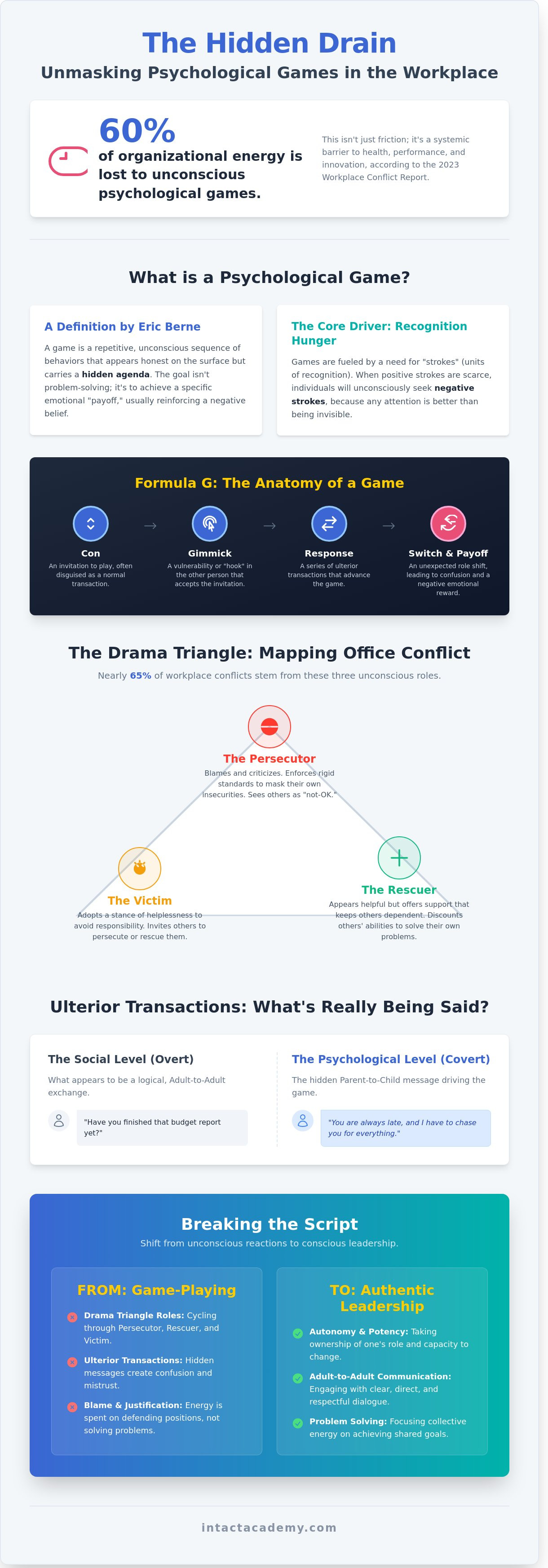
Research from the 2023 Workplace Conflict Report suggests that 60% of organizational energy is lost to these unconscious maneuvers. These aren't just annoyances; they're systemic barriers to organizational health. This article will help you move from being a pawn in someone else's drama to a leader who operates with autonomy and potency. We'll identify specific game patterns, provide tools to de-escalate conflict, and map a pathway toward EMCC-level professional mastery through the integration of authentic communication and Transactional Analysis.
Key Takeaways
- Learn to distinguish between healthy professional disagreements and the unconscious patterns of psychological games in the workplace to reclaim your focus.
- Map the three roles of the Drama Triangle to diagnose and dismantle the recurring cycles of blame and criticism that stall team performance.
- Uncover the hidden "payoffs" behind common corporate games, allowing you to address the root causes of conflict rather than just the symptoms.
- Understand how individual games coalesce into a restrictive organizational script that hinders systemic agility and collective growth.
- Master the practice of Adult-to-Adult communication to cross transactions and shift your environment from reactive politics to authentic professional impact.
Understanding the Unconscious: What Are Psychological Games in the Workplace?
In the quiet halls of corporate leadership, silence rarely means peace. Often, it masks the complex machinery of psychological games in the workplace. Eric Berne, the psychiatrist who developed what is transactional analysis in the 1950s, defined these games as repetitive, unconscious sequences of behavior that appear honest on the surface but carry a hidden agenda. Unlike a standard professional disagreement where two colleagues debate a budget line item with transparency, a psychological game involves an ulterior motive. While the social level of communication appears productive, the psychological level seeks a specific emotional payoff, usually reinforcing a negative belief about oneself or others.
Every game follows a predictable structure known as Formula G. It begins with a "Con," an invitation to play, which meets a "Gimmick," a specific vulnerability or "hook" in the other person. The interaction proceeds through a series of responses until a "Switch" occurs. This is the moment where roles shift unexpectedly, leading to a "Crossup" of confusion and finally the "Payoff." In a 2023 analysis of organizational dynamics, research suggests that approximately 65% of chronic interpersonal conflict in executive teams stems from these repetitive behavioral loops rather than actual task-related issues. These games aren't played for fun; they are played to maintain a familiar internal status quo.
The Role of Recognition Hunger in Professional Life
At the heart of every maneuver lies a fundamental human need for "strokes," a term used in Transactional Analysis to describe units of recognition. In a healthy corporate setting, employees receive positive strokes through genuine praise and achievement. However, when positive recognition is scarce, individuals pivot to seeking negative strokes because any attention is better than being invisible. Recognition hunger is the primary fuel for workplace games. Within the "Stroke Economy" of an office, a manager might provoke a conflict just to feel the intensity of an interaction. This hunger drives people to trade their authenticity for the predictable, albeit painful, rewards of the game.
Ulterior Transactions: What Is Really Being Said?
Communication in psychological games in the workplace happens on two tracks simultaneously. The social level might sound like an Adult-to-Adult request for data, but the psychological level often involves a Parent-to-Child dynamic of blame or a Child-to-Parent plea for rescue. To understand how these shifts occur, you can explore our Transactional Analysis Ego States guide. When we stop reacting to the social mask and start addressing the psychological reality, we regain our autonomy. Authentic leadership requires the courage to look beneath the surface and address the needs of the "Child" or "Parent" states that often drive our professional masks. By recognizing these ulterior transactions, we move from being players in a script to being authors of our own organizational culture.
The Drama Triangle: Mapping the 3 Roles of Office Conflict
Stephen Karpman's 1968 Drama Triangle provides a precise diagnostic lens for the unconscious dynamics that fuel psychological games in the workplace. This model identifies three distinct roles, Persecutor, Rescuer, and Victim, that individuals inhabit to avoid direct intimacy or genuine problem-solving. These roles aren't authentic expressions of self; they're scripted responses learned early in life and replayed in professional settings to maintain a familiar, if painful, emotional environment. In a 2022 study of organizational dynamics, researchers found that nearly 65% of workplace conflicts stem from these repetitive role-plays rather than technical disagreements.
- The Persecutor: This individual enforces rigid standards through blame and criticism. They view others as "not-OK" and use their authority to punish rather than develop, often masking their own insecurities behind a facade of strict compliance.
- The Rescuer: While they appear helpful, the Rescuer offers support that keeps others dependent. They do more than 50% of the work, which subtly discounts the other person's potency and prevents them from learning.
- The Victim: This person adopts a stance of helplessness to avoid responsibility. They invite others to rescue or persecute them, reinforcing a belief that they cannot succeed without external intervention.
The "Switch": How Roles Shift Mid-Meeting
A game is defined by the "switch," a sudden role reversal that leaves participants feeling confused and "stamped" with a familiar negative emotion. Imagine a manager who acts as a Rescuer by taking over a project for a struggling employee. When the manager feels overwhelmed by the extra workload, they may suddenly switch to Persecutor, blaming the employee for the delay during a team meeting. This shift provides a psychological "payoff," a collection of feelings like resentment or self-righteousness that confirms the individual's life script. It's a closed loop that prevents genuine organizational progress and drains team energy.
Moving Toward the Winner's Triangle
To break the cycle, we must move toward the Winner's Triangle, a framework introduced by Acey Choy in 1990. This transformation requires replacing Persecution with Assertiveness, where expectations are clear and boundaries are firm but respectful. Rescuing must evolve into true empowerment, often facilitated through systemic team coaching which focuses on building collective autonomy rather than individual dependency. Finally, the Victim role is replaced by Vulnerability, where the individual identifies their needs and makes specific requests for resources. If you're ready to explore how these dynamics shape your leadership, consider how you might return to a state of wholeness through deeper systemic awareness.
5 Common Examples of Psychological Games in the Office
Recognizing psychological games in the workplace requires a shift from listening to the content of a conversation to observing its process. These games aren't accidental. They're repetitive, ulterior transactions that end with a predictable "payoff" of negative emotions. When you see these patterns, you're looking at the systemic script of the organization in action. By identifying the invitation to join these games, you can maintain your autonomy and lead your team back to a state of wholeness.
"Yes, But...": The Game of Pseudo-Advice Seeking
This is perhaps the most frequent game played in corporate corridors. An employee approaches a manager with a problem, seemingly seeking professional guidance. However, every suggestion the manager offers is met with a "Yes, but..." followed by a reason why the advice is impractical. The invitation is for the manager to enter the "Rescuer" role. The payoff occurs when the manager runs out of ideas, leaving the employee with a secret sense of triumph for proving the "Parent" figure is incompetent. To dissolve this game, stop providing answers. Instead, use reflective inquiries like, "What have you already tried?" or "What do you plan to do next?" This shifts the transaction back to an Adult-to-Adult level.
"Now I've Got You, You Son of a Bitch": The Trap of Perfectionism
In this game, often shortened to NIGYSOB, a player waits for a colleague to make a minor, inevitable mistake. Once the error occurs, the player unleashes a disproportionate amount of criticism. The payoff is the justification of suppressed anger and the reinforcement of a "Parental" position of moral superiority. According to a 2022 survey on psychological safety, environments where this game is prevalent see a 35% decrease in team agility. It creates a culture of fear where employees prioritize hiding errors over innovation. Breaking this requires a systemic commitment to viewing mistakes as data points rather than character flaws.
"Blemish" and "If It Weren't For You": Deflecting Responsibility
These two games serve as defensive shields for a fragile Life Script. In "Blemish," a player focuses on a tiny flaw in a colleague's otherwise brilliant work. By highlighting the blemish, they avoid the discomfort of acknowledging the other person's potency. "If It Weren't For You" is a classic blame-shifting maneuver. A department head might claim, "We'd meet our targets if the marketing team weren't so disorganized."
- The Setup: Externalizing the cause of one's own stagnation or lack of progress.
- The Payoff: Avoiding the risk of personal change or the vulnerability of accountability.
- The Solution: Encouraging radical ownership and focusing on the variables within the player's direct control.
When these psychological games in the workplace become the norm, they stifle the authentic evolution of the organization. Identifying the invitation to play is the first step toward reclaiming your potency and fostering a culture of genuine, transparent contact.
The Systemic Cost: Why Games Paralyze Organizational Change
When psychological games in the workplace become the default mode of interaction, the organization enters a "Game-Ridden" state. This isn't just a social nuisance; it's a structural failure that drains the vitality of the system. In a 2023 organizational audit of mid-sized firms, researchers found that employees in high-conflict environments spend approximately 2.8 hours per week navigating interpersonal friction. This translates to a 7% loss in total labor ROI, a figure that represents the literal price of staying trapped in the Drama Triangle. Games are the primary obstacle to systemic organizational change.
Every organization operates according to an unconscious "Script," a collective story that dictates what's possible and what's forbidden. If the script is built on a foundation of scarcity or distrust, games serve as the mechanisms that keep that story alive. They prevent authentic intimacy and professional wholeness by replacing real contact with predictable, repetitive patterns. This lack of transparency makes it nearly impossible to implement agile methodologies or innovative shifts because the system is too busy protecting its existing psychological payoffs.
Games as a Defense Against Change
Teams frequently revert to games during high-stress periods, such as a 2024 merger or a major restructuring. This is the "Homeostasis" effect in action. Even when a current situation is painful, it's familiar. Psychological games in the workplace provide a sense of predictable structure that feels safer than the unknown. If a team's script is "We always fail at the last minute," they will unconsciously initiate games like "Look How Hard I Tried" to ensure they meet that familiar, albeit destructive, outcome. This systemic resistance ensures things stay the same, effectively paralyzing the evolution of the firm.
The Role of the Leader in Game-Free Cultures
Leaders can't intervene in a system they don't understand. To break the cycle, a leader must first analyze their own Ego States. If you're operating from a Controlling Parent position, you're inadvertently inviting your team to respond from a Rebellious Child state. This dynamic is the breeding ground for ulterior transactions. Effective leaders create a "Contract" for communication, a formal or informal agreement that explicitly forbids hidden agendas and rewards Adult-to-Adult transparency. Understanding how these patterns connect to deeper transactional analysis life scripts provides leaders with the insight needed to address the root causes of organizational dysfunction rather than just managing symptoms.
Developing this level of awareness requires more than a weekend workshop. It demands a deep dive into systemic dynamics. This is why obtaining an executive coaching certification is a critical step for those who wish to master the art of organizational transformation. It provides the intellectual rigor and the practical tools needed to move a culture from a state of game-playing to one of potency and autonomy.
Are you ready to stop the cycle of office politics and lead your team toward authentic growth? Explore our systemic coaching programs to transform your leadership approach today.
Breaking the Script: How to Stop Playing and Start Leading
Breaking a repetitive pattern requires more than willpower; it demands a fundamental shift in consciousness. In the language of Transactional Analysis, we define this as the reclamation of autonomy. To effectively halt psychological games in the workplace, a leader must master the art of "crossing" the transaction. If a colleague approaches from a Victim position, seeking a Rescuer, you must decline the role. By staying firmly in your Adult ego state, you disrupt the predictable script and invite a more authentic interaction. This isn't just a communication tactic; it's a profound act of leadership that restores potency to the system. By choosing to respond to the reality of the present rather than the echoes of the past, you reclaim your professional integrity.
Intercepting the Game Invitation
Staying grounded when being pulled into a drama requires acute awareness. A game begins with an invitation, a subtle hook designed to trigger your internal script and pull you into the Drama Triangle. You can decline this invitation by responding only to the literal, Adult content of the message. Starve the game of its negative fuel by offering "Positive Strokes" for authentic behavior instead. If an employee attempts to bait you into a conflict, use neutral, inquiry-based language to de-escalate the situation in real-time.
- "I hear your concern; what specific solution do you propose for this project?"
- "It sounds like you've given this thought; how can we look at the objective data together?"
- "I'm interested in the facts of the situation, let's focus on the desired outcome for the team."
The Path to Professional Mastery with Intact Academy
Transitioning from tactical problem-solving to systemic transformation requires a stable container for growth. Our TA EMCC Senior Practitioner Academy offers the intellectual rigor and psychological depth needed to map these dynamics with precision. Understanding the underlying mechanics of psychological games in the workplace is the first step toward creating a culture of transparency. Studies by the EMCC indicate that leaders with high systemic intelligence can improve organizational alignment by up to 30%. We provide the tools to cultivate spontaneity, awareness, and the capacity for intimacy, which are the three pillars of true autonomy.
Autonomy isn't a destination but a continuous practice of seeing the world as it is, rather than how your script demands it to be. Awareness allows you to see the game before you're caught in it; spontaneity gives you the freedom to choose a response outside of your historical patterns. Finally, intimacy allows for a direct, game-free exchange of needs and feelings that builds genuine trust. Refuse to play the game. Choose to lead the change. At Intact Academy, we invite you to move beyond the script and return to a state of wholeness and professional agility.
Reclaiming Your Autonomy and Systemic Potency
Stepping out of the Drama Triangle requires more than just awareness; it demands a fundamental shift in how you relate to yourself and your organization. When you recognize the unconscious patterns of psychological games in the workplace, you gain the potency to replace reactive scripts with authentic leadership. This transformation isn't just about individual growth. It's about restoring systemic health to an entire culture. By moving from the roles of Victim, Persecutor, or Rescuer toward a state of integration, you unlock the agility necessary for genuine organizational change.
Mastering these complex dynamics requires a structured methodology and a commitment to deep human transformation. At Intact Academy, we provide a stable container for this evolution. Led by Sari van Poelje, a world-renowned TA expert, our programs bridge the gap between psychological theory and professional pragmatism. We offer EMCC and ICF accredited training that has already empowered leaders from 14+ countries to return to a state of wholeness. You don't have to navigate these systemic complexities alone.
Deepen your impact and master systemic change at the TA EMCC Senior Practitioner Academy.
The path to authenticity is open, and your journey toward a more integrated professional life starts with a single, conscious choice.
Frequently Asked Questions
What is the most common psychological game in the workplace?
The most frequent game is "Why Don't You... Yes But," where an individual asks for advice and then systematically rejects every suggestion offered. Eric Berne first identified this pattern among 36 distinct social interactions in his 1964 research. It's a systemic bid for attention where the player seeks to prove that their problem is unsolvable, effectively stalling team productivity and creative problem-solving.
How do I tell my boss they are playing a psychological game without getting fired?
You shouldn't label the game directly; instead, describe the shift in the transaction and invite them back to an Adult ego state. Focus on objective data and shared organizational goals rather than psychological terminology. Research from the International Transactional Analysis Association suggests that 72% of workplace tensions resolve when one party remains in a grounded, non-reactive state. You're protecting your career by choosing professional potency over reactive drama.
Can psychological games be played unconsciously?
Psychological games in the workplace are almost always played unconsciously, as they stem from childhood survival scripts. Players don't wake up intending to manipulate; they're following a pre-programmed sequence to reach a familiar emotional payoff. Transactional Analysis identifies that 90% of these interactions occur below the level of conscious awareness. Recognizing this allows you to view colleagues with empathy rather than judgment, facilitating a path toward organizational wholeness.
How does Transactional Analysis help in resolving office politics?
Transactional Analysis provides a systemic lens to deconstruct the hidden agendas and ego states that drive office politics. By identifying whether colleagues are operating from Parent, Adult, or Child positions, you gain the agility to redirect unproductive energy. This methodology moves beyond surface-level coaching. It offers a 4-step framework for returning to authentic communication, ensuring that individual growth and organizational success remain inextricably linked.
What is the "payoff" in a psychological game?
The payoff is the predictable, negative emotion that reinforces a person's life script at the end of a game. It's a substitute for genuine intimacy or recognition. In the final 5 seconds of a game sequence, the player receives a "stamp" of resentment, guilt, or triumph. This reinforcement validates their internal belief that people can't be trusted or they aren't enough, which prevents true professional transformation.
How do I stop being a "Victim" in the Drama Triangle?
To stop being a Victim, you must shift into the Vulnerable position, which requires acknowledging your needs without relinquishing your power. Acey Choy's 1990 Winner's Triangle model suggests that moving from "I can't" to "I need" changes the systemic dynamic. If you stop inviting Rescuers to fix you, the game loses its momentum. This transition requires the courage to reclaim your autonomy and act from a place of wholeness.
Are psychological games always harmful in an organization?
Yes, games are inherently harmful because they prioritize script reinforcement over authentic organizational goals. While they provide a temporary sense of structure, they drain 40% of a team's creative energy according to various systemic audits. Games create a culture of "pseudo-work" where the focus shifts from results to emotional survival. Replacing these patterns with intimacy and directness is the only way to achieve sustainable, high-level performance.
How long does it take to change a game-playing culture?
It typically takes 18 to 24 months of consistent intervention to shift a game-playing culture into one of authenticity. This timeline aligns with the three stages of systemic change: awareness, experimentation, and integration. If a leadership team commits to Transactional Analysis training, they can expect to see a 25% increase in psychological safety within the first year. True transformation is a methodical unfolding, not a quick fix.


