

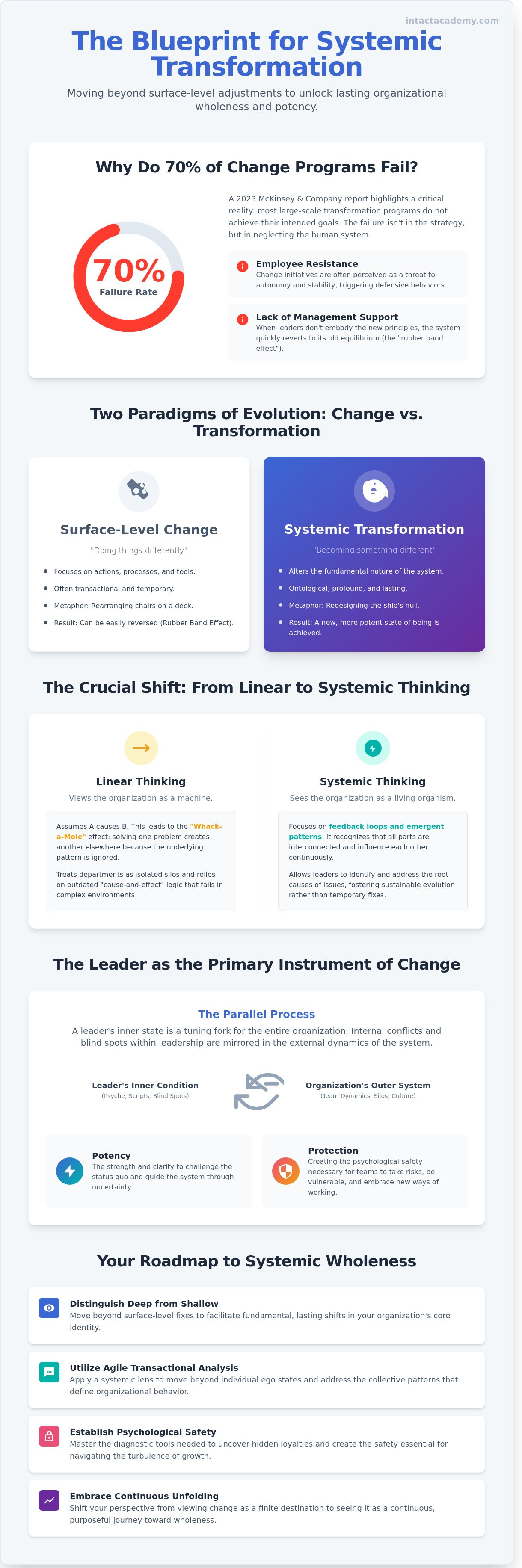
Most organizational change initiatives fail not because the strategy is flawed, but because the underlying human script remains untouched. McKinsey & Company reported in 2023 that 70% of transformation programs fail to achieve their goals, largely due to employee resistance and lack of management support. You've likely felt this friction; you've seen the surface-level shifts that dissolve as soon as the pressure is removed. True systemic transformation requires more than a new org chart or a revised set of KPIs. It demands a journey into the psychological underpinnings of your culture to ensure that every individual's autonomy aligns with the collective purpose.
We're here to help you bridge the gap between psychological depth and organizational agility. This guide provides a clear framework for facilitating deep change, offering tools to move your team toward lasting potency. We'll explore how to use the principles of Agile Transactional Analysis to measure cultural shifts and master the art of systemic intervention. By the end, you'll have a roadmap to return your organization to a state of wholeness and authenticity.
Key Takeaways
- Distinguish between surface-level change and true systemic transformation to ensure your organizational shifts are fundamental, lasting, and profound.
- Explore the "parallel process" to understand how a leader's inner condition directly mirrors and impacts the external health and dynamics of the entire system.
- Utilize the lens of Agile Transactional Analysis to move beyond individual ego states and address the collective patterns that define organizational behavior.
- Master the diagnostic tools needed to uncover hidden loyalties and establish the psychological safety essential for navigating the turbulence of growth.
- Embrace the journey toward systemic wholeness, shifting your perspective from viewing change as a destination to seeing it as a continuous, purposeful unfolding.
What is Systemic Transformation in a Professional Context?
To understand systemic transformation, we must first look beyond the surface level of operational adjustments. It is not the simple act of rearranging chairs on a deck; it is the fundamental redesign of the ship's hull. While change focuses on doing things differently, transformation focuses on becoming something different. Change is often transactional and temporary. Transformation is ontological, altering the very nature of how a system exists and interacts with its environment.
As we approach 2026, the demand for a systemic lens has never been more urgent. A 2023 McKinsey report suggests that 70% of complex, large-scale change programs fail to reach their goals because they rely on outdated, linear logic. In an era defined by global interconnectedness and rapid technological shifts, the old "cause-and-effect" models are breaking down. We can no longer treat departments as isolated silos. Instead, the modern coach or consultant must act as a systemic catalyst. This role involves inviting the organization to unfold its inherent potency and move toward a state of sustainable evolution, rather than forcing a pre-packaged solution onto a resistant culture.
The Shift from Linear to Systemic Thinking
Linear thinking assumes that if you fix part A, part B will follow. Systemic thinking recognizes that organizations are living organisms, not machines. This perspective shifts focus toward feedback loops and emergence. When leaders ignore these loops, they often experience the Whack-a-Mole effect: they solve a problem in sales only to see a new crisis emerge in customer service. By developing systemic awareness, leaders can identify the underlying patterns that drive behavior. This shift requires a high level of autonomy and the courage to look at the whole rather than the parts.
Why Traditional Change Management Often Fails
Traditional methods often ignore the "rubber band effect." This is the phenomenon where a system naturally resists external pressure and pulls back to the status quo as soon as the consultant leaves. Most programs fail because they neglect the hidden architecture of human relationships and the necessity of psychological safety. You can find a deeper analysis of these dynamics in our look at why change programs fail. Without addressing the underlying script of the organization, systemic transformation remains out of reach. Real progress requires an integration of psychological depth and professional pragmatism, ensuring that the new way of being is anchored in the collective identity of the workforce.
The Interplay of Inner Condition and Outer Systems
Systemic transformation isn't a mechanical process of moving boxes on an organizational chart; it's a biological unfolding that begins within the leader's own psyche. When a facilitator or CEO enters a room, their presence acts as a tuning fork for the entire system. This phenomenon, known as the parallel process, reveals how internal team dynamics often mirror the larger organizational struggles. If an executive board struggles with trust, you'll inevitably find silos and defensive communication in the departments below them. You simply can't transform a system further than you've transformed yourself.
Achieving this level of change requires a sophisticated balance. We must hold the psychological depth of human experience alongside the professional pragmatism of business outcomes. It's about moving beyond surface-level coaching into a space where profound human evolution meets operational excellence. Understanding these dynamics helps leaders integrate systemic insights into their daily decision-making processes to ensure lasting impact.
The Leader as the Primary Instrument of Change
Effective leaders develop a systemic eye. They learn to ignore isolated incidents and instead track the recurring patterns that signal a deeper script at play. To facilitate high-stakes shifts, a leader must provide both potency and protection. Potency provides the strength to challenge the status quo, while protection creates the psychological safety necessary for others to take risks. Without this balance, the system either stagnates in fear or collapses under the weight of unguided change. A leader's personal script, the unconscious life plan formed in early years, often acts as the invisible ceiling on what the organization can achieve. Understanding the role of leadership in change management requires recognizing how these internal patterns directly influence systemic outcomes.
Mapping the Interior Condition
Success in 2024 requires identifying the blind spots that prevent systemic agility. McKinsey (2023) research indicates that 70% of organizational transformations fail due to culture and mindset challenges rather than technical flaws. These failures often stem from a lack of autonomy, which we define as the capacity for awareness, spontaneity, and intimacy. When a leader lacks this internal freedom, the system becomes rigid and reactive. The inner condition is the foundational soil for systemic growth. By cultivating a healthy interior landscape, leaders ensure that individual autonomy and systemic health are not in competition but are instead mutually reinforcing forces.
Leveraging Transactional Analysis for Systemic Impact
Agile Transactional Analysis (TA) provides a sophisticated diagnostic lens for the human architecture of a modern business. While traditional psychology often stops at the individual, TA expands our view to "Systemic States." These are the collective patterns that emerge when individual ego states synchronize across a department or an entire board. If a leadership team operates primarily from a "Parental" state, the workforce naturally regresses into a "Child" state, creating a cycle of dependency. Achieving a systemic transformation requires us to break these cycles by moving the entire organization toward an "Adult" state characterized by presence, intimacy, and professional potency.
Many executives view human dynamics as "soft" or unquantifiable. However, TA offers a structured methodology that has been refined since Eric Berne first introduced the concepts in the 1950s. It provides a map for the messy reality of corporate life. By using these tools, we can address the underlying psychological drivers that cause 70% of change initiatives to fail, according to data from McKinsey. We don't just look at what people are doing; we look at the unconscious scripts that drive their behavior.
Uncovering the Organizational Script
Every company follows an "Organizational Script," an unconscious narrative often born from founding myths. A firm established during the 2008 financial crisis might still be operating from a script of "scarcity and survival" in 2024, even with record-breaking profits. These scripts manifest as repetitive psychological games, such as "Why Don't You... Yes But," which drain energy and stall innovation. To move beyond these limitations, leaders must learn to "unscript" their culture. Engaging in an executive coaching certification allows practitioners to identify these patterns and guide their teams toward autonomy. This process isn't a frantic rush toward a deadline; it's a methodical unfolding of the organization's true potential.
Contracting for Systemic Health
Health in a complex system depends on the integrity of its boundaries. TA utilizes the "Three-Cornered Contract" to manage the intricate relationships between the coach, the leader, and the organization. This framework ensures that every party has a clear understanding of their goals and responsibilities. During a systemic transformation, this contract acts as a "stable container" for the inevitable chaos of change. If the boundaries are clear, the system can handle higher levels of pressure without fracturing. It allows the organization to maintain stability while simultaneously evolving, ensuring that the transition is both safe and sustainable for everyone involved.
- Autonomy: Moving from scripted reactions to conscious choices.
- Potency: The ability of a leader to influence the system effectively.
- Integration: Bringing disparate parts of the organization into a cohesive whole.
5 Essential Pillars for Navigating Systemic Change
True systemic transformation doesn't happen through top-down mandates; it's an organic process that requires both psychological depth and structural precision. To move a system from its current script to a state of autonomy, we follow a five-step methodology that honors the complexity of human systems. This isn't about fixing a broken machine. It's about nurturing a living organism toward its next stage of evolution.
- Step 1: Systemic Diagnosis. We map the current reality, looking beyond the organizational chart to uncover hidden loyalties. These are the unconscious commitments to past leaders or outdated ways of working that often sabotage progress.
- Step 2: Securing the Foundation. We establish psychological safety across all levels. According to 2023 research on high-performing teams, psychological safety accounts for a 35% increase in team effectiveness. We build this by increasing the "potency" of leaders and the "protection" offered by the system.
- Step 3: Identifying Leverage Points. We find the 20% of interventions that will generate 80% of the desired movement.
- Step 4: Facilitating Emergence. We create the conditions for new behaviors to arise naturally. If we over-control the process, we kill the system's ability to self-organize and adapt.
- Step 5: Integration and Anchoring. We ensure the new state becomes the "new normal" through consistent feedback loops and structural alignment.
Identifying High-Impact Leverage Points
The most obvious point of intervention is rarely the most effective one. If a team lacks collaboration, the solution isn't usually more meetings; it's often a shift in how resources are allocated at the board level. We use systemic inquiry to find where the system is most ready for movement. By applying a "minimal intervention" approach, we achieve maximum shift with the least amount of resistance. This preserves the energy of the organization for the work that matters most. It's about finding the loose thread that, when pulled, allows the entire tapestry to be rewoven.
Anchoring the Transformation
One of the most effective ways to anchor new behaviors is by embedding them into the company's core operational structure through established frameworks. For businesses looking to solidify their transformation with a proven quality management system, specialized consultancies like Align Quality offer guidance on certifications such as ISO 9001, ensuring that changes are not just cultural but are also systematically supported.
Change often evaporates once the external consultant leaves. To prevent this, we build robust feedback loops that reinforce new systemic behaviors. Supervision plays a critical role here; it provides a reflective space for leaders to maintain the integrity of the systemic transformation. A 2022 survey of 500 CEOs showed that organizations with formal supervision processes were 40% more likely to sustain cultural change over three years. Use this checklist to ensure longevity:
- Are feedback loops automated and transparent?
- Does the internal leadership team have the systemic literacy to coach others?
- Is there a "supervision" rhythm established for the executive team to process tension?
- Have the rewards and recognition systems been updated to reflect the new values?
If you're ready to move beyond surface-level fixes and lead a profound evolution in your organization, explore our systemic transformation training programs designed for visionary leaders.
Integrating Mastery: The Journey Toward Systemic Wholeness
True systemic transformation requires more than structural adjustments or new software implementations. It demands a fundamental return to what we define as the Intact philosophy. This approach invites leaders to look past the superficial symptoms of organizational friction and reconnect with a state of wholeness. When a system is "intact," it operates from a place of authenticity and autonomy, free from the restrictive "scripts" that often dictate corporate behavior. You aren't just fixing a broken process; you're restoring the natural vitality of the human collective.
This work is never a static destination. It's a continuous unfolding. Organizations are living organisms that respond to internal pressures and external shifts. If you view change as a finite project with a clear end date, you risk ignoring the rhythmic nature of growth. Mastery involves staying present through every stage of this evolution, ensuring that the integration of new patterns becomes a permanent part of the organizational DNA. It's about building the capacity to remain agile while staying deeply grounded in your core purpose. For executives seeking to develop these capabilities, our comprehensive guide on leading organizational change from a systemic and psychological perspective provides essential frameworks for navigating complex transformations.
Professional Accreditation as a Benchmark for Quality
In a global consulting market where 82% of organizations now prioritize formal credentials when selecting external partners, the distinction between a generalist and a specialist is vital. Transitioning from a standard coach to a senior systemic practitioner requires a level of psychological depth that self-study cannot provide. Recognition from bodies like the EMCC and ICF isn't just about a certificate; it's a testament to your potency as a change agent. The TA EMCC Senior Team Coach Academy offers a rigorous path for those ready to lead high-stakes interventions. This training ensures you can hold a safe container for the complex, often turbulent work of systemic transformation.
The Path Forward with Intact Academy
Intact Academy provides the structured methodology needed to deepen your systemic impact. Our Senior Practitioner and Supervisor academies are designed for professionals who seek to move beyond transactional coaching into the realm of profound human transformation. You'll join a global community of practice that includes experts from over 30 countries, all dedicated to the principles of Agile Transactional Analysis. This network offers a space for reflective inquiry and shared wisdom, which is essential for maintaining your own professional health. The journey toward mastery is deliberate and rewarding. Explore our accredited programs and start your journey toward systemic mastery.
Mastering the Architecture of Sustainable Change
True organizational evolution begins when you align your inner script with the outer structures of your business. This process requires more than simple strategy; it demands a deep integration of the five essential pillars to ensure long-term agility. By mastering the nuances of Transactional Analysis, you move past surface-level fixes and step into the profound work of systemic transformation. This path leads to a state of wholeness where individual autonomy and organizational potency coexist in harmony.
Navigating these complexities requires a stable container for learning and growth. Our EMCC and ICF accredited programs provide that foundation, led by Sari van Poelje and a global team of experts. We've supported professionals from over 14 countries in their journey toward mastery, bridging the gap between psychological depth and professional pragmatism. You're invited to join this global community of practitioners dedicated to meaningful change and professional excellence.
Deepen your impact with our TA EMCC Senior Practitioner Academy and begin the work of returning your organization to its most authentic, effective state. Your capacity for leadership is ready to unfold.
Frequently Asked Questions
What is the difference between systemic change and systemic transformation?
Systemic change involves modifying specific processes or structures, while systemic transformation requires a fundamental shift in the organization's underlying script. Change often fixes a part; transformation evolves the whole. McKinsey reports that 70% of change programs fail because they ignore the deeper human architecture. If you only change the structure without addressing unconscious patterns, the old system eventually reasserts itself.
How does Transactional Analysis apply to organizational systems?
Transactional Analysis maps the unconscious games and ego states that drive organizational behavior. By using the Agile Transactional Analysis lens, leaders identify if they're operating from a Parent, Adult, or Child state. This clarity allows teams to move out of the Drama Triangle, a concept developed by Stephen Karpman in 1968. It transforms toxic dynamics into productive, autonomous interactions that honor the intelligence of every member.
Why is "inner work" necessary for systemic transformation?
Inner work is essential because a leader's personal script sets the boundaries for the entire systemic transformation. You can't guide a team toward wholeness if you're still operating from your own unresolved patterns. Research indicates that 90% of leadership success depends on emotional intelligence and self-awareness. When leaders integrate their shadow parts, they create the potency required for the entire system to evolve.
How long does a typical systemic transformation process take?
A complete process typically requires 36 to 60 months to become fully embedded in the corporate DNA. While you'll see shifts in team potency within the first 6 months, deep cultural integration takes significant time. This duration reflects the three phases of the Intact methodology: deconstruction, integration, and unfolding. Patience is a prerequisite for any lasting structural evolution that aims for true authenticity.
What are the main barriers to systemic change in large organizations?
The primary barriers include entrenched leadership scripts and the Parent-Child power dynamics common in traditional hierarchies. A 2023 study by BCG found that 75% of transformations fail because leaders don't change their own behaviors. When the system rewards compliance over autonomy, people stay stuck in old roles. Breaking these patterns requires more than a new strategy; it requires a new way of being.
Can systemic transformation be measured using traditional KPIs?
You can measure systemic transformation by combining traditional financial KPIs with qualitative metrics like the Stroke Economy or autonomy levels. While revenue growth is important, we also track the 27% increase in employee retention that typically follows a successful cultural shift. We look for a move from Conditional Strokes to Unconditional Positive Regard within teams. These metrics provide a map of the system's emotional health.
What role does psychological safety play in systemic work?
Psychological safety acts as the stable container that allows for deep systemic work and individual vulnerability. Amy Edmondson's research at Harvard demonstrates that high levels of safety lead to a 50% increase in productivity. Without this safety, employees stay in survival scripts and avoid the risks necessary for innovation. It's the foundation upon which the entire house of transformation is built, ensuring everyone feels seen and heard.


