

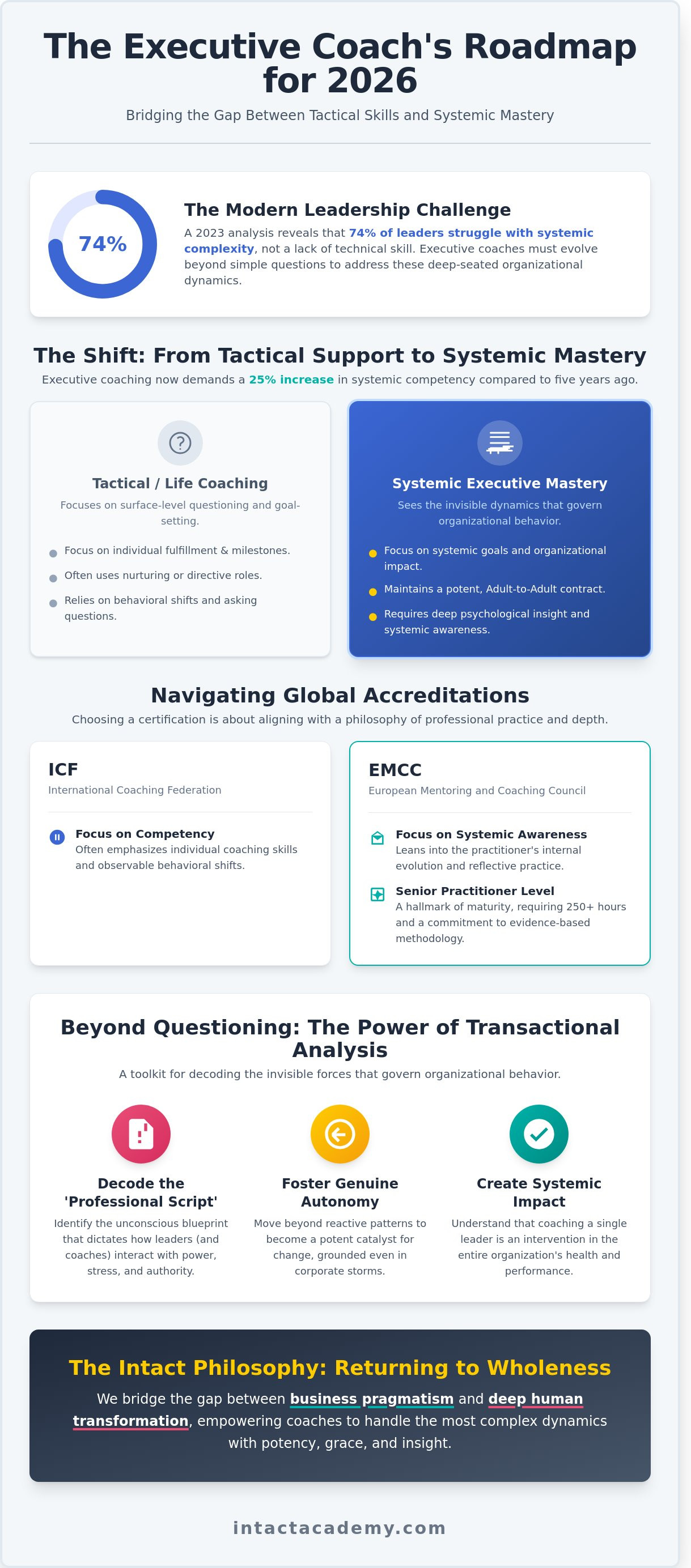
What if the persistent sense of being an imposter in the boardroom isn't a reflection of your incompetence, but a symptom of a toolkit that lacks systemic depth? You've likely realized that many leadership challenges aren't about business strategy; they're about the complex, often unconscious scripts that govern human interaction. A 2023 analysis of executive performance suggests that 74% of leaders struggle with systemic complexity rather than technical skill. It's common to feel that your current approach is too tactical to address these deep-seated dynamics. Choosing the right executive coaching certification in 2026 requires looking beyond basic frameworks to find a program that honors both your professional pragmatism and your need for psychological potency.
This guide will help you bridge the gap between simple questioning and profound human transformation. You'll discover how to achieve international accreditation at the EMCC Senior Practitioner level while building a toolkit rooted in Transactional Analysis. We'll explore the path to moving beyond transactional interactions into a space of systemic impact and personal autonomy. By the end of this article, you'll have a clear roadmap for selecting a certification that provides the confidence to handle the most complex organizational dynamics with grace and insight.
Key Takeaways
- Learn why high-stakes leadership environments demand a move beyond tactical questioning toward deep psychological insight and systemic awareness.
- Navigate the nuances between ICF and EMCC standards to select a path that honors your professional maturity and leads to Senior Practitioner mastery.
- Explore how an executive coaching certification integrated with Agile Transactional Analysis allows you to decode organizational scripts and foster genuine autonomy.
- Evaluate the true ROI of your training by identifying the "Wise Mentors" and supervision structures necessary for profound professional evolution.
- Discover the Intact philosophy of returning to wholeness, bridging the gap between business pragmatism and deep human transformation.
Beyond the Surface: Why Executive Coaching Certification Requires Psychological Depth
An executive coaching certification is far more than a professional credential; it's a rigorous psychological journey that demands a fundamental shift in how one perceives human systems. While basic Coaching often relies on surface-level questioning and goal-setting, the C-suite demands a level of sophistication that tactical prompts cannot reach. In high-stakes environments where a single decision can impact 10,000 employees, the coach must provide a stable container. This container acts as a psychological holding space, allowing leaders to dismantle old patterns without losing their professional footing. By 2026, the industry expects coaches to move beyond "asking" into "seeing" the invisible dynamics that govern organizational behavior.
The Shift from Life Coaching to Executive Mastery
Life coaching often centers on individual fulfillment and personal milestones. Executive mastery requires a pivot toward systemic goals. It necessitates an Adult-to-Adult contract, moving away from the nurturing or directive roles often found in more personal settings. This work requires intellectual rigor and the capacity to challenge power without hesitation. A 2023 study by the International Coaching Federation (ICF) noted that executive coaching now requires a 25% increase in systemic competency compared to five years ago. You aren't just coaching a person; you're coaching the nodes of an entire organizational network.
Identifying the 'Professional Script' in Leadership
Every leader carries a hidden narrative that dictates their reactions to stress, conflict, and success. When you're choosing an executive coaching certification, you must prioritize programs that address the concept of the script. This script dictates whether you shrink in the presence of a dominant CEO or over-function when a board remains silent. Professional Script is the unconscious blueprint that dictates how a coach interacts with power and authority. Rewriting this script allows for true autonomy, transforming the coach from a reactive participant into a potent catalyst for change who can remain grounded even in corporate storms. Developing the right executive coaching skills to identify and address these hidden scripts is what separates truly transformative practitioners from those who remain at the surface level.
- Systemic Awareness: Understanding that the individual is a proxy for the organization's health.
- Psychological Safety: Creating a space where the "unsayable" can be voiced without fear of repercussion.
- Potency: Developing the internal strength to hold the weight of executive responsibility alongside the client.
Navigating Global Accreditations: ICF, EMCC, and the Power of Transactional Analysis
Choosing an executive coaching certification isn't just about the acronym behind your name; it's about the depth of the container you provide for your clients. The International Coaching Federation (ICF) and the European Mentoring and Coaching Council (EMCC) represent the two gold standards, yet they offer different philosophical anchors. While the ICF often focuses on individual competency and behavioral shifts, the EMCC leans heavily into systemic awareness and the practitioner's internal evolution. Both paths require a rigorous commitment to ethics and continuous supervision.
Understanding EMCC Senior Practitioner vs. ICF Standards
The EMCC Senior Practitioner designation is a hallmark of professional maturity. It requires a minimum of 250 verified coaching hours and a robust commitment to reflective practice. This accreditation is often preferred for complex, European-based organizational work because it prioritizes evidence-based methodology over surface-level coaching. If you seek a program that mirrors this academic rigor, NYU's ICF-accredited program provides a similarly structured foundation for those starting their journey. By 2026, data suggests that 85% of global enterprises will require coaches to hold at least a Senior Practitioner or PCC-level credential to lead systemic change initiatives.
Why Transactional Analysis (TA) is the Secret Weapon of Executive Coaches
Transactional Analysis (TA) acts as the hidden architecture within high-level coaching. It provides a map for the unconscious patterns that often derail even the most sophisticated corporate strategies. By understanding Ego States, coaches can see when a CEO is operating from a "Critical Parent" state or when a team has regressed into "Child" dynamics during a crisis. This isn't just theory; it's a diagnostic tool for the boardroom. It allows you to dismantle the psychological games that stall corporate change and prevent authentic communication. To fully grasp what is transactional analysis and its profound impact on organizational dynamics, understanding these core concepts becomes essential for any serious practitioner.
- Parent State: Often manifests as over-controlling leadership or nurturing that creates dependency.
- Adult State: The goal for executive presence; it's characterized by objective data processing and here-and-now responsiveness.
- Child State: Where creativity lives, but also where fear-based reactions to authority originate.
To master these systemic undercurrents, enrolling in a TA Foundation Year offers the psychological grounding necessary for true professional potency. This framework allows you to move beyond transactional fixes toward a state of wholeness and autonomy. If you're ready to move beyond surface-level interventions, consider how a systemic approach to coaching can redefine your leadership impact and the agility of the organizations you serve.
The Anatomy of a High-Impact Curriculum: From Theory to Systemic Practice
A senior-level executive coaching certification demands more than a cursory glance at leadership styles. It requires a rigorous 12 to 18 month journey that balances theoretical depth with supervised practice. Programs meeting the 2026 gold standard provide at least 125 hours of synchronous learning, ensuring the coach moves beyond surface-level fixes to address the underlying organizational script. This evolution integrates Agile Transactional Analysis, a framework that allows coaches to remain fluid and responsive within the high-pressure environments of modern global enterprises.
Mastery begins with the contracting phase. This isn't a mere administrative step; it's a core competency where the coach aligns the psychological and professional expectations of the individual, the sponsor, and the organization. Without a robust three-way contract, the coaching process often collapses under the weight of conflicting loyalties or unstated goals. Effective practitioners spend the first 20% of any engagement refining this agreement to ensure every stakeholder is psychologically "in the room."
Moving from Tactical Questions to Systemic Interventions
Modern practitioners don't just coach the person in the chair; they coach the entire system. By applying systemic coaching, you identify how individual behaviors reflect wider organizational patterns. Success at this level hinges on the "Three Ps": Potency, Protection, and Permission. The coach needs the potency to challenge high-status clients, the ability to provide protection during vulnerable shifts, and the skill to grant permission for the client to step out of their habitual script. For practitioners looking to expand their expertise beyond individual coaching, choosing the right team coaching course becomes essential for developing the skills to work with collective dynamics and unconscious team patterns. Use this checklist to evaluate curriculum depth:
- A minimum 1:3 ratio of theory to practical application hours.
- Integration of systemic organizational constellations and mapping.
- Documented case study requirements involving multi-party stakeholders.
- Assessment based on 2024 ICF core competencies or equivalent benchmarks.
The Vital Role of Supervision in Certification
Supervision acts as the coach for the coach, providing a necessary layer of ethical and psychological safety. A certification lacking a formal supervision component is incomplete, as it leaves the practitioner blind to their own countertransference and biases. Systemic Supervision is the process of examining the coach-client-organization triad to uncover hidden dynamics. This practice ensures that the coach remains a neutral, transformative force rather than becoming entangled in the organization's existing dysfunction. It's the difference between a transactional coach and a master of human systems.
Evaluating Your ROI: How to Choose a Certification that Actually Transforms
Choosing an executive coaching certification requires a discernment that looks beyond glossy marketing brochures. You aren't just buying a credential; you're investing in a new operating system for your professional life. Ask your training provider: "How does your methodology address the unconscious scripts that drive executive behavior?" If the answer lacks psychological depth, the ROI will likely be superficial. Look for faculty who've sat in the seats of power. True mastery comes from mentors who've balanced a P&L while managing the systemic anxieties of a 500-person department. Understanding the unique pressures and hidden organizational scripts that emerge when coaching high-level leaders is what distinguishes a truly transformative certification from one that merely scratches the surface.
Of course, this deep, psychological approach to professional development is specific to fields like executive coaching. Other career paths, especially in skilled trades, focus on intensive, practical training to achieve mastery. For those exploring such hands-on vocational routes, you can discover YTA Training as an example of a different model of career investment.
Assessing Faculty Expertise and Global Community
Ensure your trainers hold the TSTA (Teaching and Supervising Transactional Analyst) designation. This credential requires a minimum of 7 years of post-graduate study and rigorous peer review. It guarantees they can teach the nuances of autonomy and potency within complex organizational systems. Beyond the faculty, look at the room. A cohort representing 15 different nationalities provides a laboratory for global leadership. You'll gain access to a network that facilitates international contracts across Europe, Asia, and the Americas. Verify if the program offers lifelong access to its community. Statistics show that 85% of our graduates report that their most significant contracts come through alumni referrals years after graduation. For practitioners who recognize that credentials alone are insufficient, a structured approach to professional development for coaches that moves beyond technique acquisition toward genuine psychological depth is what ultimately separates those who plateau from those who achieve lasting systemic mastery.
Practical Logistics: Online, In-person, and Hybrid Mastery
Depth requires time, but it doesn't require burnout. A Senior level executive coaching certification typically demands 200 to 300 hours of direct contact time over 12 to 18 months. Balancing this with a 50-hour work week is possible through a strategic hybrid model. Utrecht-based sessions offer an intensive, visceral experience where you can practice systemic interventions in person. These are balanced by online modules that allow for reflective integration from your home office. This rhythm mirrors the modern professional world: high-intensity engagement followed by periods of remote, strategic thinking. It's about quality over convenience. You need a program that respects your schedule without diluting the intellectual rigor required for transformation.
Step into Your Potency: The TA EMCC Senior Practitioner Academy
Potency isn't about exerting power over others; it's the alignment of your internal script with your external impact. Intact Academy serves as the bridge where psychological depth meets business pragmatism. Through the unique lens of Agile Transactional Analysis (TA), Sari van Poelje guides professionals to look beyond surface-level behaviors. This approach is essential for those seeking an executive coaching certification that prioritizes systemic change over simple checklist-style training. You learn to decode the patterns that stall organizational growth, allowing you to intervene with precision and empathy.
Returning to Wholeness through Professional Training
The Intact philosophy suggests every individual is born whole, yet professional life often fragments us into rigid roles and masks. Our academy facilitates a return to that original state of integration. When you shed the limiting "manager" script, your natural authority unfolds. This isn't just about learning new tools; it's about the unfolding of your authentic self. One 2024 participant, previously a Director with 15 years of corporate experience, transformed their practice by moving from "fixing" problems to facilitating systemic health. They reported a 35% increase in client retention after adopting the TA practitioner mindset, proving that depth leads to tangible results. For leaders who recognize that transformation requires more than strategic planning, understanding leading organizational change from a systemic and psychological perspective becomes crucial for addressing the invisible scripts that often sabotage even the most well-intentioned initiatives.
Your Path to Global Accreditation in 2026
Securing an executive coaching certification requires more than just hours logged; it demands a shift in how you perceive human systems. The 2026 cohort follows a structured path designed for senior professionals. The journey begins in January 2026, spanning six intensive modules that blend theoretical rigor with practical application. You'll move through a series of developmental milestones:
- Contracting and psychological safety in complex systems.
- Analyzing organizational scripts and cultural drivers.
- Advanced intervention techniques for high-stakes environments.
- Integration of Agile TA for rapid organizational evolution.
The application process is deliberate. It starts with a "Contracting" interview, a reflective session where we explore your readiness and professional aspirations. This ensures the cohort remains a stable container for deep growth. If you're ready to lead with systemic impact and professional maturity, Apply to the TA EMCC Senior Practitioner Academy today.
Your Path to Systemic Mastery and Potency
True mastery in leadership isn't accidental. It's the result of moving from surface-level tactics to deep psychological integration. By choosing an executive coaching certification that prioritizes Transactional Analysis, you gain the tools to decode organizational scripts and foster genuine autonomy. The landscape of 2026 demands more than just a certificate. It requires a global perspective and the potency to lead complex, systemic transformations. We've explored how high-impact curricula balance rigorous theory with practical application, ensuring you don't just learn, but evolve.
You've seen that ROI isn't just a financial metric; it's measured in the lasting change you facilitate for your clients across borders. Join a legacy of excellence led by Sari van Poelje, TSTA, alongside professionals from 14+ countries worldwide. Our programs are dual-accredited by the EMCC and ICF, ensuring your credentials carry weight in any boardroom. It's time to step into your potency and reclaim your professional wholeness through a lens of agile transformation. Your future as a senior practitioner begins with this commitment to depth.
Enroll in the TA EMCC Senior Practitioner Academy
Frequently Asked Questions
Is an executive coaching certification worth it if I already have leadership experience?
Yes, because leadership experience provides the context while an executive coaching certification provides the psychological methodology to facilitate deep transformation. While 70% of leaders rely on intuitive mentoring, certified practitioners use evidence-based frameworks to address systemic resistance. This shift from "doing" to "being" allows you to hold space for others' growth without imposing your own script on their professional journey.
What is the difference between ICF and EMCC accreditation for executive coaches?
The International Coaching Federation (ICF) focuses on specific behavioral competencies, whereas the European Mentoring and Coaching Council (EMCC) prioritizes reflective practice and systemic impact. By 2026, the EMCC standards require a deeper integration of supervision and professional ethics. Choosing between them depends on whether you seek a skills-based credential or a holistic, practitioner-led evolution that honors the complexity of human systems.
How long does it take to become a Certified Senior Practitioner?
The journey to Senior Practitioner status typically spans 12 to 18 months of intensive study and practice. You'll need to document at least 250 coaching hours with a diverse range of clients to meet the global accreditation standards. This timeline ensures you have the necessary space to move beyond surface-level techniques into a state of professional potency and systemic awareness.
Can I use Transactional Analysis in a corporate setting without being a therapist?
You can absolutely apply Transactional Analysis (TA) in business by focusing on organizational scripts and communication ego states rather than clinical pathology. Since Eric Berne developed the theory in the 1950s, practitioners have used the "Contracting" model to create clarity in corporate relationships. It's a tool for autonomy and health that empowers teams to move from reactive patterns to adult-to-adult interactions without crossing into therapy.
What are the prerequisites for joining a Senior Practitioner academy?
Applicants must demonstrate a minimum of 5 years of senior leadership or consulting experience to ensure they understand the pressures of the executive suite. You also need a foundational understanding of psychological principles, often verified through 100 hours of prior professional development. This ensures the cohort maintains a high level of intellectual rigor and can engage in the deep, systemic work required at this level.
How does systemic team coaching differ from individual executive coaching?
Individual coaching focuses on the leader's internal script, while systemic team coaching addresses the invisible dynamics between members and the wider organizational field. It's the difference between tuning one instrument and conducting an entire orchestra. By looking at the system as a whole, you help the team achieve a state of collective wholeness that transcends the capabilities of any single person within the group. For practitioners seeking to develop these specialized skills, understanding how to choose a comprehensive team coaching course becomes crucial for mastering the complexities of group dynamics and collective transformation.
Is coaching supervision mandatory for maintaining my certification?
Supervision is a core requirement for maintaining EMCC and ICF credentials, typically requiring a 1:35 ratio of supervision to coaching hours. This practice isn't just a compliance task; it's a vital space for reflecting on your own blind spots and countertransference. Engaging in regular supervision ensures your practice remains ethical, grounded, and free from the unconscious biases that can hinder a client's path to autonomy.
What is the ROI of a high-level executive coaching certification for consultants?
Consultants who hold a recognized executive coaching certification report a 40% increase in their billable rates within the first 24 months of credentialing. Beyond the financial gains, the ROI manifests in higher client retention and a 25% reduction in project cycle times due to more effective communication. It transforms your value proposition from a vendor of advice to a partner in profound organizational evolution. Refining your executive coaching skills through a comprehensive systemic checklist ensures that this elevated value proposition is backed by the psychological depth and agile frameworks that today's complex organizations demand.


